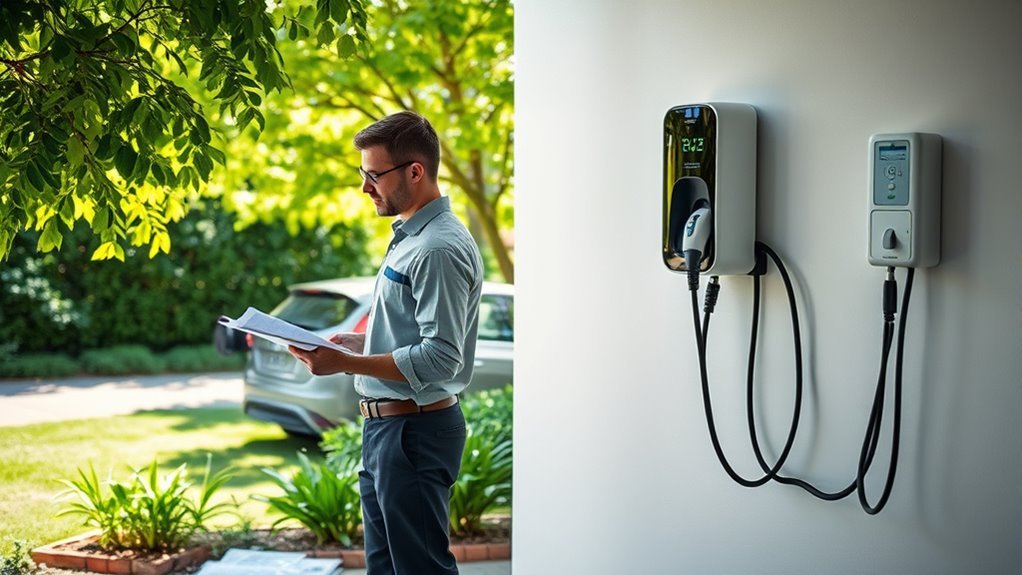
To install an EV charger, start with a site assessment to confirm it’s near your parking space and home’s power supply. Next, evaluate your electrical capacity, ideally a 100-200 amp panel for a Level 2 charger. Choose the right charger type based on your charging needs. After selecting a trusted installer, monitor the charger’s performance during the first charge, guaranteeing peak operation. Continue to gain insights on enhancing your installation experience and charger efficiency.
Assess Your Site for Optimal EV Charger Installation
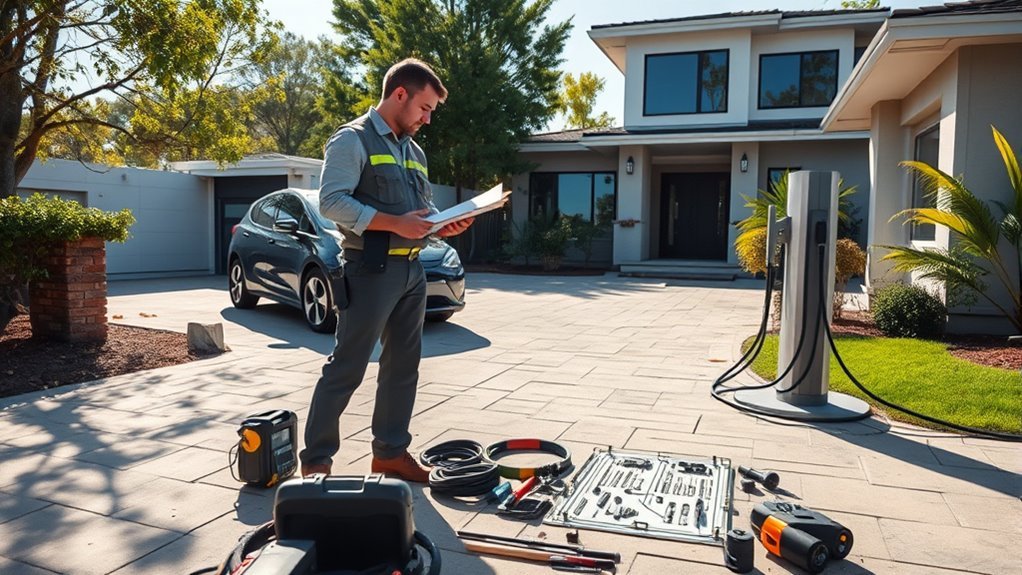
When evaluating your site for ideal EV charger installation, where should you start? First, assess site accessibility by confirming the charger’s location is close to your parking space and the home’s power supply. This minimizes cable length, reducing installation costs.
Next, conduct a detailed site inspection to identify any obstructions or hazards that could impede access. Safety considerations are paramount; verify the installation area allows for unobstructed vehicle movement and maintenance access.
Additionally, familiarize yourself with local regulations or HOA guidelines regarding EV charger installations, as they might impose specific requirements or restrictions. These factors are critical for compliance and overall safety.
Finally, consider the type of EV charger that best fits your needs, factoring in charging speed and compatibility with your vehicle. This thorough assessment paves the way for an efficient and safe EV charging experience, liberating you from concerns about installation and functionality.
Evaluate Your Home’s Electrical Capacity for EV Charging
How can you guarantee your home’s electrical system supports an EV charger? Start by evaluating your electrical panel; it should ideally have a capacity of at least 100-200 amps for a Level 2 charger.
Evaluate your electrical panel to ensure it has a capacity of at least 100-200 amps for optimal EV charging.
Examine your existing wiring, as older homes may require upgrades to handle the load efficiently. A qualified electrician can help evaluate your electrical capacity and determine if a dedicated circuit is necessary for the installation.
Remember, most UK homes operate on single-phase power, which limits charging rates to 7.4kW; if faster charging is a priority, consider upgrading to three-phase power.
Finally, verify your grounding system meets local codes to support safe and efficient charging. Taking these steps not only enhances your home’s capacity for EV charging but also liberates you from concerns about electrical safety and performance.
Explore Different Types of EV Chargers for Your Needs
As you consider installing an EV charger, understanding the different types available can greatly impact your charging experience.
Level 1 chargers, utilizing a standard 110-volt outlet, offer a slow charging speed of about 5 miles of range per hour, making them suitable for overnight use or emergencies.
In contrast, Level 2 chargers operate on 240 volts AC, providing 13 to 25 miles of charge per hour, which is ideal for home installations and longer commutes.
If you need rapid charging, DC fast chargers (Level 3) can charge to 80% in 30 minutes; however, their installation cost and infrastructure complexity often make them impractical for home use.
Smart EV chargers enhance convenience through features like Charge Scheduling and monitoring.
Evaluating your charging needs and preferences will guide you in choosing the right type of charger, balancing charging speed and installation cost effectively.
Find a Trusted Installer for a Hassle-Free Setup
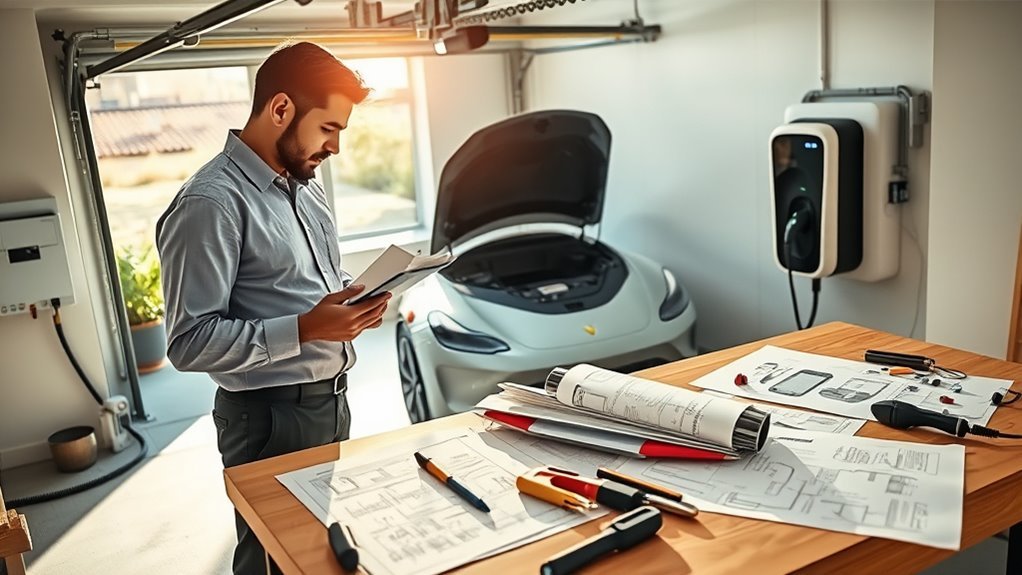
Finding a trusted installer can greatly streamline your EV charger setup, guaranteeing safety and efficiency. To begin, research multiple providers to compare quotes and service quality. Look for installers with strong qualifications—verify their licensing, experience, and customer feedback.
| Criteria | Importance |
|---|---|
| Installer Qualifications | Confirm compliance with safety standards |
| Customer Feedback | Gauge satisfaction from previous clients |
Discuss your EV’s specific requirements and your home’s electrical capacity during the site survey. Make certain the installer is updated on regulations, such as the necessity for a Type B RCD for enhanced safety. It’s also wise to choose installers who offer warranties and ongoing support, addressing any future issues with your charging setup. This thorough approach will help you secure a reliable installation, paving the way for your electric vehicle journey.
Check Your First Charge’s Performance for Smooth Operation
After installation, it’s crucial to thoroughly check your EV charger’s performance to guarantee smooth operation. Start by measuring the charging speed, ensuring it aligns with the expected output of around 7.4kW for home chargers.
During the first charge, use thermal imaging to monitor the charger’s temperature, confirming it stays within safe operating limits to prevent overheating—a key indicator of potential issues.
Use thermal imaging during the initial charge to ensure the charger stays within safe temperature limits and prevent overheating.
Next, verify the ground fault detection system by testing it under simulated fault conditions. It should trip at or below the designed threshold of 6 mA.
Additionally, check the pilot signal communication between the charger and your vehicle, ensuring compliance with SAE J1772 specifications.
Document any anomalies or performance issues you encounter during this initial charge. This diligence not only enhances your charger performance but also lays the groundwork for a reliable and safe charging experience moving forward.
Frequently Asked Questions
What Is an Essential Step in the Installation of EV Charging Stations?
An essential step in installing EV charging stations is conducting a thorough site assessment. It helps identify electrical requirements, ensuring your property can handle the load while meeting safety standards for ideal charger performance.
What Is the 80 20 Rule for EV Charging?
The 80/20 rule for EV charging is like a shortcut on a map; it boosts charging efficiency and reduces installation costs. Charge to 80% for daily needs, maximizing battery life without unnecessary wear or expense.
What Are the 7 Stages of Battery Charging?
The seven stages of battery charging include Bulk, Absorption, Float, Equalization, Rest, Discharge, and Reconditioning. Each charging stage optimizes battery health, ensuring efficient energy storage and longevity for your devices.
How to Set up a Project EV Charger?
To set up a Project EV charger, conduct a thorough site assessment, ensuring it meets electrical requirements. With around 40% of homes lacking adequate power, upgrading is essential for efficient charging and future-proofing your investment.
Conclusion
In conclusion, successfully installing an EV charger involves careful planning and execution. By evaluating your site, reviewing your electrical capacity, and choosing the right charger, you lay the groundwork for a seamless installation. Finding a trusted installer guarantees everything runs smoothly, so you can hit the ground running with your first charge. With these steps in place, you’ll be charging your vehicle in no time, making the shift to electric driving a breeze.







Leave a Reply