Electric cars stop charging automatically when their battery reaches full capacity, thanks to an integrated Battery Management System (BMS). This system cuts off power flow to prevent overcharging and switches the charger to standby mode, which conserves energy. Additionally, a balancing charge phase may activate to guarantee individual cells in the battery maintain equal charge levels. Understanding the mechanics of charging protection can help maximize your vehicle’s performance and efficiency. Discover more insights to guarantee ideal battery health.
How Do Electric Cars Charge and Stop Charging?
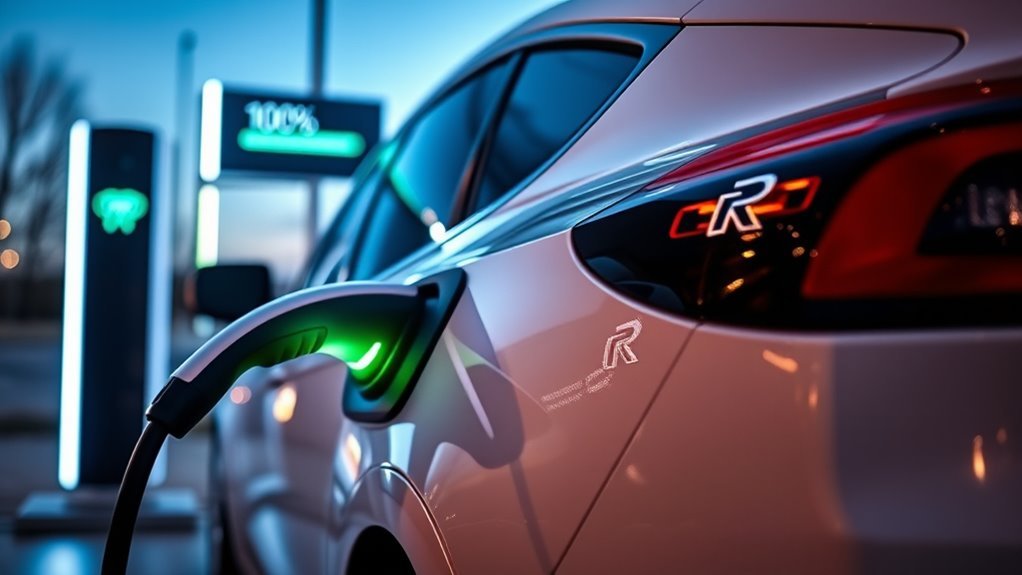
When you plug in an electric car, it employs a sophisticated Battery Management System (BMS) to manage the charging process efficiently. This advanced charging technology automatically halts charging once the battery reaches 100%, preventing overcharging, which can harm battery efficiency.
Upon reaching full capacity, the charger enters standby mode, and the BMS disconnects power flow to eliminate overheating risks and energy waste.
Once the battery is full, the charger goes into standby, preventing overheating and conserving energy.
Many electric vehicles switch to a balancing charge phase, equalizing the charge across individual cells while drawing minimal energy. Public chargers also stop charging when the battery is full, though you might incur idle fees if you leave your vehicle connected.
To optimize battery health and energy use, built-in features enable you to schedule charging times, typically recommending a range between 20% and 80% for your daily needs. This intelligent management guarantees your electric vehicle operates efficiently and sustainably.
What Happens When an EV Battery Reaches Full Capacity?
As your electric vehicle’s battery reaches full capacity, the Battery Management System (BMS) takes immediate action by cutting off the power flow to prevent overcharging. This critical function enhances battery safety, ensuring your investment isn’t compromised.
Once the battery hits 100%, the charger seamlessly shifts to standby mode, conserving energy and minimizing the risk of overheating.
During this period, most electric vehicles engage in a balancing charge, which equalizes the charge across individual cells. This process operates at a low load and may last several hours, but you’ll notice negligible additional costs. Charging costs come to a halt as the BMS effectively manages the energy draw.
Public EV chargers follow suit, stopping charging once full, though be mindful of potential idle fees if your vehicle remains plugged in.
Can You Overcharge an Electric Vehicle by Accident?
You can’t accidentally overcharge your electric vehicle due to advanced built-in charging safeguards.
The battery management systems and charge controllers actively monitor the charging process, ensuring the battery disconnects once fully charged.
Additionally, charging status indicators provide clear visual cues, so you always know the battery’s state.
Built-In Charging Safeguards
Electric vehicles (EVs) are designed with sophisticated built-in charging safeguards that effectively prevent accidental overcharging. These safeguards utilize advanced charging technology to enhance battery safety, ensuring your EV remains in prime condition.
Key features include:
- Automatic disconnection of power supply when the battery is full.
- Dashboard indicators that signal charging status and completion.
- Trickle charging to maintain full capacity without overcharging.
- Recommendations to keep battery levels between 30% and 80% for prolonged health.
Thanks to these mechanisms, you can charge your EV confidently, without worrying about overcharging.
Understanding these built-in safeguards empowers you to maximize your vehicle’s performance and prolong battery life, ultimately enhancing your driving experience.
Battery Management Systems
While concerns about overcharging an electric vehicle (EV) are common, the technology behind Battery Management Systems (BMS) effectively mitigates this risk.
Your EV is equipped with a BMS that automatically disconnects the power supply once the battery reaches full capacity, ensuring peak battery life. Modern EV batteries also include charge controllers, which enhance charging efficiency by halting power flow at full charge.
Additionally, the BMS shifts to a trickle charging mode to maintain the battery’s capacity without inflicting damage. This sophisticated system not only safeguards against overcharging but also enhances your EV’s performance.
With these protective measures in place, you can confidently charge your vehicle without worrying about accidental overcharging disrupting its longevity or efficiency.
Charging Status Indicators
How can drivers be certain their electric vehicle (EV) isn’t being overcharged? Monitoring the charging display is key. Most EVs come equipped with charging status indicators that help you track the battery’s health and charging progress.
Understanding the indicator meanings is essential since they can differ across models. Here are some features to look for:
- Visual alerts showing charging progress.
- Colors or symbols indicating battery levels.
- Notifications when charging is complete.
- Automatic disconnection by the Battery Management System.
Thanks to these systems, your EV automatically stops charging when full, preventing overcharging and extending battery life.
Regularly checking these indicators guarantees safe and efficient charging practices, empowering you to drive with confidence.
The Impact of Charging Frequency on Battery Health
To maintain ideal battery health, you should charge your electric vehicle within the recommended range of 20% to 80%.
Frequent full charges can greatly impact battery longevity, accelerating degradation rates due to higher calendar aging.
Monitoring and adjusting your charging frequency can help guarantee your battery remains in peak condition for the long term.
Optimal Charging Levels
Maintaining ideal charging levels is essential for preserving the health of your electric vehicle’s battery. To optimize charging efficiency and enhance battery preservation, aim to keep your battery charge between 20% and 80% for everyday use.
Regularly charging to 100% should be reserved for long trips. Consider the following guidelines:
- Charge every two to three days for short daily drives.
- Avoid high states of charge (SoC) above 90% for extended periods.
- Implement charge limit settings to manage daily capacity.
- Refrain from leaving your battery fully charged for long durations.
Frequency Impact on Longevity
While you might think that frequent charging is the best way to keep your electric vehicle’s battery healthy, overcharging and high states of charge can actually accelerate battery degradation.
To optimize battery preservation, aim to maintain your charge between 20% and 80%. Charging patterns that involve frequent full charges can result in a 20-30% reduction in battery lifespan.
While it’s fine to fully charge for long trips, daily use should avoid prolonged periods at full capacity to prevent stress on the battery.
Smart EVs can help you schedule charging to minimize high states of charge, ultimately enhancing battery longevity.
Benefits of Charging to 100%?
Charging your electric vehicle (EV) to 100% offers several advantages, especially before commencing long journeys where maximizing range is essential. By doing so, you guarantee that you have sufficient power to reach your destination without frequent charging stops.
Here are some key benefits:
- Enhanced range: A full charge allows for longer trips without interruptions.
- Battery management system (BMS): Your EV’s BMS prevents overcharging and maintains battery health through trickle charging.
- Charge balancing: Charging to 100% can help balance charge across individual cells, promoting uniform performance.
- LFP battery compatibility: For lithium iron phosphate (LFP) batteries, regular full charges can be beneficial without greatly impacting battery longevity.
Although it’s best to keep your battery between 20% and 80% for long-term health, charging to 100% occasionally can be advantageous, guaranteeing peak performance and lifespan of your EV’s battery pack.
Do Public Chargers Also Stop Charging When Full?
When you plug your electric vehicle into a public charger, you’re not just connecting to a power source; you’re activating a sophisticated communication system between your vehicle and the charger.
Plugging in your EV activates a smart communication system, ensuring efficient charging and battery protection.
This interaction guarantees that both Level 2 and Level 3 public chargers automatically stop delivering power once your EV’s battery reaches full capacity. The charger then enters standby mode, cutting off the power flow to prevent overcharging and unnecessary energy consumption.
However, be mindful of public charger policies regarding idle fee implications. If your vehicle remains connected after charging is complete, you might incur fees designed to encourage prompt disconnection.
This system not only protects your battery but also promotes efficient use of charging stations. By understanding these processes, you can maximize your EV experience while supporting a sustainable charging infrastructure.
How to Find Public Charging Stations?
Finding public charging stations for your electric vehicle (EV) can be straightforward, especially with the right tools at your disposal.
Utilize mobile apps and resources that provide real-time data to enhance your charging experience. Here’s how you can effectively locate charging stations:
- Use dedicated mobile apps like PlugShare and ChargePoint for up-to-date information.
- Check your vehicle’s built-in navigation, which often identifies nearby chargers based on your location and route.
- Explore charging networks’ maps that detail Level 2 and Level 3 chargers, including user reviews for reliability.
- Join community forums and social media groups focused on EV ownership for shared tips and live updates on station availability.
Best EV Charging Practices to Maximize Battery Lifespan
To guarantee your electric vehicle’s battery remains healthy and efficient, it’s essential to adopt best charging practices. Aim to keep your charging habits between 20% and 80% for daily use. Frequent full charges can accelerate degradation in lithium-ion batteries.
While charging to 100% is fine for long trips, avoid prolonged periods at full charge, especially with nickel manganese cobalt (NMC) batteries. They should be limited to 80-90% for ideal battery maintenance.
If your EV uses lithium iron phosphate (LFP) batteries, they can handle regular full charges better, but it’s still wise to maintain an 80% threshold for routine use.
Utilize charge limit settings on your vehicle to manage battery capacity effectively, reducing unnecessary wear from high state-of-charge conditions. By adopting these practices, you’ll prolong your EV battery’s life, ensuring better performance and efficiency in the long run.
Frequently Asked Questions
Is It Bad to Leave EV Plugged in After Fully Charged?
Leaving your EV plugged in after fully charged isn’t inherently bad, but poor charging habits can impact battery lifespan. Aim to avoid prolonged periods at 100% to maintain ideal health and longevity of your battery.
When My Car Is Fully Charged, Does It Stop Charging?
“An ounce of prevention is worth a pound of cure.” When your car’s fully charged, the battery management system halts the charging mechanisms, ensuring safety and efficiency while preserving battery health. You’re free to unplug!
What Happens if You Leave a Device Plugged in Even After It Is Charged 100%?
If you leave a device plugged in after it’s charged 100%, the battery management system may extend charging cycles unnecessarily, risking degradation and reducing overall battery lifespan. It’s best to unplug when fully charged.
Is It Better to Charge Your Car to 80 or 100?
It’s better to charge your car to 80% for ideal battery longevity and charging efficiency. Frequent full charges can accelerate degradation, so maintaining that range preserves your battery’s health and extends its overall lifespan.
Conclusion
To sum up, electric cars are designed with advanced charging systems that stop the flow of electricity once the battery reaches full capacity, preventing overcharging. But what if you rely on public chargers? Can you trust them to do the same? As you navigate the world of EV charging, understanding these nuances can greatly impact your battery’s longevity. So, as you plug in next time, consider: are you truly maximizing your vehicle’s potential, or is there more to uncover?







Leave a Reply