To estimate your EV charging time accurately, divide the charge needed (in kWh) by the charger’s power (in kW), factoring in efficiency losses of about 10%. For instance, charging a 60 kWh battery from 20% to 80% typically requires around 36 kWh, leading to approximately 4.69 hours on a 7.68 kW charger. Remember, various factors like charging speed, state of charge, and temperatures also come into play. Continue on to uncover more insights and tips.
How to Calculate Your EV Charging Time: A Step-by-Step Guide
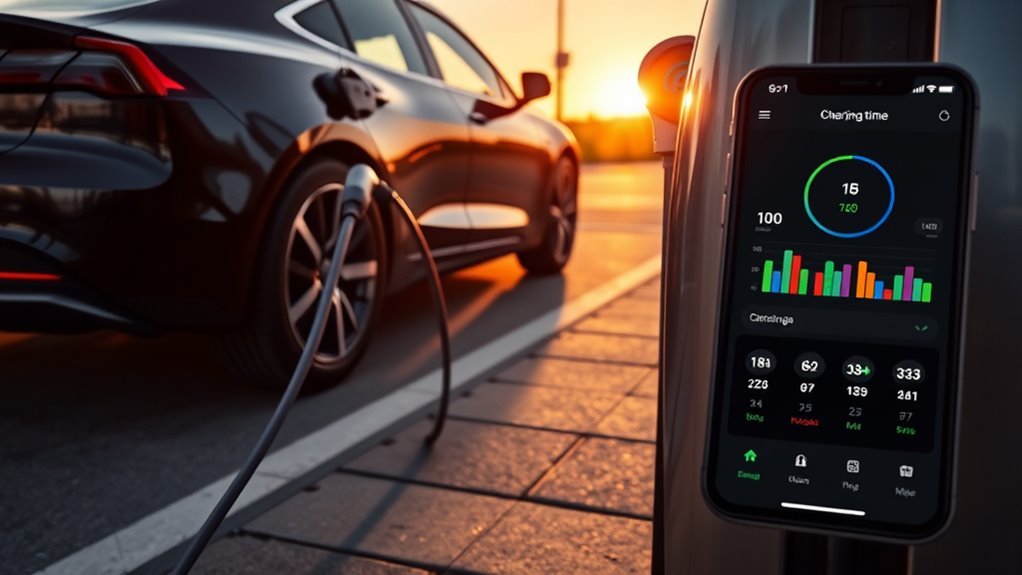
When you’re looking to calculate your EV charging time, understanding the fundamental formula is key: divide the charge needed in kilowatt-hours (kWh) by the power of your charger in kilowatts (kW).
For instance, if your EV has a 60 kWh battery and you want to charge from 20% to 80%, you’ll need 36 kWh. Using a 7.68 kW charger, expect it to take about 4.69 hours.
Don’t forget to factor in efficiency—about 0.9—to account for energy losses.
To get a more tailored estimate, input your current charge level, target level, and charging power into an online calculator. This helps dispel common EV charging myths.
Also, remember charging etiquette: avoid hogging chargers, especially when others are waiting. Being mindful of these practices not only enhances your experience but also promotes a positive community around EV usage.
Critical Factors Affecting Your EV Charging Speed
When charging your EV, several essential factors can impact speed considerably.
The power output of the charger, the current state of charge of your battery, and the ambient temperature all play crucial roles in determining how quickly you can recharge.
Understanding these elements will help you optimize your charging experience.
Charger Power Output
Charger power output substantially impacts your EV’s charging speed, as higher wattage results in quicker replenishment of your vehicle’s battery. Understanding this can help you choose the right charging infrastructure.
Here are key points to evaluate:
- Level 1 Chargers: Around 1.44 kW, providing about 4 miles of range per hour.
- Level 2 Chargers: Approximately 7.68 kW, offering about 24 miles of range per hour.
- Level 3 DC Fast Chargers: Deliver 50 kW or more, with some exceeding 350 kW, allowing for over 150 miles per hour.
- Charger Efficiency: Limited by both the station’s output and your EV’s onboard charger capabilities.
Be aware that real-world charging times can vary based on external factors and battery condition.
Battery State Of Charge
The battery state of charge (SoC) plays an essential role in determining how quickly your electric vehicle (EV) can recharge.
Charging efficiency peaks between 10% and 60% SoC, as the non-linear charging curve allows for rapid energy intake. However, as your battery approaches 80% to 100%, charging power typically tapers off, resulting in longer times for that final 10%.
Cold temperatures below +10°C can increase internal resistance, negatively impacting battery performance and slowing down charging speeds.
Additionally, your EV model may limit the maximum DC charging rate, influencing how quickly your battery can accept charge.
Environmental Temperature Effects
Environmental temperature plays an essential role in your EV’s charging speed, impacting performance greatly as conditions fluctuate.
Effective temperature management is crucial for enhancing charging efficiency. Here are some key points to reflect on:
- Charging speed declines below +10°C due to increased internal resistance in cold batteries.
- The ideal battery temperature range for peak charging is 20–25°C.
- In extremely hot conditions, batteries may reduce charging power to prevent overheating.
- Colder weather extends charging time, as batteries need extra time to warm up.
Being aware of these temperature effects allows you to make seasonal adjustments to your charging habits.
Planning your charging sessions with temperature in mind can enhance your EV experience considerably.
Common Misconceptions About EV Charging Times
How can you make sense of the various myths surrounding EV charging times? Understanding these charging myths is vital for effective battery management. Here’s a quick look at some common misconceptions:
| Misconception | Reality |
|---|---|
| Charging times are linear | Speeds decline after 80% SoC |
| All charging stations provide same power | Levels vary: Level 1 (1.44 kW), Level 2 (7.68 kW), Level 3 (50 kW+) |
| Vehicles charge at maximum advertised rate | Limited by onboard charger and station output |
| Charging from 0% to 100% takes same time as 20% to 80% | The latter is considerably quicker |
Many underestimate environmental factors that affect charging efficiency. Knowing these truths can empower you to manage your EV’s battery life more effectively, ensuring you get the most out of every charge.
How to Figure Out How Much Charge Your EV Needs?
To determine how much charge your EV needs, first assess the remaining battery percentage displayed on your dashboard.
Subtract this from your vehicle’s maximum battery capacity to calculate the required kWh for a full charge.
Assess Remaining Battery Percentage
Understanding how much charge your EV needs is essential for maintaining ideal performance and avoiding unexpected downtime.
To evaluate your remaining battery percentage, follow these steps:
- Check your dashboard for the current battery percentage.
- Identify your EV’s maximum battery capacity in kWh.
- Subtract the remaining percentage from 100% to determine the charge needed.
- Monitor your daily energy consumption, averaging 10-13 kWh, to anticipate future needs.
For instance, if your EV has a 60 kWh battery with 20% remaining, you’ll need 48 kWh to recharge fully.
Regularly evaluating your battery health and charge cycles allows you to establish a routine, minimizing emergency charging and optimizing your driving experience.
Calculate Required kWh
Calculating the required kWh for your electric vehicle is vital for effective energy management.
To determine how much charge you need, subtract your remaining battery percentage from its maximum capacity, then multiply by the battery size in kWh. For instance, if you have a 60 kWh battery at 20% remaining, you’d need 48 kWh to fully charge.
Most EVs display their current state of charge, making it easier to estimate this requirement. Given that the average American drives about 250 miles a week, which consumes roughly 10-13 kWh daily, understanding your charging habits is essential.
Knowing your battery size and typical daily usage allows for better planning and guarantees you’re always ready for your journeys.
Types of EV Chargers and Their Charging Speeds
While selecting the right EV charger is essential for your charging needs, it’s important to know the different types available and their respective charging speeds. Understanding these options helps you optimize your charging experience within various charging networks.
- Level 1 Chargers: Provide 1.44 kW, offering about 4 miles of range per hour—perfect for overnight home charging.
- Level 2 Chargers: Operate at 7.68 kW, delivering approximately 24 miles of range per hour—ideal for both home and public charging stations.
- Level 3 DC Fast Chargers: Deliver 50 kW or more, allowing for rapid charging of over 150 miles in just one hour, provided your vehicle supports it.
- Ultra-Fast Chargers: Many exceed 100 kW, drastically reducing charging times for compatible electric vehicles.
When selecting a charger, always consider charger compatibility with your vehicle to guarantee efficient charging.
Real-Life Scenarios for EV Charging Time Calculations
Choosing the right EV charger is only the beginning; practical scenarios illustrate how charging times can vary considerably based on the charger type and vehicle specifications.
For instance, if you own a 2021 Tesla Model 3 with a 75 kWh battery at 20% capacity, a Level 2 charger operating at 7.68 kW will take about 4.5 hours for a full charge. In contrast, using a Level 3 DC Fast Charger rated at 150 kW can get a compatible EV from 0% to 80% in just 30 minutes.
Real-world examples, like charging a Nissan Leaf with a 40 kWh battery from 20% to 100% on a Level 1 charger, can take up to 14 hours, showcasing the importance of charging convenience.
Additionally, a Hyundai Kona Electric can achieve an impressive charge from 10% to 90% in approximately 54 minutes with a 100 kW charger, emphasizing the impact of charging speed.
Tips for Using an EV Charging Time Calculator Effectively
To make the most of an EV charging time calculator, start by inputting your vehicle’s battery size in kilowatt-hours (kWh) for accurate estimates.
Here are some tips to enhance your accuracy:
- Enter the current charge level as a percentage and set your target charge level, ideally not exceeding 80% for battery longevity.
- Determine the charging power (kW) by using the lower value between your vehicle’s onboard charger and the charging station.
- Account for external factors such as ambient temperature and power-sharing at charging stations, as these can greatly influence charging times.
- Always add a time buffer of 20-30% to the calculator’s estimate, especially in colder weather or during peak usage times.
Best Practices for Efficient EV Charging Sessions
Maximizing the efficiency of your EV charging sessions is key to ensuring your vehicle is ready when you need it. To enhance your charging habits, aim to charge your EV when it’s at a lower state of charge (SoC) of around 20% and avoid exceeding 80%. Charging slows considerably past this point due to battery protection mechanisms.
Opt for Level 2 (7.68 kW) or Level 3 DC Fast Chargers (50 kW+) for faster sessions; Level 3 can provide up to 150 miles of range in just an hour.
Be mindful of ambient temperatures, as extreme cold can hinder charging efficiency. Ideally, charge at temperatures around 20-25°C. Preconditioning your battery through your vehicle’s navigation system can optimize its temperature, enhancing charging speed.
Finally, incorporate a 20-30% buffer in your charging time estimates to account for real-world discrepancies, ensuring effective battery maintenance and readiness.
Frequently Asked Questions
How Do You Estimate EV Charging Time?
To estimate EV charging time, divide the battery capacity needed by the charging efficiency of your charger. This gives you a clear idea of how long it’ll take to reach your desired charge level.
What Is the 80 20 Rule for EV Charging?
The 80/20 rule for EV charging recommends you charge between 20% and 80% capacity. This strategy enhances battery efficiency, reduces degradation, and maximizes your charging efficiency, liberating you from frequent, long charging sessions.
How Do You Determine Charging Time?
To determine charging time, divide your EV’s battery capacity by the charger’s power at charging stations. Adjust for inefficiencies, ensuring you account for factors like temperature and maximum charging rates for accuracy.
What Is the Formula for EV Charging Speed?
To determine charging speed, divide the charge needed (kWh) by charger power (kW). Remember to factor in charging efficiency, typically around 0.9, for accurate estimates. You’ll get a clearer picture of your EV’s performance.
Conclusion
To sum up, accurately estimating your EV charging time is essential for maximizing efficiency and convenience. By understanding the various factors at play, from charger types to battery capacity, you can avoid the common pitfalls that lead to endlessly waiting for a charge. Remember, with the right tools and knowledge, you can make EV charging as seamless as a rocket launch. Use the tips provided to optimize your charging sessions and keep your electric vehicle ready for every adventure ahead.







Leave a Reply