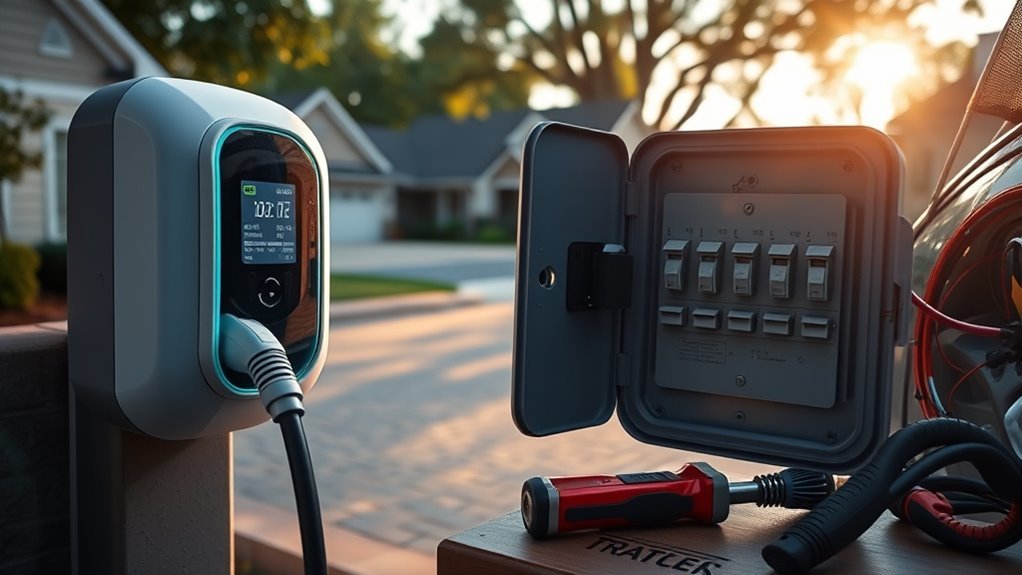
If your circuit breaker trips while charging your electric vehicle (EV), the problem may be an overloaded circuit, an incorrect charging-current setting, damaged wiring, or a fault in the charging equipment. The timing of the trip and any error messages can help identify the cause. Before resetting the breaker or changing settings, make sure the charging equipment is safe to use.
Quick Answer
An EV charger may trip its breaker because the charging current exceeds the circuit’s safe continuous-load capacity, the outlet or wiring is damaged, or a ground fault occurs. Check the charger’s error messages and configured current. Stop charging if you notice heat, damage, or repeated trips, and have a qualified electrician inspect the installation.
Key Takeaways
- For ordinary continuous-load sizing, EV charging current should not exceed 80% of the circuit breaker’s rating.
- A 40-amp circuit typically supports up to 32 amps of continuous charging, while a 50-amp circuit supports up to 40 amps.
- Repeated breaker trips can indicate overloads, electrical faults, overheating, or incompatible protection devices.
- Never install a larger breaker without confirming that the wiring and entire circuit are properly rated.
- A qualified electrician can determine whether the solution is a repair, a lower charging-current setting, a dedicated circuit, or an electrical upgrade.
At a Glance
| Time Required | About 5–10 minutes for basic external checks; professional diagnosis varies. |
| Difficulty | Easy for external observations; electrical repairs require professional expertise. |
| Tools Needed | Vehicle or charger app, charging-equipment manual, and a flashlight for external inspection. |
| Cost | No cost for basic checks; professional inspection or repair costs depend on the problem. |
Why Your Breaker Trips and How to Fix It
When you charge your electric vehicle, the circuit supplies power continuously for an extended period. That sustained electrical demand makes correct breaker sizing, wiring, and charging-current settings especially important.
An undersized circuit breaker may trip when the charger draws more current than the circuit is designed to carry. A shared circuit can also become overloaded when other appliances operate at the same time.
However, not every breaker trip indicates an overload. A damaged cable, overheated outlet, ground fault, or internal charging-equipment problem can also interrupt charging.
The correct circuit rating depends on the charger’s configured output, wiring, equipment instructions, and applicable electrical code—not simply whether the charger is labeled Level 2.
Many Level 2 chargers support adjustable output. For example, Tesla’s Wall Connector installation guidance lists several breaker and charging-current combinations.
A properly installed dedicated circuit, compatible charging equipment, and secure electrical connections help reduce interruptions. If the existing electrical system cannot safely support the desired charging rate, an electrician can assess lower-current charging, approved load management, or electrical upgrades.
What to Do Immediately When Your EV Breaker Trips
Start with safety before attempting to identify the cause.
Warning: Stop charging immediately if you notice a burning smell, smoke, sparks, melted plastic, unusual buzzing, or excessive heat. Do not repeatedly reset a tripping breaker. Never open an electrical panel or charger enclosure to investigate wiring unless you are qualified to perform that work. If there is smoke or fire, move to safety and contact emergency services.
- Stop the charging session. Use the vehicle or charging-equipment controls if they are functioning normally.
- Disconnect the vehicle when safe. Do not touch a damaged, wet, smoking, or unusually hot connector.
- Look for visible warning signs. Inspect only accessible external surfaces, including the cable, connector, plug, and outlet.
- Check the charger display or app. Record any error message, warning light, or fault code.
- Identify what tripped. Determine whether the household breaker opened or the charging station simply stopped delivering power.
- Follow the equipment manual. If there are no warning signs, the manufacturer may provide an appropriate reset procedure. Do not continue resetting a breaker that trips again.
If the breaker trips repeatedly, leave the affected charging circuit out of service until the cause has been identified.
Common Causes of EV Charging Breaker Trips
EV charging interruptions generally fall into several categories: excessive electrical load, grounding problems, damaged equipment, incorrect configuration, and overheating.
Undersized Circuit Breaker
An undersized breaker cannot safely support the current demanded by the charging equipment.
For ordinary continuous-load sizing, the circuit rating must be at least 125% of the maximum charging current. This is commonly expressed as the 80% rule.
For example, a charger configured to deliver 32 amps normally requires a circuit rated for at least 40 amps.
A charger delivering 48 amps normally requires a 60-amp circuit.
The breaker, wiring, charging equipment, and installation must all be suitable for the selected configuration.
A breaker that trips after charging has operated for some time may be responding to sustained overload or excessive heat. However, the timing alone cannot establish the cause.
Shared Circuit Load
When an EV charger shares a circuit with other equipment, the combined electrical demand can exceed the circuit’s capacity.
For example, operating another high-demand appliance while the vehicle charges may increase the current enough to trip the breaker.
Under the 2023 National Electrical Code, individual branch circuits are generally required for EVSE outlets exceeding 16 amps or 120 volts, with specific provisions for qualifying managed charging arrangements.
The published NEC Article 625 reference explains the individual-circuit requirement and permitted energy-management arrangements.
If your charger shares a circuit with unrelated appliances, have a qualified electrician evaluate the installation.
Unplugging another appliance may temporarily reduce demand, but it does not make an improperly configured or noncompliant installation safe.
GFCI and Ground-Fault Problems
A ground-fault circuit interrupter (GFCI) helps protect people from electric shock by detecting an unsafe imbalance between electrical conductors.
A GFCI trip can result from:
- Damaged charging equipment or insulation.
- Moisture entering a connector or electrical component.
- Grounding or wiring faults.
- Interactions between the charger’s integrated protection and an upstream GFCI device.
Some charging stations include their own ground-fault protection. ChargePoint notes that additional upstream GFCI protection can contribute to unwanted trips in certain installations.
However, the applicable electrical code may require GFCI protection for a plug-in installation. The correct arrangement depends on the equipment, installation type, and local requirements.
Warning: Never bypass or remove required GFCI protection to stop an EV charger from tripping. Have an electrician determine whether the problem is a genuine ground fault, faulty equipment, or an installation compatibility issue.
Damaged Outlets, Plugs, and Wiring
A worn receptacle, loose electrical connection, damaged plug, or deteriorating wiring can create excessive heat and charging interruptions.
Watch for external signs such as:
- Brown or black discoloration around a plug or outlet.
- Melting, cracking, or deformation.
- A burning smell.
- An unusually hot plug or connector.
- Damaged cable insulation.
- A plug that does not fit securely in its receptacle.
Do not continue charging through damaged equipment.
According to the Electrical Safety Foundation International, EV charging equipment should be inspected for damage, and extension cords and multi-plug adapters should not be used for vehicle charging.
Faulty Chargers or Vehicle Charging Errors
Charging can also stop because the equipment detects a condition outside its operating limits.
Possible causes include internal equipment faults, poor grounding, overheating, overcurrent, and abnormal supply voltage.
Some chargers communicate these problems through colored indicator lights or app notifications.
For example, Tesla’s Wall Connector documentation identifies different fault indications for ground faults, high temperature, power-supply problems, and vehicle overcurrent.
Use the fault information for your specific charger model rather than assuming that every charging interruption has the same cause.
What Size Breaker Does an EV Charger Need?
The correct breaker size depends on the charger’s maximum configured output and the electrical installation.
The following examples illustrate the ordinary continuous-load relationship used for many residential charging installations.
| Circuit Breaker | Typical Maximum Continuous Charging Current |
|---|---|
| 15 A | 12 A |
| 20 A | 16 A |
| 30 A | 24 A |
| 40 A | 32 A |
| 50 A | 40 A |
| 60 A | 48 A |
These examples are consistent with published Tesla Wall Connector specifications. Actual equipment ratings and permitted configurations vary by model.
Understanding the 80% Rule
EV charging is treated as a continuous electrical load under NEC Article 625.
For ordinary circuit sizing:
Maximum continuous charging current = breaker rating × 0.80.
Alternatively:
Minimum circuit rating = maximum charging current × 1.25.
For a 40-amp breaker:
40 × 0.80 = 32 amps.
For a charger delivering 40 amps:
40 × 1.25 = 50 amps.
These calculations do not replace the manufacturer’s instructions or a proper assessment of conductor size, termination ratings, electrical panel capacity, and applicable code requirements.
Note: A 50-amp breaker does not automatically mean your electrical system can support 40-amp charging. The complete circuit, including conductors, receptacles, connections, and charging equipment, must be suitable for that load.
Level 1 vs. Level 2 Charging
Level 1 charging uses a standard 120-volt supply in a typical U.S. residential installation. Level 2 charging generally uses a 240-volt supply.
Level 1 equipment draws less current, but the circuit must still be suitable for continuous EV charging.
Level 2 equipment can provide faster charging, although the actual charging rate depends on the circuit, charging station, and vehicle’s onboard charger.
The U.S. Department of Energy’s home-charging guidance recommends having an electrician assess available electrical capacity before installing Level 2 equipment.
How to Inspect and Upgrade Your Electrical System
Inspecting the charging installation helps identify problems before they become more serious.
Homeowners can check visible equipment and documented settings. Electrical measurements, internal inspections, and repairs should be performed by qualified professionals.
Evaluate Breaker Amperage Rating
Start by identifying the breaker assigned to the EV charger.
Check its labeled amperage rating without removing the panel cover.
Next, compare that rating with the charger’s documented installation requirements and configured maximum current.
For example, a charging station configured for 40-amp output normally requires a circuit rated for at least 50 amps.
If you cannot identify the breaker’s rating or the charging equipment’s configuration, contact the installer or a licensed electrician.
A professional can determine whether the breaker is correctly selected, whether it is compatible with the electrical panel, and whether it has become defective.
Do not replace a breaker with a higher-rated unit simply to stop tripping. A larger breaker may fail to provide proper protection for undersized wiring.
Inspect Wiring Condition
Wiring condition is essential for safe EV charging.
Begin with a visual inspection of accessible external components:
- Check the charging cable for cuts, cracks, or damaged insulation.
- Look for melting or discoloration around the plug and receptacle.
- Inspect the charging connector for visible damage or contamination.
- Check the exterior of the charging station for damage or overheating.
- Make sure the cable is not stretched, crushed, or exposed to avoidable physical damage.
- Avoid extension cords and multi-plug adapters.
If anything appears damaged, stop charging and arrange a professional inspection.
A qualified electrician can check internal wiring, conductor suitability, grounding, and terminal connections using the proper procedures and equipment.
Older wiring or electrical components may need replacement if they cannot safely support the installed charger.
Assess Circuit Load Capacity
A correctly sized branch circuit is only one part of the installation.
The home’s electrical service and panel must also have sufficient capacity for the vehicle charger alongside other household loads.
A professional load calculation considers the existing electrical system, connected equipment, and proposed EV charging load.
If the existing electrical supply cannot support the charger’s maximum output, possible solutions include:
- Using a lower approved charging-current configuration.
- Installing a properly sized dedicated circuit.
- Using an approved energy-management system.
- Repairing or replacing inadequate electrical components.
- Upgrading the electrical panel or service when necessary.
A full panel upgrade is not automatically required for every home EV charger installation.
The appropriate solution depends on the available capacity, charging needs, manufacturer instructions, and local electrical code.
Ensuring EV Charger Compatibility
To prevent charging interruptions, the charging equipment must be compatible with the electrical supply and the vehicle.
Check the following before installing or reconfiguring your charger:
- Charging current: Confirm the equipment’s configured maximum output matches the circuit’s approved capacity.
- Voltage: Verify that the electrical supply meets the charger’s requirements.
- Vehicle capability: Check the maximum AC charging current supported by the vehicle.
- Connection type: Use the appropriate manufacturer-approved charging connector or adapter.
- Installation method: Confirm whether the selected configuration is approved for plug-in or hardwired installation.
- Grounding and protection: Have the installer verify the required electrical protection and grounding arrangement.
- Manufacturer instructions: Follow the equipment’s installation and commissioning requirements.
Adjustable chargers can be especially useful when a home has limited spare electrical capacity.
However, the equipment’s installer-controlled maximum current must match the approved circuit configuration.
ChargePoint specifically warns that incorrectly configured amperage can cause breaker trips during charging.
See the ChargePoint Home Flex installation FAQ for manufacturer-specific examples.
Pro Tip: If your vehicle or charging app allows you to reduce charging current within the equipment’s approved operating range, that setting can help identify whether charging demand contributes to the problem. A successful session at lower current does not prove that damaged wiring or another electrical fault has been resolved.
How Can You Troubleshoot Persistent Breaker Trips?
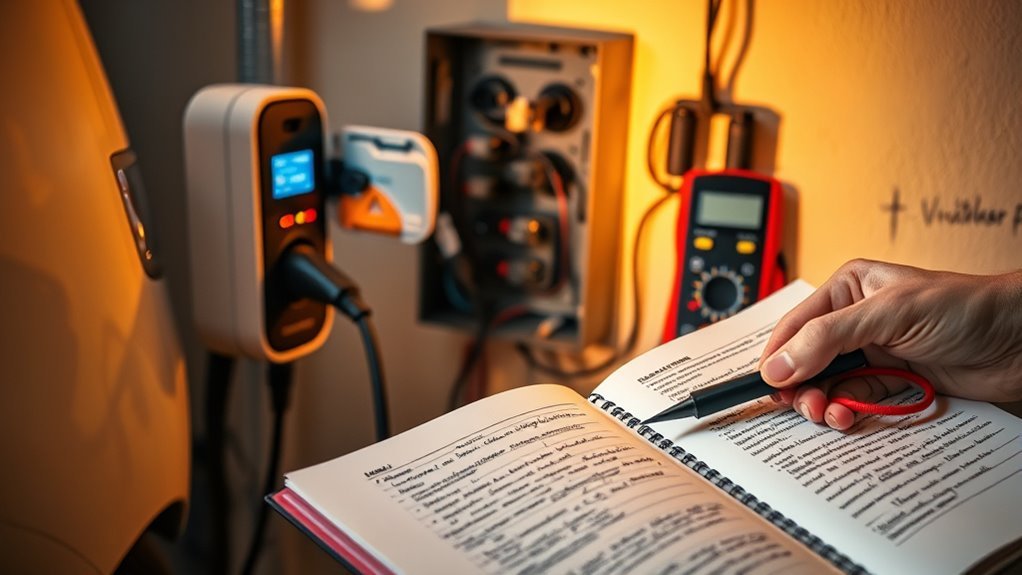
Persistent charging interruptions are easier to investigate when you record exactly what happens.
Start by noting whether the breaker trips immediately, after charging has been running, or only under particular conditions.
Also record any error messages shown by the charging station or vehicle.
Identify When the Breaker Trips
The pattern of the interruption can help an electrician narrow down the possible causes.
| Symptom | Possible Cause | Recommended Action |
|---|---|---|
| Breaker trips immediately. | Ground fault, short circuit, equipment fault, or protection-device interaction. | Stop charging and arrange electrical diagnosis if the problem repeats. |
| Breaker trips after charging runs for some time. | Overload, overheating, or an electrical connection problem. | Check documented current settings and have the circuit inspected. |
| Trip occurs when another appliance starts. | Combined circuit load or an electrical capacity problem. | Have an electrician review the circuit arrangement and load calculation. |
| Charger displays a ground-fault warning. | Grounding problem, leakage fault, moisture, or damaged equipment. | Follow the manufacturer’s fault guidance and stop using damaged equipment. |
| Charging stops but the household breaker remains on. | Charging-station fault, vehicle restriction, or equipment protection. | Check the vehicle display, charger app, and manufacturer error codes. |
| Plug or outlet shows heat damage. | Poor contact, damaged components, or another electrical defect. | Stop using the circuit and arrange professional repair. |
These are diagnostic clues, not definitive fault diagnoses. Different problems can produce similar symptoms.
Check Charger Status and Error Codes
Many modern chargers provide fault information through status lights or companion apps.
For example, Tesla’s Wall Connector can report ground faults, grounding problems, high temperatures, and overcurrent conditions through different light patterns.
Review the Tesla Wall Connector troubleshooting guide or the equivalent documentation for your charging station.
Record the exact message or light pattern before contacting support.
Do not assume that an error displayed by the charging station means the household breaker has tripped. The charging equipment may have stopped power delivery through its own protective system.
Verify Charging Current Settings
Check the charging-current setting shown in your vehicle or charging app.
If the current exceeds the circuit’s approved continuous-load capacity, the equipment needs to be configured correctly.
Manufacturer-approved reductions in charging current may lower the electrical demand.
However, changing an installer-controlled circuit rating is not the same as selecting a lower charging rate in a vehicle app.
Have a qualified installer verify commissioning settings whenever the circuit rating is uncertain.
Check the Outlet and Charging Cable
Inspect visible external surfaces for damage after the equipment is safely disconnected.
Look for discoloration, cracks, melted material, or cable damage.
Do not open the charging station, remove receptacle covers, or tighten internal electrical connections yourself unless you are qualified to perform that work.
If the plug or receptacle is damaged, replacement and an inspection of the associated connections may be necessary.
Consider Weather and Moisture
Outdoor-rated EV charging equipment is designed for use in its specified environmental conditions.
However, damaged seals, connectors, or enclosures may allow moisture to affect electrical components.
If trips occur after heavy rain or water exposure, inspect the accessible equipment for visible damage and follow the manufacturer’s instructions.
Do not handle damaged or water-affected electrical equipment while energized.
Document the Problem for Professional Diagnosis
Before contacting an electrician or charging-equipment manufacturer, collect the following information:
- Charger manufacturer and model.
- Vehicle make and model.
- Breaker amperage rating, if clearly labeled.
- Configured charging current, if known.
- Whether the breaker or charger protection device trips.
- Approximate time between starting charging and the interruption.
- Any error messages or indicator-light patterns.
- Visible damage, unusual heat, or other warning signs.
- Whether another appliance was operating when the problem occurred.
This information can help the professional investigate the issue without unnecessary guesswork.
When to Seek Professional Help for Charging Issues?
Contact a qualified electrician when breaker trips persist, the circuit rating is uncertain, or you suspect an electrical defect.
Professional help is especially important when you notice:
- Repeated breaker trips during charging.
- Visible melting, discoloration, or damaged wiring.
- Unusual heat, electrical buzzing, or burning odors.
- A charger that repeatedly reports grounding or overcurrent faults.
- Trips that continue after an appropriate manufacturer-approved reset.
- An older electrical panel that may not support the intended charging load.
- A recently installed charger that may have incorrect circuit or current settings.
A qualified electrician can inspect the electrical panel, test the circuit, assess the wiring, verify grounding, and check the installation against applicable electrical requirements.
They can also identify whether a breaker or another component needs replacement.
If the electrical supply tests correctly but the charging equipment continues to report faults, contact the charging-equipment manufacturer for further diagnosis.
Do You Need an Electrical Panel Upgrade?
Not every breaker problem requires a new electrical panel.
Possible solutions include correcting an amperage setting, repairing damaged components, installing a suitable dedicated circuit, or reducing the configured charging output.
Where permitted, approved load-management equipment can help accommodate EV charging within an existing electrical supply.
A panel or service upgrade may be appropriate when the electrical system cannot safely support the required load or has other deficiencies.
The decision should follow a professional assessment rather than breaker size alone.
How to Prevent Future EV Charging Breaker Trips
Once the underlying problem has been corrected, a few practical habits can help maintain reliable charging.
- Use charging equipment approved for your vehicle and installation.
- Keep the configured charging current within the circuit’s approved limits.
- Inspect visible cables, plugs, and connectors regularly.
- Never charge through damaged equipment.
- Keep charging connectors properly stored when not in use.
- Follow the manufacturer’s environmental and maintenance requirements.
- Avoid extension cords and multi-plug adapters.
- Do not share an ordinary dedicated charging circuit with unrelated appliances.
- Keep charging-equipment firmware updated when supported by the manufacturer.
- Arrange professional inspection when unusual heat, recurring trips, or equipment faults appear.
If you install another charging station or add major electrical appliances, have an electrician review the available electrical capacity before increasing the load.
Frequently Asked Questions
Why Does My EV Charger Keep Tripping the Breaker?
Common causes include circuit overload, incorrect charging-current settings, ground faults, damaged wiring, overheating, and defective charging equipment. The timing of the trip and any equipment error messages can help identify the likely cause. Repeated trips require professional investigation.
What Is the 80/20 Rule for EV Charging?
The term can refer to battery-charging habits, but that is different from the electrical 80% continuous-load rule. For ordinary circuit sizing, continuous EV charging current should not exceed 80% of the circuit rating. For example, a 40-amp circuit normally supports up to 32 amps of continuous charging. A battery’s state-of-charge percentage does not determine the breaker’s safe current rating.
What Are the Common Issues With EV Charging?
Common problems include slow charging, interrupted sessions, incorrect current settings, grounding faults, overheating, connector damage, and charging-equipment errors. Some problems involve the electrical installation, while others involve the charger or vehicle. Manufacturer fault codes can help distinguish them.
What Is the 80% Rule on Breakers?
For ordinary continuous-load circuit sizing, the sustained load should not exceed 80% of the circuit rating. This is equivalent to sizing the circuit for at least 125% of the continuous load. EV charging is treated as a continuous load under NEC Article 625. Equipment specifications and applicable local requirements must also be followed.
Why Does My EV Charger Trip After an Hour?
A delayed trip may involve sustained overload, rising equipment temperature, or an electrical connection problem. The timing does not establish the exact cause. Stop charging if the problem repeats and have the circuit and equipment inspected.
Can I Replace a 40-Amp Breaker With a 50-Amp Breaker?
Not simply to stop tripping. The wiring, terminals, receptacle, charging equipment, and complete installation must be suitable for the higher circuit rating. An electrician must verify the system before changing breaker size.
Can I Reset the Breaker After It Trips?
Follow the manufacturer’s instructions and first check for visible warning signs. Do not reset a breaker when equipment is damaged, overheating, smoking, or producing a burning smell. If the breaker trips again, stop charging and arrange professional diagnosis. Repeated resets are not a repair.
Can Hardwiring Help With EV Charger Breaker Trips?
Hardwiring removes the plug-and-receptacle connection and may be preferred or required for certain charging configurations. It can also help address some installation-specific GFCI compatibility concerns when permitted by local code. However, hardwiring will not correct an overloaded circuit, damaged wiring, or a defective charger. An electrician should determine whether changing the installation method is appropriate.
Conclusion
If your breaker trips while charging your EV, identifying the underlying cause is more important than simply restoring power.
Consider Sarah, a hypothetical homeowner whose older electrical system cannot support her charger’s intended output. A professional assessment might show that reducing the approved charging current, adding suitable load management, or upgrading part of the electrical system is necessary.
The right solution depends on the actual installation.
Start with safe external checks, verify the charger settings, and use manufacturer fault information to understand what happened. Never ignore recurring trips or warning signs such as overheating and damaged wiring.
With a properly configured circuit and professionally corrected electrical faults, you can enjoy safer, more reliable EV charging without unnecessary interruptions.
Sources
- U.S. Department of Energy — Charging Electric Vehicles at Home — Level 1 and Level 2 charging, electrical capacity, installation considerations, and local code compliance.
- Tesla — Wall Connector Circuit Breaker Rating and Maximum Output — Manufacturer-documented breaker and charging-current combinations.
- ChargePoint — Home Flex Installation FAQ — Charging-current configuration, installation methods, and GFCI considerations.
- Leviton — 2023 NEC Article 625 Electric Vehicle Branch Circuit Reference — Continuous charging loads, individual branch circuits, and energy-management provisions.
- Electrical Safety Foundation International — Electric Vehicle Charging Safety — Equipment inspection, charging precautions, and electrical safety guidance.
- Tesla — Troubleshooting a Wall Connector — Equipment status indicators, fault conditions, and manufacturer troubleshooting procedures.





Leave a Reply