Starting an EV charging business takes more than buying chargers and finding an empty parking lot. You need a location where drivers want to charge, enough electrical capacity, a practical business model, and a budget that covers installation and ongoing operations. Funding opportunities can help reduce startup costs, but a successful charging station must also provide reliable equipment, convenient payment options, and a positive customer experience.
Quick Answer
To start an EV charging business, research local demand, choose a suitable location and business model, and obtain utility capacity and installation quotes. Build a financial forecast, secure funding, obtain permits, and hire qualified installers. Select compatible charging equipment and payment software, test the station, and establish maintenance and customer support procedures before opening.
Key Takeaways
- Choose locations based on charging demand, parking time, electrical capacity, and installation costs.
- Level 2 charging generally suits longer parking stays, while DC fast charging serves drivers who need a shorter stop.
- Calculate profitability using energy sold, electricity costs, demand charges, maintenance, network fees, and financing expenses.
- Federal, state, utility, and Canadian funding programs have different eligibility requirements and application periods.
- Use qualified electrical contractors, certified equipment, reliable payment systems, and a clear maintenance plan.
At a Glance
| Time Required | Allow several months for planning, utility coordination, permitting, installation, and testing. Major electrical upgrades can extend the timeline. |
| Difficulty | Advanced business planning with professional electrical installation and regulatory requirements. |
| Tools Needed | Market research, station-location maps, financial spreadsheet, site plan, utility assessment, contractor quotes, and charging-management software. |
| Cost | DOE benchmarks suggest approximately $6,000 per public Level 2 connector for equipment and typical installation combined, or roughly $58,000–$150,000 per DC fast connector. Major utility upgrades, property costs, networking, and other project expenses are additional. |
How to Start an EV Charging Business: Step-by-Step
Before investing in equipment, build a business plan around actual charging demand and project costs. This sequence can help you avoid expensive changes after construction begins.
- Research the local market: Identify EV ownership, traffic patterns, nearby charging stations, and underserved customer groups.
- Choose your business model: Decide whether to own the chargers, lease space to an operator, or enter a revenue-sharing partnership.
- Evaluate potential sites: Compare access, parking time, amenities, existing electricity supply, and future expansion opportunities.
- Prepare a financial forecast: Estimate equipment, installation, utility upgrades, operating expenses, revenue, and working capital.
- Secure financing and agreements: Investigate applicable incentives, arrange funding, and establish property or partnership contracts.
- Obtain approvals: Coordinate with the utility, local permitting authority, and qualified electrical contractors.
- Install and commission the equipment: Test charging, payments, communication, safety systems, and customer support.
- Launch and monitor operations: Track energy sales, utilization, uptime, expenses, and customer feedback.
Pro Tip: Contact the local electric utility before signing a long-term property lease or ordering charging equipment. An otherwise attractive location may need expensive electrical upgrades that change the entire business case.
Key Funding Opportunities for Your EV Charging Business

Funding can reduce the amount of money you need to invest in an EV charging business. However, grants, tax credits, utility incentives, and financing programs have different eligibility requirements.
Start by identifying the programs that apply to your location, business structure, charger type, and proposed installation date.
United States Federal Funding
The Bipartisan Infrastructure Law established major EV charging infrastructure programs, including the National Electric Vehicle Infrastructure Formula Program (NEVI) and the Charging and Fueling Infrastructure Discretionary Grant Program (CFI).
These programs do not provide automatic startup grants to every charging business.
NEVI funding is allocated to states, which administer charging infrastructure projects through their own processes. Private charging businesses may participate through eligible state programs, contracts, or partnerships.
The FHWA Charging and Fueling Infrastructure program supports eligible community and corridor projects.
Its Community Grant program gives priority consideration to projects that improve charging access in areas such as rural communities and locations with limited private parking. Eligible applicants include certain government bodies, public authorities, and other specified organizations. Private companies may participate through appropriate agreements with eligible recipients.
Note: The $500,000 figure associated with certain CFI Community Grants refers to a minimum grant award under the relevant funding opportunity. It does not mean that every business in a rural community with fewer than 10,000 residents automatically qualifies for $500,000.
Federal EV Charger Tax Credits
The Alternative Fuel Vehicle Refueling Property Credit, commonly called Section 30C, previously helped qualifying businesses offset charging infrastructure costs.
For eligible business property placed in service from January 1, 2023, through June 30, 2026, the credit generally provided:
- A base credit of 6% of qualifying costs.
- An enhanced credit of 30% when applicable prevailing wage and apprenticeship requirements were met.
- A maximum credit of $100,000 per qualifying item, subject to the program’s rules.
- Location restrictions involving eligible low-income or non-urban census tracts.
However, the credit expired for property placed in service after June 30, 2026.
Warning: As of September 2026, do not include Section 30C as an available incentive for a newly installed charging project. If your equipment was placed in service before the deadline, review the IRS eligibility requirements with a qualified tax professional.
State and Utility Incentives
State energy offices, transportation agencies, and electric utilities may offer funding for qualifying charging infrastructure.
For example, California’s Clean Transportation Program supports eligible transportation and charging projects through program-specific funding opportunities.
Check the California Energy Commission’s funding opportunities for current eligibility requirements, available funding, and application deadlines.
Utility programs may also help with charging equipment, electrical infrastructure, or approved service upgrades. Availability varies by service territory.
Canadian Charging Infrastructure Funding
Canada’s Zero Emission Vehicle Infrastructure Program (ZEVIP) has supported charging infrastructure through federal funding.
The program originally received CAD $280 million and was later recapitalized with an additional CAD $400 million, bringing those allocations to CAD $680 million.
However, this amount represents program funding, not money automatically available to an individual business.
Natural Resources Canada reports that its owner/operator funding intake closed on March 20, 2026. Smaller projects may also have opportunities through authorized funding-delivery organizations, depending on available programs.
Consult the official ZEVIP program information before making funding assumptions.
Preparing a Strong Funding Application
A useful funding application should explain:
- The location and expected customer demand.
- The number and type of charging ports.
- Utility capacity and installation requirements.
- Total project costs and available matching funds.
- Ownership, maintenance, and operating responsibilities.
- Expected public benefits and long-term financial sustainability.
Keep your financial plan workable even if a grant is delayed or unavailable.
Understanding the EV Charging Market and Its Potential
To succeed in the EV charging market, you need to understand where drivers charge, how long they park, and whether existing stations meet local demand.
A national forecast alone cannot tell you whether a specific location will be profitable.
Market Demand Assessment
Start by examining local EV registration data, traffic patterns, nearby charging infrastructure, and the needs of potential customers.
Useful customer groups include:
- Apartment residents: Drivers who may not have access to private home charging.
- Employees: Drivers who leave vehicles parked for several hours.
- Retail customers: Shoppers who need convenient charging while visiting nearby businesses.
- Highway travelers: Drivers who need reliable fast charging during longer trips.
- Commercial fleets: Businesses with repeat charging requirements and predictable schedules.
Use charging-network maps and local transport data to identify service gaps.
For each proposed site, record nearby station locations, connector types, charging speeds, prices, access hours, and reported reliability.
High EV ownership can indicate demand, but strong competition and widespread home charging can limit the number of customers who will use your station.
Revenue Potential Analysis
Revenue depends mainly on how much electricity customers purchase and the price you charge.
A charger with a high power rating does not automatically generate high revenue. It must attract enough paying customers to justify its equipment and operating costs.
The basic calculation is:
Annual charging revenue = Average energy sold per day (kWh) × Customer price per kWh × 365.
The following table provides an illustrative example for one charging port. The prices and utilization assumptions are examples, not verified industry averages or guaranteed earnings.
| Financial Metric | Level 2 Example | DC Fast Example |
|---|---|---|
| Charging sessions per day | 3 | 8 |
| Average energy per session | 15 kWh | 35 kWh |
| Customer charging price | $0.40/kWh | $0.48/kWh |
| Assumed electricity purchase rate | $0.18/kWh | $0.22/kWh |
| Annual charging revenue | $6,570 | $49,056 |
| Illustrative annual electricity cost | $2,957 | $22,484 |
| Amount remaining before other expenses | Approximately $3,614 | Approximately $26,572 |
These simplified calculations assume constant daily utilization and equal purchased and billed energy. Actual results can differ because of charging losses, electricity tariffs, seasonal demand, and equipment downtime.
The amount remaining is not net profit. It excludes demand charges, network fees, payment processing, rent, maintenance, insurance, taxes, financing, and equipment depreciation.
A profitable EV charging business depends on energy sold, operating margins, and reliable equipment—not simply the number of chargers installed.
Choosing the Right Business Model for EV Charging Stations
Your business model determines who owns the charging equipment, pays operating costs, serves customers, and receives charging revenue.
Choose a structure that matches your available capital, property arrangements, and ability to manage daily operations.
Match Your Business Model to Customer Demand
Level 2 charging often suits workplaces, apartment buildings, hotels, and other locations where drivers park for longer periods.
DC fast charging is generally more suitable for highways, travel stops, and locations where drivers need to continue their journey sooner.
Rural areas may offer opportunities where charging coverage is limited, but lower traffic can make utilization harder to predict. Available funding should support a viable project rather than replace market research.
Consider these common operating models:
- Owner-operated: You buy and operate the chargers and retain charging revenue while paying project and operating costs.
- Third-party operated: A charging company installs and operates equipment at a host property under an agreed arrangement.
- Revenue sharing: A property owner and charging operator divide eligible revenue according to their contract.
- Fleet charging: You provide charging to commercial customers through negotiated access or service agreements.
- Mobile charging: You provide charging services at different locations, subject to equipment capacity, service logistics, and local requirements.
Fixed charging sites are typically easier to integrate with permanent utility service. Mobile operations may provide flexibility but introduce transportation, staffing, and power-supply costs.
Revenue Generation Strategies
Charging businesses can use several pricing and customer-retention methods.
- Per-kWh pricing: Customers pay according to electricity delivered, where permitted.
- Session fees: A fixed fee applies when a charging session begins.
- Time-based fees: Customers pay according to charging or parking time, subject to applicable rules.
- Membership plans: Frequent users may receive discounts or other benefits.
- Fleet contracts: Commercial customers receive agreed charging access and billing arrangements.
- Property partnerships: Site hosts may earn rent, revenue sharing, or increased customer visits.
Memberships can encourage repeat visits, but they should not prevent access where applicable public funding rules prohibit mandatory membership.
For federally funded projects subject to 23 CFR Part 680, additional pricing disclosure and payment requirements apply.
Estimate Startup Costs and Financial Requirements
Equipment is only one part of the investment. Your total budget must include construction, utility work, software, and funds to cover operations before the station reaches steady utilization.
The U.S. Department of Energy’s charging infrastructure guidance provides useful public-charger cost benchmarks.
| Cost Category | Planning Consideration |
|---|---|
| Level 2 hardware | Approximately $3,500 per public connector under DOE’s cited benchmark. |
| Level 2 installation | Approximately $2,500 per connector on average, with substantial site variation. |
| DC fast hardware | Approximately $38,000–$90,000 per connector, depending on output and equipment. |
| DC fast installation | Approximately $20,000–$60,000 per connector under DOE’s cited estimates. |
| Utility infrastructure | Service upgrades, transformers, metering, and related electrical work depend on the site. |
| Other project expenses | Permits, engineering, land or lease costs, signage, accessibility improvements, software, insurance, and contingency funds. |
These are planning benchmarks rather than installation quotes. Your actual costs depend on charger specifications, local labor rates, available electrical capacity, construction requirements, and the number of ports installed.
A complete financial forecast should also include:
- Expected daily charging sessions and energy sales.
- Electricity purchase rates and applicable demand charges.
- Network subscriptions and payment processing fees.
- Maintenance contracts and equipment replacement reserves.
- Property rent, insurance, taxes, and administrative expenses.
- Loan payments or other financing obligations.
- Working capital and a contingency allowance.
Calculate your operating break-even point by dividing monthly fixed operating expenses by the expected contribution margin per kWh, after variable expenses. This estimates how much energy you must sell to cover those fixed costs.
Test your forecast against lower utilization, higher electricity prices, and unexpected downtime before making an investment decision.
How to Navigate EV Charging Regulations?
Understanding EV charging regulations protects your investment and helps ensure that the station is safe and legally operated.
Requirements depend on the jurisdiction, charging equipment, site configuration, and whether the project receives public funding.
Electrical Codes and Installation Requirements
In the United States, the National Electrical Code includes Article 625, which addresses electric vehicle power transfer systems and related installation requirements.
The applicable code edition is the one adopted by the relevant jurisdiction, including any local amendments.
Work with qualified electrical professionals to address:
- Electrical service and circuit capacity.
- Overcurrent protection and disconnecting requirements.
- Equipment listing and installation instructions.
- Charging connector placement and cable storage.
- Environmental protection and suitable outdoor equipment.
- Permits, inspections, and utility approval.
Requirements concerning connector storage height should not be treated as a universal mounting height for every charger.
Warning: Commercial EV charging equipment should be installed, inspected, and serviced by appropriately qualified professionals. Do not modify electrical protection systems, cables, or charging connectors to bypass equipment faults or installation requirements.
Federal Charging Infrastructure Standards
Projects covered by 23 CFR Part 680 must meet additional requirements involving equipment, operation, pricing, accessibility, and reliability.
For covered corridor-serving DC fast charging projects, the standards include requirements involving four charging ports and specified power-delivery capability.
Other covered projects may have different eligible charger configurations.
The rules also address:
- Applicable connector and interoperability requirements.
- Secure and accessible payment methods.
- Public access and operating hours.
- Charging price disclosure.
- Customer support and outage reporting.
- Equipment certification and qualified technicians.
- Cybersecurity and customer data protection.
- Charging-port reliability and reporting.
These federal project standards do not automatically apply to every privately funded commercial charging installation.
Business Permits and Insurance
Beyond electrical permits, review local requirements for business registration, land use, construction, parking, signage, sales taxes, and electricity resale or charging fees.
Determine whether your insurance covers equipment damage, public liability, business interruption, and other relevant operating risks.
Have a qualified professional review your property and operating agreements before committing to major construction expenses.
Selecting the Best Location for Your Charging Stations
Location selection can have a major effect on charging demand, installation expenses, and operating costs.
High-traffic locations such as shopping centers, travel stops, commercial properties, and airports may offer opportunities, but traffic volume should not be the only deciding factor.
Evaluate Customer Access and Parking Time
Choose locations that match the charging service you plan to provide.
- Shopping centers and workplaces may suit Level 2 charging.
- Highway services and travel stops may suit DC fast charging.
- Hotels and apartment properties may support longer charging sessions.
- Commercial depots may offer predictable fleet demand.
Assess visibility from the road, entry and exit routes, lighting, parking layout, nearby amenities, and accessibility for people with disabilities.
Consider vehicle charging-port locations, cable reach, and whether larger vehicles or vehicles towing trailers need access.
Confirm Utility Capacity Before Committing
Ask the electric utility to evaluate the site’s existing service and the additional capacity required for your proposed chargers.
DC fast charging can require significant power, making electrical infrastructure an especially important cost consideration.
Discuss the following with the utility and electrical designer:
- Available electrical capacity.
- Potential transformer or service upgrades.
- Connection and construction timelines.
- Electricity rate options and demand charges.
- Metering arrangements.
- Managed charging and future expansion.
Also check cellular or internet coverage for networked charging equipment.
A site with lower traffic but existing electrical infrastructure may offer a different financial profile from a busy location requiring major utility work.
Plan for Future Expansion
When practical, allow room for additional charging ports, electrical equipment, and vehicle access.
Future expansion should be considered during the original site design, even if your first phase includes only a limited number of chargers.
Coordinate expansion plans with the property owner and utility so future construction does not unnecessarily disrupt existing operations.
Essential Equipment for EV Charging Stations
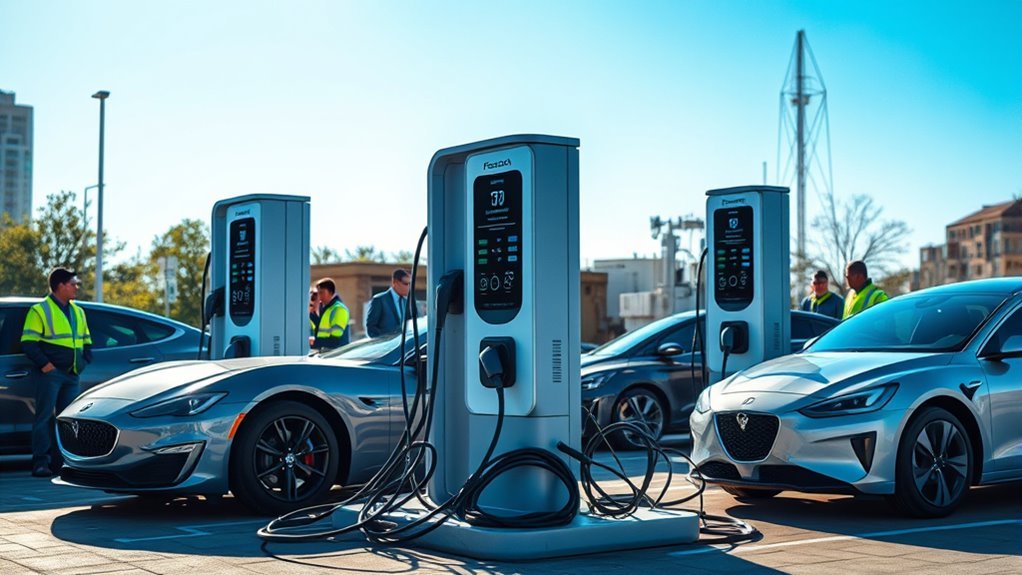
Reliable equipment is essential for operating an EV charging station efficiently and providing a consistent customer experience.
Select equipment according to the site’s expected demand, utility capacity, budget, and applicable standards.
Choose the Right Charger Types
Level 2 chargers provide AC charging and generally suit locations where drivers can leave their vehicles for longer periods.
DC fast chargers, sometimes called Level 3 chargers, deliver DC power to compatible vehicles and are designed for faster charging sessions.
Actual charging speed depends on the charger, vehicle, battery condition, temperature, and other operating factors.
Review connector compatibility, including CCS and SAE J3400/NACS where appropriate, and ensure that any publicly funded project meets its specific connector requirements.
Electrical and Power Management Equipment
A commercial charging installation may require switchgear, transformers, meters, protective equipment, distribution panels, and other site-specific electrical components.
For multi-port installations, load management can help control total electrical demand and allocate available power.
Battery storage may be considered for certain projects, but it is not a standard requirement for every charging station. Any storage proposal should be evaluated against its capital cost, operating savings, and applicable safety requirements.
Charging Management and Payment Systems
A Charging Station Management System (CSMS) helps operators manage connected chargers.
Depending on the platform, it may support:
- Remote station monitoring.
- Pricing and session management.
- Customer authentication.
- Energy and utilization reporting.
- Fault notifications.
- Software updates.
- Charging access and billing.
Some systems also integrate with electrical load-management functions.
Choose a network platform compatible with your charging hardware. Support for open communication standards can reduce dependence on a single vendor.
Provide suitable payment options, which may include contactless cards, mobile payments, or other approved methods. Confirm the requirements for your project before purchasing payment hardware.
Maintenance and Connectivity
Include reliable internet or cellular connectivity where the charging platform requires it.
Establish maintenance procedures for connectors, cables, charging units, protective equipment, displays, and payment systems.
Provide staff with a clear process for identifying unsafe equipment, reporting faults, and arranging qualified repairs.
Operating and Maintaining Your EV Charging Business
After installation, your main responsibility is keeping the chargers accessible, functional, secure, and financially sustainable.
Develop a Maintenance Schedule
Use the equipment manufacturer’s maintenance instructions and establish a service agreement with qualified technicians.
Regular checks should cover:
- Connector and cable condition.
- Visible equipment damage.
- Charging-session failures.
- Payment system operation.
- Network connectivity.
- Required firmware and software updates.
- Signage, lighting, and parking access.
Inspect equipment more promptly after severe weather, vandalism, collision damage, or customer reports of unsafe conditions.
Track Business Performance
Review your charging station’s operating data regularly.
| Metric | Why It Matters |
|---|---|
| Energy sold | Shows actual charging demand and supports revenue calculations. |
| Sessions per port | Helps identify busy and underused chargers. |
| Charging revenue | Measures customer payments before expenses. |
| Electricity expenses | Reveals energy costs and the effect of utility tariffs. |
| Uptime and failed sessions | Measures service reliability and lost charging opportunities. |
| Operating cash flow | Shows whether the business can cover recurring expenses. |
Compare actual results with your financial forecast and adjust pricing, maintenance, and marketing strategies when necessary.
Strategies to Attract and Retain EV Drivers at Your Charging Station
To attract and retain EV drivers, combine easy station discovery with reliable charging and responsive customer service.
Improve Station Visibility
Use clear signage to help drivers locate the charging area and understand available parking spaces.
List your chargers on relevant charging-location services, including PlugShare and supported charging-network maps.
Keep station information accurate, including:
- Location and access instructions.
- Connector types.
- Charging power.
- Pricing and additional fees.
- Operating hours.
- Available amenities.
Provide a Convenient Charging Experience
Well-lit parking, clear payment instructions, reliable chargers, and accessible customer support can improve satisfaction.
Where practical, provide 24/7 access, especially at travel-oriented sites. However, operating hours should match customer demand, property restrictions, and applicable funding requirements.
Nearby restrooms, food, shopping, and seating can make charging stops more convenient.
Build Customer Loyalty
Consider discounts, membership benefits, fleet partnerships, and other incentives that encourage repeat visits.
Make pricing transparent and respond promptly to billing disputes or equipment problems.
Encourage customers to report faults and provide feedback. Use that information to improve service and identify recurring issues.
Pro Tip: Include a visible support number or help option at every charging location. Drivers should be able to get assistance without searching for the operator’s website or creating an account.
Frequently Asked Questions
What Are the Main Ongoing Costs of Running an EV Charging Station?
The main ongoing expenses include electricity, utility demand charges where applicable, maintenance, charging-network subscriptions, payment processing, insurance, rent, and customer support. Financing costs and equipment replacement reserves should also be included in the business budget.
How Do I Handle Software Updates for My Charging Stations?
Follow the manufacturer’s update schedule and maintain a software management plan. Review release notes, apply security updates, test payment and charging functions after significant changes, and document any problems. Use approved rollback procedures when supported by the manufacturer.
What Type of Customer Service Should I Provide at My Charging Station?
Provide clear charging instructions, accessible support, billing assistance, and a way to report faults. Staff should know how to identify common problems and escalate technical issues to qualified service providers. Gather customer feedback to improve reliability and convenience.
How Can I Promote My Charging Station to Attract More Users?
List your chargers on charging maps, install visible signage, build partnerships with nearby businesses, and promote convenient amenities. Keep pricing and availability information accurate. Local advertising and loyalty programs can also help customers discover and revisit your station.
What Are the Common Maintenance Issues for EV Chargers?
Common problems include damaged connectors, worn cables, communication failures, payment problems, software faults, and electrical supply interruptions. Regular inspections, remote monitoring, and a qualified maintenance provider can help reduce downtime.
How Much Money Do I Need to Start an EV Charging Business?
The investment depends on charger type, number of ports, existing electrical infrastructure, and property costs. DOE’s cited benchmarks suggest approximately $6,000 per public Level 2 connector for equipment and typical installation combined, while DC fast charging equipment and installation may total roughly $58,000–$150,000 per connector. Major utility upgrades and other project expenses can increase the total substantially.
Is an EV Charging Business Profitable?
It can be profitable when charging revenue exceeds electricity, maintenance, network, property, financing, and other expenses. Results depend heavily on utilization and installation costs. Build a site-specific financial forecast rather than relying on a fixed industry-wide earnings estimate.
Can I Start an EV Charging Business Without Owning Property?
Yes. You may be able to lease suitable parking space or partner with a property owner under an operating or revenue-sharing agreement. The contract should address equipment ownership, electricity payments, customer access, maintenance, insurance, revenue distribution, and responsibilities when the agreement ends.
Conclusion
Starting an EV charging business requires careful market research, strategic funding, suitable charging equipment, and a location that meets both customer needs and electrical requirements.
Before investing, confirm utility capacity, obtain realistic installation quotes, and build a financial forecast based on expected charging demand rather than unsupported revenue estimates.
By choosing the right business model, following applicable regulations, and maintaining a reliable customer experience, you can build a charging service that supports EV drivers while working toward sustainable business growth.
Sources
- U.S. Department of Energy — Procurement and Installation for Electric Vehicle Charging Infrastructure — Equipment costs, installation estimates, utility coordination, and infrastructure planning.
- Internal Revenue Service — Alternative Fuel Vehicle Refueling Property Credit — Section 30C eligibility, historical credit rates, limits, and expiration.
- Federal Highway Administration — Charging and Fueling Infrastructure Discretionary Grant Program — Federal funding structure, eligibility, and eligible projects.
- California Energy Commission — Funding Opportunities — Current state funding solicitations and application information.
- Natural Resources Canada — Zero Emission Vehicle Infrastructure Program — Canadian funding allocations, program structure, and intake information.
- Electronic Code of Federal Regulations — 23 CFR Part 680 — Applicable federally funded EV charging infrastructure standards, payment requirements, accessibility, and reliability.






Leave a Reply