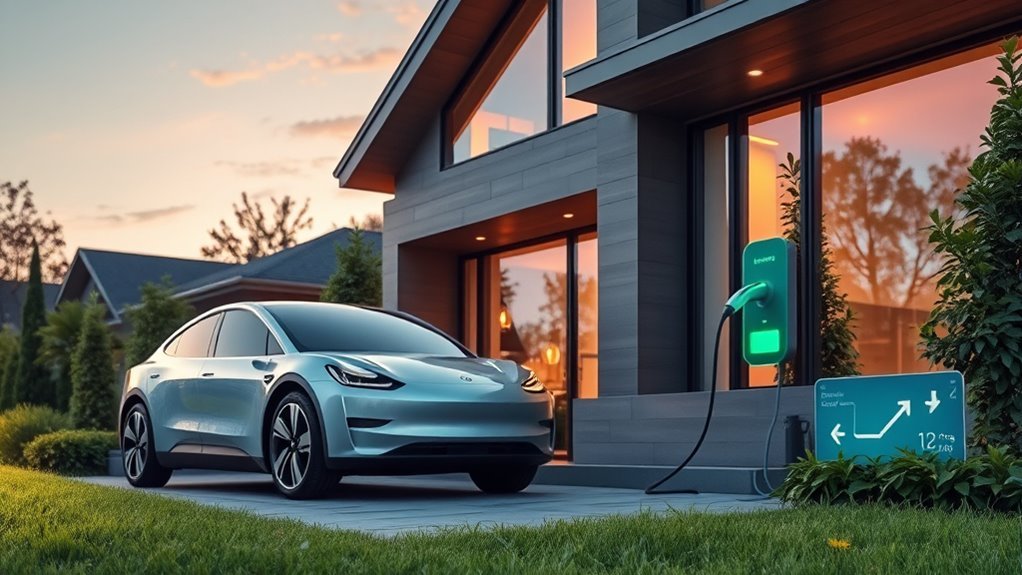
Bidirectional charging allows a compatible electric vehicle (EV) to do more than recharge its battery. It can also supply stored electricity to your home, power external devices, or send energy back to the electricity grid. Depending on your vehicle and equipment, this technology can provide backup power, help manage electricity costs, and support a more flexible energy system.
Quick Answer
Bidirectional EV charging allows electricity to flow into and out of a vehicle’s battery. Vehicle-to-Grid (V2G) sends power to the grid, Vehicle-to-Home (V2H) supplies a house, and Vehicle-to-Load (V2L) powers connected devices. Each requires compatible equipment, and home or grid connections may need additional hardware, professional installation, and utility approval.
Key Takeaways
- V2G: Sends electricity from a compatible EV to the grid through an approved system.
- V2H: Uses stored vehicle energy to power a home during an outage or reduce electricity purchases during expensive periods.
- V2L: Supplies power directly to appliances, tools, and other compatible devices.
- Compatibility matters: A vehicle with V2L does not automatically support V2H or V2G.
- Savings vary: Electricity rates, equipment costs, charging losses, utility programs, and battery use determine financial results.
- Safety comes first: Home backup and grid export require suitable equipment, approved electrical connections, and professional installation.
At a Glance: Home Bidirectional Charging
| Time Required | Planning, permits, installation, and approval vary by property and utility. |
| Difficulty | Professional electrical installation required for home-connected systems. |
| Tools and Equipment | Compatible EV, supported bidirectional charging equipment, approved home-integration hardware, and suitable electrical protection. |
| Cost | Depends on equipment, electrical upgrades, installation labor, permits, and utility requirements. Obtain an itemized quotation. |
What Is Bidirectional Charging and How Does It Work?
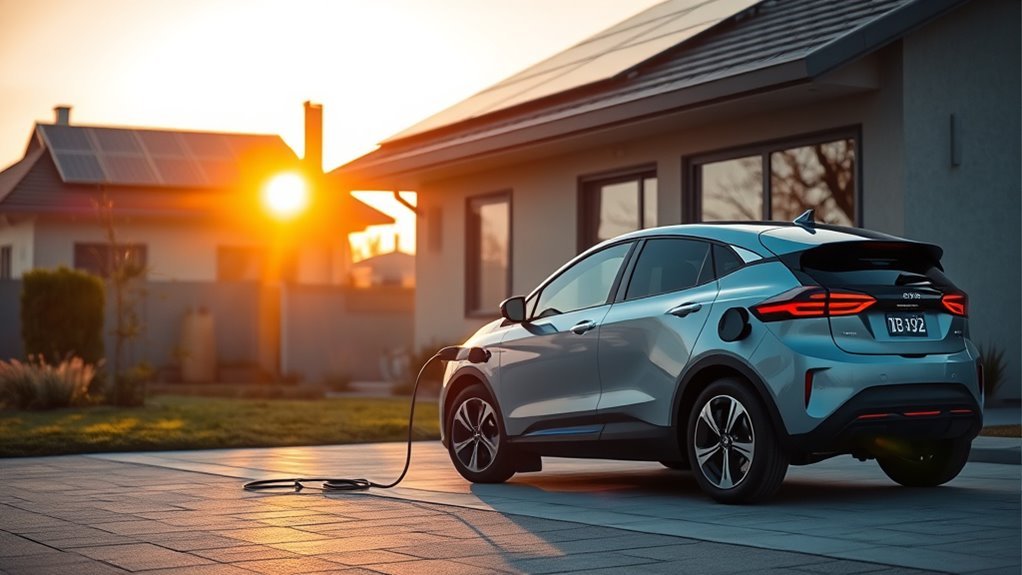
Bidirectional charging is a technology that allows a compatible electric vehicle to both receive electricity and deliver stored energy to an external system.
With conventional charging, electricity flows into your EV battery. With bidirectional charging, electricity can also flow out of the battery to a supported destination.
The U.S. Department of Energy explains that bidirectional EVs can supply external loads, buildings, or the electricity grid when paired with suitable equipment.
How Two-Way Energy Flow Works
The process involves charging, storing, converting, and distributing electricity:
- Charging: Electricity enters the vehicle and charges its high-voltage battery.
- Energy storage: The battery stores electricity as direct current (DC).
- Discharging: When the system requests power, the vehicle releases stored energy.
- Power conversion: Suitable power electronics convert or manage the electricity for the connected application.
- Distribution: The system supplies approved household circuits, external devices, or the grid.
Where the AC-to-DC and DC-to-AC conversion takes place depends on the vehicle and charging architecture. Some systems use an external bidirectional DC charger, while others rely on vehicle-based power electronics.
For example, the SigenStor EV DC charging system integrates with the manufacturer’s wider home-energy platform. However, its V2X functionality still depends on vehicle compatibility, supported software, and regional availability.
Before purchasing any such system, confirm that the manufacturer supports your exact vehicle and intended application.
Bidirectional Charging vs. Smart Charging
Smart charging and bidirectional charging are related, but they are not the same.
Smart charging controls when and how much electricity an EV receives. It can schedule charging during lower-priced periods without sending electricity out of the battery.
Bidirectional charging adds the ability to discharge energy for an external use.
You can benefit from off-peak electricity rates with an ordinary smart charger. You only need bidirectional equipment if you want to export battery energy or use a supported vehicle-to-home function.
Understanding Vehicle-to-Grid (V2G) and Its Benefits
Vehicle-to-Grid (V2G) allows a compatible EV to supply stored electricity to the public electricity grid.
A participating utility or energy-management program can coordinate charging and discharging based on demand, electricity prices, and the vehicle owner’s settings.
V2G is one application of Vehicle-to-Everything (V2X), the broader term for using vehicle energy outside the car.
Grid Stability Contribution
As more electric vehicles enter the market, their batteries may help balance electricity supply and demand.
During periods of high electricity demand, participating vehicles can discharge energy to reduce pressure on the grid.
During periods of lower demand or surplus renewable generation, EVs can charge and store electricity for later use.
This flexibility can help integrate solar and wind energy, reduce peak demand, and support certain grid services.
However, these benefits depend on coordinated charging, suitable grid connections, and programs that can manage participating vehicles.
V2G is not automatically available simply because an EV supports bidirectional charging.
Financial Incentives for Owners
Some utilities and energy companies compensate eligible EV owners for making battery energy available or exporting electricity.
Payment arrangements may include:
- Compensation for electricity delivered to the grid.
- Credits for participating in demand-response programs.
- Payments for making battery capacity available during specified periods.
- Benefits from charging during lower-priced periods and discharging when electricity is more valuable.
Actual earnings depend on the utility, tariff, eligible vehicle, exported energy, participation rules, and equipment costs.
For a documented example, Ford’s October 2025 Home Power Management announcement described residential V2G pilot participants receiving compensation of up to $1,000.
That figure describes a particular pilot program. It is not a guaranteed annual payment for other EV owners.
Some programs compensate customers for reducing household electricity demand through V2H rather than exporting electricity directly to the grid.
Energy Cost Savings
V2G can create financial value when electricity is stored during lower-priced periods and exported when the program offers suitable compensation.
However, the difference between charging and export prices is not your actual profit.
You must also account for electricity lost during charging and discharging, equipment expenses, applicable fees, and battery use.
| Charging Strategy | Savings Potential | Additional Benefits |
|---|---|---|
| Off-Peak Charging | Depends on the difference between electricity rates | Can reduce ordinary charging expenses |
| Peak Discharging | Depends on export compensation and operating costs | May help reduce peak grid demand |
| V2G Participation | Program-specific; no universal annual earnings figure | May support grid services and renewable energy integration |
Pro Tip: Ask your utility for its actual V2G export rate, payment schedule, minimum participation requirements, and any restrictions before purchasing expensive equipment.
How Vehicle-to-Home (V2H) Boosts Energy Independence
Vehicle-to-Home (V2H) allows a compatible EV battery to supply electricity to a house through an approved home-energy system.
Unlike V2G, the primary destination is your household rather than the public electricity grid.
V2H can provide emergency backup power and, where supported, help manage electricity costs during normal grid operation.
Enhanced Energy Security
During a power outage, a properly installed V2H system can use the EV battery to supply selected household circuits or supported home loads.
This may allow you to keep essential equipment running, including:
- Refrigerators and freezers.
- Lighting.
- Internet equipment and phone chargers.
- Selected fans and other essential appliances.
- Other approved loads within the system’s power limit.
Actual backup capability depends on battery charge, available energy, system output, appliance demand, and the home’s electrical configuration.
For example, the Ford F-150 Lightning’s documented Home Backup Power arrangement uses a compatible truck, Ford Charge Station Pro, and Home Integration System.
The vehicle must be connected and correctly configured for the supported backup function to operate.
Cost Savings Potential
V2H may reduce electricity expenses by using energy stored during lower-priced periods to power your home when grid electricity costs more.
For some customers, the benefit comes from reducing electricity purchases rather than selling electricity.
Ford’s Home Power Management announcement estimated that certain participating customers could save approximately $500 per year through managed charging and home energy use.
Your results may be higher, lower, or negligible depending on your electricity plan and household consumption.
Before investing, compare the expected savings with the total installed cost.
Backup Power Reliability
V2H can improve emergency preparedness when the system is properly installed and the vehicle is available with sufficient battery charge.
Three benefits are particularly useful:
- Backup power: The EV can supply supported household circuits during an outage.
- Emergency preparedness: A stored energy reserve can support essential loads while grid power is unavailable.
- Solar integration: Compatible systems may coordinate vehicle energy with rooftop solar and home battery storage.
However, V2H is not an unlimited power source. The battery eventually needs recharging, and your vehicle must remain connected while supplying the home.
How Long Can an EV Power a Home?
Backup runtime depends on usable battery energy and the average electrical load.
The basic calculation is:
Estimated runtime = usable battery energy (kWh) ÷ average electrical demand (kW).
For example, suppose your vehicle has 30 kWh available above the battery reserve you want to keep for driving.
If the connected appliances use an average of 1 kW, the theoretical runtime is about 30 hours before conversion losses and other system consumption.
Actual runtime will be shorter because energy conversion is not perfectly efficient.
Heavy appliances, especially heating, cooling, and cooking equipment, can also reduce backup duration considerably.
Note: A kilowatt (kW) measures how quickly electricity is delivered. A kilowatt-hour (kWh) measures stored or consumed energy. Both matter when evaluating backup systems.
Warning: Home backup systems must use approved equipment that safely isolates the home from the utility grid during an outage. Never connect an EV outlet to household wiring using an improvised cable or connection.
The Role of Vehicle-to-Load (V2L) in Everyday Life
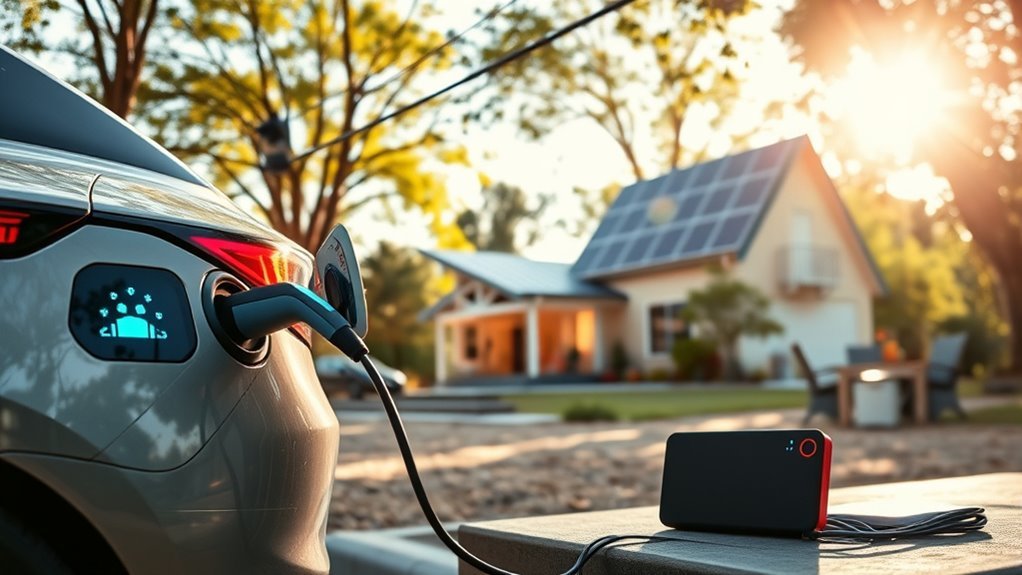
Vehicle-to-Load (V2L) allows an EV to supply electricity directly to compatible appliances and devices.
Unlike a complete V2H system, V2L generally does not require a permanently installed home-integration system.
Depending on the vehicle, power may be available through a built-in outlet or a manufacturer-approved external adapter.
Common uses include:
- Charging laptops, phones, and portable electronics.
- Operating suitable camping equipment.
- Powering small tools.
- Running compatible appliances during an outage.
- Supplying temporary electricity in locations without convenient grid access.
Vehicles offering V2L include selected Hyundai IONIQ 5, Kia EV6, and BYD Atto 3 configurations.
However, the available output differs by model, market, and equipment.
For example, Kia’s U.S. 2025 EV6 guide specifies a maximum V2L output of 1.9 kW.
Some other regional vehicle configurations advertise higher V2L output, so always check the specifications for your own vehicle.
V2L equipment may also stop supplying electricity when the battery reaches the discharge limit selected in the vehicle settings.
This helps preserve energy for driving.
Warning: V2L is not automatically a whole-home backup system. Do not exceed the outlet’s rated power, use damaged cables, or attempt to backfeed household circuits. Follow the vehicle manufacturer’s electrical safety instructions.
V2G vs. V2H vs. V2L: What’s the Difference?
All three technologies use stored EV battery energy, but they serve different purposes.
| Feature | V2G | V2H | V2L |
|---|---|---|---|
| Destination | Electricity grid | Home | Connected devices |
| Main purpose | Grid services and energy export | Home backup and energy management | Portable power |
| Typical equipment | Supported bidirectional system and grid connection | Supported charger and home-integration equipment | Built-in outlet or approved adapter |
| Utility involvement | Export approval and applicable program requirements | May require interconnection approval | Normally unnecessary for standalone device use |
| Potential financial benefit | Program compensation | Lower grid purchases | Portable-power convenience |
Another related application is Vehicle-to-Building (V2B), which supplies energy to a commercial building or facility.
V2X is the broader category that includes these applications.
Which Electric Vehicles Support Bidirectional Charging?
Compatibility is more complicated than checking whether a vehicle has a charging port or supports fast charging.
A vehicle may offer V2L without supporting whole-home backup or electricity export.
Likewise, a vehicle that supports V2H in one country may not have the same approved equipment or functionality in another market.
| Vehicle | Documented Application | Important Limitation |
|---|---|---|
| Ford F-150 Lightning | Home backup and supported energy-management applications | Requires supported home-integration equipment and software. |
| Nissan LEAF | Documented V2H and V2X applications | Compatibility depends on generation, connector, equipment, and region. |
| Hyundai IONIQ 5 | Available V2L functionality | V2L does not establish universal V2H or V2G compatibility. |
| Kia EV6 | Available V2L functionality | Power ratings and equipment differ by market and model configuration. |
| BYD Atto 3 | V2L in supported markets | Regional specifications and accessories must be checked. |
For a current explanation of supported applications and regional differences, see Nissan’s V2X technology information.
Before buying a charger, confirm compatibility using the vehicle manufacturer’s documentation and the equipment manufacturer’s approved compatibility information.
Essential Factors to Consider When Selecting a Bidirectional Charger
Selecting a bidirectional charger starts with identifying what you want the vehicle to power.
Choose the application first, verify the complete system second, and compare equipment costs only after compatibility is confirmed.
Consider these essential factors:
- Vehicle compatibility: Confirm the exact model, model year, charging connector, supported software, and available V2H or V2G functionality.
- Power output: Compare the system’s continuous output with the electrical demand of the loads you want to support.
- Battery capacity: Check how much usable energy will remain after your preferred driving reserve.
- Home integration: Determine whether you need a compatible inverter, gateway, transfer equipment, or electrical-panel changes.
- Grid requirements: Ask whether utility permission, export controls, or a specific interconnection agreement applies.
- Installation cost: Request an itemized quotation covering equipment, labor, electrical upgrades, permits, and commissioning.
- Warranty and support: Check the vehicle warranty, approved equipment list, software requirements, and service arrangements.
Do not confuse high charging power with backup capability. A charger rated for fast vehicle charging does not necessarily provide the same power when exporting energy.
Understanding Charger Standards and Connectors
Bidirectional charging depends on more than the physical shape of the plug.
Different vehicles and equipment may use CHAdeMO, CCS, or NACS-related charging arrangements, depending on their market and generation.
The supported communication protocol, export capability, and complete system approval must also match.
A physical adapter alone does not guarantee bidirectional operation.
Confirm the complete vehicle-to-charger-to-home or vehicle-to-grid combination before installation.
How to Implement Bidirectional Charging in Your Home
Installing a bidirectional home charging system requires careful planning and qualified electrical work.
The following process helps you identify the right equipment, avoid compatibility mistakes, and prepare your home for safe operation.
Step 1: Confirm Vehicle Compatibility
Start by checking whether your exact vehicle supports the application you want.
For example, the Nissan LEAF has documented V2H applications, while the Ford F-150 Lightning supports home backup through its approved equipment arrangement.
Check the owner’s manual, model year, required software, and available accessories.
Do not assume that every vehicle with a V2L outlet can supply household circuits.
Step 2: Identify Your Energy Needs
Decide whether your priority is emergency backup, daily electricity cost management, portable power, or grid export.
For home backup, identify the circuits and appliances you need during an outage.
Estimate their combined power demand and the amount of energy they consume over time.
Also decide how much battery charge you want to preserve for driving.
Step 3: Select Compatible Equipment
Choose charging and home-integration hardware specifically supported by the vehicle manufacturer or system provider.
Depending on the arrangement, the installation may require:
- A suitable bidirectional EV charger.
- Compatible power conversion equipment.
- A home energy management system.
- Approved transfer or isolation equipment.
- Electrical protection and monitoring.
- Supported communication and control software.
A complete home backup installation is different from an ordinary wall-mounted EV charging station.
Step 4: Arrange Professional Installation
Have a qualified electrician or approved installation provider assess your home’s electrical system.
The installer should determine whether the existing panel, service capacity, wiring, and protection equipment are suitable.
The project must follow applicable electrical codes, permit requirements, and manufacturer instructions.
For V2G, obtain the necessary utility interconnection and export approval before operating the system.
Warning: Never modify high-voltage vehicle components or bypass approved home electrical protection. Installation and commissioning should be performed by qualified professionals.
Step 5: Configure Energy Management
Once installed, configure the system according to the manufacturer’s instructions.
Useful settings may include:
- Minimum vehicle battery reserve.
- Preferred charging periods.
- Supported home energy schedules.
- Backup power priorities.
- Utility-approved export settings.
A battery reserve is particularly important if you depend on your vehicle for daily transportation.
Step 6: Test and Monitor the System
Ask your installer to demonstrate the system’s supported operating modes and confirm that it works as intended.
Check the charging connection, energy management controls, and approved backup operation.
Monitor electricity consumption and battery behavior during normal use.
Follow manufacturer maintenance guidance and keep relevant software updated.
Bidirectional Charging Costs and Financial Considerations
The total cost of a bidirectional system depends on much more than the charger itself.
Important cost components include:
- Bidirectional charging hardware.
- Home integration and energy management equipment.
- Electrical-panel or service upgrades.
- Installation labor.
- Permits, inspections, and utility requirements.
- Optional solar or home battery integration.
- Software, service, or program fees where applicable.
A portable V2L adapter and a complete V2H installation should not be compared using the same installation-cost estimate.
Ask for a written quotation that identifies what is included and whether the equipment is approved for your specific vehicle.
How to Estimate Your Potential Savings
For home energy management, compare the cost of purchasing electricity during peak hours with the cost of charging your EV at a lower rate.
Remember to account for energy lost during conversion and any additional system expenses.
For V2G, use the actual export compensation offered by your utility rather than assuming that exported electricity receives the ordinary retail electricity price.
A useful financial comparison includes:
- Expected annual electricity savings.
- Any confirmed program payments.
- Total installed cost.
- Ongoing fees.
- Battery-use considerations.
- The period over which you expect to use the equipment.
This provides a more realistic basis for deciding whether the installation makes financial sense.
Government Incentives and Utility Programs
Government incentives and utility programs depend on your location and the date your equipment enters service.
In the United States, the federal Alternative Fuel Vehicle Refueling Property Credit under Section 30C included qualifying bidirectional charging equipment.
However, the IRS states that the credit is unavailable for property placed in service after June 30, 2026.
State, local, and utility programs may have separate eligibility rules and deadlines.
Check current programs directly with the responsible agency or utility before treating an incentive as part of your installation budget.
Solar Integration and Battery Health
Using Bidirectional Charging With Solar Panels
Bidirectional EV charging can complement a compatible rooftop solar installation.
During periods of solar generation, electricity may be used to charge the vehicle. Stored vehicle energy can then support the home later when the solar panels produce less electricity.
However, not every existing solar installation supports this arrangement.
Compatibility depends on the inverter, energy management system, electrical configuration, and approved backup equipment.
Some systems may also coordinate a dedicated home battery with the vehicle.
Ask the installer whether the solar system can recharge the EV during a grid outage, because ordinary grid-connected solar equipment may shut down when utility power fails.
Does Bidirectional Charging Affect Battery Lifespan?
Bidirectional charging adds potential battery use beyond ordinary driving.
Battery aging depends on factors such as temperature, charge level, depth of discharge, charging power, and the frequency of charging and discharging.
Research has examined the additional degradation associated with V2G operation and the financial compensation needed to account for battery use.
See the 2025 Applied Energy study on V2G battery degradation and compensation.
To manage battery use:
- Follow the manufacturer’s charging recommendations.
- Use supported battery reserve settings.
- Avoid unnecessary deep discharge cycles.
- Keep the vehicle’s battery management software updated.
- Review warranty terms for the intended bidirectional application.
Bidirectional charging should not be assumed to extend battery lifespan or cause a fixed amount of additional degradation in every vehicle.
Troubleshooting Common Bidirectional Charging Problems
If the system does not operate as expected, start with the manufacturer’s instructions and the equipment’s displayed fault information.
| Problem | What to Check |
|---|---|
| Vehicle charges but will not discharge | Confirm vehicle support, software settings, charger compatibility, and battery reserve. |
| Home backup does not start | Check supported backup settings and whether the required home-integration equipment is installed and operating. |
| Grid export is unavailable | Verify utility permission, program enrollment, equipment approval, and export configuration. |
| V2L outlet stops supplying power | Check the connected load, battery discharge limit, and any vehicle warning messages. |
| Solar integration does not work | Confirm inverter compatibility, supported operating modes, and energy management settings. |
If an electrical fault persists, stop using the affected function and contact the approved installer or equipment manufacturer.
Do not bypass safety devices or attempt to repair high-voltage vehicle components yourself.
Frequently Asked Questions
Can Bidirectional Charging Work With Any Electric Vehicle Model?
No. The vehicle must support the intended power-export function and work with compatible equipment. V2L, V2H, and V2G capabilities differ by model, model year, software, and region. Check the manufacturer’s approved compatibility information before purchasing equipment.
What Are the Installation Costs for Bidirectional Charging Systems?
Costs vary according to the charger, home-integration hardware, installation labor, electrical upgrades, permits, and utility requirements. A portable V2L accessory is not equivalent to a complete home-backup installation. Obtain an itemized quotation for your property and vehicle.
Is Bidirectional Charging Compatible With All Solar Power Setups?
No. Solar integration requires compatible power conversion equipment, system controls, and an approved electrical configuration. Some existing solar installations need additional hardware, especially if you want the system to operate during a grid outage.
How Does Bidirectional Charging Impact Battery Lifespan?
Additional charging and discharging can contribute to battery wear. The effect depends on temperature, battery chemistry, charge levels, cycling patterns, and system controls. Follow manufacturer guidance, use appropriate reserve settings, and check warranty coverage.
Are There Government Incentives for Adopting Bidirectional Charging?
Incentives depend on location and installation date. In the United States, the federal Section 30C credit is unavailable for equipment placed in service after June 30, 2026. Separate state, local, or utility programs may have different requirements. Verify current eligibility before making a purchase.
Can a V2L Vehicle Power an Entire House?
V2L normally supplies individual devices through approved outlets or adapters. It is not automatically designed to power an entire house. Whole-home or selected-circuit backup requires a compatible system and an approved electrical connection.
Can V2H Work During a Power Outage?
Yes, if the vehicle and home-backup equipment support that function. The system must safely isolate the home from the utility grid and have sufficient battery energy available. Not every bidirectional charger includes outage backup capability.
Do You Need Utility Approval for Vehicle-to-Grid Charging?
Generally, exporting electricity to the public grid requires meeting the utility’s interconnection requirements and applicable local rules. Participation in a compensation program may involve additional equipment, enrollment, and operating conditions.
Conclusion
Bidirectional charging expands what an electric vehicle can do with its stored energy.
V2G can support electricity-grid services, V2H can provide home backup and energy management, and V2L offers convenient portable power for compatible devices.
However, the benefits depend on having the right vehicle, approved equipment, suitable electricity rates, and a properly installed system.
Before investing, confirm compatibility, review your energy needs, obtain a complete installation quotation, and check your utility’s current requirements.
With the right setup, bidirectional charging can make your EV a useful part of your home energy system while preserving the battery reserve you need for everyday driving.
Sources
- U.S. Department of Energy — Managed and Bidirectional Charging — Technical definitions, applications, and grid integration.
- Ford — Introducing Home Power Management, October 28, 2025 — Home backup, managed charging, and documented utility-program examples.
- Nissan — Connecting Society With EVs (V2X) — V2L, V2H, V2B, and V2G applications and regional availability.
- Kia — 2025 EV6 Vehicle Feature Tips — U.S. V2L operating instructions, output limits, and battery discharge settings.
- Internal Revenue Service — Alternative Fuel Vehicle Refueling Property Credit — Eligibility, bidirectional equipment, and federal credit deadlines.
- Applied Energy — Vehicle-to-Grid Impact on Battery Degradation and Estimation of V2G Economic Compensation, 2025 — Battery aging and V2G compensation considerations.





Leave a Reply