
If your Toyota Camry is overheating, the problem could be low coolant, a leak, a faulty thermostat, a failing water pump, a blocked radiator, or a cooling fan that is not working correctly. The cause often depends on when the engine gets hot. Overheating in traffic can point to a different problem than overheating at highway speeds. Before checking any components, stop safely and let the vehicle cool. This guide explains the warning signs, common causes, safe troubleshooting steps, and when your Camry needs professional attention.
Quick Answer
A Toyota Camry usually overheats because the cooling system cannot circulate coolant or release engine heat properly. Common causes include coolant leaks, thermostat failure, water pump problems, radiator restrictions, and cooling fan faults. Stop driving when the temperature warning appears, turn off the A/C, and follow your owner’s manual. Never open a hot cooling system.
Key Takeaways
- Stop safely if your Camry displays an overheating warning or the temperature gauge enters the red zone.
- Never remove a radiator cap or pressurized coolant reservoir cap while the system is hot.
- Overheating at idle often points toward an airflow or fan problem, while overheating under load may indicate circulation or cooling-capacity problems.
- A full coolant reservoir does not rule out thermostat, radiator, water pump, pressure, or trapped-air problems.
- Follow the coolant specification and maintenance schedule for your exact Camry model year.
- If overheating returns after repairs, have the entire cooling system tested rather than replacing more parts at random.
At a Glance
| Time Required | A basic visual inspection takes several minutes after the engine has cooled completely. Professional diagnosis may take longer. |
| Difficulty | Easy for basic visual checks; professional-level for cooling-system pressure tests and component diagnosis. |
| Tools Needed | Owner’s manual, flashlight, protective gloves, and the correct premixed coolant if topping up is appropriate. |
| Cost | Visual checks require no replacement parts. Diagnostic and repair costs depend on the fault and model year. |
Signs Your Camry Is Overheating
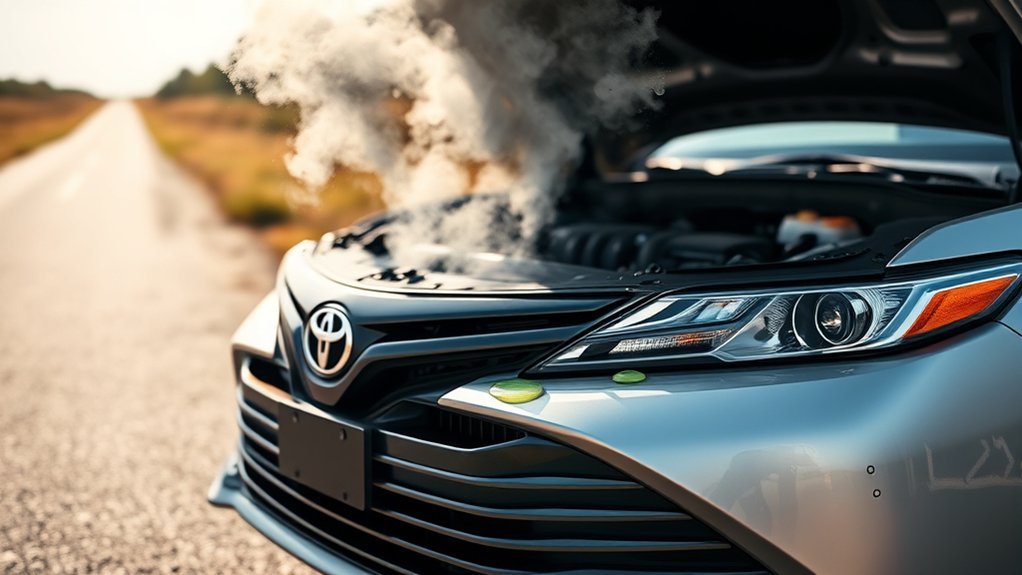
When your Toyota Camry shows signs of overheating, act quickly. Continuing to drive with excessive engine temperature can damage important engine components.
Common symptoms include:
- High temperature reading: The engine temperature gauge moves toward the red zone, if your model has a gauge.
- Dashboard warning: An engine temperature or cooling-system warning appears.
- Steam from under the hood: Hot coolant may be escaping from the cooling system.
- Coolant boiling or overflowing: The reservoir may bubble or release coolant because of excessive heat, pressure loss, or another cooling-system problem.
- Reduced engine power: The vehicle may limit performance when overheating occurs.
- Unusual coolant smell: A sweet smell near the engine compartment can indicate a coolant leak.
- Cabin heater stops producing warm air: Low coolant or trapped air may prevent proper circulation through the heater core.
You may also notice overheating while idling or waiting at stoplights. This can happen when the cooling fan cannot move enough air through the radiator.
However, symptoms alone do not identify the failed component. A thermostat, fan, water pump, radiator, coolant leak, or another problem may produce similar warning signs.
Warning: Steam, boiling coolant, or a high-temperature warning means you should stop driving as soon as it is safe. Never remove a hot radiator cap or pressurized coolant reservoir cap. Hot coolant can spray out and cause serious burns.
What to Do When Your Toyota Camry Overheats
Your first priority is getting the vehicle and its occupants to a safe location. Do not continue driving simply to see whether the warning disappears.
- Pull over safely. Move away from traffic, switch on your hazard lights if needed, and place the transmission in Park.
- Turn off the air conditioning. This reduces an additional load on the engine.
- Follow your model’s overheating procedure. Stop the engine or hybrid system as directed by the owner’s manual. If steam or coolant is escaping, keep the hood closed until the steam has stopped.
- Allow the system to cool. Do not touch hot cooling-system components or remove a pressurized cap.
- Inspect only when safe. Once the engine is completely cool, look for visible coolant leaks, damaged hoses, and the reservoir level.
- Arrange service when necessary. A large coolant leak, recurring overheating, or a warning that remains active requires professional attention.
For the instructions specific to your vehicle, consult the official Toyota owner’s manual.
When Should You Stop Driving and Call for a Tow?
Do not continue driving if:
- Steam is escaping from the engine compartment.
- Coolant is leaking heavily or the reservoir is empty.
- The temperature warning returns after the vehicle cools.
- The cooling fan is not working when required.
- The engine runs poorly, loses substantial power, or makes unusual mechanical noises.
- A hybrid-system overheating warning remains active.
Towing is safer than risking additional engine or hybrid-system damage when the cause has not been corrected.
What Causes Overheating in a Toyota Camry?
Overheating occurs when the cooling system cannot remove engine heat effectively. Several components work together to control temperature, so a failure in one area can affect the entire system.
1. Low Coolant Levels and Leaks
Coolant carries heat away from the engine. If the system loses coolant, it may not circulate enough fluid to maintain the correct operating temperature.
Common leak locations include radiator hoses, hose connections, the radiator, coolant reservoir, water pump, and related seals.
Coolant should not need frequent topping up. A level that repeatedly drops needs investigation.
2. Faulty Thermostat
The thermostat helps control coolant circulation according to engine temperature.
A thermostat stuck closed can restrict coolant flow and contribute to overheating. One stuck open may cause unusually slow engine warm-up.
3. Clogged or Damaged Radiator
The radiator releases heat from the coolant into the surrounding air.
Internal restrictions, external debris, damaged fins, or coolant leaks can reduce its cooling ability. Heavy dirt or debris between the radiator and air-conditioning condenser may also restrict airflow.
4. Water Pump Failure
The water pump circulates coolant through the cooling system.
A failing pump may cause poor circulation, coolant leakage, abnormal noise, or overheating. Pump design and drive arrangements vary by Camry model year and powertrain.
5. Radiator Fan Malfunction
The cooling fan moves air through the radiator when vehicle speed alone does not provide enough airflow.
A failed fan motor, wiring problem, fuse, control issue, or related electrical fault may cause overheating, particularly in traffic or while idling.
6. Cooling-System Pressure and Other Problems
Additional causes include:
- A radiator or reservoir pressure cap that cannot maintain the required pressure.
- Air trapped in the cooling system after repairs or coolant replacement.
- Restricted or damaged coolant hoses.
- A coolant temperature sensor or control-system problem.
- A combustion-gas leak caused by a damaged head gasket or another internal engine problem.
- Cooling-system problems that become more noticeable during heavy engine load or hot-weather driving.
A technician should distinguish between these possibilities before recommending major repairs.
Toyota Camry Overheating Symptom Chart
The conditions under which your Camry overheats can help narrow the diagnosis.
| Symptom | Possible Causes | Next Step |
|---|---|---|
| Overheats while idling or in traffic | Cooling fan or airflow problem | Have fan operation and controls checked. |
| Overheats at highway speeds or under load | Coolant circulation, radiator restriction, or cooling-capacity problem | Arrange cooling-system diagnosis. |
| Coolant level keeps dropping | External leak, pressure loss, or possible internal leak | Request a pressure test and leak inspection. |
| Reservoir is full but engine overheats | Thermostat, pump, radiator, trapped air, or pressure problem | Check circulation and cooling-system performance. |
| Overheats after coolant replacement | Trapped air, incorrect fill, leak, or an unresolved original fault | Have the filling and air-bleeding procedure checked. |
| Overheats after replacing the thermostat or pump | Remaining fault, trapped air, installation issue, or another failed component | Request a complete system diagnosis. |
Remember: These patterns suggest possible causes. They do not confirm that a specific component has failed.
First Steps to Check for Overheating Symptoms
Once your Toyota Camry has cooled completely, begin with the simplest visible checks.
- Inspect the coolant level: Check the appropriate reservoir against its cold-level markings.
- Examine the radiator: Look for visible damage, coolant residue, corrosion, and debris.
- Inspect the hoses: Look for cracks, swelling, loose connections, or dried coolant deposits.
- Review the temperature warning: Note when it appeared and whether the vehicle was idling, climbing, accelerating, or traveling at highway speed.
- Check for visible leaks: Examine the ground beneath the vehicle and accessible cooling-system components.
Do not remove pressurized caps or disconnect cooling-system hoses while the engine is hot.
Also, avoid reaching near an electric cooling fan. It may start automatically under certain conditions.
Pro Tip: If your Camry overheats only under specific driving conditions, record when it happens. The difference between overheating at idle and overheating under load can help a technician narrow the diagnosis.
How to Diagnose Thermostat and Water Pump Problems
The thermostat and water pump both affect coolant circulation, but they perform different jobs.
The thermostat regulates coolant flow according to temperature, while the water pump moves coolant through the system.
Signs of Thermostat Failure
A malfunctioning thermostat may cause:
- Unexpectedly high engine temperature readings.
- Rapid overheating after the engine warms up.
- Unusually slow engine warm-up.
- Temperature changes that do not match normal driving conditions.
- Overheating despite an adequate coolant level.
A stuck-closed thermostat can restrict circulation. A stuck-open thermostat generally causes an engine to warm up more slowly.
However, these symptoms can overlap with other cooling-system faults.
A technician may use temperature readings, diagnostic trouble codes, and the appropriate model-specific service procedure to determine whether the thermostat is functioning correctly.
Water Pump Inspection Tips
When inspecting your Camry’s water pump, look for visible signs of coolant leakage or corrosion around the accessible pump area.
Other possible symptoms include:
- Unusual grinding or whining noises on applicable pump designs.
- Recurring coolant loss.
- Poor coolant circulation.
- Overheating after the engine reaches operating temperature.
A damaged drive belt can affect a belt-driven pump, but not every Camry uses the same water pump arrangement. Check the service information for your engine and model year.
If overheating continues after a water pump replacement, do not automatically assume the thermostat is faulty. Trapped air, incorrect filling, leaks, radiator restrictions, or another unresolved problem may still be present.
Testing Coolant Flow Rate
Coolant circulation testing should use procedures appropriate for your Camry’s engine and cooling-system design.
A qualified technician may:
- Confirm the coolant level and system condition.
- Check for external leaks and pressure loss.
- Compare temperature readings at appropriate cooling-system locations.
- Evaluate thermostat operation using manufacturer-approved procedures.
- Check water pump performance and relevant diagnostic information.
- Confirm that the cooling system has been filled and bled correctly.
Do not remove the thermostat or disconnect coolant hoses simply to observe flow while the engine is running. Such testing can be unsafe and may not identify the actual failure.
The Importance of Radiator Maintenance
The radiator releases engine heat into the surrounding air. Damage, internal restrictions, or blocked airflow can reduce its ability to cool the engine.
Regular inspections help identify problems before they cause overheating.
Regular Inspection Schedule
Use your Camry’s maintenance guide rather than relying on a universal coolant replacement interval.
During routine checks:
- Inspect the radiator and coolant reservoir for visible damage or leaks.
- Check coolant levels and condition when the engine is cold.
- Look for debris blocking the radiator and condenser.
- Check the condition of accessible hoses and connections.
- Have cooling fan operation investigated if overheating occurs at idle or low speeds.
For a documented example, the 2025 Toyota Camry Warranty and Maintenance Guide specifies:
- Engine/intercooler coolant, if applicable: Initial replacement at 100,000 miles or 120 months.
- Subsequent engine/intercooler coolant replacement: Every 50,000 miles or 60 months.
- Inverter/intercooler coolant, if applicable: Initial replacement at 150,000 miles or 180 months, followed by 50,000-mile or 60-month intervals.
These are 2025 model-year specifications. Your own Camry may have different requirements, particularly if it is an older model.
Replace contaminated coolant or repair a cooling-system problem when necessary rather than waiting for the next scheduled interval.
Signs of Radiator Damage
Radiator damage can compromise cooling efficiency and lead to overheating.
Look for:
- Visible coolant leaks.
- Damaged or corroded radiator components.
- Blocked or bent cooling fins.
- Coolant residue around radiator connections.
- Debris restricting airflow through the radiator.
A malfunctioning cooling fan can produce similar symptoms even when the radiator itself is in good condition.
If the radiator is heavily blocked, damaged, or leaking, have it inspected before replacing it.
Importance of Coolant Quality
Proper coolant helps transfer heat, protect cooling-system components from corrosion, and provide freeze protection.
Toyota specifies Super Long Life Coolant or a compatible coolant meeting the requirements in the applicable owner’s manual.
In U.S. applications, Toyota Super Long Life Coolant is commonly supplied as a premixed 50/50 solution of coolant and deionized water. Specifications may vary by market.
Follow the coolant label and your vehicle’s manual. Do not assume that every coolant with a similar color is compatible.
Important practices include:
- Check coolant condition: Look for contamination or unusual discoloration.
- Use the correct formulation: Avoid mixing incompatible coolant types.
- Check pressure integrity: A faulty pressure cap can affect cooling-system operation.
- Follow the correct service interval: Replace coolant according to the applicable maintenance guide.
Toyota also advises against using plain water alone as a normal substitute for the specified coolant mixture. See its engine coolant maintenance guidance.
Note: Coolant color alone is not a reliable compatibility test. Use the coolant specification listed for your exact Toyota Camry model year.
Identifying and Fixing Bad Hoses and Coolant Leaks
Inspecting your Toyota Camry’s hoses for wear and damage is essential. Even a small leak can reduce coolant level over time.
Common warning signs include:
- Cracks or splits in a hose.
- Bulging or visibly damaged hose sections.
- Coolant residue around hose connections.
- Loose or damaged clamps.
- Recurring coolant loss without an obvious puddle.
Hoses carry coolant between the engine, radiator, and other cooling-system components. A damaged hose can leak, while an internally restricted hose may interfere with circulation.
Inspect accessible connections only after the engine has cooled completely.
If you suspect a leak but cannot locate it, a professional cooling-system pressure test can help identify the source.
Do not continue driving with a significant coolant leak. Repeatedly adding coolant without repairing the cause can allow overheating to return.
When to Replace Your Toyota Camry’s Radiator Fan?
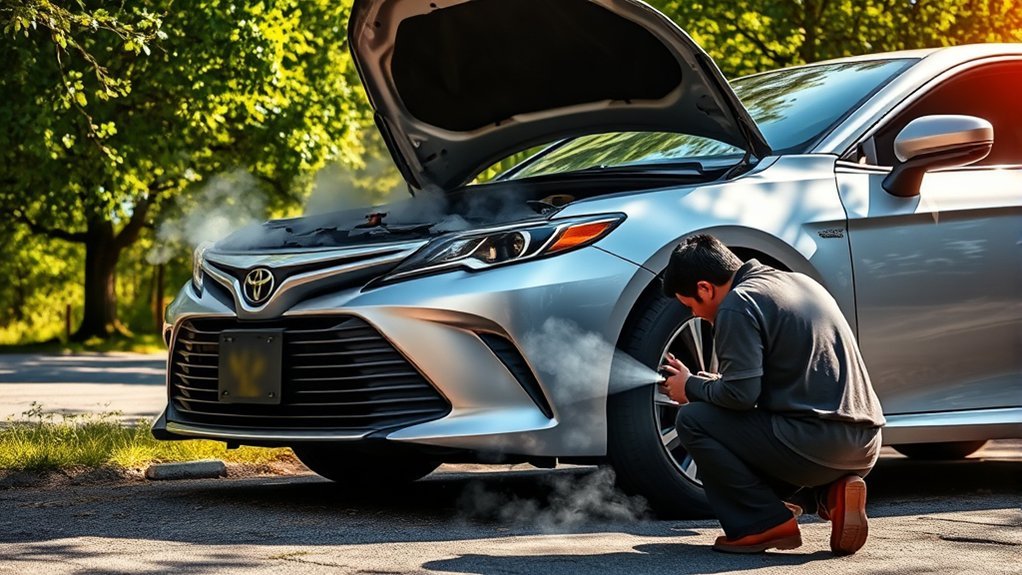
The radiator fan is especially important when your Camry is idling or moving slowly because less natural airflow passes through the radiator.
Consider having the fan system inspected if:
- The vehicle repeatedly overheats in traffic or while idling.
- The fan does not operate when the cooling system requires it.
- The fan makes unusual mechanical noises.
- The fan assembly has visible damage.
- Wiring or connectors show signs of corrosion or damage.
- Fan operation is inconsistent with the cooling system’s requirements.
However, a fan that does not run continuously is not necessarily faulty. Electric fan operation depends on temperature, air-conditioning demand, and vehicle control logic.
A fan that operates with the A/C switched on but appears inactive at other times does not automatically need replacement.
Have the motor, relevant fuses, wiring, connectors, and fan-control system checked before replacing components.
Warning: Keep hands, clothing, and tools away from electric cooling fans. They may start automatically. Do not perform electrical tests or reach near fan blades while the system may activate.
Why Your Camry Overheats When the Coolant Is Full
A full coolant reservoir does not prove that coolant is circulating correctly or that the cooling system can maintain proper operating temperature.
Possible causes include:
- A thermostat that restricts coolant flow.
- A failing water pump.
- An internally restricted radiator.
- A cooling fan problem.
- Trapped air in the system.
- A pressure cap that is not functioning correctly.
- An internal engine problem affecting cooling-system pressure.
The reservoir may also appear full while another part of the cooling system has an air pocket or circulation problem.
If overheating continues despite an adequate coolant level, have the system diagnosed rather than repeatedly topping it up.
Toyota Camry Hybrid Overheating: What Is Different?
Hybrid Camrys require particular attention because the hybrid powertrain may have cooling components and circuits separate from the gasoline engine’s cooling system.
The U.S. Toyota Camry became an exclusively hybrid model for the 2025 model year, although earlier Camry generations included both gasoline and hybrid versions.
Depending on model year and equipment, a hybrid Camry may have separate cooling requirements for components such as the inverter or power control unit.
This means an engine-temperature problem and a hybrid-system overheating warning should not automatically be treated as the same fault.
Check the exact warning displayed on the dashboard and follow the applicable owner’s manual.
Hybrid Safety Warning: Do not touch, disconnect, or attempt to repair orange high-voltage cables, connectors, or hybrid electrical components. Make sure the vehicle is fully switched off before any permitted owner inspection. Hybrid-system diagnosis and repairs should be performed by qualified technicians.
The Toyota Camry maintenance guide contains model-specific coolant maintenance information and high-voltage safety precautions.
Preventing Overheating Issues
Preventing overheating starts with maintaining your Camry’s cooling system and responding to small problems before they become serious.
Follow these practices:
- Check coolant levels: Inspect the correct reservoir when the engine is cold.
- Investigate coolant loss: Do not treat repeated topping up as normal maintenance.
- Inspect hoses: Look for cracks, swelling, leaks, and damaged connections.
- Keep the radiator clear: Remove accessible debris without damaging cooling fins.
- Use the correct coolant: Follow Toyota’s specification for your model year.
- Follow scheduled maintenance: Replace coolant at the recommended mileage or time interval.
- Watch for fan problems: Have unusual fan behavior investigated.
- Address warning lights promptly: Do not ignore an engine-temperature or hybrid-system warning.
Periodically inspect the accessible water pump area for visible leakage or deterioration as part of broader cooling-system maintenance.
Also, have the cooling system inspected after major repairs involving coolant draining, hose replacement, radiator replacement, thermostat replacement, or water pump replacement.
An improperly filled system or trapped air can cause overheating even when the replaced component is working correctly.
How to Handle Used Coolant Safely
Automotive coolant can contain ethylene glycol, which is toxic to people and animals.
Keep coolant away from children and pets. Collect used coolant in a suitable container and use an appropriate recycling or disposal facility.
Do not pour used coolant onto the ground, into storm drains, or into household drains.
The U.S. Environmental Protection Agency provides additional guidance on safe automotive fluid handling and disposal.
Seeking Professional Help for Persistent Problems
If you have replaced the thermostat or water pump but your Toyota Camry still overheats, a complete cooling-system diagnosis is more useful than replacing additional parts without testing.
Seek professional assistance if you notice:
- Recurring coolant overflow or boiling.
- Cooling fans that do not operate when required.
- Persistent overheating after maintenance.
- Unexplained coolant loss.
- Overheating immediately after a cooling-system repair.
- Hybrid-system overheating warnings.
- Possible internal engine problems.
A qualified technician may perform a cooling-system pressure test, check fan operation, inspect thermostat and pump performance, evaluate radiator efficiency, and confirm proper coolant circulation.
If there are signs of an internal engine leak, further testing may be necessary.
Questions to Ask Your Repair Shop
Before approving repairs, ask:
- Which test identified the failed component?
- Was the cooling system checked for pressure loss?
- Were thermostat operation and coolant circulation verified?
- Were the fan motor and its control system tested?
- Was the correct coolant used?
- Was the system filled and bled according to Toyota’s procedure?
- Does my Camry have a separate hybrid cooling circuit that also needs inspection?
These questions help distinguish a confirmed repair from a guess based only on symptoms.
Frequently Asked Questions
What causes a Toyota Camry to overheat?
Common causes include low coolant, leaks, thermostat failure, water pump problems, a restricted radiator, cooling fan faults, and cooling-system pressure problems. The exact cause depends on the symptoms and vehicle configuration.
What are 10 common causes of overheating on a Toyota?
Ten possible causes are low coolant, coolant leaks, thermostat failure, water pump malfunction, radiator blockage, damaged hoses, cooling fan failure, pressure cap failure, trapped air, and internal engine problems such as a head gasket leak. These possibilities require diagnosis rather than automatic parts replacement.
What are three simple things to check if your Toyota is overheating?
After the engine has cooled completely, check the coolant reservoir level, look for visible radiator or hose leaks, and inspect the radiator for external damage or airflow restrictions. Never open the pressurized cooling system while it is hot.
Why is my car overheating even though the coolant is full?
A full reservoir does not guarantee proper coolant circulation. A faulty thermostat, water pump problem, radiator restriction, fan malfunction, trapped air, or pressure problem can still cause overheating.
Why does my Toyota Camry overheat when idling but cool down while driving?
This pattern often suggests inadequate airflow through the radiator at low speeds. The cooling fan, its electrical controls, and radiator airflow should be checked. Other cooling-system faults can cause similar symptoms.
Can I drive my Camry after it overheats?
Do not continue driving while an overheating warning is active. Follow your owner’s manual and arrange professional assistance if the warning returns, coolant is leaking, or the cause remains unknown. Towing may prevent additional damage.
Sources
- Toyota Owners — Manuals and Warranties — Model-specific operating instructions, cooling-system precautions, and overheating procedures.
- Toyota — 2025 Camry Warranty and Maintenance Guide — Coolant replacement intervals, maintenance requirements, and hybrid safety precautions.
- Toyota — How Often to Change Engine Coolant — Coolant selection, overheating signs, and general maintenance guidance.
- Toyota USA Newsroom — 2025 Camry Hybrid Powertrain Announcement — Confirmation of the Camry’s transition to an exclusively hybrid powertrain for the 2025 U.S. model year.
- U.S. Environmental Protection Agency — Vehicle Pollution Prevention — Safe handling and disposal of automotive fluids, including antifreeze.
Conclusion
Toyota Camry overheating can result from low coolant, a faulty thermostat, a failing water pump, radiator problems, damaged hoses, or cooling fan faults. The most useful first step is to identify when the overheating occurs and whether coolant loss or another visible problem is present.
Always prioritize safety. Stop driving when an overheating warning appears, allow the cooling system to cool completely, and never open a hot pressurized coolant system.
Regular coolant checks, radiator maintenance, hose inspections, and model-specific scheduled servicing can help prevent problems. If your Camry continues overheating after maintenance or parts replacement, have a qualified technician diagnose the complete cooling system before further damage occurs.







Leave a Reply