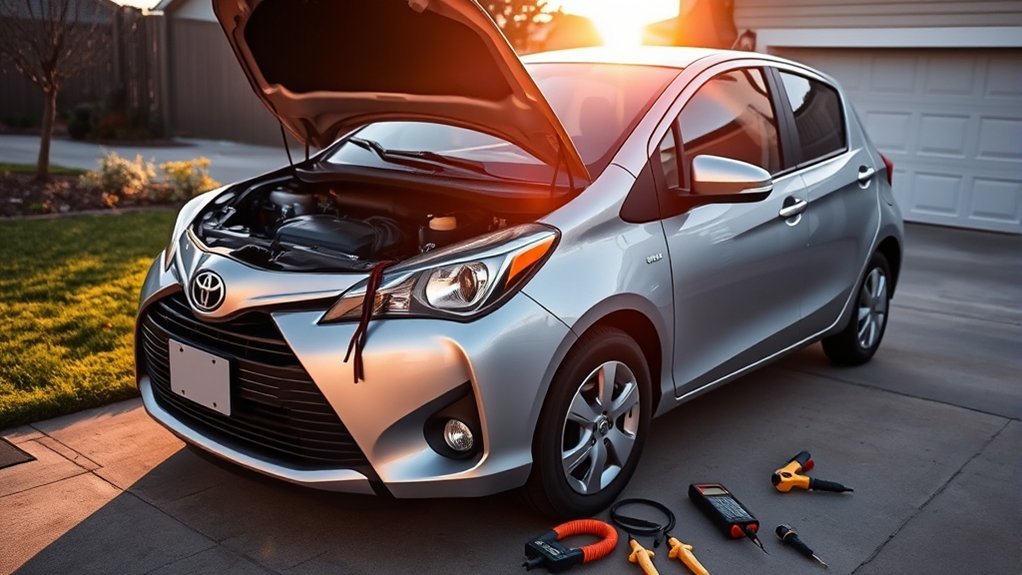
If your Toyota Yaris won’t start, the first step is to identify what happens when you turn the key or press the Start button. A weak battery, loose electrical connection, starter problem, fuel delivery fault, or unrecognized key can prevent the vehicle from starting. The sound of the engine and the behavior of the dashboard lights can help you narrow down the cause before paying for repairs.
Quick Answer
If your Toyota Yaris won’t start, check the 12V battery, battery connections, fuel level, gear position, and key recognition first. Rapid clicking or slow cranking often points to a battery or connection problem. If the engine cranks normally but never starts, fuel delivery, ignition, or engine-management faults need further diagnosis.
Key Takeaways
- No cranking: Check the battery, terminals, starting procedure, key recognition, and starter circuit.
- Slow cranking or rapid clicking: A discharged battery or poor electrical connection is a common possibility.
- Normal cranking without starting: Check fuel availability and have the ignition and engine-management systems diagnosed if the problem continues.
- Hybrid models: Check whether the READY indicator appears. The gasoline engine does not need to run continuously for the hybrid system to be operating.
- Safety: Stop attempting to start the vehicle if you notice a strong fuel smell, visible fuel leakage, smoke, or a damaged battery.
At a Glance
| Time Required | About 5–15 minutes for basic visual and electrical checks; professional diagnosis may take longer. |
| Difficulty | Beginner for basic checks; intermediate to professional for electrical and fuel-system diagnosis. |
| Tools Needed | Owner’s manual, flashlight, optional digital multimeter, and an approved 12V jump starter or jumper cables. A technician may need a diagnostic scanner and electrical testing equipment. |
| Cost | Basic visual checks cost nothing. Battery testing, roadside assistance, parts, and labor vary by location and the confirmed fault. |
Warning: If you smell strong gasoline fumes, see leaking fuel, notice smoke, or find a swollen or leaking battery, stop attempting to start the vehicle. Switch everything off, avoid flames and sparks, and arrange professional assistance. Do not run the engine inside an enclosed garage.
Common Symptoms When Your Toyota Yaris Won’t Start

When your Toyota Yaris won’t start, pay attention to the sound it makes, whether the dashboard lights illuminate, and whether the engine actually turns over.
These observations provide useful clues, although they do not confirm a specific failed component.
What Different Starting Symptoms Mean
| Symptom | Possible Cause | First Check |
|---|---|---|
| No sound and no dashboard lights | Discharged battery, disconnected terminal, or main electrical fault | Battery condition and connections |
| Rapid clicking | Low battery charge or excessive resistance in an electrical connection | Battery voltage and terminal condition |
| One click but no cranking | Starter, starter relay, battery cable, or grounding problem | Battery and starter circuit |
| Engine turns slowly | Weak battery, poor connection, or starter problem | Battery test |
| Engine cranks normally but does not start | Fuel delivery, ignition, immobilizer, or engine-management fault | Fuel level, warning lights, and diagnostic trouble codes |
| Engine starts and then stalls | Fuel delivery, charging, ignition, or engine-control problem | Battery and charging-system diagnosis |
| Hybrid dashboard operates but READY does not appear | 12V battery, key recognition, starting conditions, or hybrid-system fault | READY indicator, 12V system, and dashboard messages |
If the engine cranks normally, repeatedly replacing the battery without further testing may not solve the problem. Conversely, if the starter barely turns, checking the fuel pump should not be your first step.
Top Causes of Starting Issues in Your Yaris
Several electrical, mechanical, and fuel-related faults can prevent your Toyota Yaris from starting. The most useful approach is to match the possible cause to the symptoms.
Weak Battery Symptoms
A weak or discharged 12V battery is a common reason a conventional Yaris will not crank properly.
Typical signs include:
- Dim dashboard or interior lights.
- Rapid clicking when attempting to start.
- Slow engine cranking.
- Electrical equipment switching off during a starting attempt.
- The vehicle starting after a correctly performed jump-start.
Battery problems may become more noticeable in cold weather or after the vehicle has been parked for an extended period.
Inspect the battery terminals for looseness, corrosion, and damaged cables. A battery can have enough power to illuminate the dashboard while lacking sufficient capacity to crank the engine.
If a jump-start works, arrange a battery and charging-system test before purchasing a replacement.
Fuel Delivery Problems
If your Yaris cranks at its normal speed but does not start, fuel delivery is one possible area to investigate.
Potential problems include:
- Empty fuel tank: Check the fuel gauge and consider whether the displayed level could be inaccurate.
- Faulty fuel pump: The pump may fail to deliver the required fuel.
- Restricted fuel filter: A restriction can reduce fuel flow, depending on the vehicle’s fuel-system design.
- Insufficient fuel pressure: A pump, electrical, or pressure-control fault can prevent proper fuel delivery.
- Fuel injector problems: Electrical or mechanical faults may interfere with fuel delivery to the engine.
An empty tank or fuel-delivery failure normally prevents the engine from firing rather than preventing the starter from turning.
Fuel-pressure testing requires suitable equipment and knowledge of the specific engine. Do not disconnect pressurized fuel lines as a basic troubleshooting method.
Starter Motor and Starter Relay Problems
If the dashboard lights appear normal but the engine does not crank, the starter circuit may need attention.
Possible faults include a worn starter motor, faulty starter relay, damaged wiring, poor ground connection, or a starting-interlock problem.
A single click can suggest a starter-circuit issue, but it does not prove that the starter motor needs replacement.
A technician should check battery voltage, voltage drop, and starter-control signals before replacing expensive components.
Key Recognition and Ignition Problems
Some Yaris models use an electronic immobilizer that prevents starting when the correct key is not recognized.
If your vehicle displays a key warning or does not respond normally to the Start button, try the following:
- Use the correct key and remove unnecessary electronic devices from its immediate surroundings.
- Try a spare registered key if available.
- For push-button models, follow the emergency key-detection procedure in your owner’s manual.
- Check whether the dashboard requests that you press the brake or clutch pedal.
- If the ignition key will not turn, gently move the steering wheel while turning the key. Never force it.
A discharged key-fob battery is different from a discharged vehicle battery. A suitable emergency key-start procedure may still allow the vehicle to start, depending on its equipment.
Ignition, Sensor, and Engine-Management Faults
If the engine turns normally but never fires, the fault may involve more than the fuel system.
Other possibilities include:
- Worn or faulty spark plugs.
- Ignition-coil problems.
- Crankshaft or camshaft position sensor faults.
- Electrical supply or fuse problems.
- Engine-control or immobilizer faults.
- Less commonly, mechanical timing or compression problems.
A diagnostic scanner can help identify relevant fault codes. However, a fault code identifies an affected system or circuit; it does not always identify the exact part that needs replacement.
Understanding the Role of the Battery in Starting Issues
The 12V battery supplies the electrical power required for starting and supports the vehicle’s electrical systems.
On conventional gasoline models, the battery provides the power needed by the starter motor. On hybrid models, the 12V battery supports the vehicle’s control systems so the hybrid system can become operational.
Battery Power Importance
A healthy, properly charged battery helps your Toyota Yaris start reliably.
Several factors can reduce its available power:
- Long periods without driving.
- Repeated short journeys.
- Cold weather.
- Electrical accessories left operating while the vehicle is off.
- Age-related battery deterioration.
- Charging-system problems.
- Corroded or loose battery connections.
Battery deterioration and insufficient charging are different problems. A serviceable battery may simply need recharging, while a defective battery may fail again even after being fully charged.
Signs of Weakness
A digital multimeter can provide an initial indication of the battery’s state of charge.
For a conventional 12V lead-acid battery, take the reading with the engine off after the battery has rested. Results can vary with battery type, temperature, and recent charging.
| Resting Voltage | General Interpretation |
|---|---|
| Around 12.6V or slightly higher | Typically indicates a well-charged battery, but does not prove it can deliver sufficient starting current. |
| Around 12.4V | Indicates a partially charged battery. Further testing may be appropriate if starting is difficult. |
| Around 12.0V or lower | Indicates substantial discharge and warrants charging and testing. |
| Around 11V or lower | Indicates a severely discharged battery or possible battery fault. It does not establish that the battery is permanently defective. |
AAA identifies approximately 12.6V with the engine off as a typical battery reading and recommends additional testing when battery condition is uncertain. See its battery and alternator testing guide.
Pro Tip: Ask for a battery load or conductance test if your Yaris repeatedly fails to start. A simple voltage reading cannot confirm the battery’s ability to supply starting current.
Jump-Start Techniques
Jump-starting may temporarily resolve a no-start condition caused by a discharged 12V battery.
However, the exact connection points and procedure depend on the model year, engine, and whether your Yaris is a conventional gasoline vehicle or a hybrid.
Follow the instructions in the owner’s manual for your specific vehicle.
Before Jump-Starting
- Park both vehicles safely and apply the parking brakes.
- Switch off unnecessary electrical accessories.
- Use a suitable 12V booster battery or compatible jump-start pack.
- Check that the booster vehicle and Yaris cannot touch each other.
- Do not attempt to jump-start a visibly damaged, leaking, swollen, or frozen battery.
- Keep sparks, cigarettes, flames, and loose cables away from the battery.
- Identify the designated positive terminal and negative grounding point.
General Jumper-Cable Connection Sequence
For conventional models where the owner’s manual specifies this arrangement:
- Connect the red positive clamp to the Yaris’s designated positive terminal.
- Connect the other red clamp to the positive terminal of the booster battery.
- Connect the black negative clamp to the booster battery’s negative terminal.
- Connect the remaining black clamp to the designated solid, unpainted grounding point on the Yaris, away from the battery and moving engine components.
- Start the donor vehicle if the applicable procedure requires it. Follow the manual’s charging and starting instructions.
- Attempt to start your Yaris.
- Once the vehicle starts, disconnect the cables in the reverse order.
Toyota’s 2026 Yaris battery-discharge instructions illustrate the specified connection points and emphasize having the vehicle inspected after a successful jump-start.
Warning: Never reverse jumper-cable polarity or allow the clamps to touch. On hybrid models, use only the approved 12V jump-start points. Do not touch orange high-voltage cables or attempt to jump-start the high-voltage traction battery.
If the Yaris starts after a jump but fails again later, have the battery, charging system, and electrical connections tested.
Do not assume that a successful jump-start proves the battery alone was responsible.
How Fuel System Maintenance Affects Yaris Starting Issues
Maintaining the fuel system helps your Toyota Yaris start and run consistently.
A failing fuel pump, fuel-pressure problem, restricted fuel filter, or injector fault can prevent the correct amount of fuel from reaching the engine.
Fuel-system maintenance should follow the recommendations for your specific model year and engine. Some vehicles use fuel-filter arrangements that are not intended for routine owner replacement.
To reduce avoidable fuel-related problems:
- Keep sufficient fuel in the tank.
- Use fuel that meets the vehicle manufacturer’s requirements.
- Follow the specified maintenance schedule.
- Address hard starting, hesitation, and stalling before they become recurring problems.
- Have suspected fuel-pressure problems diagnosed using appropriate equipment.
If the engine cranks but will not start after refueling, verify the fuel level and check for dashboard warning messages. Do not assume the fuel pump has failed without further testing.
What If You Smell Fuel?
A brief odor near a filling station is not the same as a strong, persistent fuel smell around the engine or underneath the vehicle.
Fuel odor during starting attempts may involve unburned fuel, a fuel-system leak, or another fault.
A clogged fuel filter is not a reliable explanation for fuel odor.
Warning: If fuel odor is strong or persistent, or you see leaking gasoline, switch off the ignition and stop starting attempts. Do not smoke, use an open flame, or drive the vehicle until the cause has been identified. Arrange professional assistance.
The AA’s petrol-odor safety guidance explains why a suspected fuel leak needs prompt professional attention.
Special Troubleshooting for Toyota Yaris Hybrid Models
If you drive a Toyota Yaris Hybrid, starting behavior differs from that of a conventional gasoline model.
A hybrid may become ready to drive without the gasoline engine immediately running.
Check the READY Indicator
Follow the starting procedure in your owner’s manual, including pressing the brake pedal and using the Power button as instructed.
When the READY indicator illuminates, the hybrid system has started successfully.
The gasoline engine may remain off temporarily because the hybrid system controls when it needs to operate.
Toyota confirms this behavior in its 2026 Yaris Hybrid power-switch instructions.
If READY does not appear, check the dashboard for key, battery, or hybrid-system messages.
Check the Hybrid’s 12V Battery
The hybrid still relies on a separate 12V electrical system.
If that battery becomes discharged, the vehicle may be unable to initialize the hybrid system even though the high-voltage traction battery has charge.
Possible symptoms include:
- Dim interior lights.
- Unresponsive electrical controls.
- Failure to enter READY mode.
- Unusual dashboard warning messages.
Follow the correct 12V recovery procedure for your particular model.
Some Yaris Hybrid versions use a designated positive jump-start terminal in the engine-compartment fuse box rather than requiring a direct connection to the battery.
Toyota illustrates this arrangement in its Yaris Hybrid auxiliary-battery instructions.
Do not attempt to service the high-voltage battery, orange cables, inverter, or other hybrid high-voltage components.
Quick Checks Before Consulting a Mechanic
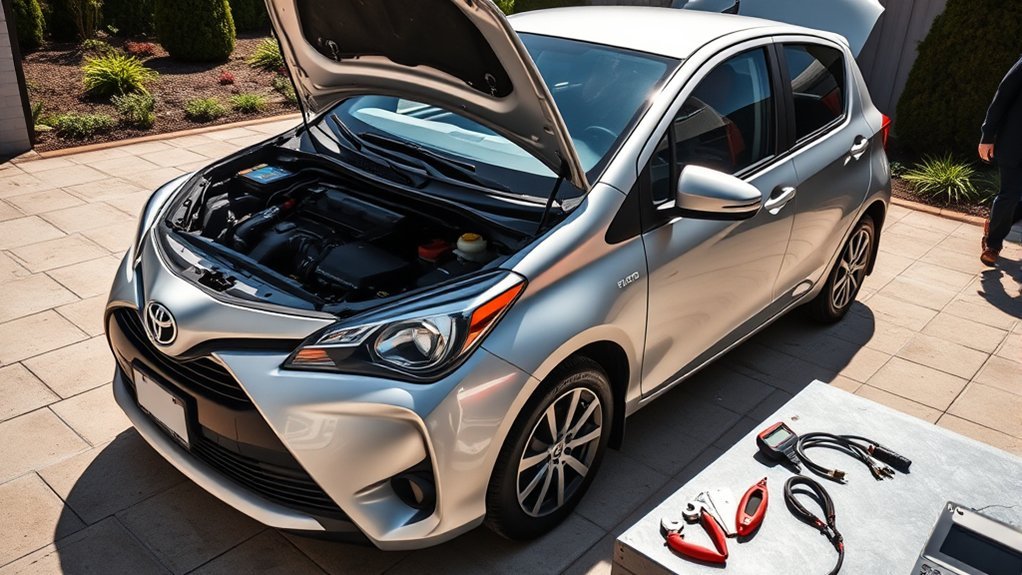
Before calling a mechanic, perform a few simple checks that do not require dismantling the vehicle.
These steps can help identify an easily corrected starting problem and provide useful information if professional diagnosis is needed.
The most useful starting clue is whether the engine does not crank, cranks slowly, or cranks normally without firing.
Step 1: Confirm the Correct Starting Procedure
Apply the parking brake and check the transmission position.
- Automatic transmission: Select Park and press the brake pedal as instructed.
- Manual transmission: Select Neutral and fully depress the clutch pedal as required by your model.
- Push-button start: Make sure the electronic key is inside the vehicle and recognized.
If the dashboard displays a message about the brake pedal, clutch pedal, key, or gear position, follow the relevant instruction.
Step 2: Observe the Dashboard Lights
Turn on the ignition without repeatedly attempting to start the engine.
If the dashboard remains completely dark, check the 12V battery and its connections.
If the lights illuminate normally, note any battery, immobilizer, engine, or hybrid-system warning messages.
Normal-looking dashboard lights do not prove that the battery, starter circuit, or ignition switch is fully functional.
Step 3: Inspect the Battery Terminals
With the vehicle switched off, visually inspect accessible battery connections.
Look for:
- Loose terminal clamps.
- White, blue, or green corrosion.
- Damaged cables.
- Visible battery swelling or leakage.
If a terminal is loose or heavily corroded, arrange appropriate cleaning or repair.
Do not handle a leaking, swollen, or otherwise damaged battery.
Step 4: Check the Fuel Level
Confirm that the fuel tank contains enough fuel.
If the displayed level seems inconsistent with recent driving or refueling, the fuel-level reading may need further investigation.
Do not assume an engine that cranks normally has a battery problem simply because it will not start.
Step 5: Listen to the Starting Sound
Make one controlled starting attempt and identify whether you hear:
- Rapid clicking.
- A single click.
- Slow cranking.
- Normal cranking without the engine firing.
- No starter activity.
A fuel pump may make a brief sound when the ignition is switched on, but pump operation varies by vehicle.
Hearing a pump does not confirm adequate fuel pressure, and failing to hear it does not prove that it has failed.
Step 6: Try the Spare Key
If your Yaris shows a key-recognition warning or does not respond to the Start button, try a spare registered key.
For a model equipped with an emergency key-detection procedure, follow the instructions in its owner’s manual.
If the steering lock appears to prevent the ignition key from turning, gently move the steering wheel while turning the key.
Step 7: Consider a Safe Jump-Start
If the symptoms suggest a discharged 12V battery, follow the correct jump-start procedure for your vehicle.
If it starts, arrange battery and charging-system testing.
If it does not start despite a suitable power supply and correct connections, the cause may lie elsewhere in the starting system.
Step 8: Record the Symptoms Before Calling for Help
Make a note of:
- Whether the engine cranks.
- The sound it makes.
- Whether the dashboard lights dim.
- Any warning messages.
- Whether the vehicle starts after a jump.
- Whether the problem occurs only when the engine is hot or cold.
- Whether the vehicle recently stalled or required several starting attempts.
These details can help a mechanic narrow down the problem without immediately replacing parts.
What If Your Yaris Starts After a Jump but Dies Again?
If a jump-start gets your Yaris running but it later fails to start, the battery may not be holding a charge, or the charging system may not be replenishing it properly.
On a conventional gasoline model, possible causes include:
- A worn or defective battery.
- A failing alternator.
- Loose or damaged charging-system wiring.
- Poor electrical-ground connections.
- An electrical drain while the vehicle is parked.
On a hybrid model, diagnosis of the 12V charging system differs because the vehicle uses hybrid-system components rather than a conventional alternator arrangement.
Have the appropriate charging system checked by a qualified technician.
Do not repeatedly drive a vehicle that stalls or loses electrical power unexpectedly.
Indicators That Professional Help Is Needed for Your Yaris
Some starting problems are simple, but others require specialized diagnostic equipment.
Seek professional help if:
- The engine repeatedly cranks but will not start: Fuel delivery, ignition, engine sensors, or other systems may require testing.
- The vehicle requires several starting attempts: An intermittent electrical or mechanical fault may be developing.
- The battery repeatedly loses charge: The battery, charging system, and possible electrical drain need investigation.
- Dashboard warning lights remain illuminated: Relevant diagnostic codes and system information should be checked.
- The starter makes unusual noises: Starter-circuit or mechanical problems may need repair.
- The vehicle starts and stalls: Continued operation may be unreliable or unsafe.
- A hybrid will not enter READY mode: The 12V system, key recognition, or hybrid control system may require diagnosis.
Stop and arrange roadside assistance: Do not continue starting attempts if there is visible fuel leakage, strong gasoline odor, smoke, a damaged battery, or an indication of a serious electrical fault. A vehicle that repeatedly stalls should be inspected before being driven again.
Do not keep cranking the engine for extended periods. Repeated attempts can discharge the battery and overheat starting components.
Consult your owner’s manual for any model-specific cranking limits or recovery instructions.
Choose a Trusted Mechanic for Your Yaris
A qualified mechanic can distinguish between a discharged battery, a failed starter, a fuel-system problem, and an engine-management fault.
When choosing a repair shop, consider:
- Experience: Look for technicians familiar with Toyota electrical and starting systems.
- Hybrid knowledge: If you own a Yaris Hybrid, choose a workshop equipped and trained to diagnose hybrid vehicles.
- Reputation: Review customer feedback and seek recommendations from people you trust.
- Diagnostic process: Ask whether the shop will test the suspected component before replacing it.
- Transparency: Request a clear explanation of the diagnosis and an estimate before authorizing repairs.
A useful diagnostic report may include battery-test results, relevant fault codes, charging-system measurements, and the checks performed on the starter or fuel system.
Avoid approving a starter motor, fuel pump, or battery replacement based only on a symptom when the component has not been properly tested.
Frequently Asked Questions
Why Is My Toyota Yaris Not Starting Sometimes?
Intermittent starting problems can result from loose battery connections, a weak battery, key-recognition faults, a starter-circuit issue, or fuel and engine-management problems. Record whether the engine cranks normally, turns slowly, or makes no sound. If the problem continues, have the relevant systems tested rather than replacing parts at random.
Why Does My Toyota Have Power but Won’t Start?
Dashboard lights and other accessories require much less power than a conventional starter motor. The battery may therefore power electrical equipment without being able to crank the engine. If the engine cranks normally but will not fire, fuel delivery, ignition, immobilizer, and engine-management faults are other possibilities.
What Is the Most Common Problem With the Toyota Yaris?
There is no single problem that can accurately be described as the most common across every Yaris generation, engine, and market. For starting complaints, battery condition, electrical connections, the starter circuit, key recognition, and fuel delivery are useful areas to investigate. The actual cause depends on the symptoms and diagnostic results.
What Is the Biggest Cause of Starter Motor Failure on Toyota?
Starter motors can fail because of internal wear, electrical faults, or mechanical damage. However, a discharged battery, poor cable connection, faulty relay, or grounding problem can produce similar symptoms without the starter itself being defective. Battery and starter-circuit testing should come before replacement.
Why Does My Toyota Yaris Start With a Jump but Not by Itself?
A successful jump-start suggests that the additional electrical power helped the vehicle start. The battery may be discharged, unable to hold a charge, or affected by a charging-system or connection problem. Have the battery and charging system tested to identify the cause.
Why Won’t My Toyota Yaris Hybrid Start?
Check whether the READY indicator appears. If READY is illuminated, the hybrid system is operating even if the gasoline engine is silent. If READY does not appear, possible causes include a discharged 12V auxiliary battery, key-recognition problem, incorrect starting conditions, or hybrid-system fault. Follow the model-specific owner’s manual and avoid handling high-voltage components.
Conclusion
If your Toyota Yaris won’t start, begin with the simplest checks: confirm the correct starting procedure, inspect the battery and its connections, verify the fuel level, and observe what happens during a starting attempt.
Slow cranking and rapid clicking often lead toward battery or electrical-connection checks. Normal cranking without starting requires a different approach that may involve fuel delivery, ignition, or engine-management diagnosis.
For a Yaris Hybrid, check the READY indicator and remember that its 12V system has a separate role from the high-voltage traction battery.
A safe, symptom-based approach can help you identify simple problems and give your mechanic the information needed for an accurate repair. If you encounter fuel leakage, damaged electrical components, persistent starting failure, or an unfamiliar hybrid-system warning, seek professional assistance rather than continuing to attempt repairs.
Sources
- Toyota — Yaris Engine Will Not Start — Manufacturer guidance for distinguishing starting symptoms and checking possible causes.
- Toyota — 2026 Yaris Battery Discharge and Jump-Starting — Official 12V jump-start procedures and safety guidance.
- Toyota — 2026 Yaris Hybrid Power Switch — Correct hybrid starting procedure and READY indicator operation.
- Toyota — Yaris Hybrid Auxiliary Battery Recovery — Hybrid-specific 12V battery and jump-start guidance.
- AAA — Bad Alternator vs. Bad Battery — Battery symptoms, voltage testing, and charging-system diagnosis.
- The AA — Petrol Smell in a Car — Fuel-odor diagnosis and safety recommendations, updated February 24, 2026.







Leave a Reply