If your Toyota Vitz won’t start, the first step is to identify what happens when you turn the key or press the start button. A dead battery, faulty starter motor, fuel delivery problem, or ignition fault can prevent the engine from starting, but each produces different clues. Checking those clues in the right order can help you avoid unnecessary repairs.
Quick Answer
If your Toyota Vitz won’t start, check the battery, battery terminals, fuel level, and gear-selector position first. A clicking sound or slow cranking often points to a battery or starting-system problem. If the engine cranks normally but will not start, investigate fuel delivery, ignition, or immobilizer faults.
Key Takeaways
- A weak or discharged 12-volt battery is one of the first things to check when the engine cranks slowly or will not crank.
- If the engine turns normally but will not start, check fuel, ignition, and immobilizer-related causes.
- Dashboard lights working does not prove the battery can supply enough current to start the engine.
- A failed jump-start does not automatically mean the starter motor needs replacement.
- Smart-key and hybrid starting procedures depend on the Vitz model and production year.
- Stop troubleshooting if you notice fuel leakage, smoke, damaged electrical components, or repeated abnormal starter noises.
At a Glance
| Time Required | About 15–30 minutes for basic checks; repairs may take longer. |
| Difficulty | Beginner for visual checks; intermediate or professional for electrical and fuel-system diagnosis. |
| Tools Needed | Flashlight, digital multimeter, vehicle owner’s manual, and a suitable 12-volt jump starter if needed. |
| Cost | Basic visual checks cost nothing. Testing, replacement parts, and labor vary by location and fault. |
Common Reasons Your Toyota Vitz Won’t Start and How to Fix Them
When your Toyota Vitz won’t start, it can be frustrating, especially when you’re in a hurry. The most useful clue is whether the engine turns over when you attempt to start it.
No crank means the starter does not turn the engine. You may hear clicking, a single click, or nothing at all.
Crank-no-start means the engine turns over but does not begin running on its own.
These conditions have different likely causes.
Toyota Vitz Starting Symptoms and Likely Causes
| Symptom | Possible Cause | First Check |
|---|---|---|
| No lights and no crank | Discharged battery or disconnected battery cable | Battery terminals and voltage |
| Rapid clicking | Low battery voltage or poor electrical connection | Battery condition and connections |
| Single click but no crank | Battery, cable, starter relay, or starter fault | Battery load test and starter circuit |
| Engine cranks slowly | Weak battery, poor connection, or starter problem | Battery and cable condition |
| Engine cranks normally but will not start | Fuel, ignition, sensor, or immobilizer fault | Fuel level, warning lights, and fault codes |
| Starts with a jump but later fails again | Battery, charging system, or parasitic electrical drain | Battery and charging-system tests |
| Smart key is not detected | Key battery, interference, or immobilizer issue | Spare key and emergency key procedure |
The most important first clue is whether the starter turns the engine. That single observation helps narrow the troubleshooting process.
A bad alternator can also contribute to starting problems by allowing the 12-volt battery to discharge. However, battery and charging-system testing is needed before deciding which component has failed.
First Checks Before Diagnosing Your Toyota Vitz
Before buying replacement parts, work through these simple checks.
- Park safely. Apply the parking brake and make sure the vehicle cannot move.
- Check the gear position. On an automatic or CVT model, select Park. Follow the correct procedure for your transmission.
- Press the correct pedal. Automatic models generally require the brake pedal, while manual models may require the clutch pedal.
- Check the fuel gauge. If the tank is empty or nearly empty, add the correct fuel.
- Observe the dashboard. Look for battery, security, key-detection, or other warning messages.
- Listen during one normal starting attempt. Note whether you hear rapid clicking, a single click, slow cranking, normal cranking, or nothing.
- Inspect the battery. Check for visible corrosion, loose terminals, or damaged cables without touching exposed electrical connections unnecessarily.
If an automatic Vitz does not crank in Park, you can try Neutral while holding the brake and following your vehicle’s starting instructions. If it starts in Neutral but not Park, the transmission range or start-interlock circuit may need professional inspection.
On models with a mechanical ignition key, a steering lock may prevent the key from turning. Gently move the steering wheel while turning the key. Never force the ignition cylinder.
Warning: Never attempt to start the vehicle in a closed garage. Exhaust contains dangerous carbon monoxide. Stop immediately if you notice smoke, burning smells, visible fuel leakage, or damaged battery components.
How to Diagnose a Dead or Weak Battery in Your Toyota Vitz
A discharged or weak 12-volt battery is one of the first things to investigate when your Vitz cranks slowly, produces rapid clicking sounds, or has dim dashboard lights.
Start by checking the battery terminals. Corrosion or loose connections can restrict the current needed by the starter motor.
Check Your Toyota Vitz Battery Voltage
Use a digital multimeter set to DC voltage. With the engine switched off and the battery rested, place the red probe on the positive terminal and the black probe on the negative terminal.
For a conventional 12-volt lead-acid battery, the following readings provide a general guide:
- Approximately 12.6 volts: Usually indicates a fully charged battery at rest.
- Approximately 12.4 volts: Suggests the battery is below a full charge.
- Approximately 12.2 volts: Suggests a substantially discharged battery.
- Around 12.0 volts or lower: Indicates that charging and further testing are needed.
These are approximate reference values, not a complete battery diagnosis. Temperature, battery chemistry, surface charge, and recent vehicle use can affect the reading.
A battery may also show normal voltage without being able to deliver enough current to start the engine.
If the voltage is low, charge the battery with suitable equipment and have it load-tested before deciding whether replacement is necessary.
For additional guidance, see AAA’s battery and alternator testing guide.
How to Jump-Start a Toyota Vitz Safely
If the battery is discharged, a suitable 12-volt jump starter or another compatible vehicle may help.
Follow the exact connection points and procedure in your Vitz owner’s manual. Battery locations and approved jump-starting points may differ between models.
- Switch off the ignition and unnecessary electrical accessories.
- Check that the battery is not cracked, leaking, frozen, or visibly damaged.
- Identify the specified positive terminal and approved negative or grounding point.
- Connect the booster cables or jump starter according to the manufacturer’s instructions.
- Attempt to start the vehicle using the normal starting procedure.
- Once the vehicle starts, disconnect the equipment in the specified order.
- Arrange battery and charging-system testing if the problem returns.
Toyota’s official battery-discharge guidance explains the importance of correct cable connections and avoiding sparks near a battery.
Warning: Never reverse positive and negative connections, allow jumper clamps to touch, or attempt to jump-start a damaged battery. If you are unsure about the correct procedure, use professional roadside assistance. Do not push-start an automatic or CVT Vitz.
Why the Battery Keeps Going Flat
If your Vitz starts after a jump but the battery becomes discharged again, possible causes include:
- An aging battery that no longer holds sufficient charge.
- A faulty alternator or charging-system connection on a conventional gasoline model.
- A light or electrical accessory remaining on while parked.
- A parasitic electrical drain from a faulty module or aftermarket accessory.
- Short journeys that do not replenish the energy used during starting.
A professional battery load test, charging-system test, and parasitic-draw test can help distinguish these causes.
Do not disconnect the battery while the engine is running to test the alternator. This can damage vehicle electronics.
Signs of a Failing Starter Motor and What to Do
A failing starter motor can prevent your Toyota Vitz from turning the engine even when the battery is charged.
Possible symptoms include a single click without cranking, intermittent failure to crank, or unusual grinding sounds during starting attempts.
However, these symptoms are not enough to prove starter failure.
Before replacing the starter, inspect the battery, terminals, ground connections, and starting circuit.
How to Check a Suspected Starter Problem
- Confirm that the battery is charged and can pass a load test.
- Check the visible battery cables and ground connections for looseness or corrosion.
- Confirm that the correct starting procedure is being followed.
- Check the relevant starter fuse or relay using the correct vehicle wiring information.
- If the starter still does not operate, have a technician test the control circuit, voltage supply, and voltage drop under load.
A starter that receives proper electrical power but cannot turn the engine may need repair or replacement.
If replacement is necessary, use the correct part for your Vitz engine, production year, and transmission configuration.
Note: Repeated grinding noises may indicate a problem with starter engagement. Stop trying to start the engine and have the starter and related components inspected.
Fuel System Issues That Could Prevent Your Toyota Vitz From Starting
If your Toyota Vitz cranks at a normal speed but will not start, fuel delivery is one possible cause.
Begin with the simplest check: verify that the tank contains enough fuel. A faulty fuel gauge can occasionally make this less obvious than expected.
If the fuel level is adequate, the fuel pump, filter, injectors, or electrical controls may require investigation.
Fuel Pump Functionality Check
The fuel pump delivers fuel from the tank to the engine.
On some Vitz models, you may hear a brief humming sound when the fuel system activates. However, an audible pump does not prove that adequate fuel pressure is reaching the engine.
Similarly, the absence of an audible hum does not automatically establish pump failure.
If you suspect a fuel-delivery problem:
- Confirm that the tank contains fuel.
- Check the relevant fuse using the correct model-specific information.
- Look for warning lights or stored engine fault codes.
- Have a qualified technician test fuel pressure and pump electrical operation.
Fuel-pressure measurements should be compared with the specification for your exact engine.
If pressure is inadequate, the pump, electrical supply, regulator, or another fuel-system component may need further testing.
Warning: A strong gasoline smell or visible fuel leakage is a safety concern. Do not start the engine, operate electrical equipment near the leak, or open pressurized fuel lines. Move away from the vehicle and seek professional assistance.
Clogged Fuel Filter Inspection
A restricted fuel filter can reduce fuel flow and contribute to poor performance, hesitation, stalling, or difficulty starting.
However, the fuel filter’s location and service arrangement depend on the Vitz model. Some configurations incorporate filtering components within the fuel-pump assembly.
Do not assume that every Vitz has an easily accessible external filter.
If a restriction is suspected, have the fuel system tested before replacing parts.
Use the correct replacement component and service procedure for your vehicle.
Fuel Injector and Fuel-Pressure Problems
Even with a working pump, the engine may not start if the injectors do not receive the correct electrical commands or deliver fuel properly.
Possible causes include an electrical fault, restricted injector, or incorrect fuel pressure.
A technician can inspect fault codes, injector operation, and fuel pressure to narrow the problem.
Replacing the fuel pump without these checks may not solve a crank-no-start condition.
Common Electrical Problems Affecting Your Toyota Vitz’s Start
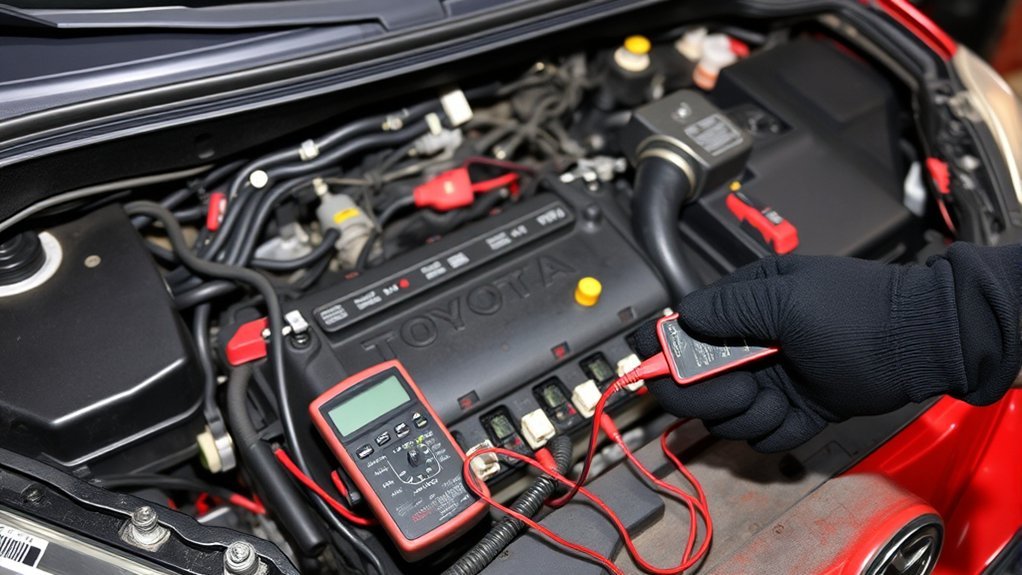
Electrical problems can interrupt the starting process even when your Toyota Vitz battery appears to have power.
The dashboard and radio use much less current than a conventional starter motor, so working accessories do not rule out a weak battery.
Common electrical causes include:
- Loose or corroded battery terminals.
- Damaged ground or positive battery cables.
- A blown fuse or faulty starter relay.
- A malfunctioning ignition switch or start-button circuit.
- A brake-pedal, clutch, or transmission range interlock problem.
- Immobilizer or smart-key communication faults.
- A charging-system fault that repeatedly discharges the battery.
If the engine does not crank, check the battery and basic start conditions before investigating more complex electrical components.
When Your Vitz Has Dashboard Power but Will Not Start
If the dashboard lights illuminate but the starter does nothing, observe whether the lights become dim when you attempt to start.
A major drop in brightness may indicate insufficient battery voltage or a poor electrical connection.
If the lights remain bright and the starter stays silent, check the gear position, pedal input, security warning, and starter-control circuit.
On some models, a faulty brake-light switch may prevent the push-button start system from recognizing the required brake-pedal input.
If the brake lights do not work, have the brake-light circuit checked rather than assuming the start button itself has failed.
Battery Drain and Charging-System Problems
If your Vitz repeatedly needs a jump-start, the problem may involve more than the battery.
A charging-system fault can leave the battery undercharged, while an electrical drain can discharge it after the vehicle is parked.
A technician can test the battery, inspect charging performance, and measure electrical consumption with the vehicle switched off.
This helps prevent unnecessary battery replacement when another fault is responsible.
Troubleshooting Key Fob and Smart Key Issues for Your Toyota Vitz
Smart-key problems can prevent an equipped Toyota Vitz from recognizing the key and authorizing the starting process.
If your vehicle displays a key warning or fails to recognize the smart key, work through these checks.
A weak smart-key battery may interrupt normal key detection, but a registered key may still work through the vehicle’s emergency recognition procedure.
- Check the key battery: Replace a weak or dead key-fob battery using the correct battery type specified for your key.
- Try the spare key: If the spare starts the vehicle, the original key may be faulty or require further inspection.
- Check for interference: Move the key away from other electronic devices or metallic objects that may affect communication.
- Check the smart-key settings: Some equipped vehicles allow the smart-key function to be disabled.
- Use the emergency starting procedure: Follow the instructions for your exact Vitz model.
How to Start a Vitz With a Weak Smart-Key Battery
On Toyota models equipped with the applicable emergency recognition system, bringing the registered electronic key close to the engine start button can allow the vehicle to recognize it despite a depleted key battery.
Typically, you must select Park, press the brake pedal, hold the key against the specified area of the start button, and then follow the displayed or documented starting procedure.
Refer to your Vitz manual for the exact sequence and key orientation.
Toyota documents this type of procedure in its official electronic-key emergency instructions.
The procedure is model-dependent and should not be treated as a universal instruction for every Vitz.
If neither registered key works, the immobilizer, key receiver, or associated electrical system may require professional diagnosis.
The Role of the Ignition System in Starting Problems
When your Toyota Vitz cranks normally but refuses to run, the ignition system is another area to investigate.
On gasoline engines, the ignition coils and spark plugs must produce a correctly timed spark to ignite the air-fuel mixture.
However, an ignition problem and a starter problem are not the same thing.
The engine may crank normally even when no spark is being produced.
Ignition Switch Functionality Issues
A faulty ignition switch or start-control circuit may prevent the vehicle from sending the correct starting command.
Possible symptoms include:
- No response when turning the key or pressing the start button.
- Intermittent starting problems.
- Electrical accessories behaving unexpectedly.
- The ignition key failing to turn normally.
Before replacing the ignition switch, check the battery, relevant fuses, starter-control circuit, and any security-system warnings.
A qualified technician can test whether the required electrical signals reach the appropriate components.
If the ignition switch is confirmed faulty, replacement may be necessary.
Spark Plug Performance Matters
Spark plugs are essential for combustion in a gasoline-powered Toyota Vitz.
Worn, contaminated, or damaged spark plugs may cause hard starting, misfires, rough idling, or poor engine performance.
Faulty ignition coils can produce similar symptoms.
If the engine cranks normally but will not start, ignition testing may help identify whether an adequate spark is present.
A suitable spark tester or professional diagnostic equipment should be used. A standard multimeter alone cannot confirm spark quality under operating conditions.
Replace spark plugs according to the maintenance schedule for your specific Vitz engine and plug type.
Do not use one generic replacement interval for every model.
Engine Sensors and Fault Codes
Some starting problems involve engine-management sensors rather than the battery, starter, or spark plugs.
For example, a faulty crankshaft position sensor can prevent the engine computer from receiving the information needed to control ignition and fuel injection correctly.
If the check-engine light appears or the engine cranks without starting, a diagnostic scan may help identify the affected system.
Common areas a technician may investigate include:
- Crankshaft and camshaft position signals.
- Ignition coil operation.
- Fuel-injection commands.
- Immobilizer authorization.
- Engine-management wiring and power supply.
A fault code is a diagnostic clue, not automatic proof that the named component needs replacement.
If the engine cranks unusually fast or makes abnormal mechanical noises, stop attempting to start it. A mechanical or compression problem may require inspection.
Special Considerations for a Toyota Vitz Hybrid
If you own a Toyota Vitz Hybrid, the starting process differs from that of a conventional gasoline model.
The hybrid system may become ready to drive without immediately starting the gasoline engine.
The most important indication is the READY light.
If READY is illuminated, the hybrid system can be operational even when the gasoline engine is silent.
Toyota explains this operating characteristic in its hybrid-system guidance.
What to Check if Your Vitz Hybrid Will Not Enter READY Mode
- Check that the vehicle is in Park and the parking brake is applied.
- Press the brake pedal firmly and follow the normal starting procedure.
- Look for key-detection messages or hybrid-system warnings.
- Check the condition of the 12-volt auxiliary battery.
- Use the correct model-specific emergency starting procedure if the 12-volt battery is discharged.
- If READY does not illuminate, have the hybrid system professionally inspected.
The 12-volt auxiliary battery helps power the vehicle’s control systems. A discharged 12-volt battery can therefore prevent the hybrid system from starting normally.
The high-voltage traction battery is a separate component and must not be treated like a conventional 12-volt starter battery.
Hybrid Safety Warning: Never touch, disconnect, or attempt to repair orange high-voltage cables, traction-battery connections, or hybrid electrical components. These systems can cause serious electric shock. Hybrid electrical diagnosis should be performed by a qualified technician.
When You Should Call a Pro for Help With Your Toyota Vitz
If your Toyota Vitz still won’t start after checking the battery, fuel level, starting procedure, and key recognition, professional diagnosis is the next step.
Contact a qualified mechanic or roadside assistance provider if you encounter:
- Repeated no-start conditions despite a charged battery.
- Security or immobilizer warnings that do not clear.
- Persistent battery drainage.
- Starter grinding or other abnormal mechanical noises.
- Normal cranking without successful ignition.
- Visible fuel leakage or a strong gasoline smell.
- Hybrid-system warning messages or failure to enter READY mode.
- Repeated unsuccessful troubleshooting attempts.
A technician can perform a battery load test, charging-system assessment, starter-circuit test, fuel-pressure test, and diagnostic scan as appropriate.
These tests help identify the actual fault instead of replacing several expensive components by guesswork.
Pro Tip: Before calling a mechanic, record what happens during a starting attempt. Mention whether the dashboard lights work, whether the engine cranks, what sounds you hear, and whether any warning lights appear. This can help the technician narrow the diagnosis.
Preventative Measures to Avoid Starting Issues in Your Toyota Vitz
Preventative maintenance can reduce the risk of unexpected starting problems.
The following practical checks can help keep your Vitz reliable. Use your model-specific maintenance schedule for required service intervals.
| Maintenance Task | Suggested Check |
|---|---|
| Inspect battery and terminals | Periodically and before long trips |
| Battery condition test | During routine service or when symptoms appear |
| Charging-system inspection | When battery discharge repeats or charging warnings appear |
| Key-fob battery | Replace when weak or as directed by the manual |
| Fuel level | Monitor regularly and avoid running out of fuel |
| Spark plugs and ignition components | Follow the model-specific maintenance schedule |
| Fuel-system inspection | When performance, starting, or fuel-delivery symptoms appear |
Keeping the battery charged, maintaining clean electrical connections, and addressing early symptoms can help prevent inconvenient breakdowns.
If your car is driven infrequently, an appropriate battery maintainer may help prevent unnecessary discharge.
Tips for Regular Maintenance to Keep Your Toyota Vitz Running Smoothly
Regular maintenance helps your Vitz start reliably and perform as intended.
Battery care and scheduled engine servicing are especially important, but the correct requirements depend on the vehicle’s engine and production year.
Regular Oil Changes
Regular oil changes help protect your Toyota Vitz engine by maintaining lubrication and reducing wear.
Use the engine oil viscosity, specification, and replacement interval listed in your vehicle’s maintenance documentation.
The correct interval may depend on engine type, operating conditions, service history, and the applicable regional maintenance schedule.
Important practices include:
- Use oil that meets the required specification.
- Replace the oil filter as directed.
- Check the engine oil level regularly.
- Investigate unusual oil consumption or visible leaks.
- Follow the shorter service interval where the manual specifies severe operating conditions.
For official model-specific information, visit Toyota’s Vitz owner’s manual library and select the correct production period and powertrain.
Battery Maintenance Practices
Battery upkeep is just as important for reliable starting.
Inspect the battery case for visible damage, check the terminals for corrosion, and make sure the connections remain secure.
If you use a multimeter, remember that resting voltage provides only part of the picture. A battery load test can reveal problems that a simple voltage reading misses.
If the vehicle is parked for extended periods, consider a compatible battery maintainer and follow the manufacturer’s instructions.
Replace a failing battery with one that meets the correct specifications for your Vitz.
Hybrid owners should follow the correct instructions for the auxiliary 12-volt battery and avoid working on high-voltage components.
Frequently Asked Questions
What Can Cause a Toyota Vitz Not to Start?
Common possible causes include a discharged battery, loose battery connections, starter problems, fuel-delivery faults, ignition faults, and immobilizer issues. The first step is to determine whether the engine cranks normally, cranks slowly, or does not crank at all.
Why Does My Toyota Have Power but Won’t Start?
Dashboard lights and accessories require less current than the starter motor. Your battery may still be weak even when the lights work. Other possible causes include a faulty starter circuit, incorrect gear position, ignition fault, or immobilizer problem.
What Is the Common Problem With the Toyota Vitz?
There is no single starting fault that applies to every Toyota Vitz. Battery condition, electrical connections, starter operation, fuel delivery, and ignition are sensible places to investigate. The likely cause depends on the vehicle’s age, maintenance history, and symptoms.
How to Start a Toyota Vitz With a Key?
For a conventional ignition-key model, apply the parking brake, select the correct gear position, insert the registered key, and follow the specified starting procedure. Automatic models generally require the brake pedal, while manual models may require the clutch. Turn the key to START and release it when the engine starts. Check your owner’s manual for the exact procedure.
Why Does My Toyota Vitz Make a Clicking Sound but Not Start?
Rapid clicking often suggests low battery voltage or poor electrical connections. A single click may also involve the starter circuit or starter motor. Test the battery and inspect the connections before replacing the starter.
Why Does My Toyota Vitz Crank but Not Start?
If the engine turns normally but does not begin running, possible causes include insufficient fuel delivery, ignition failure, a crankshaft position sensor problem, or an immobilizer fault. Check the fuel level and warning lights first, then arrange diagnostic testing if the problem continues.
Can a Toyota Vitz Start With a Dead Key-Fob Battery?
Some smart-key-equipped models support an emergency recognition procedure that allows a registered key to be detected near the start button despite a depleted key battery. Follow the instructions for your exact model and replace the key battery afterward.
Why Does My Toyota Vitz Hybrid Have No Engine Sound?
A Vitz Hybrid can be operational without its gasoline engine running. Check whether the READY indicator is illuminated. If READY is on, the vehicle may be ready to drive. If READY does not appear, investigate the starting procedure, auxiliary battery, and any hybrid-system warnings.
Conclusion
If your Toyota Vitz won’t start, begin with the battery, electrical connections, fuel level, and correct starting procedure.
Then use the symptoms to narrow the problem. Clicking or slow cranking often leads to battery and starter-system checks, while normal cranking without ignition points toward fuel, ignition, sensor, or immobilizer diagnosis.
For hybrid models, check the READY indicator rather than relying only on engine noise.
Regular maintenance and early attention to unusual starting behavior can reduce the chance of an unexpected breakdown. If the basic checks do not identify the problem, professional testing is safer and more reliable than replacing parts by guesswork.
Sources
- Toyota — Official Vitz Owner’s Manuals — Model-specific instructions for different production periods and powertrains.
- Toyota — If the Vehicle Battery Is Discharged — Jump-starting procedures and battery safety.
- Toyota — If the Electronic Key Does Not Operate Properly — Emergency electronic-key recognition guidance for equipped Toyota vehicles.
- Toyota — Hybrid System Features — Hybrid operation and READY-related characteristics.
- AAA — Bad Alternator vs. Bad Battery — Battery voltage, charging, and diagnostic considerations.
- AAA — 14 Reasons Why Your Car Won’t Start — Common battery, starter, ignition, and fuel-related starting problems.





Leave a Reply