Quick Answer
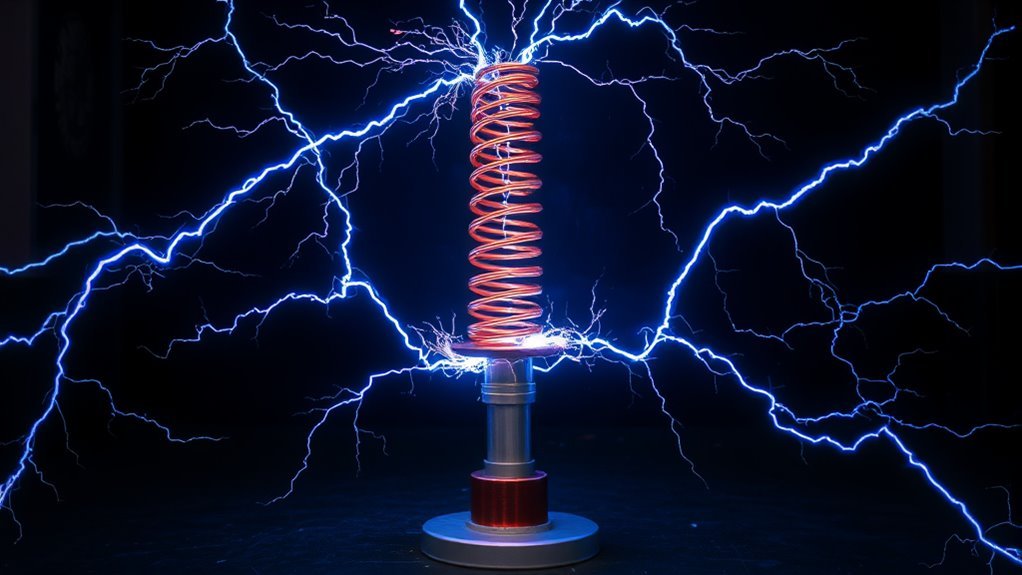
A Tesla coil is a resonant transformer circuit that produces high-voltage, low-current electricity. It generates high-frequency alternating current through electromagnetic induction and resonant oscillation. These devices serve primarily in educational, research, and entertainment settings rather than as practical power transmission tools.
A Tesla coil is a resonant transformer that produces high-voltage, low-current alternating current (AC) electricity, sometimes exceeding one million volts. It works by charging a capacitor connected to a primary coil, which discharges through a spark gap to create high-frequency oscillations. This process allows energy to transfer into the secondary coil through resonance. Understanding its core components and mechanics helps clarify why this device remains a staple of electrical experimentation.
Key Takeaways
- Tesla coils generate high-voltage, low-current AC electricity using resonant circuits.
- Operation relies on charging a capacitor and creating oscillations across a spark gap.
- Resonance between the primary and secondary coils maximizes energy transfer efficiency.
- These devices function mainly in education, research, and specialized electrical displays.
- Safety precautions remain vital because of high-voltage output and electrical interference.
Principles of Tesla Coil Operation
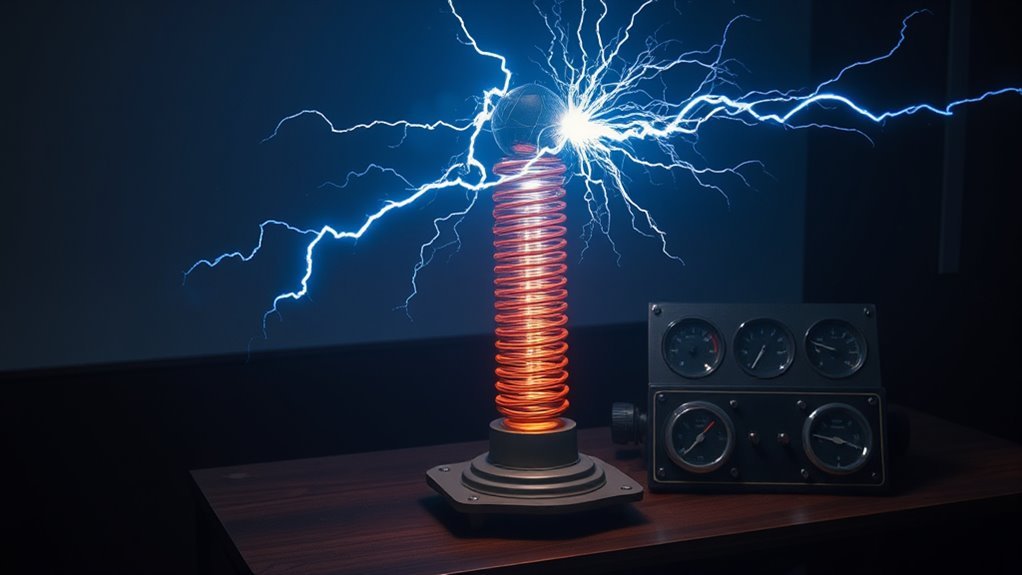
To understand Tesla coils, view them as resonant transformers. They boost lower input voltages into massive high-voltage, low-current outputs.
The process starts when a transformer charges a capacitor linked to the primary coil. This energy discharges through a spark gap, which triggers oscillations. These oscillations usually occur between 50 kHz and 1 MHz. This frequency allows efficient energy transfer to the secondary coil via electromagnetic induction.
The secondary coil’s voltage rises well above the primary coil’s voltage because of the specific capacitance relationship between the two circuits. The top electrode—often shaped like a torus or sphere—helps manage this build-up while minimizing electric field strength.
Essential Components of a Tesla Coil
Several primary components work together to generate the signature high-frequency alternating current of a Tesla coil.
Transformer and Capacitor Function
The transformer acts as the initial power booster, often stepping up household voltage to 50,000 volts or more. This high-pressure energy charges the capacitor, which acts as a storage bank. The capacitor releases its stored energy in a rapid burst across the spark gap. The specific values of the capacitor directly dictate the system’s resonant frequency.
Spark Gap Operation
The spark gap functions as a high-speed switch. It prevents current from flowing until the voltage reaches a breakdown threshold in the air. Once the air ionizes, it creates a conductive path, enabling the rapid discharge needed for efficient oscillation. Precise control of this gap determines the overall efficiency of the energy transfer.
The Role of Resonance
Resonance dictates the performance of a Tesla coil. By ensuring the primary and secondary circuits share the same frequency, the device maximizes the efficiency of the energy transfer.
Achieving this state requires precise calibration of inductors and capacitors. If the circuits don’t match, energy reflects back, reducing the voltage output. A higher Q factor in the circuit further improves performance by minimizing resistive energy losses during the oscillation cycle.
High Voltage Generation Explained
Tesla coils utilize electromagnetic induction to create massive voltages. Once the spark gap triggers, the energy oscillates back and forth between the primary and secondary circuits.
- Primary capacitors store initial electrical energy.
- Spark gap triggers release this energy as rapid pulses.
- Secondary coils amplify this energy through magnetic coupling.
- Top electrodes act as terminal capacitance to support peak voltage.
Common Types of Tesla Coils
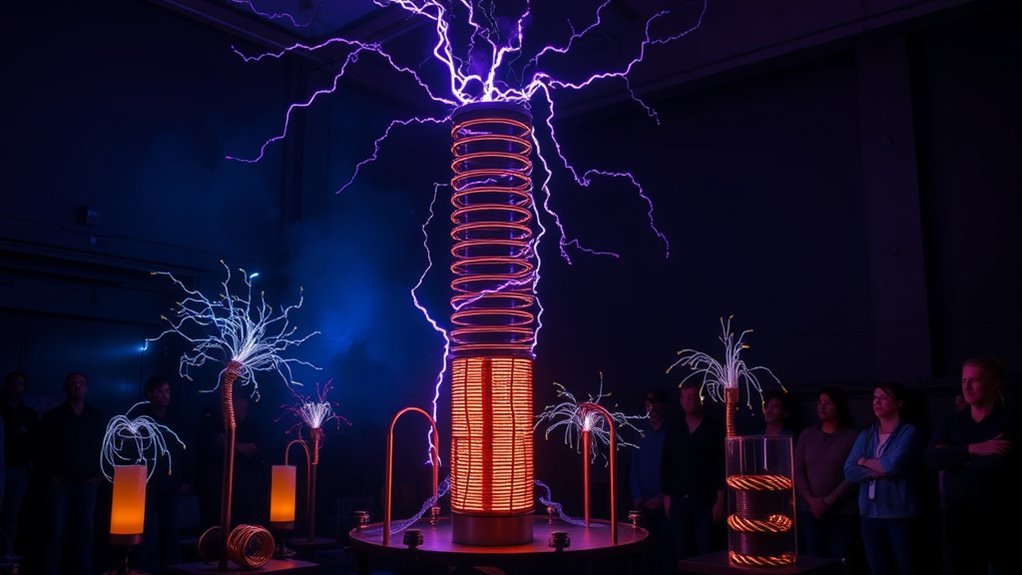
Different designs serve specific needs depending on power requirements and output goals:
- Single Resonant Tesla Coils (SSTC): These use solid-state electronics to maintain a single resonant frequency, making them compact and easier to control.
- Dual Resonant Solid State Tesla Coils (DRSSTC): By using two resonant circuits, these models achieve much higher output voltages and finer oscillation control.
- Class E Tesla Coils: These employ advanced switching to reduce power losses, often used in smaller, high-frequency applications.
Modern Applications of Tesla Coils
While Nikola Tesla envisioned them for global power, today’s coils serve more focused purposes:
- Education: They visually demonstrate electricity, magnetic fields, and wave phenomena in physics classrooms.
- Entertainment: Musicians and performance artists use them to create musical notes or visual light displays by manipulating spark discharge.
- Engineering Research: Scientists use them to study high-voltage phenomena, insulation breakdown, and electromagnetic interference.
Essential Safety Protocols
Operating a Tesla coil involves significant risks. Always maintain a safe distance of at least 10 feet from the device during operation to avoid arc strikes.
Use insulated tools and never touch the equipment while it’s active. Because these devices produce intense electromagnetic fields, individuals with pacemakers or sensitive electronics must avoid the area entirely. Always consult a qualified professional before attempting to build or operate high-voltage equipment.
Common Misconceptions
High voltage does not always mean high danger, but it remains a serious hazard. While the low current reduces the chance of fatal injury compared to household power, the high frequency can still cause skin burns.
Another myth suggests Tesla coils produce static electricity. In reality, they generate high-frequency alternating current. This distinction matters because the dynamic nature of AC allows it to create arcs and induce power in nearby conductive objects, unlike the stationary charge found in static electricity generators.
Conclusion
Tesla coils remain a bridge between complex electrical theory and physical wonder. They demonstrate how resonance and induction work together to manipulate energy in ways that feel almost magical. If you plan to explore this field, start by prioritizing safety and building a strong foundation in circuit theory. With the right focus, you can learn how these iconic devices continue to spark scientific curiosity today.







Leave a Reply