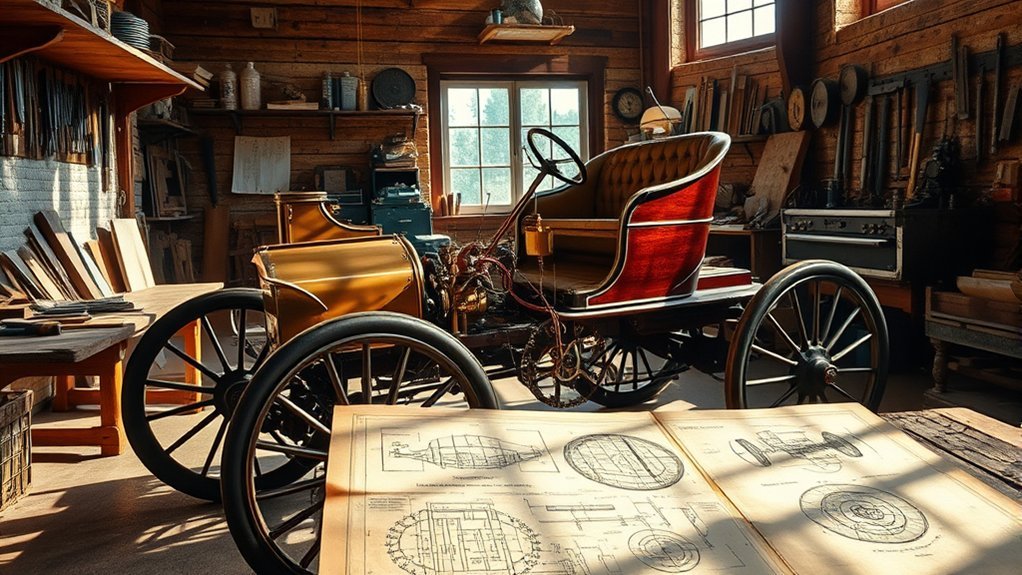
Karl Benz is widely credited with inventing the first practical gasoline-powered automobile. He completed the Benz Patent-Motorwagen in Mannheim, Germany, in 1885 and filed a patent application on January 29, 1886. However, the history of the first car began long before Benz, with inventors experimenting with steam power and early engines.
Quick Answer
Karl Benz is widely credited with inventing the first practical gasoline-powered automobile. He completed his three-wheeled Patent-Motorwagen in Mannheim, Germany, in 1885, filed its patent application on January 29, 1886, and publicly drove it that July. Earlier inventors developed steam-powered vehicles, but Benz designed a practical automobile around an internal combustion engine.
Key Takeaways
- 1885: Karl Benz completed the first practical gasoline-powered automobile, the Benz Patent-Motorwagen.
- January 29, 1886: Benz filed his patent application, DRP 37435.
- July 1886: The Motorwagen made its first publicly reported outing.
- Earlier inventions: Ferdinand Verbiest described a small steam-powered vehicle in the 17th century, while Nicolas-Joseph Cugnot developed a full-size steam road vehicle in the 18th century.
- 1894: The Benz Velo became an important early series-produced automobile.
- 1901: The Curved Dash Oldsmobile helped establish large-scale automobile production in the United States.
- 1913–1914: Ford’s moving assembly line dramatically reduced the time required to build a Model T.
The Birth of the Automobile: Who Invented It?
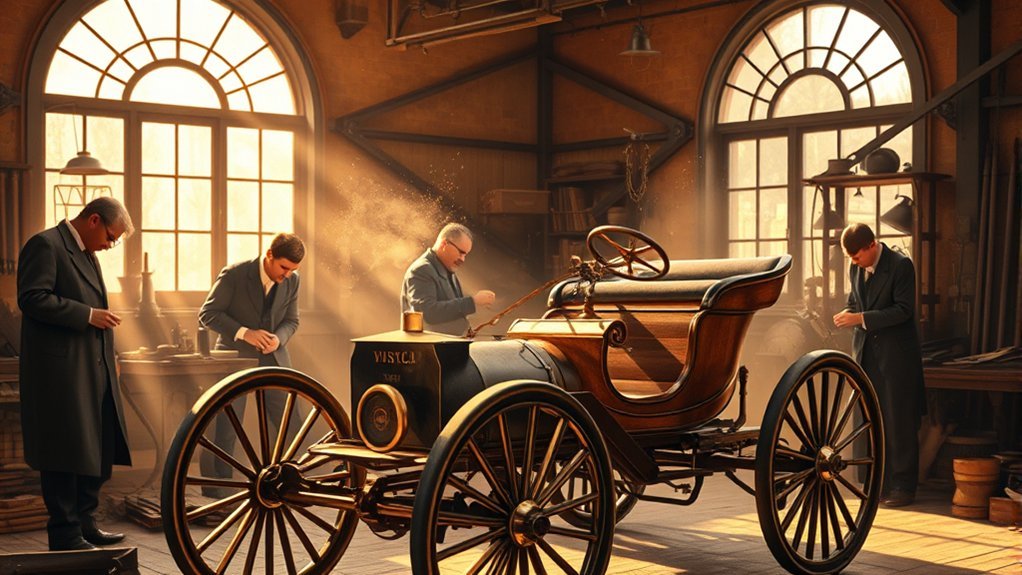
The birth of the modern automobile is usually traced to Karl Benz and his Patent-Motorwagen. Unlike a horse-drawn carriage fitted with a motor, Benz designed the vehicle as a complete machine built around its engine.
His three-wheeled automobile used a gasoline-powered, single-cylinder, four-stroke engine. The vehicle had a lightweight tubular steel frame, wire-spoked wheels, and a differential that allowed its driven wheels to rotate at different speeds when turning.
According to Mercedes-Benz’s historical records, the original vehicle produced approximately 0.75 horsepower (0.55 kW).
Benz completed the vehicle in 1885 and applied for German patent DRP 37435 on January 29, 1886. Newspapers reported its first public outing in July 1886.
These events explain why both 1885 and 1886 appear in automobile history. One represents the completion of the vehicle, while the other marks its patent application and public introduction.
Note: The answer to “Who invented the first car?” depends on the definition of a car. Earlier steam-powered road vehicles existed, but Benz is widely credited with creating the first practical automobile powered by a gasoline internal combustion engine.
What Did the First Car Look Like?
The original Patent-Motorwagen looked more like a motorized tricycle than a modern car. It had an open seating area, three thin wheels, and an exposed engine at the rear.
Its main features included:
- Three wheels: One wheel at the front for steering and two at the rear.
- Engine: A rear-mounted, single-cylinder, four-stroke gasoline engine.
- Power: Approximately 0.75 horsepower (0.55 kW).
- Frame: A lightweight tubular steel structure.
- Ignition: An electrical ignition system with a spark plug.
- Cooling: A water-based evaporation and thermosiphon cooling system.
- Drive: A transmission system that transferred engine power to the rear wheels.
The vehicle had no enclosed cabin, automatic transmission, or modern dashboard. It was also far slower and less comfortable than today’s passenger cars.
Nevertheless, its engine, chassis, steering, and transmission worked together as a purpose-built motor vehicle. That integrated design was one of Benz’s most important achievements.
A Look at Early Competing Designs and Technologies
Karl Benz did not develop the automobile in isolation. Several earlier inventors had experimented with self-propelled vehicles, while others were developing engines that would eventually power automobiles.
Ferdinand Verbiest’s Steam Vehicle
Around 1672, Ferdinand Verbiest, a Flemish Jesuit working at the Chinese imperial court, described a small steam-powered vehicle intended as a demonstration for Emperor Kangxi.
The model was approximately 65 centimeters long and could not carry a driver or passengers.
Its design used steam to turn a mechanical system connected to the wheels. However, surviving historical evidence does not conclusively establish the construction details of the original vehicle.
Modern reconstructions have demonstrated that the concept could work. Autoworld in Brussels documents the reconstruction and the historical background.
Verbiest’s work is an early milestone in self-propelled vehicle development, but the small demonstration device was not a practical passenger automobile.
Nicolas-Joseph Cugnot’s Steam Vehicle
In 1769, French military engineer Nicolas-Joseph Cugnot developed an experimental steam-powered road vehicle.
His design was intended to move heavy military equipment, particularly artillery, without horses.
A larger steam-powered vehicle followed in 1770–1771. It used a boiler and steam cylinders to drive a front wheel, which also provided steering.
The Musée des Arts et Métiers in Paris preserves the historic Cugnot vehicle and documents its development.
Cugnot’s machines demonstrated that a full-size road vehicle could move under its own power. However, their weight, limited operating time, and need to maintain steam pressure made them unsuitable for widespread personal transportation.
Gottlieb Daimler and Wilhelm Maybach
While Benz worked in Mannheim, Gottlieb Daimler and Wilhelm Maybach were developing lightweight, high-speed internal combustion engines.
In 1885, they demonstrated an engine-powered two-wheeled vehicle known as the Reitwagen.
In 1886, Daimler introduced a motorized carriage, widely recognized as the first four-wheeled automobile powered by a high-speed internal combustion engine.
There was an important difference between the two approaches:
- Benz: Created a purpose-built three-wheeled automobile with its engine integrated into the overall vehicle design.
- Daimler and Maybach: Developed a lightweight engine and adapted an existing carriage to create a four-wheeled motor vehicle.
Both approaches contributed to the development of the modern automobile.
Early Electric Automobiles
Gasoline was not the only power source explored by early automobile makers. Steam and electric vehicles competed with gasoline-powered models during the late 19th and early 20th centuries.
Electric cars offered quieter operation and did not require hand-cranking a gasoline engine. However, battery capacity and charging limitations restricted their usefulness for longer trips.
By the early 1910s, gasoline-powered automobiles were gaining ground as engine technology, fuel availability, and manufacturing methods improved.
This early competition shows that automotive development involved several technologies rather than one invention appearing overnight.
Timeline: Important Milestones in Automobile History
The following timeline separates early vehicle experiments from the invention of the practical automobile and the development of mass production.
| Year | Milestone | Historical Importance |
|---|---|---|
| Around 1672 | Verbiest’s steam-powered model | Early self-propelled vehicle concept. |
| 1769 | Cugnot’s steam vehicle | Early full-size steam road transport. |
| 1876 | Otto’s four-stroke engine | An important foundation for gasoline engines. |
| 1885 | Benz completes the Patent-Motorwagen | First practical gasoline-powered automobile. |
| 1886 | Benz patent application and public outing | Major milestone in the automobile’s public history. |
| 1886 | Daimler’s motor carriage | Early four-wheeled gasoline automobile. |
| 1888 | Bertha Benz’s long-distance journey | Demonstrated practical automobile travel. |
| 1893 | Benz’s double-pivot steering | Improved four-wheeled vehicle steering. |
| 1894 | Benz Velo | Important early series-produced automobile. |
| 1901 | Curved Dash Oldsmobile | Pioneered large-scale automobile production in America. |
| 1908 | Ford Model T | Helped bring automobile ownership to a wider market. |
| 1913–1914 | Ford’s moving assembly line | Greatly increased manufacturing efficiency. |
Innovations That Made the First Automobile Possible
The first practical automobile required more than an engine. Inventors needed a power source that was small enough for road use, a vehicle capable of steering and stopping, and a reliable way to transfer power to the wheels.
Improvements in internal combustion engines, ignition, cooling, transmission systems, and vehicle construction made Benz’s design possible.
Early Engine Innovations
Early inventors experimented with steam power and several forms of internal combustion engines.
In 1876, Nicolaus August Otto developed a successful four-stroke internal combustion engine. Earlier internal combustion engines already existed, but Otto’s design became an important foundation for later gasoline engines.
The four-stroke cycle operates through four stages:
- Intake: The cylinder draws in an air-fuel mixture.
- Compression: The piston compresses the mixture.
- Power: Ignition causes combustion, pushing the piston downward.
- Exhaust: The piston pushes combustion gases out of the cylinder.
This process allowed engineers to develop more efficient engines suitable for road vehicles.
Daimler and Maybach worked on making engines lighter and capable of operating at higher speeds. Benz applied related engine principles to a purpose-built automobile.
Internal Combustion Breakthroughs
The Patent-Motorwagen’s engine was compact enough to fit into a lightweight vehicle while providing power for road travel.
Its major features included a horizontally mounted cylinder, electrical ignition, a controlled exhaust valve, and a water-based cooling system.
Benz also combined the engine with a transmission and chassis designed specifically for the vehicle.
These engineering choices were significant because earlier steam vehicles needed bulky boilers and additional time to generate steam.
Gasoline-powered vehicles still had limitations, including difficult starting procedures, limited power, and the need for reliable fuel supplies. Nevertheless, they offered an approach that could be developed into practical everyday transportation.
By 1901, the Mercedes 35 hp, developed by Wilhelm Maybach for Daimler-Motoren-Gesellschaft, demonstrated another major step toward the modern automobile.
Its long wheelbase, low center of gravity, powerful engine, and advanced radiator helped move automobile design away from the traditional horse-drawn carriage layout.
Mass Production Techniques
Inventing the automobile and making it affordable were two different challenges.
The Benz Velo, introduced in 1894, was an important early series-produced car. Approximately 1,200 vehicles of the Velo family were built during its production period.
In 1901, Ransom E. Olds introduced the Curved Dash Oldsmobile. Its relatively simple design and organized manufacturing process helped establish large-scale automobile production in the United States.
Henry Ford later advanced automobile manufacturing with the moving assembly line.
Experiments began in 1913, and improvements continued into 1914. According to The Henry Ford, Model T production time fell from approximately 12.5 hours to 93 minutes.
The moving assembly line worked by bringing parts and partially assembled vehicles to workers in a planned sequence. This reduced unnecessary movement and improved manufacturing efficiency.
| Year | Vehicle or Development | Impact |
|---|---|---|
| 1894 | Benz Velo | Early series production. |
| 1901 | Curved Dash Oldsmobile | Pioneering American mass production. |
| 1908 | Ford Model T | A practical car designed for a broad market. |
| 1913 | Moving assembly line | Reduced manufacturing time and labor per vehicle. |
| Early 1914 | Model T assembly improvements | Production time reduced to approximately 93 minutes. |
| 1927 | Model T production ends | More than 15 million produced during its lifetime. |
Standardized and interchangeable parts were also essential. They allowed manufacturers to assemble vehicles more efficiently and replace components without making every part individually.
These methods helped turn automobiles from expensive, relatively uncommon machines into products available to a much wider population.
Karl Benz’s Role in Automotive History
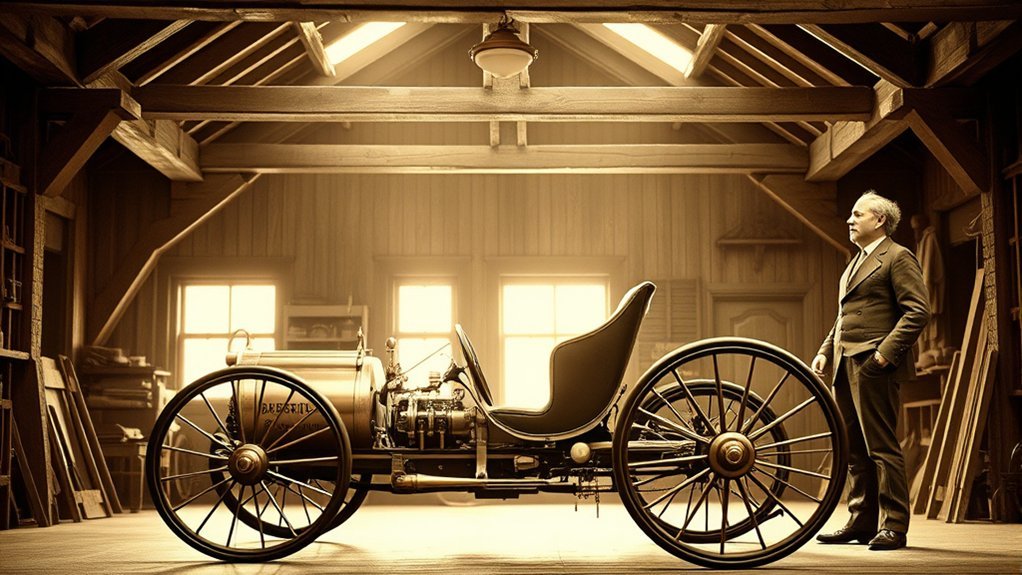
Karl Benz’s importance extends beyond building the Patent-Motorwagen. He continued improving automobile engines, steering systems, and vehicle design while helping establish a commercial automobile manufacturing business.
His work also demonstrated that automobiles could be designed as complete transportation systems rather than experimental engines attached to existing carriages.
Patent-Motorwagen’s Invention Process
Benz’s early engine development helped finance his automobile project. His first successful stationary gasoline engine was a two-stroke design that ran in 1879.
He later developed a lightweight vehicle using a four-stroke engine.
By 1885, the first Patent-Motorwagen was complete. On January 29, 1886, Benz filed his patent application for a vehicle powered by a gas engine.
The patent, numbered DRP 37435, is often described as the automobile’s birth certificate.
The vehicle made its first publicly reported outing in July 1886, introducing a new form of transportation to a wider audience.
| Year | Milestone | Importance |
|---|---|---|
| 1885 | Motorwagen completed | Purpose-built gasoline automobile. |
| January 1886 | Patent application filed | Documented the vehicle’s integrated design. |
| July 1886 | Public outing | Introduced the invention to the public. |
| 1888 | Bertha Benz’s journey | Demonstrated longer-distance travel. |
| 1900 | Benz & Cie’s manufacturing success | Became a leading automobile manufacturer. |
Innovations in Engine Design
Benz’s contribution was not limited to increasing engine power. He developed a vehicle in which the engine, transmission, chassis, and steering system worked together.
His important engineering contributions included:
- Integrating a gasoline engine into a purpose-built vehicle.
- Using a lightweight three-wheeled chassis.
- Developing practical ignition and cooling arrangements.
- Using a differential to support driven-wheel movement.
- Introducing a double-pivot steering system for four-wheeled vehicles in 1893.
The 1893 steering development was particularly important because controlling four-wheeled vehicles was a major engineering challenge.
The Benz Victoria used this improved steering arrangement, helping establish a foundation for later passenger-car designs.
Bertha Benz’s Historic 1888 Journey
Bertha Benz played a major role in demonstrating the automobile’s practical value.
In August 1888, she traveled from Mannheim to Pforzheim with her sons Eugen and Richard, without informing Karl Benz beforehand.
The journey covered more than 100 kilometers in one direction, largely on roads that had not been designed for automobiles.
During the trip, Bertha and her sons encountered mechanical and fuel-supply challenges. They obtained additional fuel from a chemist’s shop and dealt with problems along the route.
The journey demonstrated that the automobile could travel between towns rather than merely perform short demonstrations near a workshop.
Bertha also contributed financial support and practical assistance to Benz’s engineering work. Her role was therefore much broader than simply driving the vehicle.
The Mercedes-Benz account of Bertha Benz documents her contributions and the journey.
The Patent-Motorwagen demonstrated that a gasoline-powered automobile could work. Bertha Benz’s 1888 journey showed that it could serve as a practical means of travel.
Legacy and Industry Impact
By 1900, Benz & Cie. had become one of the world’s leading automobile manufacturers.
The company’s 1894 Benz Velo was a major step toward repeatable vehicle production. Approximately 1,200 examples of the Velo family were manufactured.
Benz’s influence can be seen in the continued development of integrated vehicle engineering, steering systems, and automobile manufacturing.
Although later inventors and manufacturers introduced additional technologies, the Patent-Motorwagen remains a central milestone in the history of practical gasoline-powered transportation.
How Did the Automobile Change Transportation Forever?
The automobile gradually transformed how people traveled, worked, and lived.
Before widespread car ownership, many people depended on walking, horses, railways, or local public transportation. Automobiles offered greater flexibility, particularly for journeys that did not follow established transportation routes.
The introduction of the Ford Model T in 1908 helped accelerate this change.
The Model T initially sold for approximately $850, while later versions reached prices as low as $260. Improved manufacturing efficiency helped make automobile ownership possible for more households.
More than 15 million Model T vehicles were produced between 1908 and 1927.
Changes to Daily Life
Automobiles created new opportunities for travel and commerce:
- Personal mobility: Drivers could travel without following railway routes or fixed public transportation schedules.
- Employment: People gained access to jobs farther from their homes.
- Business: Motor vehicles helped transport goods and serve customers across larger areas.
- Tourism: Road trips and automobile-based leisure travel became increasingly popular.
- Urban development: Cities and towns expanded road networks, parking facilities, and automobile infrastructure.
The automobile also created new industries, including vehicle repair, fuel distribution, road construction, and automobile insurance.
Social and Environmental Effects
Not every consequence was positive.
Greater automobile use contributed to traffic congestion, road accidents, air pollution, and dependence on petroleum fuels.
Road construction and parking requirements also changed how cities used land. In some communities, development patterns became more dependent on private vehicles, making public transportation and walking less convenient.
These effects continue to influence transportation planning and the development of cleaner vehicle technologies.
How Did the Automobile Evolve After Its Invention?
After the Patent-Motorwagen, automobile technology developed quickly.
Manufacturers improved engines, steering, suspension, braking, and vehicle construction while experimenting with different power sources.
The 1894 Benz Velo helped establish repeatable vehicle production. The 1901 Curved Dash Oldsmobile demonstrated the commercial potential of producing affordable automobiles in larger numbers.
In the same period, the Mercedes 35 hp introduced a vehicle layout that more closely resembled the modern automobile, with a lower center of gravity and a longer wheelbase.
The Ford Model T and moving assembly line then made efficient large-scale production an increasingly important part of the industry.
Important Automotive Improvements
Several later developments improved safety, comfort, and everyday usability.
- 1901: The Mercedes 35 hp demonstrated a more modern vehicle layout and improved engine-cooling technology.
- 1912: Cadillac introduced an electric starter developed by Charles Kettering, reducing the need for dangerous hand-cranking.
- 1921: The Duesenberg Straight Eight introduced four-wheel hydraulic brakes to a production automobile.
- Later decades: Manufacturers developed improved transmissions, suspension systems, lighting, occupant protection, and electronic controls.
The electric starter was especially important because starting early gasoline engines by hand could be difficult and dangerous. The Henry Ford Museum’s Cadillac engine record documents the 1912 development.
Likewise, the museum’s Duesenberg historical record documents the introduction of four-wheel hydraulic brakes in 1921.
Over time, automobiles evolved from simple open vehicles into enclosed machines with more powerful engines, improved handling, and increasingly sophisticated safety equipment.
Modern vehicles now include gasoline, hybrid, plug-in hybrid, and battery-electric designs. Although their technology differs greatly from the Patent-Motorwagen, they continue the original idea of providing self-powered personal transportation.
Frequently Asked Questions
Where Was the First Car Invented?
The first practical gasoline-powered automobile was developed by Karl Benz in Mannheim, Germany. He completed the Benz Patent-Motorwagen in 1885 and filed its patent application on January 29, 1886.
What Was the First Car Like?
The Benz Patent-Motorwagen was an open, three-wheeled vehicle with a rear-mounted single-cylinder gasoline engine. It produced approximately 0.75 horsepower and used a lightweight tubular steel frame, electrical ignition, and water-based cooling.
Did Germany Invent the First Car?
Germany was the birthplace of the first practical gasoline-powered automobile developed by Karl Benz. However, earlier steam-powered road vehicles were developed in other countries, including France. The answer depends on whether the question refers to the first self-propelled vehicle or the first practical gasoline automobile.
Was the First Car Made in 1769?
Nicolas-Joseph Cugnot developed an early steam-powered road vehicle in France in 1769. A larger vehicle followed in 1770–1771. These were important early self-propelled machines, but they were not practical gasoline-powered passenger cars. Karl Benz’s Patent-Motorwagen came more than a century later.
Why Do Some Sources Say the First Car Was Invented in 1885 and Others Say 1886?
Karl Benz completed the Patent-Motorwagen in 1885. He filed his patent application on January 29, 1886, and its first publicly reported outing occurred in July 1886. Both dates are important, but they refer to different milestones.
Who Invented the First Four-Wheeled Gasoline Automobile?
Gottlieb Daimler and Wilhelm Maybach developed the engine technology used in Daimler’s 1886 motor carriage, widely recognized as the first four-wheeled automobile powered by a high-speed internal combustion engine.
Was the Ford Model T the First Car?
No. The Model T was introduced in 1908, more than two decades after Benz completed the Patent-Motorwagen. Ford’s achievement was helping make automobiles affordable to a much larger market through efficient production and standardized parts.
Conclusion
The automobile was the result of centuries of experimentation, but Karl Benz’s Patent-Motorwagen marked a major turning point. Completed in 1885 and patented through an application filed in 1886, it brought together a gasoline engine, purpose-built chassis, steering, and transmission in a practical vehicle.
Earlier inventors such as Ferdinand Verbiest and Nicolas-Joseph Cugnot demonstrated the possibilities of steam-powered transportation. Otto, Daimler, and Maybach advanced the engine technology that helped make gasoline-powered vehicles possible.
Bertha Benz proved the value of longer-distance automobile travel, while manufacturers such as Benz & Cie., Oldsmobile, and Ford developed the production methods needed to reach a wider market.
From the three-wheeled Patent-Motorwagen to today’s electric and hybrid vehicles, automobile development has remained a continuous process of engineering improvement. Benz’s contribution was a foundational step in that history.
Sources
- Mercedes-Benz Group — Benz Patent Motor Car: The First Automobile (1885–1886) — vehicle construction, engine specifications, patent application, public outing, Bertha Benz’s journey, and the Benz Velo.
- Mercedes-Benz Group — Beginnings of the Automobile — Daimler and Maybach, early four-wheeled automobiles, steering developments, and Mercedes history.
- Autoworld Brussels — Eolipyle: The First Automobile Invention — Ferdinand Verbiest’s early steam-powered vehicle and its reconstruction.
- Musée des Arts et Métiers — Fardier à vapeur — Nicolas-Joseph Cugnot’s steam-powered vehicle and historical specifications.
- The Henry Ford — Curved Dash Oldsmobile Historical Collection — the 1901 Oldsmobile and early American automobile mass production.
- The Henry Ford — Assembly Line Research Guide — Model T production, assembly time, manufacturing milestones, and historical pricing.







Leave a Reply