How long does it take to charge an electric car? The answer depends on your battery size, charging equipment, and how much charge you need. A standard household outlet may need more than a day to refill a large battery, while a Level 2 home charger can handle many charging needs overnight. A compatible DC fast charger can add substantial driving range in less than an hour.
However, charging from 20% to 80% is very different from charging from empty to 100%. Understanding that difference helps you plan home charging, road trips, and public charging stops without relying on misleading estimates.
Quick Answer
An electric car can take more than 40 hours to charge using a standard 120-volt outlet, around 6–12 hours for a substantial recharge using Level 2 equipment, or approximately 20–60 minutes for a typical DC fast-charging stop. Actual times depend on battery capacity, starting charge, vehicle charging limits, temperature, and available power.
Key Takeaways
- Level 1 charging: Uses a standard 120V outlet and commonly adds about 2–5 miles of driving range per hour.
- Level 2 charging: Uses a 240V connection at home or a suitable public station. Many EVs can recover a substantial amount of charge overnight.
- DC fast charging: Can add substantial range in 20–60 minutes, although performance varies significantly between vehicles.
- Battery size matters: Larger batteries generally need more energy, but vehicle charging capability is equally important.
- Charging slows near full: The final 20% can take considerably longer than earlier portions of a DC fast-charging session.
- Daily charging: Follow your vehicle manufacturer’s recommended charge limits instead of applying one battery percentage rule to every EV.
Electric Car Charging Times at a Glance
The following table provides a useful starting point for comparing charging methods in the United States.
At a Glance
| Level 1 — 120V | About 2–5 miles of range per hour. A large battery may require 40 hours or longer for a complete recharge. |
| Level 2 — 240V | Often adds around 10–30 miles of range per hour. Many EVs can complete a substantial recharge in approximately 6–12 hours. |
| DC Fast Charging | A compatible EV may reach approximately 80% in 20–60 minutes from a low starting charge. The exact charging window and time depend on the model. |
| Best Everyday Option | Level 2 home charging is often convenient for regular overnight charging. Level 1 may be sufficient for shorter daily commutes. |
| Best Road-Trip Option | Compatible DC fast charging, with stops planned around the vehicle’s charging performance and the available charging network. |
These estimates are general planning ranges, not guaranteed charging times. The U.S. Department of Energy’s Alternative Fuels Data Center explains how charging power, battery capacity, and equipment affect charging performance.
Understanding Charging Methods: Level 1, Level 2, and DC Fast Charging
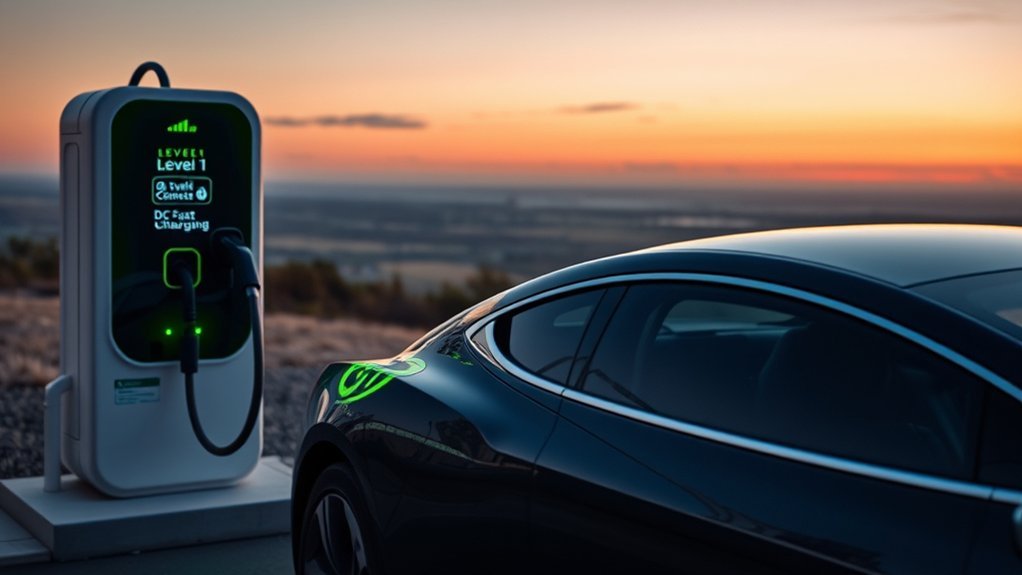
Electric vehicles use three main charging methods. The main differences are the electrical supply, power available, and how quickly energy reaches the battery.
Level 1 Charging
Level 1 charging uses a standard 120-volt household outlet and a compatible charging cable.
It is the slowest charging method, but it can be practical when you drive relatively few miles each day and leave your vehicle parked overnight.
- Power source: Standard 120V outlet.
- Typical range added: Approximately 2–5 miles per hour.
- Charging time: A large battery can require more than 40 hours to recharge fully.
- Best use: Short commutes, overnight top-ups, and situations where Level 2 equipment is unavailable.
A smaller plug-in hybrid battery may recharge overnight, while a large battery-electric vehicle may take several days if it is nearly empty.
Level 2 Charging
Level 2 charging uses a higher-power AC electrical connection, typically 240V at home or 208V at some commercial locations.
It is commonly used in homes, workplaces, apartment buildings, hotels, and public parking areas.
Depending on the equipment and vehicle, Level 2 charging can provide roughly 3–19.2 kW of power, although many home installations operate at lower outputs.
A typical 7.2 kW home charging setup can provide a substantial overnight recharge. However, a vehicle with a lower onboard charging limit cannot use the full power of a stronger charging unit.
DC Fast Charging
DC fast charging delivers direct-current electricity through specialized equipment. It can provide substantially more power than ordinary home charging.
Many modern EVs can gain useful driving range in 20–60 minutes, although some charge faster and others need considerably longer.
DC fast charging is especially useful during road trips or when you need additional range without parking for several hours.
Note: A station advertised at 350 kW does not automatically deliver 350 kW to every vehicle. Your EV determines how much power it can safely accept, and charging power changes throughout the session.
How Long Does It Take to Fully Charge an Electric Car?
A complete charge from 0% to 100% generally takes longer than the partial charging times advertised by vehicle manufacturers.
For example, a vehicle that can recharge from 10% to 80% in approximately 30 minutes may need considerably more time to reach 100%.
The difference comes from the battery’s charging curve. As the battery fills, its management system often reduces charging power to control temperature and protect the cells.
Why Does the Last 20% Take Longer?
At a low state of charge, a battery may accept relatively high charging power when conditions are suitable.
As it approaches full capacity, the charging rate usually drops. This means charging from 80% to 100% can take disproportionately longer than an earlier 20% increase.
For road trips, the fastest charging stop is often the one that adds enough range to reach your next destination—not necessarily a charge to 100%.
For everyday use, you can often reduce waiting time by charging only to the level needed for your next journey.
When extra range is necessary, charging to 100% is appropriate if it follows your vehicle manufacturer’s guidance.
How to Calculate Electric Car Charging Time
You can estimate charging time using the amount of energy needed and the charging power available.
Estimated charging time = Energy needed (kWh) ÷ Charging power (kW)
This gives an ideal estimate. Actual charging takes longer because of energy losses, temperature management, and changes in charging power.
Example: Charging a 60 kWh Battery
Suppose your EV has a 60 kWh usable battery and you want to charge from 20% to 80%.
- Calculate the charging difference: 80% − 20% = 60%.
- Calculate the energy needed: 60 kWh × 0.60 = 36 kWh.
- Use your available charging power: 7.2 kW.
- Divide the required energy by the power: 36 ÷ 7.2 = 5 hours.
The ideal estimate is five hours. In practice, allow additional time for charging losses and other operating conditions.
A complete 0–100% charge of the same battery would theoretically take about 8.3 hours at a constant 7.2 kW before accounting for losses.
This explains why a blanket statement that every 60 kWh battery charges fully in eight hours is misleading.
Estimating DC Fast-Charging Time
For DC fast charging, average power during the session matters more than the charger’s advertised peak output.
For example, adding 36 kWh at an average battery charging rate of 60 kW would theoretically take 36 minutes.
That does not mean a vehicle connected to a 60 kW station will maintain exactly 60 kW throughout the session.
The actual average depends on the battery’s charging curve, temperature, and starting percentage.
Pro Tip: Use the charging-time estimate shown by your vehicle or its mobile app when available. It can account for the vehicle’s current battery condition and charging settings more accurately than a simple manual calculation.
How Does Battery Size Affect Charging Times?
Battery capacity is measured in kilowatt-hours (kWh). It describes how much energy a battery can store.
A larger battery usually needs more electricity to recharge, but battery size alone does not determine charging speed.
Battery Capacity Impact
Consider a small plug-in hybrid with a 13.8 kWh battery and a larger battery-electric vehicle with a 60 kWh battery.
If both accept the same charging power and start at the same percentage, the smaller battery generally needs less time to reach the target percentage.
However, many plug-in hybrids have relatively low onboard charging limits. A larger EV with a more powerful onboard charger can sometimes add energy faster.
That is why battery capacity and maximum charging power must be considered together.
Charging Method Variations
Consider two vehicles with different batteries:
- Smaller plug-in hybrid: May finish charging in a few hours using compatible Level 2 equipment.
- 60 kWh electric car: Can recover a substantial amount of charge overnight with a suitable home charger.
- 80 kWh electric car: Needs more energy for the same percentage increase but may support higher AC or DC charging power.
Some plug-in hybrids do not support DC fast charging at all. Always check the vehicle’s charging specifications before assuming a particular method is available.
Top-Up Charging: Benefits and How It Works
Top-up charging means adding electricity before the battery becomes nearly empty.
Instead of waiting until you need a complete recharge, you add energy while the vehicle is parked at home, work, or a public charging location.
This approach can make EV ownership more convenient, particularly when charging fits naturally into your daily routine.
Benefits of Regular Top-Up Charging
- More convenient range management: Start each day with enough charge for your planned driving.
- Less dependence on fast charging: Regular home charging can reduce the need for additional public stops.
- Flexible charging: Add energy while shopping, working, or completing other activities.
- Battery management: Avoid repeatedly leaving the battery at an extremely low state of charge.
Level 2 charging commonly adds around 10–30 miles of driving range per hour, depending on the vehicle and equipment.
DC fast charging can add substantially more range in a short stop, but the number of miles gained depends on the vehicle’s efficiency and charging performance.
For daily charging, follow the charge limit recommended by your vehicle manufacturer. Some vehicles recommend a lower daily limit, while others have different guidance based on their battery chemistry.
How Do Temperature and Charger Type Affect Charging Speed?
Temperature and charger type can make a noticeable difference in how quickly your EV charges.
Cold Weather Charging
Low temperatures can slow battery charging and reduce the amount of power the battery can accept.
Some vehicles use battery preconditioning to warm the battery before reaching a fast charger.
When supported, selecting a charging station in the vehicle’s navigation system may automatically prepare the battery for arrival.
The U.S. Department of Energy’s winter EV guidance recommends using available preconditioning features to help improve battery performance in cold conditions.
Hot Weather Charging
High battery temperatures can also reduce charging performance.
The vehicle’s thermal management system may limit charging power to prevent excessive heat.
This can be especially noticeable after extended highway driving or repeated fast-charging sessions.
Charger Power and Vehicle Limits
Charging speed also depends on the maximum power the vehicle can accept.
For example, an EV limited to 50 kW DC charging will not suddenly accept 150 kW simply because it connects to a more powerful station.
Likewise, a vehicle’s onboard AC charger determines how much power it can use from Level 1 and Level 2 equipment.
Real-World Charging Times for Popular Electric Vehicle Models
Manufacturer charging specifications provide useful comparisons, but the advertised figures usually assume particular charging conditions.
Battery temperature, starting charge, charger output, and model year can all affect the result.
Tesla Model S Charging
The Tesla Model S supports home AC charging and high-power DC charging through Tesla’s Supercharger network.
According to Tesla’s official Supercharging information, the Model S can add up to 200 miles of range in 15 minutes under suitable conditions.
That figure describes a maximum range gain, not a complete battery recharge.
For home charging, the time depends on the available AC power and the battery’s starting percentage.
At 7.4 kW, eight hours of charging represents a theoretical maximum of 59.2 kWh delivered before accounting for losses. Whether that is enough for a full charge depends on the battery and its initial state of charge.
For road trips, Tesla’s navigation system can help plan Supercharger stops along the route.
Nissan LEAF Charging Time
Nissan LEAF charging times vary considerably by model year and battery configuration.
The older LEAF and the redesigned 2026 U.S. model should not be treated as having identical charging specifications.
Previous-Generation Nissan LEAF
The 2025 LEAF was available with 40 kWh and 60 kWh battery configurations.
Nissan’s published Level 2 estimates for these configurations were approximately:
- 40 kWh battery: 7.5 hours for a full charge under the stated conditions.
- 60 kWh battery: 11 hours for a full charge under the stated conditions.
Fast-charging capability also varies by battery version. Older LEAF models commonly use CHAdeMO for DC charging, making connector compatibility important when planning a trip.
For further details, consult Nissan’s LEAF charging guide.
2026 Nissan LEAF
The redesigned 2026 U.S. Nissan LEAF introduces a 75 kWh battery configuration and different charging hardware.
It uses a J1772 connection for standard AC charging and a built-in NACS connection for compatible DC fast charging.
Nissan advertises a 20–80% DC fast-charging time of approximately 30 minutes under suitable conditions.
This is a partial charging estimate, not a promise that the entire battery will recharge in 30 minutes.
You can review Nissan’s current EV range and charging information for further details.
Home vs. Public Charging Stations: What You Need to Know
Home charging and public charging serve different purposes.
Home charging is often convenient for regular daily use because the vehicle can recharge while parked overnight.
Public charging is useful during longer journeys, when you need additional range, or when home charging is unavailable.
Home Charging
Most home charging uses Level 1 or Level 2 equipment.
Level 1 may be sufficient for drivers with short daily commutes. Level 2 is generally more practical when you have a larger battery or need to replenish substantial range overnight.
Before installing Level 2 equipment, have a qualified electrician assess your electrical system, circuit capacity, and applicable installation requirements.
Warning: EV charging creates a sustained electrical load. Use suitable, safety-certified equipment and an appropriately rated circuit. Do not improvise charging connections or use extension cords or adapters that are not approved for your vehicle and equipment. Have damaged or overheating outlets inspected before continuing to charge.
The Department of Energy’s home charging guide explains equipment selection, electrical installation, charging costs, and safety considerations.
Public Charging
Public stations commonly provide Level 2 or DC fast charging.
Level 2 stations can be practical at workplaces, hotels, shopping centers, and other locations where you plan to park for several hours.
DC fast chargers are better suited to shorter stops during longer journeys.
Before arriving, check whether the station is compatible with your vehicle, available for use, and capable of providing the charging power you need.
EV Charging Connector Compatibility
Not all electric vehicles use the same charging connector.
- J1772: Common AC charging connection used by many non-Tesla vehicles in North America.
- CCS: A DC fast-charging connection used by many EVs.
- CHAdeMO: A DC charging connection found on many older Nissan LEAF models and some other vehicles.
- NACS/J3400: The North American charging connection developed from Tesla’s connector design and adopted by additional vehicle manufacturers.
Some vehicles can use adapters, but compatibility depends on the specific car, adapter, charging station, and network access rules.
Always confirm that the intended station supports your vehicle before relying on it during a road trip.
How Much Does It Cost to Charge an Electric Car?
Charging cost depends on how much electricity you add and what the charging provider charges for that electricity.
At home, the basic calculation is:
Charging cost = Electricity used (kWh) × Electricity rate ($/kWh)
Home Charging Cost Example
Suppose your vehicle needs 36 kWh of energy and your electricity rate is $0.20 per kWh.
The ideal energy cost would be:
36 × $0.20 = $7.20
The actual amount billed may be higher because charging consumes additional electricity through conversion losses and battery management.
Your local electricity rate and any time-of-use pricing will affect the final cost.
Public Charging Costs
Public charging prices vary by location and operator.
Depending on the station, you may encounter:
- Per-kWh energy charges.
- Time-based charging fees.
- Session or connection fees.
- Parking charges.
- Idle fees after charging is complete.
- Subscription or membership pricing.
Check the charging provider’s app or payment screen before starting the session.
A fixed price range cannot accurately represent every public charging situation because the energy needed and applicable charges differ.
Tips for Optimizing Your Electric Vehicle Charging Experience
A few charging habits can make EV ownership more convenient while helping you manage battery temperature, charging costs, and driving range.
Use Level 2 Charging for Regular Driving
If you have reliable access to a suitable Level 2 charger, overnight charging can eliminate many routine public charging stops.
Choose equipment that matches your vehicle’s onboard charging capability and your home’s electrical capacity.
Follow the Manufacturer’s Battery Guidance
Use the daily charging limit recommended in your vehicle’s manual or charging settings.
Some vehicles recommend charging to approximately 80% for routine use, while others have different recommendations based on battery chemistry.
Charging to 100% may be useful before a longer journey when permitted by the manufacturer.
Precondition Before Fast Charging
If your vehicle supports battery preconditioning, use it when approaching a fast charger in cold weather.
This can help the battery reach a more suitable temperature for charging.
Plan Around the Charging Curve
On road trips, compare the time required to gain additional range with the time needed to reach another compatible charger.
Charging beyond 80% may be worthwhile when stations are far apart or when you need extra range, but it can add considerable waiting time.
Use Scheduled Charging When Available
Some vehicles and home charging systems let you schedule charging for specific hours.
If your electricity provider offers lower rates during certain periods, scheduled charging may help reduce costs.
Pro Tip: Before a road trip, check charging availability and plan an alternative station along your route. This provides flexibility if your preferred charger is occupied, unavailable, or incompatible.
Why Is My Electric Car Charging Slowly?
If your EV charges more slowly than expected, the problem may be related to the station, vehicle settings, battery temperature, or electrical supply.
Common Charging Problems
- Cold battery: Low battery temperature can reduce charging power. Use preconditioning if supported.
- High starting charge: A battery already near 80% may accept less power than it would at a lower state of charge.
- Charger power limitation: The station may deliver less power than its advertised maximum.
- Vehicle charging limit: Your EV may not support the full output of the connected charger.
- Scheduled charging: A charging schedule or charge limit may prevent immediate charging.
- Connector issue: The charging connection may be incompatible or not fully seated.
- Station fault: The equipment may be unavailable, malfunctioning, or unable to start the session.
First, check the vehicle’s charging display for an estimated completion time or warning message.
Next, confirm the charging cable is connected correctly and the charging schedule is set as intended.
If a public session fails, follow the station’s instructions or contact the charging operator.
If home charging repeatedly interrupts, trips a breaker, or produces unusual heat, stop using the affected equipment and arrange a qualified inspection.
Frequently Asked Questions
How long does it take to charge an electric car at a public charging station?
A public Level 2 charger may require several hours for a substantial recharge. A compatible DC fast charger can often add a large amount of range in approximately 20–60 minutes. Actual charging time depends on the vehicle, charger output, battery condition, and starting percentage.
How long does it take to charge an electric car at a filling station?
If the location offers DC fast charging, a compatible EV may complete a useful charging stop in approximately 20–60 minutes. Charging to 100% can take considerably longer. Waiting for an available charger may add time to your stop.
How much does it cost to charge an electric car at a power station?
The price depends on the electricity delivered, the provider’s rate, and any additional fees. For example, purchasing 36 kWh at $0.45 per kWh would cost $16.20 before applicable session, parking, or idle fees. Always check the displayed rate before charging.
How long does it take to charge an electric car at Walmart?
Charging time depends on the equipment installed at the specific Walmart location and your vehicle’s capabilities. A compatible DC fast charger may provide a useful recharge in approximately 20–60 minutes, while Level 2 charging can take several hours. Check the charging provider’s app for the available station type, connector, and power rating.
Can I charge an electric car using a regular household outlet?
Yes, many EVs support Level 1 charging through a suitable 120V outlet and compatible charging cable. It is slow but may meet the needs of drivers with short daily commutes. Use an appropriately rated electrical circuit and follow the equipment manufacturer’s instructions.
Why does charging from 80% to 100% take so long?
Battery management systems commonly reduce charging power as the battery approaches full capacity. This charging taper helps manage temperature and battery conditions. The final 20% may therefore take substantially longer than an earlier 20% increase, particularly during DC fast charging.
Should I always stop charging at 80%?
No. The appropriate charging limit depends on your vehicle and battery chemistry. Some manufacturers recommend approximately 80% for daily use, while others provide different guidance. Charging to 100% can be useful when extra range is needed. Follow the recommendations displayed in your vehicle or owner’s manual.
Does a more powerful charging station always charge my car faster?
No. Your vehicle has its own charging limits. A car that accepts a maximum of 50 kW cannot use the full output of a 150 kW or 350 kW station. Battery temperature, starting charge, and the charging curve can further reduce the power delivered.
Conclusion
Electric car charging times vary widely, but understanding the three charging methods makes planning much easier.
Level 1 charging can work for short daily commutes, Level 2 is often convenient for overnight charging, and DC fast charging provides useful range during longer journeys.
For a more accurate estimate, consider your battery capacity, current charge percentage, target charge, and the power your vehicle can actually accept.
Once you understand those factors, you can choose charging stops that fit your schedule, avoid unnecessary waiting, and keep your EV ready for everyday driving and longer trips.
Sources
- U.S. Department of Energy — Electric Vehicle Charging Stations — Charging levels, equipment specifications, connectors, and charging-time factors.
- U.S. Department of Energy — Charging Electric Vehicles at Home — Residential charging, electrical installation, safety, and charging costs.
- U.S. Department of Energy — Winterizing Your Electric Vehicle — Cold-weather charging, battery preconditioning, and fast-charging considerations.
- Tesla — Supercharging Support — Manufacturer-supported charging performance and range-gain information.
- Nissan USA — Nissan LEAF Charging Guide — Previous-generation LEAF battery configurations and charging estimates.
- Nissan USA — EV Range and Charging — Current LEAF charging information, charging methods, and connector compatibility.






Leave a Reply