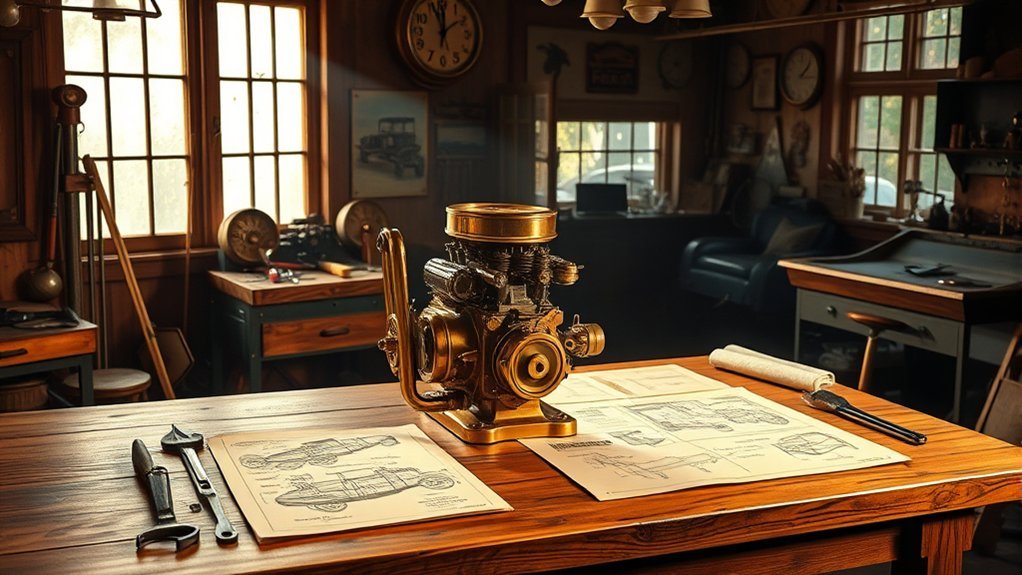
Karl Benz is widely credited with designing the first practical gasoline-powered automobile. He completed the three-wheeled Benz Patent-Motorwagen in 1885 and applied for its patent on January 29, 1886. His invention helped establish the foundation of the modern automotive industry. However, earlier steam-powered vehicles existed, and other inventors, including Gottlieb Daimler and Wilhelm Maybach, made important contributions to automobile development.
Quick Answer
Karl Benz designed the first practical gasoline-powered automobile, the Benz Patent-Motorwagen, in 1885 and patented it in 1886. Earlier steam-powered road vehicles existed, but Benz’s integrated engine-and-chassis design helped establish the modern automobile. Gottlieb Daimler and Wilhelm Maybach developed the first four-wheeled gasoline-powered automobile in 1886.
Key Takeaways
- Karl Benz: Built the first practical gasoline-powered automobile in 1885 and filed patent number 37435 on January 29, 1886.
- Earlier vehicles: Nicolas-Joseph Cugnot built a steam-powered road vehicle in 1769, showing that powered transportation existed before Benz.
- Gottlieb Daimler and Wilhelm Maybach: Developed the first four-wheeled gasoline-powered automobile in 1886.
- Bertha Benz: Completed a pioneering long-distance automobile journey in 1888, demonstrating the car’s practical potential.
- Benz Velo: Introduced in 1894, it became one of the earliest successful series-production automobiles, with approximately 1,200 examples manufactured.
- Henry Ford: Did not invent the automobile but helped make car ownership more accessible through the Model T and moving assembly-line production.
Who Really Invented the First Car?
The answer depends on what you mean by the first car. Steam-powered vehicles, early electric carriages, and gasoline-powered automobiles appeared at different stages of transportation history.
The Library of Congress recognizes several inventors whose work contributed to the development of the automobile.
- 1769 — Nicolas-Joseph Cugnot: Built a steam-powered, self-propelled road vehicle in France for military use.
- Early 19th century: Inventors experimented with electric-powered carriages.
- 1885–1886 — Karl Benz: Developed and patented a practical gasoline-powered automobile with an integrated engine and chassis.
- 1886 — Gottlieb Daimler and Wilhelm Maybach: Developed a four-wheeled automobile powered by an internal combustion engine.
Cugnot’s vehicle was an important early example of powered road transportation. However, it was a steam-powered machine rather than the type of lightweight gasoline automobile that would later become common.
Benz’s contribution was to create a working automobile designed around a compact gasoline engine instead of simply attaching a motor to an existing carriage.
Historical Note: The terms “first car,” “first gasoline automobile,” “first four-wheeled automobile,” and “first mass-produced car” describe different achievements. Treating them as identical can lead to misleading accounts of automotive history.
How Karl Benz Gave Birth to the Automobile
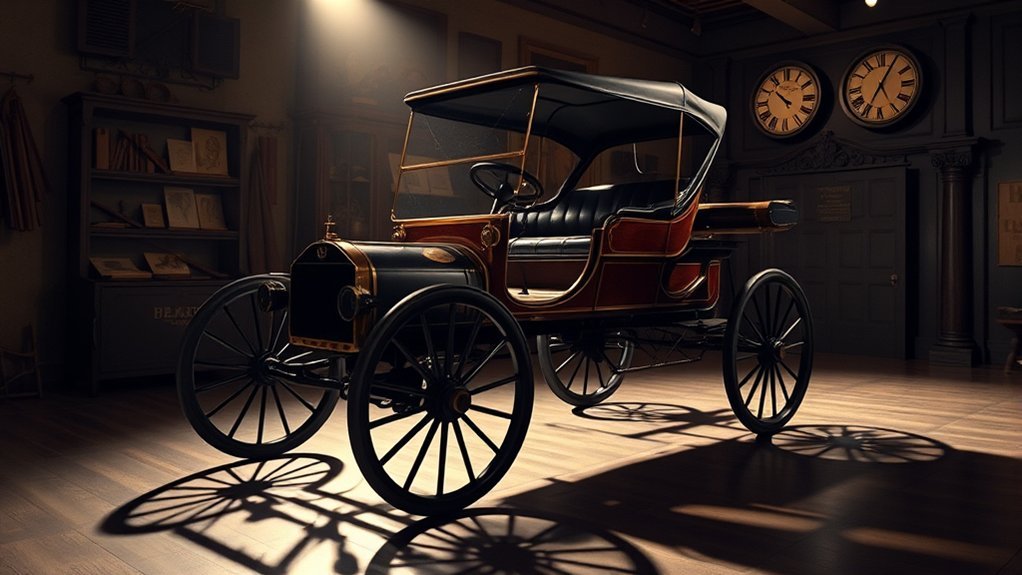
Karl Benz’s work helped transform the automobile from an experimental concept into a practical form of personal transportation.
Before developing his motor car, Benz worked on stationary gasoline engines. His first successful stationary two-stroke engine ran on New Year’s Eve in 1879.
He then pursued a more ambitious idea: a lightweight vehicle designed specifically around a gasoline engine.
When Was the First Benz Automobile Built?
Benz completed his first automobile in 1885.
On January 29, 1886, he filed a patent application for a vehicle powered by a gas engine. The patent received number 37435.
Newspaper reports documented the vehicle’s first public outing in July 1886.
These dates are recorded in the official Mercedes-Benz history of the Patent Motor Car.
The Benz Patent-Motorwagen was completed in 1885, patented in 1886, and became a defining milestone in the development of the modern gasoline-powered automobile.
How the Original Patent-Motorwagen Worked
The Benz Patent-Motorwagen was a two-seat, three-wheeled vehicle with a single-cylinder, four-stroke gasoline engine mounted horizontally at the rear.
Its engine and chassis were designed to work together as one vehicle.
According to Mercedes-Benz’s historical specifications, the original design included:
- Engine: Single-cylinder, four-stroke gasoline engine.
- Power: Approximately 0.75 horsepower (0.55 kW).
- Layout: Rear-mounted engine and three wheels.
- Frame: Lightweight tubular steel construction.
- Ignition: Electrical ignition with a spark plug.
- Cooling: Water-based evaporation cooling.
- Drivetrain: A differential that allowed the driven wheels to rotate at different speeds.
These features created a more complete automobile design than a simple engine attached to a horse-drawn carriage.
Why Did the First Benz Car Have Three Wheels?
Benz initially chose a three-wheel layout because steering a four-wheeled vehicle presented a difficult engineering problem.
His original design used one front wheel for steering and two wheels at the rear.
The arrangement allowed him to concentrate on developing the engine, drivetrain, and overall vehicle design without first solving the challenges of four-wheel steering geometry.
He later introduced a double-pivot steering system that made practical four-wheeled Benz automobiles possible.
Bertha Benz: The Woman Behind the First Long-Distance Drive
In August 1888, Bertha Benz completed one of the most important journeys in early automotive history.
Accompanied by her teenage sons Eugen and Richard, she drove an improved Benz Patent-Motorwagen from Mannheim to Pforzheim, her birthplace, and later returned.
The complete journey covered approximately 180 kilometers (112 miles), including the return trip.
The outward journey alone covered more than 100 kilometers.
Bertha undertook the trip without telling her husband beforehand. Her goal was to demonstrate that his automobile could travel beyond short local test routes.
The Challenges Bertha Benz Faced
The journey required far more than simply operating the vehicle.
Roads were often unpaved, fuel stations did not exist, and early automobiles needed frequent attention.
Bertha and her sons encountered mechanical and practical difficulties along the way.
- Fuel supply: Bertha obtained fuel from a pharmacy because modern gasoline stations did not yet exist.
- Mechanical problems: The travelers dealt with vehicle problems during the journey.
- Road conditions: Uneven roads and steep sections made the drive demanding.
- Public skepticism: Many people had never seen an automobile complete a journey of this length.
The Mercedes-Benz account of Bertha Benz’s life describes the journey as an important demonstration of the gasoline automobile’s potential.
Why Her Journey Mattered
Bertha’s achievement showed that the automobile could serve a practical purpose beyond engineering demonstrations.
Her journey also exposed problems that vehicle makers needed to solve, including fuel availability, road performance, reliability, and ease of operation.
It helped build confidence in the Benz vehicle and contributed to the growth of Benz & Cie.
Today, the Bertha Benz Memorial Route commemorates the historic journey through southwestern Germany.
Daimler’s Four-Wheeled Innovations
While Karl Benz was developing his three-wheeled automobile, Gottlieb Daimler and Wilhelm Maybach were working independently on compact, high-speed internal combustion engines.
Their experiments helped establish the technical foundation for four-wheeled gasoline-powered vehicles.
First Four-Wheeled Automobile
In 1886, Daimler and Maybach developed what is generally recognized as the first four-wheeled gasoline-powered automobile.
Unlike Benz’s purpose-designed three-wheeler, their early motor carriage was based on an existing horse-drawn carriage fitted with a gasoline engine.
The vehicle demonstrated that a compact engine could power a conventional four-wheel carriage without horses.
Although Benz and Daimler were working in the same region of Germany, they developed their early automobiles independently.
Their different approaches helped advance the emerging automotive industry.
Innovations in Engine Design
Daimler and Maybach focused on developing a compact engine that could operate at higher speeds than many earlier stationary engines.
Their work produced an engine nicknamed the “grandfather clock” because of its distinctive shape.
In 1885, they tested a motorized two-wheeled vehicle known as the Reitwagen.
They then adapted their engine technology for other applications, including the four-wheeled motor carriage.
The 1889 Daimler Steel-Wheel Car
In 1889, Daimler and Maybach introduced another important vehicle: the steel-wheel car.
Unlike their earlier motor carriage, this vehicle was designed more directly around its engine and mechanical components.
It featured a two-cylinder V-engine and a four-speed gearbox.
The German Patent and Trade Mark Office documents Maybach’s role in developing this vehicle.
Daimler-Motoren-Gesellschaft was subsequently founded in 1890, creating a business that would become an important part of the automotive industry.
Innovations in Early Automobile Design That Shaped the Industry
The earliest automobile inventors had to solve several engineering challenges before cars could become reliable everyday transportation.
Engine performance, vehicle control, steering, cooling, and power delivery all required continued development.
Benz’s later inventions demonstrate how quickly automobile engineering progressed after 1886.
Pioneering Engine Innovations
Early gasoline engines were small and relatively weak compared with modern automotive engines.
Engineers improved their performance by refining combustion, mechanical arrangements, and engine construction.
Three developments from Benz’s work are especially important:
- The original Patent-Motorwagen engine: Benz combined a compact four-stroke engine with a purpose-designed vehicle, rather than simply mounting an engine on an existing carriage.
- The 1897 twin engine: Benz developed an arrangement using two horizontal single-cylinder units positioned alongside each other. However, this design proved unsatisfactory.
- The contra engine: Benz followed the twin engine with a better arrangement featuring opposing cylinders. This helped establish the horizontally opposed engine configuration.
Different versions of the contra engine eventually produced up to approximately 16 horsepower (12 kW).
This was a substantial increase over the original Patent-Motorwagen’s output.
Breakthrough Steering Mechanisms
Steering was another major challenge for early automobile designers.
A four-wheeled vehicle needs its front wheels to turn in a controlled way while following different paths around a corner.
Benz addressed this problem with his double-pivot steering system, patented in 1893.
The three-horsepower Benz Victoria was an early vehicle to use the system.
This advancement helped make four-wheeled automobiles more practical and improved vehicle maneuverability.
The Benz Velo followed in 1894, using developments that had emerged from Benz’s work on four-wheeled vehicle design.
Key Engineering Insight: The automobile did not emerge from a single invention. Reliable engines, steering, braking, cooling, and power delivery had to develop together before motor vehicles could become practical transportation.
The Evolution of the Automobile: From Patent to Production
The development of the automobile took place over several decades.
Benz’s original Patent-Motorwagen was a pioneering vehicle, but wider adoption required more reliable designs and manufacturing methods capable of producing multiple cars.
The Benz Velo and Early Series Production
The Benz Velo, introduced in 1894, was a lightweight four-wheeled automobile designed to be more accessible than earlier experimental vehicles.
Mercedes-Benz identifies it as the world’s first series-production automobile.
Approximately 1,200 examples were manufactured during its production run from 1894 to 1901.
This made the Velo an important step toward producing automobiles in meaningful quantities rather than constructing them mainly as individual experimental machines.
However, early series production was not the same as the later moving assembly-line system used by Ford.
Henry Ford and Large-Scale Automobile Production
Henry Ford entered automobile history after Benz and Daimler had already demonstrated working gasoline-powered vehicles.
Ford introduced the Model T in 1908 with the goal of making automobiles more affordable and practical for ordinary buyers.
In 1913, Ford Motor Company began using moving assembly-line methods at its Highland Park plant.
Workers completed individual production tasks as components and vehicles moved through the manufacturing process.
This system greatly reduced assembly time and helped Ford manufacture automobiles in much larger numbers.
Ford’s contribution was therefore not inventing the automobile itself, but transforming how automobiles could be manufactured and sold.
Ford’s official moving assembly-line history documents this manufacturing development.
Important Automobile History Milestones
The following timeline shows how the automobile developed from early powered road vehicles into a manufactured consumer product.
| Year | Inventor or Company | Milestone |
|---|---|---|
| 1769 | Nicolas-Joseph Cugnot | Steam-powered self-propelled road vehicle. |
| 1885 | Karl Benz | Completion of the original Patent-Motorwagen. |
| 1886 | Karl Benz | Patent application for his gasoline-powered automobile. |
| 1886 | Daimler and Maybach | Four-wheeled gasoline-powered motor carriage. |
| 1888 | Bertha Benz | Pioneering long-distance automobile journey. |
| 1889 | Daimler and Maybach | Development of the steel-wheel car. |
| 1893 | Karl Benz | Double-pivot steering patent and Benz Victoria. |
| 1894 | Benz & Cie. | Introduction of the series-produced Benz Velo. |
| 1897 | Karl Benz | Twin-engine development followed by the contra engine. |
| 1908 | Ford Motor Company | Introduction of the Model T. |
| 1913 | Ford Motor Company | Implementation of moving assembly-line automobile production. |
| 1926 | Benz & Cie. and Daimler-Motoren-Gesellschaft | Merger forming Daimler-Benz AG. |
How the First Automobile Shaped Modern Transportation
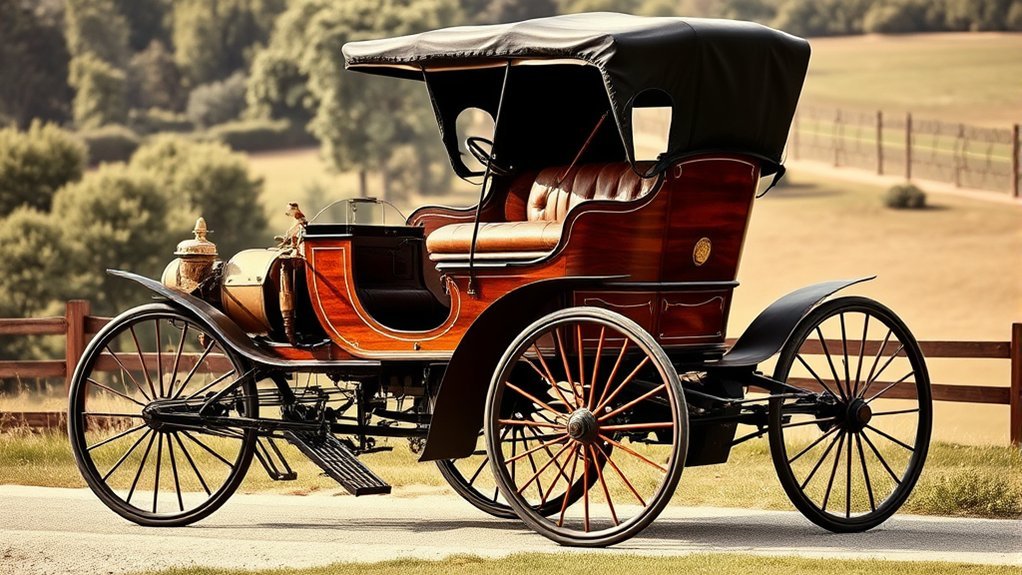
The Benz Patent-Motorwagen helped establish a new approach to transportation: a compact, self-propelled vehicle designed for personal use.
Although its performance was modest compared with modern cars, its basic concept became central to the automobile industry.
Benz’s integrated vehicle design, Bertha Benz’s demonstration of practical road travel, and later engineering improvements all helped move automobiles toward wider acceptance.
Developments in steering, engine performance, and manufacturing eventually made cars easier to operate, more reliable, and more affordable.
The 1926 Daimler-Benz Merger
Karl Benz and Gottlieb Daimler did not develop their first automobiles together.
However, the companies associated with their inventions eventually joined forces.
In 1926, Benz & Cie. and Daimler-Motoren-Gesellschaft merged to form Daimler-Benz AG.
The new company brought together two important branches of early German automobile engineering under the Mercedes-Benz brand.
The official Mercedes-Benz historical overview explains the independent origins of the two businesses and their later development.
From Early Gasoline Cars to Modern Vehicles
Automotive technology continued to change throughout the 20th and 21st centuries.
Manufacturers introduced increasingly advanced braking systems, transmissions, suspension designs, electronic controls, and occupant-protection technologies.
Electric vehicles have also become an important part of modern transportation.
Although their power systems differ from the original Patent-Motorwagen, modern cars continue to build on the broader idea that Benz and other early inventors helped establish: a practical self-propelled road vehicle designed for everyday transportation.
The automobile’s development was not the achievement of one inventor alone. It resulted from many advances in mechanical engineering, manufacturing, infrastructure, and vehicle design.
Frequently Asked Questions
Who Designed the First Car?
Karl Benz is generally credited with designing the first practical gasoline-powered automobile. He completed the Benz Patent-Motorwagen in 1885 and patented it in 1886. However, earlier steam-powered vehicles existed, including Nicolas-Joseph Cugnot’s vehicle from 1769.
Was Henry Ford the Inventor of the First Car?
No. Karl Benz developed his gasoline-powered automobile decades before Ford introduced the Model T in 1908. Ford’s major contribution was improving large-scale automobile manufacturing, particularly through moving assembly-line production beginning in 1913.
Who Invented the First Car in the 1920s?
The first automobile was not invented in the 1920s. Gasoline-powered automobiles had existed since the 1880s. By the 1920s, manufacturers were improving vehicle design, production efficiency, comfort, and reliability. The 1926 merger of Benz & Cie. and Daimler-Motoren-Gesellschaft formed Daimler-Benz AG.
What Is the Story of Karl Benz?
Karl Benz was a German engineer who developed gasoline engines before completing his Patent-Motorwagen in 1885. He filed its patent application in 1886. His wife Bertha demonstrated the vehicle’s practical potential through a long-distance journey in 1888. Benz later developed improved steering and engine designs, while his company became an important early automobile manufacturer.
What Year Was the First Gasoline-Powered Automobile Invented?
Karl Benz completed the Patent-Motorwagen in 1885 and applied for its patent on January 29, 1886. The vehicle’s first public outing was reported in July 1886. For this reason, both 1885 and 1886 commonly appear in accounts of the automobile’s invention.
Who Built the First Four-Wheeled Automobile?
Gottlieb Daimler and Wilhelm Maybach developed the first four-wheeled gasoline-powered automobile in 1886. Their motor carriage used a compact internal combustion engine fitted to a carriage. It was developed independently of Benz’s three-wheeled automobile.
What Was the First Production Car?
The Benz Velo, introduced in 1894, is recognized by Mercedes-Benz as the first series-production automobile. Approximately 1,200 examples were manufactured between 1894 and 1901. Ford’s later moving assembly line represented a different milestone in large-scale automobile manufacturing.
Why Is Bertha Benz Important in Automobile History?
In 1888, Bertha Benz and her two sons completed a pioneering long-distance journey using a Benz Patent-Motorwagen. The approximately 180-kilometer round trip demonstrated that an automobile could travel between towns and highlighted practical issues that future vehicle designs needed to address.
Conclusion
Karl Benz’s design of the Benz Patent-Motorwagen helped establish the modern gasoline-powered automobile. Completed in 1885 and patented in 1886, his three-wheeled vehicle combined a compact engine with a purpose-designed chassis.
Bertha Benz’s historic 1888 journey demonstrated its practical potential, while Gottlieb Daimler and Wilhelm Maybach independently advanced four-wheeled automobile development.
Later innovations, including Benz’s steering systems, the Benz Velo, and Ford’s moving assembly-line production, helped turn the automobile from an engineering achievement into a widely used form of transportation.
The modern car is therefore the result of contributions from many inventors and manufacturers. Benz’s original achievement remains a defining starting point in the history of practical gasoline-powered automobiles.
Sources
- Library of Congress — Who Invented the Automobile? — Historical context covering steam, electric, and gasoline-powered vehicles.
- Mercedes-Benz Group — The First Automobile, 1885–1886 — Patent dates, original vehicle specifications, Bertha Benz’s journey, steering innovations, and engine development.
- Mercedes-Benz Group — Bertha Benz — Her contribution to automobile development and the 1888 long-distance journey.
- Mercedes-Benz Group — Beginnings of the Automobile — The independent development of Benz and Daimler automobiles, early production, and company history.
- German Patent and Trade Mark Office — Wilhelm Maybach — Daimler-Maybach engine development and the 1889 steel-wheel car.
- Ford Motor Company — The Moving Assembly Line — Ford’s contribution to large-scale automobile manufacturing.







Leave a Reply