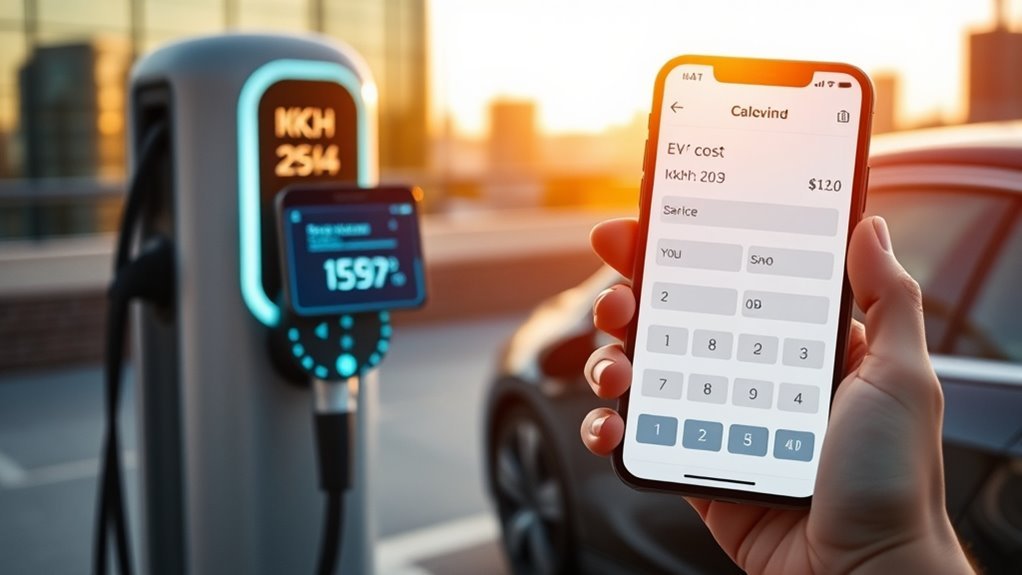
To calculate your EV charging cost, use this simple formula: Cost to fully charge = Battery size (kWh) × electricity price ($/kWh). For example, charging a 60 kWh battery at $0.16/kWh will cost you about $9.60. Include a 5% buffer for charging losses. Public charges can be notably higher, so comparing costs is essential. If you want to discover more about estimating charging costs and finding savings, keep exploring the topic further.
Why Understanding EV Charging Costs Matters
Understanding EV charging costs matters because it directly impacts your budget and overall ownership experience. By grasping the nuances of charging efficiency, you can greatly reduce your expenses.
For instance, home charging typically ranges from $0.04 to $0.17 per kWh, in stark contrast to public charging rates that soar to $0.20 to $0.60 per kWh. When you know the cost per mile—around $0.048 at home versus $0.12 at DC fast chargers—you can make more informed choices regarding your vehicle usage.
Effective cost comparisons between different EV models also become possible, enabling you to assess operating costs accurately.
Comparing costs across EV models allows for accurate assessments of your overall operating expenses.
Planning road trips is less intimidating with a clear understanding of these charges, ensuring you avoid unexpected public charging fees. By understanding the factors that influence charging costs, like local electricity rates and battery size, you can optimize your charging strategy for enhanced financial freedom.
How to Use the Cost Formula for EV Charging
To effectively manage your EV charging expenses, you’ll want to master the cost calculation formulas that simplify the budgeting process.
Start with the core formula: Cost to fully charge = Battery size (kWh) × electricity price ($/kWh). This gives you a clear picture of your total charging expenses based on your vehicle’s capacity and local rates.
Next, use the formula for cost per 100 miles: Cost per 100 miles = (kWh per 100 miles × electricity price). This helps you understand the efficiency metrics of your EV over distance.
For a more granular view, calculate cost per mile with: Cost per mile = (kWh per 100 miles × price) ÷ 100.
Don’t forget to account for charging losses of about 5-10%.
Essential Steps to Estimate Home EV Charging Costs
While estimating your home EV charging costs might seem intimidating, it’s a straightforward process once you know the essential steps.
Start by determining your local electricity price per kilowatt-hour (kWh), which averages around $0.16–$0.18 in 2025. Next, calculate the energy needed for a full charge by multiplying your battery size (in kWh) by the electricity price. For example, charging a 60 kWh battery at $0.16 per kWh would cost approximately $9.60.
To estimate EV charging costs, multiply your battery size by local electricity prices, adding a buffer for efficiency losses.
Don’t forget to include a 5% buffer to account for charging efficiency losses. This guarantees your estimate is more accurate.
Finally, monitor your energy consumption through your vehicle displays or EPA data. This insight can help you average monthly charging costs, typically around $63 for standard EV usage.
Public vs. Home Charging Costs: What You Need to Know?
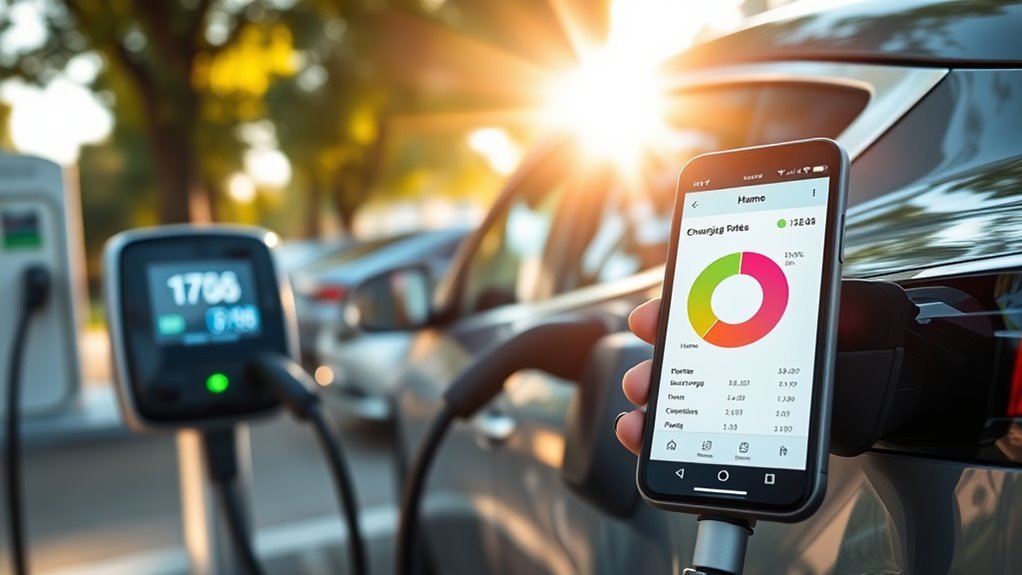
How much are you willing to pay for the convenience of charging your electric vehicle away from home?
Home charging typically costs between $0.04 and $0.17 per kWh, making it a much more economical choice than public charging, which ranges from $0.20 to $0.60 per kWh.
For instance, charging a 60 kWh battery at home would cost you about $9.00, while using a public station could set you back between $24 and $36.
Additionally, public charging often comes with extra fees like session and idle fees, further increasing your costs.
Although public charging is essential for long trips or for those without home charging access, it can be two to three times pricier than charging at home.
Best Strategies for Lowering Your EV Charging Costs
Understanding the cost differences between public and home charging sets the stage for exploring effective strategies to lower your EV charging expenses.
One of the best ways to save is by utilizing time-of-use pricing. Charging your EV during off-peak hours can slash your costs by 20-50% compared to peak rates. Additionally, installing a home charging station is a smart move, as home charging typically costs between $0.04 to $0.17 per kWh, far less than public rates averaging $0.20 to $0.60 per kWh.
Plan your trips to align with charging station availability, and prefer AC chargers over DC fast chargers to keep expenses down.
Regularly monitor your energy consumption and adjust your habits according to local electricity rates, which average around $0.16 to $0.18 per kWh in 2025.
Finally, precondition your vehicle while plugged in to save battery energy for driving, enhancing efficiency further.
Frequently Asked Questions
How to Calculate the Cost of Charging an EV?
To calculate EV charging costs, multiply your battery size by energy rates. Consider charging stations’ higher rates versus home charging. Add approximately 5% for efficiency losses to guarantee your estimate reflects actual expenses.
What Is the Formula for EV Charging?
To calculate EV charging, you multiply the battery size by the charging rate. Consider energy consumption, cost factors, and those pesky charging rates; they’re like the weather—unpredictable but essential for your wallet’s forecast!
What Is the 80 20 Rule for EV Charging?
The 80/20 rule for EV charging suggests you charge your vehicle to 80% for ideal charging efficiency. This strategy enhances battery health, reduces costs, and maximizes your driving freedom without unnecessary energy waste.
How to Calculate Battery Charging Cost?
Did you know charging efficiency losses can reach up to 10%? To calculate your battery charging cost, multiply your battery capacity by the electricity price, adjusting for efficiency to guarantee accurate budgeting for your electric vehicle.
Conclusion
In summary, understanding EV charging costs can greatly impact your budget and overall driving experience. Did you know that charging at home can save you up to 50% compared to public charging stations? By utilizing the cost formula and adopting strategies to minimize expenses, you can maximize your savings and make informed choices. With the shift to electric vehicles on the rise, being savvy about charging costs is more important than ever for your financial well-being.







Leave a Reply