Charging an electric vehicle (EV) does use a significant amount of electricity. On average, you’ll consume about 408 kWh monthly, translating to an annual energy consumption of roughly 4,900 kWh. Charging costs can vary by state, averaging around $57.90 per month. Factors like driving habits, electricity rates, and charger efficiency also impact your expenses. Using solar panels could help cut costs substantially. Explore more to understand the specifics of charging and potential savings.
How Much Electricity Does Charging an Electric Vehicle Use?
When it comes to charging electric vehicles (EVs), understanding electricity consumption is vital for both budgeting and energy management.
On average, you’ll use about 408 kilowatt-hours (kWh) monthly, which breaks down to around 13.4 kWh daily. If you drive 14,000 miles annually, expect to consume roughly 4,900 kWh per year, as EVs typically consume 0.35 kWh per mile.
On average, EV owners consume about 408 kWh monthly, translating to roughly 4,900 kWh annually for 14,000 miles.
Your charging frequency plays an important role in managing this energy use. Most home charging utilizes Level 2 chargers, averaging 7.2 kW, which can fully recharge your vehicle in 8 to 10 hours, depending on battery size.
Despite the increasing electricity demand in various sectors, charging your EV accounts for less than one percent of total electricity use in the U.S. Consequently, focusing on energy efficiency can greatly impact both your budget and the environment, allowing you to enjoy the benefits of EV ownership more fully.
Understanding Different Types of EV Chargers and Their Wattage
Charging an electric vehicle (EV) effectively relies on understanding the different types of chargers available and their respective wattage.
There are three main types: Level 1, Level 2, and Level 3 (DC Fast). Level 1 chargers, operating at 1.4 to 1.9 kW, connect to standard 120-volt outlets, providing limited efficiency for occasional use.
Level 2 chargers, the most common for home charging, utilize 3.3 to 19.2 kW, typically recharging your EV in 8 to 10 hours.
In contrast, Level 3 DC FastDC Fastchargers, ranging from 50 to 350 kW, can charge your EV to 80% in under 30 minutes, making them crucial for long-distance travel but impractical for home use.
The wattage directly influences charger efficiency and electricity consumption; higher wattage results in faster charging, impacting your overall energy use and reliance on robust charging infrastructure.
Understanding these differences is essential for optimizing your EV charging experience.
How Long Does It Take to Charge Your EV?
When considering how long it takes to charge your EV, the type of charger you use plays an essential role.
Level 1 chargers are impractical for daily use due to their lengthy charging times, while DC Fast Chargers can greatly reduce that time.
Additionally, the size of your EV’s battery and the benefits of off-peak charging can further influence your overall charging experience.
Charging Time By Charger Type
Understanding how long it takes to charge your electric vehicle (EV) hinges on the type of charger you’re using.
Level 1 chargers, operating at 120V, provide a slow charging rate of 1.4 to 1.9 kW, adding only 3 to 5 miles of range per hour, making them less suitable for daily use.
Level 2 chargers, with 240V compatibility, charge faster at 3.3 to 19.2 kW, typically taking 8 to 10 hours for a full charge.
For rapid charging, DC Fast Chargers deliver between 50 kW to 350 kW, enabling an 80% charge in under 30 minutes.
Keep in mind that charging efficiency and environmental factors can greatly influence these times, so choose the right charger for your needs.
Battery Size Impact
The time it takes to charge your electric vehicle (EV) is greatly influenced by battery size. Understanding battery capacity and charging efficiency can help you manage your charging needs effectively.
Here are key points to take into account:
- A typical 60 kWh battery takes about 8 to 9 hours using a 7.2 kW Level 2 charger.
- Larger batteries, like the 100 kWh, may require 10 to 12 hours on the same charger.
- Level 3 DC Fast Chargers can boost your charge to 80% in under 30 minutes, ideal for long trips.
- Level 1 chargers, delivering only 1.4 to 1.9 kW, can take up to 24 hours for larger batteries.
Knowing these factors empowers you to optimize your EV charging experience.
Off-Peak Charging Benefits
Charging your electric vehicle (EV) during off-peak hours not only cuts costs but also improves the efficiency of your energy use. By charging when electricity rates are lower, you can maximize cost savings while helping maintain grid stability. Using a Level 2 charger, you can fully charge your EV in about 8 to 10 hours, allowing for ideal energy use.
| Charging Time | Cost Savings |
|---|---|
| 8 hours | Significant |
| 10 hours | Even Greater |
With an average consumption of 0.35 kWh per mile, off-peak charging guarantees your daily energy needs are met without straining the electrical grid. Implementing smart charging technologies can further improve your efficiency and savings.
Monthly Charging Costs for Electric Cars: What to Expect
When considering the monthly charging costs for your electric vehicle, expect an average expense of about $57.90, though this can fluctuate based on your local electricity rates and driving habits.
For instance, residents in California might face charges as high as $89.76, while those in Texas may only pay around $51.24.
Understanding these variations is essential for effectively managing your EV operating costs.
Average Monthly Charging Costs
On average, you’ll find that charging an electric vehicle (EV) costs about $57.90 per month, though this figure can fluctuate based on local electricity rates and your driving habits. Understanding these costs can help you budget effectively.
Here are some key points to reflect on:
- Monthly electricity usage for an average EV driver is around 408 kilowatt-hours (kWh).
- Charging costs vary considerably by state; California averages about $89.76, while Texas sits around $51.24.
- If you charge during off-peak hours, you can take advantage of lower rates.
- Annually, running an electric car sums up to about $695, demonstrating substantial savings compared to traditional gas vehicles.
Factors Influencing Charging Expenses
While numerous factors influence the monthly charging costs of electric vehicles (EVs), the most significant aspects typically include local electricity rates, charging habits, and the type of charger used.
Your charging efficiency can greatly impact expenses; a Level 2 charger, for instance, delivers about 7.2 kW, completing a full charge in 8 to 10 hours.
Seasonal variations also play a role, as energy demand fluctuates throughout the year, affecting electricity prices. In states like California, you might see monthly costs soar to $89.76, while in Texas, it could drop to around $51.24.
Ultimately, understanding these factors helps you anticipate your monthly charging expenses and maximize your savings compared to traditional gasoline vehicles.
Calculating Your EV’s Energy Use
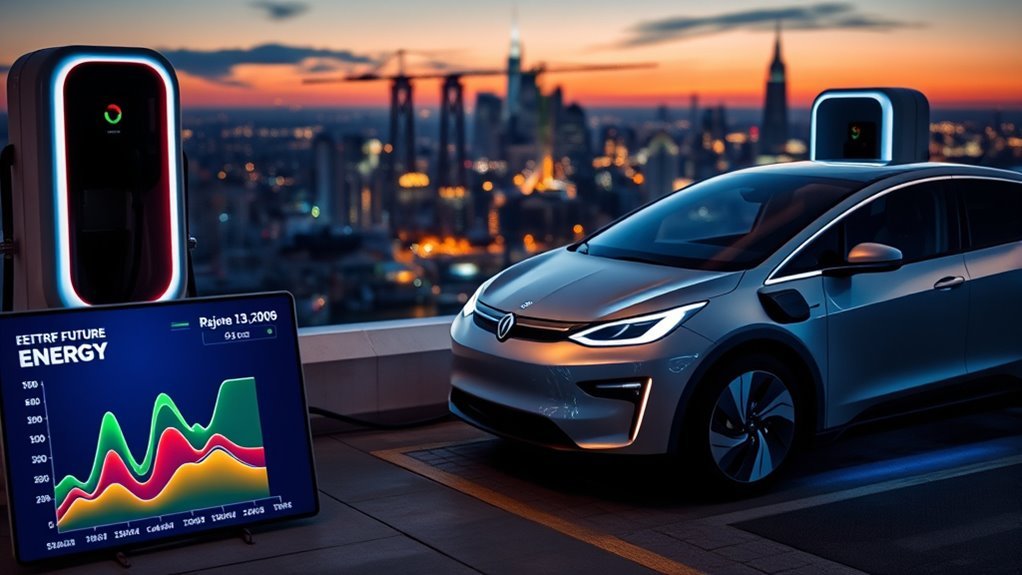
How can you effectively gauge your electric vehicle’s (EV) energy consumption? Understanding your energy use can empower you to adopt better charging habits and enhance energy efficiency. Here’s how to calculate it:
- Determine Your Driving Distance: On average, Americans drive about 14,000 miles annually.
- Calculate Monthly Usage: At 0.35 kWh per mile, you’re looking at roughly 408 kWh monthly.
- Analyze Charging Costs: With an average charging expense of $57.90 per month, this varies by local electricity rates.
- Consider Charging Time: For a 60 kWh battery, expect an 8-9 hour charge from empty using a Level 2 charger.
What Factors Affect Your Electric Bill When Charging an EV?
Charging an electric vehicle (EV) can noticeably impact your electric bill, with several factors influencing the costs incurred. Your charging habits play an essential role; how often and when you charge can greatly alter expenses.
For instance, if you charge during off-peak hours, you can benefit from lower electricity rates, reducing overall costs. Local electricity rates also vary widely, with states like California averaging $89.76 monthly while Texas sits at $51.24.
Additionally, the efficiency of your charger and the distance you drive directly affect your energy consumption. On average, you might consume around 408 kilowatt-hours (kWh) monthly, translating to about 13.4 kWh daily.
How Can You Reduce Charging Costs With Solar Panels?
Reducing your EV charging costs can be effectively achieved by integrating solar panels into your home energy system. By harnessing renewable energy, you can considerably offset your charging expenses.
Here’s how solar panel benefits can lead to substantial savings:
- Lower Electricity Bills: Solar systems can produce enough energy to cover your EV charging needs, potentially eliminating monthly costs.
- Peak Sunlight Utilization: Charging your EV during sunlight hours maximizes your renewable energy savings, reducing reliance on the grid.
- Battery Storage Integration: Adding storage allows you to save excess energy for nighttime charging, enhancing cost efficiency.
- Long-term Investment: Over time, solar panels can cover almost 100% of your charging expenses, making them a smart financial choice.
Frequently Asked Questions
Does an EV Charger Increase the Electric Bill?
Yes, an EV charger does increase your electric bill. Charging costs depend on your electricity rates, but you can expect an average monthly increase around $57.90, varying by your location and driving habits.
Is It Cheaper to Charge a Car at Home or a Charging Station?
It’s cheaper to charge at home than at a station. Home charging costs less per kilowatt-hour, while station pricing can vary greatly, leading to higher expenses. You’ll likely save money by charging overnight.
What Runs up the Electric Bill the Most?
Like a leaky faucet, your electric bill rises due to high energy consumption from appliances, heating, and cooling. Charging efficiency also plays a role, but those factors typically dominate your monthly electricity expenses.
Does Charging an EV Car Cost a Lot at Home?
Charging an EV at home can be affordable, with costs averaging around $57.90 monthly. Conducting a cost analysis reveals that your expenses vary considerably based on electricity rates and your driving habits.
Conclusion
In summary, charging your electric vehicle (EV) does consume a significant amount of electricity, with an average EV requiring about 30 kWh to travel 100 miles. This translates to roughly 1,200 kWh annually for a typical driver. Understanding your charging habits and costs can help you manage your electric bill effectively. Additionally, integrating solar panels can drastically reduce your charging expenses, making the shift to electric not just environmentally friendly, but also economically viable.







Leave a Reply