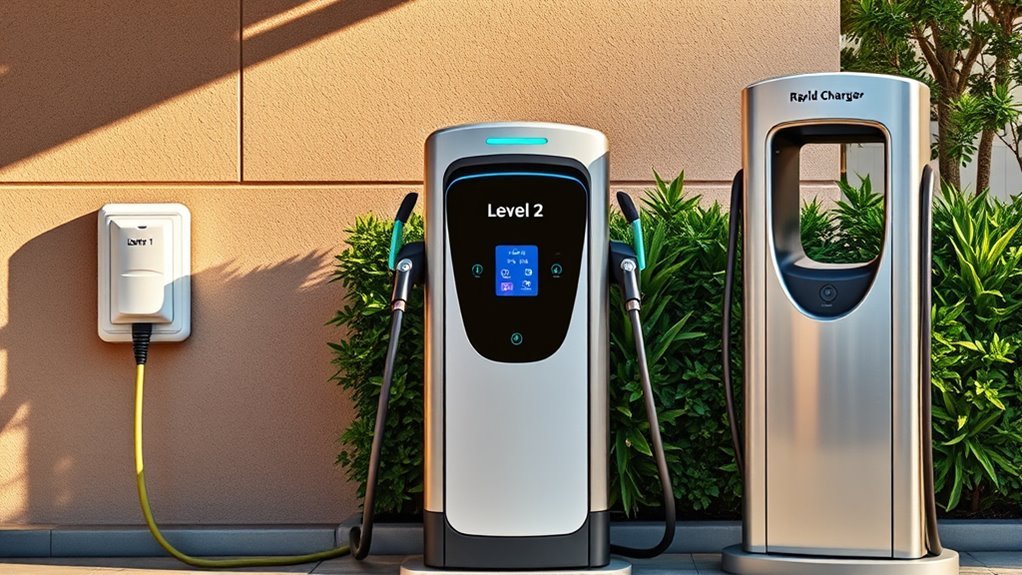
When it comes to EV charging levels, you’ll encounter Level 1, Level 2, and DC Fast Charging. Level 1 is the slowest, using a standard 120V outlet, ideal for low-mileage drivers. Level 2, operating at 240V, speeds up charging considerably, perfect for home and public use. DC Fast Charging is essential for long trips, providing rapid charging in just 20-40 minutes. Understanding these levels helps you optimize your EV experience, and there’s even more to explore.
Understanding EV Charging Levels: An Overview
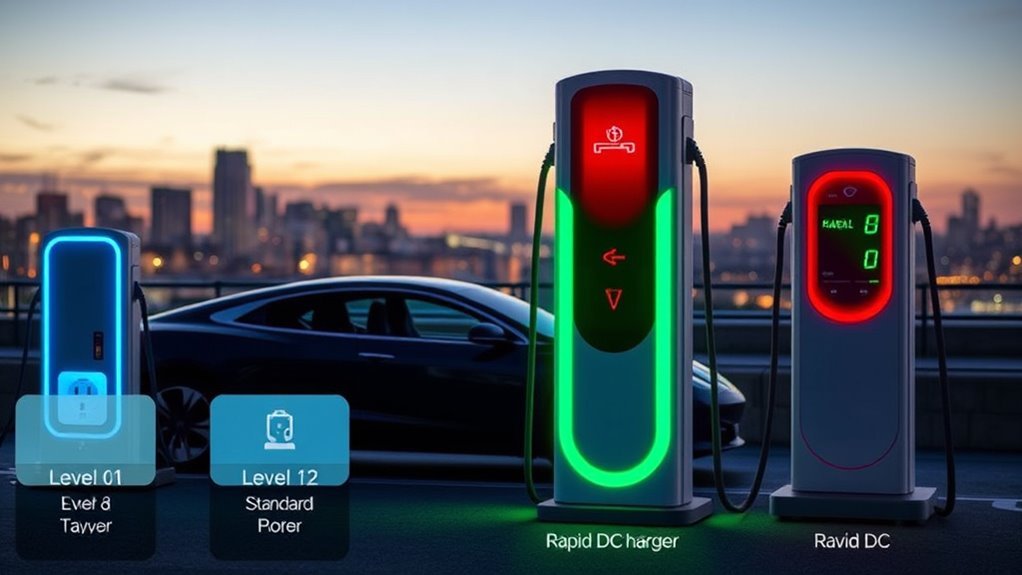
When considering the best way to charge your electric vehicle (EV), it’s crucial to understand the different charging levels available.
Level 1 charging, utilizing a standard 120V outlet, offers the slowest option, adding 3-7 miles of range per hour. This method’s low charging costs make it suitable for overnight use, especially for low-mileage drivers.
Level 2 charging operates at 240V, delivering 10-75 miles of range per hour, making it a more efficient choice for daily commutes and reducing your carbon footprint.
Finally, Level 3 charging, or DC Fast Charging, provides rapid energy replenishment, enabling an 80% charge in as little as 20-40 minutes—ideal for long-distance travel.
While these options vary in speed and convenience, they all contribute to a more sustainable future by lowering the environmental impact of your transportation choices.
Understanding these levels helps you make empowered decisions that align with your lifestyle and eco-conscious values.
Level 1 Charging: The Basics and Best Use Cases
Level 1 charging serves as the most basic and accessible option for electric vehicle (EV) owners. Utilizing a standard 120-volt AC outlet, it has both advantages and limitations. Here’s what you should know:
- Level 1 Advantages: It’s cost-effective since it doesn’t require special installation; you can plug in your EV anywhere there’s an outlet.
- Ideal for Overnight Charging: Perfect for those who drive 40 miles or less daily, allowing you to wake up to a fully charged vehicle.
- Slow Charging Speed: Adds only 3-7 miles of range per hour, making it impractical for high-mileage drivers.
- Charging Duration: Battery electric vehicles (BEVs) take about 40-50 hours to charge to 80%, while plug-in hybrids (PHEVs) take 5-6 hours.
Understanding these aspects helps you decide if Level 1 charging suits your lifestyle.
Level 2 Charging: Speeding Up Your EV Experience
If you’re looking to enhance your electric vehicle (EV) charging experience, Level 2 charging offers a significant upgrade over Level 1. Operating on 208-240 volts, it delivers charging speeds of 10-75 miles of range per hour, ideal for everyday use and extended driving needs. You can expect to charge battery electric vehicles (BEVs) to 80% in just 4-10 hours and plug-in hybrids (PHEVs) in 1-2 hours, drastically reducing downtime.
Level 2 chargers are commonly found in residential areas, workplaces, and public stations, providing convenience wherever you go. However, keep in mind the installation considerations; upgrading your electrical wiring may be necessary.
That said, many utility companies offer discounted rates for using Level 2 chargers, maximizing energy efficiency. Unlike Level 1 chargers, which rely on standard outlets, Level 2 chargers utilize dedicated circuits, ensuring faster battery regeneration and improved performance, especially in colder weather.
DC Fast Charging: Essential for Long-Distance Travel
When planning long-distance travel with your EV, DC Fast Charging (DCFC) is a game changer.
With the ability to charge your vehicle to 80% in just 20 to 40 minutes, you can minimize downtime and keep your journey on track.
Plus, the growing network of DCFC stations along major highways guarantees you’ll have convenient access to quick charging stops.
Speed Of Charging
As electric vehicle (EV) technology evolves, DC fast charging has become a game changer for long-distance travel. With its ability to charge your vehicle to 80% in just 20 to 40 minutes, this technology drastically improves charging efficiency and minimizes downtime.
Here are key benefits of DC fast charging:
- Rapid Power Delivery: Charges at rates from 50 kW to over 350 kW.
- Range Replenishment: Quickly restores significant driving range during road trips.
- Battery Health: Designed to optimize battery longevity while ensuring efficient charging.
- Accessibility: Essential for reducing range anxiety, particularly on major highways.
With over 21,676 stations in the USA as of 2021, the expanding network supports the growing adoption of electric vehicles, ensuring you’re always ready to go.
Accessibility Along Routes
While traveling long distances in an electric vehicle (EV), having access to DC fast charging stations along your route is vital for a smooth journey.
These chargers, primarily located along highways, can deliver between 15 to 350 kW of power, enabling you to charge your EV to 80% in just 20 to 40 minutes.
Effective route planning guarantees you can leverage these charging networks to minimize downtime and alleviate range anxiety.
As of late 2021, there were about 21,676 DC fast charging stations in the U.S., yet expanding this infrastructure is essential to support the rising demand for quick, reliable charging options.
Embracing DC fast charging enhances your long-distance travel experience and empowers your journey toward electric mobility.
Impact On Travel Plans
Access to DC fast charging stations directly influences your travel plans, especially during long-distance trips. The impact assessment of charging infrastructure reveals that rapid charging considerably enhances travel convenience.
Here are key considerations:
- Charge Speed: DCFC can charge your EV to 80% in just 20 to 40 minutes, minimizing downtime.
- Power Output: With outputs from 15 kW to 350 kW, these stations offer a much faster alternative than Level 1 and 2 options.
- Location: Strategically placed along highways, they allow quick recharges on your journey.
- Infrastructure Growth: As the number of stations increases, future EV targets become more attainable, alleviating range anxiety.
Embracing DC fast charging makes long-distance electric travel viable and liberating for all drivers.
Comparing Charging Times Across Levels
Understanding the differences in charging times across various levels is essential for electric vehicle (EV) owners.
Level 1 charging, using a standard 120V outlet, adds only 3-7 miles of range per hour. This slow pace can lead to impractical charging costs and hinder your daily driving needs.
In contrast, Level 2 charging operates at 240V, delivering 10-75 miles of range per hour. This makes it ideal for overnight home charging or workplace use, considerably reducing environmental impact.
For long trips, DC Fast Charging, or Level 3 charging, is a game-changer. It can provide 80% charge in just 20-40 minutes, with power outputs ranging from 50 kW to over 350 kW.
This rapid capability allows you to maximize your time on the road while minimizing charging costs. By understanding these charging times, you can make informed decisions that align with your lifestyle and sustainability goals.
How Charging Compatibility Works for Your EV
Understanding charger types is essential for ensuring you find the right fit for your EV.
Each connector type varies, impacting compatibility and charging rates considerably.
Charger Types Overview
When traversing the world of electric vehicle (EV) charging, it’s crucial to recognize the different charger types and their compatibility with your vehicle.
Understanding these can help you make informed decisions about your charging needs within various charging networks:
- Level 1 Chargers: Use a standard 120V outlet, adding 3-7 miles of range per hour, suitable for most passenger EVs.
- Level 2 Chargers: Operate on 208-240V, providing 10-75 miles of range per hour; often found in homes and public locations.
- Level 3 Chargers (DC Fast Chargers): Deliver DC power, charging to 80% in 20-60 minutes, ideal for long-distance travel.
- Connector Types: CCS, CHAdeMO, GB/T, and Tesla Superchargers affect compatibility, so know your vehicle’s requirements.
Choose wisely to maximize efficiency!
Connector Compatibility Differences
Connector compatibility is a critical factor to evaluate when charging your electric vehicle (EV). Most EVs use the SAE J1772 connector for Level 1 and Level 2 charging, ensuring access to standard home and public charging infrastructure.
For DC Fast Charging, different connector standards apply, including CCS (Combined Charging System) and CHAdeMO. CCS comes in two variants—CCS1 for North America and CCS2 for Europe—engineered for fast charging in modern EVs.
Although CHAdeMO is being phased out, some existing models still support it. If you own a Tesla, you can utilize a J-plug adapter to connect with non-Tesla charging stations, broadening your charging options across various levels of infrastructure while maintaining compatibility.
Charging Rate Variations
Charging rates vary considerably across different levels, impacting how you can manage your EV’s energy needs.
Understanding these variations enhances your user experience and charging efficiency:
- Level 1: Uses a standard 120V outlet, delivering 3-5 miles of range per hour—impractical for daily high-mileage use.
- Level 2: Operates on 240V, adding 10-75 miles of range per hour—ideal for home, workplace, and public charging.
- Level 3 DC Fast Charging: Provides rapid charging at 15 kW to 350 kW, achieving 80% charge in just 20-40 minutes.
- Compatibility Considerations: Most battery electric vehicles support Level 3 charging with CCS or CHAdeMO, while plug-in hybrids should avoid it.
Selecting the right charging level is essential for maximizing your EV’s potential.
Finding the Right EV Charger for You
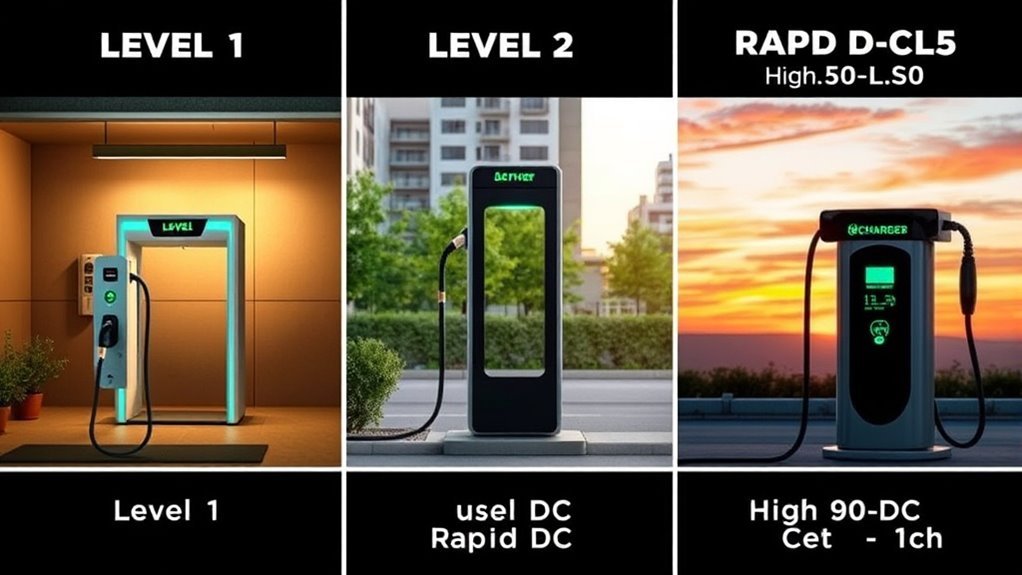
Choosing the right EV charger can greatly impact your driving experience and convenience.
Begin by evaluating your daily driving habits. If you typically drive 40 miles or less, a Level 1 charger may suffice, utilizing a standard 120V outlet for slow charging. However, if you need quicker charging, consider a Level 2 charger, which operates at 240V and can add up to 75 miles of range per hour.
Evaluate your driving habits to determine whether a Level 1 or Level 2 charger best meets your needs for efficiency.
For long-distance travel, DC Fast Charging is ideal, offering rapid charging that reaches 80% in just 20-40 minutes.
When selecting a charger, factor in installation costs and your electrical system’s capacity. Level 2 and DC Fast Chargers may require upgrades and can be more expensive than Level 1 options.
Balancing your driving needs with these cost considerations will guarantee you choose the most suitable EV charger, enhancing your journey toward electric liberation.
Future Trends in EV Charging Technology and Infrastructure
As the demand for electric vehicles continues to grow, the infrastructure supporting EV charging is set for a transformative expansion. Anticipating this surge, here are some key trends shaping the future infrastructure and charging innovations:
- Rapid Deployment: The U.S. will need over 100,000 DC fast charging stations by 2025 to meet rising EV adoption.
- Faster Charging: Innovations in DC fast chargers aim to reduce charging times to under 15 minutes for an 80% charge, making long-distance travel more convenient.
- Smart Solutions: Integrating AI and machine learning into the charging infrastructure will optimize energy usage and balance grid demand.
- Standardization: The move towards standardized connectors like CCS enhances interoperability among EV models, streamlining user experience.
These advancements promise to create a robust, efficient, and sustainable charging network, paving the way for widespread electric mobility.
Frequently Asked Questions
What’s the Difference Between Level 2 and DC Fast Charging?
Level 2 charging’s slower speed suits daily use, while DC Fast Charging offers significant advantages in charging speed, allowing you to recharge up to 80% in 20-40 minutes, ideal for quick top-ups during travel.
What Is the Difference Between Level 1 and Level 2 EV Chargers?
Level 1 chargers use standard outlets for home charging, offering slower speeds and compatibility with most vehicles. Level 2 chargers require dedicated installations, providing faster charging and enhanced convenience for daily use and higher mileage drivers.
How Much Faster Is Level 2 Than Level 1?
Level 2 charging is about 3 to 10 times faster than Level 1, enhancing charging efficiency. While installation costs can be higher, the time saved in charging makes it worthwhile for daily use.
How Much Faster Is a Level 2 EV Charger Than a Level 1?
A Level 2 EV charger’s charging speed is over three times greater than Level 1. While installation requirements differ, the efficiency gained makes Level 2 the ideal choice for quicker, convenient charging at home or public stations.
Conclusion
As you navigate the world of electric vehicles, understanding charging levels is essential for your journey. Picture yourself effortlessly plugging into a Level 2 charger at a bustling café, sipping coffee while your EV charges swiftly. Or imagine the freedom of a DC fast charger on a road trip, fueling your adventure in mere minutes. By choosing the right charging solution, you’ll not only enhance your EV experience but also contribute to a cleaner, more sustainable future.






Leave a Reply