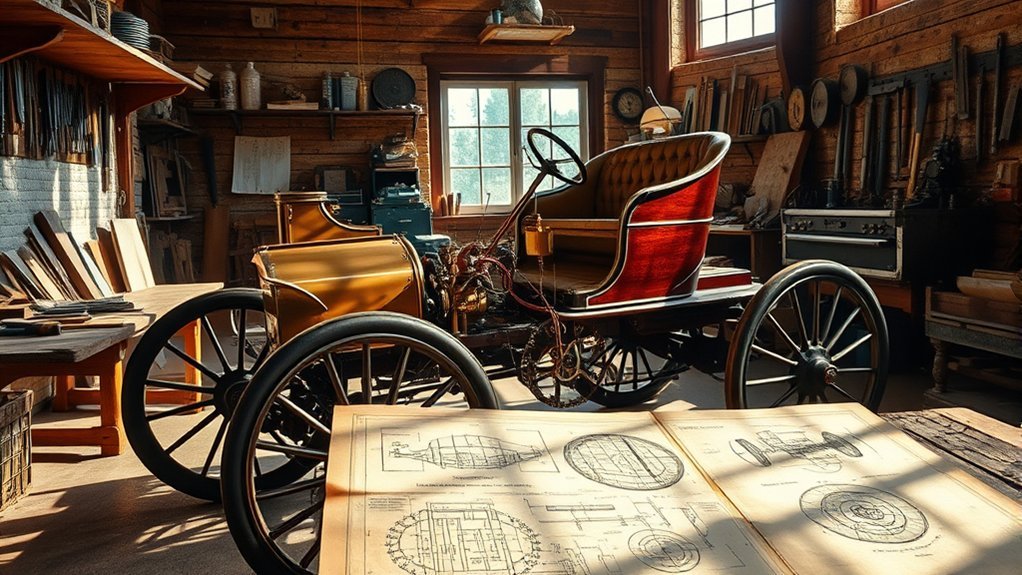
The first practical automobile was invented by Karl Benz in 1885 in Mannheim, Germany. He developed the Benz Patent Motorwagen, which was powered by an internal combustion engine and was patented on January 29, 1886. This vehicle differed greatly from earlier steam-powered models. A public demonstration in July 1886 captured people’s interest, marking the automobile’s impact on transportation. To understand the evolution and innovations that followed, stay tuned for more insights on automotive history.
Key Takeaways
- The first practical automobile, the Benz Patent Motorwagen, was invented by Karl Benz in 1885.
- The patent for the Motorwagen was granted on January 29, 1886, marking its official recognition.
- The public demonstration of the Motorwagen took place in July 1886, showcasing its practicality.
- Earlier attempts at automobiles include Ferdinand Verbiest’s steam vehicle in 1672 and Cugnot’s 1769 steam-powered model.
- The first mass-produced automobile in the U.S. was the 1901 Curved Dash Oldsmobile, revolutionizing accessibility.
The Birth of the Automobile: Who Invented It?
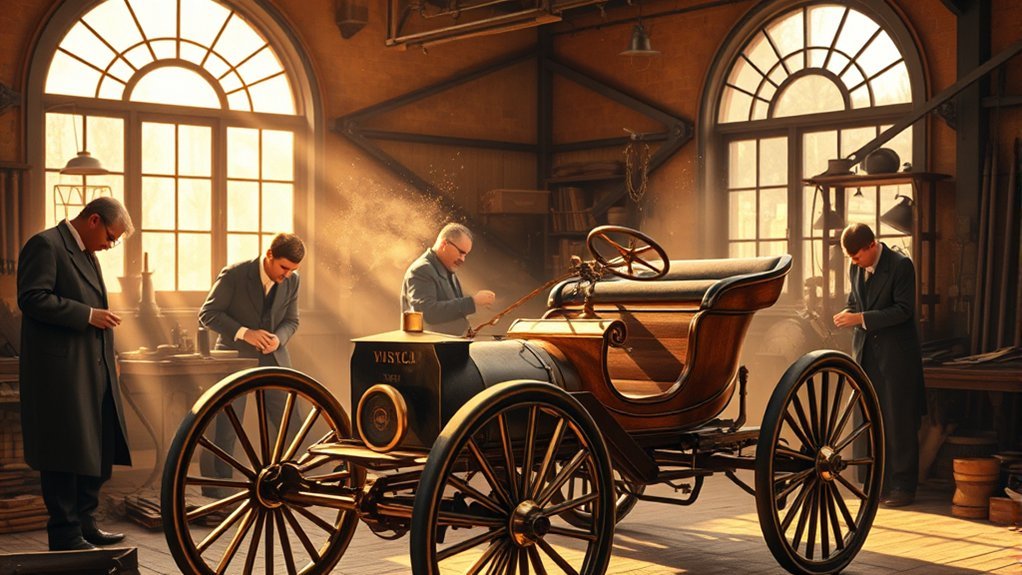
The birth of the automobile is often traced back to Karl Benz, whose innovative spirit led to the creation of the first practical automobile in 1885. He developed the Benz Patent Motorwagen, a three-wheeled vehicle that utilized an internal combustion engine, marking a pivotal moment in the history of cars.
This invention, patented on January 29, 1886, showcased Benz’s vision for a gasoline-powered automobile, distinct from earlier steam-powered models like the one created by Nicolas-Joseph Cugnot in 1769.
In July 1886, Benz publicly demonstrated the functionality of his Patent Motor Car, gaining attention and paving the way for the automotive industry. His work built upon the four-stroke engine invented by Nicolaus August Otto in 1876, solidifying the foundation for liquid-fueled vehicles.
Benz’s contributions not only revolutionized transportation but also ignited a wave of innovation that continues to shape our world today.
A Look at Early Competing Designs and Technologies
While Karl Benz’s Patent Motorwagen is often celebrated as the first practical automobile, a variety of early competing designs and technologies emerged that shaped the automotive landscape.
In 1672, Ferdinand Verbiest created a small-scale steam-powered vehicle, marking an early concept of an automobile, though it was merely a toy.
Nicolas-Joseph Cugnot followed in 1769 with the first full-scale steam-powered automobile capable of carrying passengers, a significant milestone in automotive history.
Fast forward to the early 1900s, the 1901 Curved Dash Oldsmobile became the first mass-produced automobile in the U.S., laying the groundwork for modern passenger cars.
Then, in 1913, Henry Ford revolutionized production with the moving assembly line, drastically cutting costs and time, exemplified by the Model T‘s assembly time of just 93 minutes.
Each of these innovations contributed to the evolution of the automobile, setting the stage for today’s automotive industry.
Innovations That Made the First Automobile Possible
To understand the creation of the first automobile, you must consider key innovations leading up to it.
Starting with the four-stroke internal combustion engine developed by Otto in 1876, this breakthrough set the stage for the practical applications seen in Benz’s Patent-Motorwagen in 1886.
Following this, advancements in design and mass production techniques, particularly by figures like Ransom E. Olds and Henry Ford, transformed the automobile from a luxury into an accessible mode of transportation.
Early Engine Innovations
Innovations in engine technology during the late 19th century set the stage for the birth of the automobile, as inventors sought efficient power sources to replace horse-drawn vehicles.
In 1876, Nicolaus August Otto created the first internal combustion engine, the Otto cycle, which became an essential foundation for future designs.
By 1885, Gottlieb Daimler patented the modern gas engine and adapted a stagecoach to create the world’s first four-wheeled automobile.
Just a year later, Karl Benz received the Benz Patent for his gas-fueled car, the Motorwagen, powered by a single-cylinder four-stroke engine.
These advancements, influenced by steam-powered vehicles, revolutionized automobile production, leading to the gasoline-powered cars we’re aware of today.
Internal Combustion Breakthroughs
The evolution of the internal combustion engine in the late 19th century was pivotal to the creation of the first practical automobile. In 1876, Nicolaus August Otto developed the revolutionary four-stroke internal combustion engine, laying the groundwork for gasoline-powered vehicles.
Fast forward to 1886, when Karl Benz patented his innovative car, marking a significant milestone in automotive history. This vehicle incorporated Otto’s engine principles, redefining transportation.
By 1901, the modern car emerged with the Mercedes, showcasing advanced design and technology thanks to Gottlieb Daimler’s contributions.
Although Henry Ford’s assembly line innovations in 1913 would later transform production, these early breakthroughs in internal combustion engineering established the foundation for the automotive revolution, making cars more accessible and practical for the masses.
Mass Production Techniques
As the internal combustion engine advanced, the need for efficient manufacturing methods became apparent. The Oldsmobile Curved Dash, the first mass-produced automobile in the U.S., pioneered assembly line production in 1901. This innovation set the stage for Henry Ford’s revolutionary moving assembly line in 1913, which reduced the Model T assembly time from over 12 hours to just 90 minutes. Standardized parts, first utilized in the 1894 Benz Velo, enabled large-scale production, radically transforming automobile manufacturing.
| Year | Vehicle | Impact |
|---|---|---|
| 1901 | Oldsmobile | First mass-produced automobile |
| 1913 | Model T | Introduced moving assembly line |
| 1927 | Model T | Price dropped to $290 |
| 1914 | Model T | 248,000 units produced |
Karl Benz’s Role in Automotive History
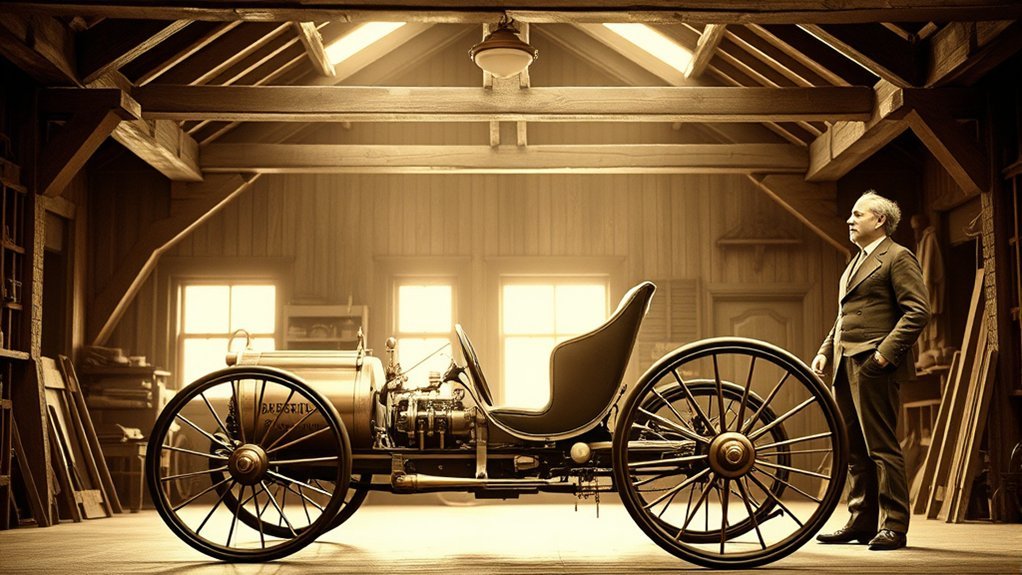
Karl Benz’s journey in automotive history began with the invention of the Benz Patent Motorwagen, patented in 1886, which showcased his groundbreaking engine design.
His innovations didn’t stop there; in 1893, he developed the double-pivot steering system, further influencing vehicle engineering.
This foundation not only propelled Benz & Cie. to become a leading manufacturer by 1900 but also left a lasting legacy that shaped the future of the automotive industry.
Patent-Motorwagen’s Invention Process
Revolutionizing transportation, Karl Benz initiated a journey to create the Patent-Motorwagen, a groundbreaking invention that forever changed the landscape of personal mobility. On January 29, 1886, he patented this innovative design, merging a gasoline internal combustion engine with a three-wheeled chassis—marking a significant milestone in automotive history. The first public outing in July 1886 demonstrated its practicality, capturing public interest and paving the way for the automotive industry. By 1900, Benz & Cie. became the world’s largest manufacturer of automobiles, thanks to the Patent-Motorwagen’s success.
| Year | Milestone | Impact |
|---|---|---|
| 1886 | Patent granted | Birth certificate of the automobile |
| July 1886 | First public outing | Showcased practical use |
| 1900 | Benz & Cie. becomes largest | Led automotive technology growth |
Innovations in Engine Design
While many inventors contributed to the development of automotive technology, Karl Benz stands out for his groundbreaking innovations in engine design that laid the foundation for modern vehicles.
His work culminated in the Patent-Motorwagen, the first practical automobile powered by an internal combustion engine.
Key milestones include:
- The integration of engine and chassis into a single unit, revolutionizing motor vehicle construction.
- The introduction of a three-wheeled design that made its public debut in July 1886, marking a pivotal moment in automotive history.
- The invention of a double-pivot steering system in 1893, enhancing vehicle maneuverability and handling.
Legacy and Industry Impact
Although many inventors paved the way for automotive technology, the legacy of Karl Benz remains unparalleled, as his innovations fundamentally transformed the industry.
In 1886, he patented the first practical automobile, the Patent-Motorwagen, marking the inception of the automotive industry. By 1900, Benz & Cie. emerged as the world’s largest automobile manufacturer.
His wife, Bertha Benz, undertook the first long-distance journey in 1888, showcasing the vehicle’s practicality and igniting public interest.
In 1894, he introduced the world’s first production car, the Benz Velo, producing 1,200 units.
Benz’s pioneering work laid the groundwork for the modern automotive industry, influencing future designs and production methods, including the assembly line techniques later popularized by Henry Ford, solidifying his enduring legacy.
How Did the Automobile Change Transportation Forever?
The introduction of the automobile fundamentally transformed transportation, setting off a chain reaction that reshaped society. With the launch of the Model T by the Ford Motor Company in 1908, cars became accessible to the average American, with prices plummeting from $825 to $290 by 1927. The implementation of mass production through the moving assembly line in 1913 drastically cut production time, allowing personal vehicles to flourish.
By the 1920s, urban planning evolved to accommodate automobiles, leading to expansive road networks.
Public transportation systems suffered as personal vehicles became the preferred mode of travel.
The boom in the automobile industry saw over 15 million Model T cars sold, greatly enhancing mobility.
Ultimately, these changes redefined societal norms, granting individuals newfound freedom in their work, leisure, and community interactions. The automobile’s impact on transportation ignited a revolution that continues to influence our lives today.
How Did the Automobile Evolve After Its Invention?
As the automotive landscape rapidly changed, innovations began to define the evolution of the automobile itself. Following Karl Benz’s 1886 Patent-Motorwagen, the 1894 Benz Velo emerged as the first production vehicle, setting the stage for mass production.
By 1901, the Curved Dash Oldsmobile became the first mass-produced automobile in the U.S., igniting the Detroit automobile industry. Henry Ford revolutionized vehicle production in 1913 with the Model T, slashing prices from $825 to $290 by 1927, making cars accessible to the masses.
This boom saw the number of car manufacturers surge from 30 in 1899 to 485 by 1909. Innovations like electric starters introduced in 1912 and hydraulic brakes in 1921 enhanced automotive safety and efficiency, marking the shift to modern vehicles powered by gasoline engines.
These advancements collectively shaped the automotive industry, paving the way for future innovations and evolving consumer freedom in transportation.
Frequently Asked Questions
Where Was the First Car Invented?
The first car was invented in Mannheim, Germany, by Karl Benz in 1886. This historical milestone marked a pivotal moment in automobile evolution, showcasing design innovations and mechanical advancements that fueled a global transportation revolution.
How Was the First Car in the World?
Imagine a world without motorized vehicles—chaos! The first car emerged from steam engine innovations, combining early prototypes and engineering breakthroughs. Its design features sparked transportation evolution and cultural impact, marking a significant leap in manufacturing advancements.
Did Germany Invent the First Car?
Yes, Germany invented the first car, showcasing automotive innovations through Benz’s legacy. Early car designs and technological advancements marked historic milestones, establishing German engineering as a leader among automotive pioneers, profoundly impacting global car manufacturing.
Was the First Car Made in 1769?
Yes, the first car, powered by a steam engine, emerged in 1769. This French inventor’s breakthrough sparked automotive evolution, influencing mechanized transport and societal changes through early prototypes that paved the way for future engineering advancements.
Conclusion
In the grand saga of human innovation, the birth of the automobile stands as a monumental leap, igniting a revolution beyond imagination. You can almost hear the roar of engines and feel the excitement of open roads, as Karl Benz and his contemporaries turned dreams into reality. This wasn’t just a mere invention; it was the spark that propelled society into a new era, reshaping lifestyles, economies, and the very fabric of our existence. Buckle up—history’s just getting started!







Leave a Reply