Electric vehicles (EVs) typically use a single-speed transmission, meaning they don’t have traditional gears like internal combustion engine (ICE) vehicles. This design simplifies the driving experience and provides instant torque at any speed, enhancing acceleration and efficiency. With fewer components—about 90% less than ICE vehicles—maintenance is easier and less costly. Interested in how these features improve performance and convenience? There’s plenty more to explore about EV mechanics and innovations in the industry.
Key Takeaways
- Most electric vehicles (EVs) utilize a single-speed gearbox, eliminating the need for traditional multi-gear systems found in internal combustion engine vehicles.
- High-performance EVs may feature multi-speed transmissions, like the Porsche Taycan, to enhance performance and acceleration.
- EVs deliver instant torque at zero RPM, negating the need for complex gear shifting during driving.
- The simplicity of EV transmissions results in fewer moving parts, leading to reduced maintenance costs compared to conventional vehicles.
- Regenerative braking systems in EVs also contribute to efficiency, further minimizing the reliance on traditional gearing mechanisms.
What Are the Key Components of Electric Vehicle Transmissions?
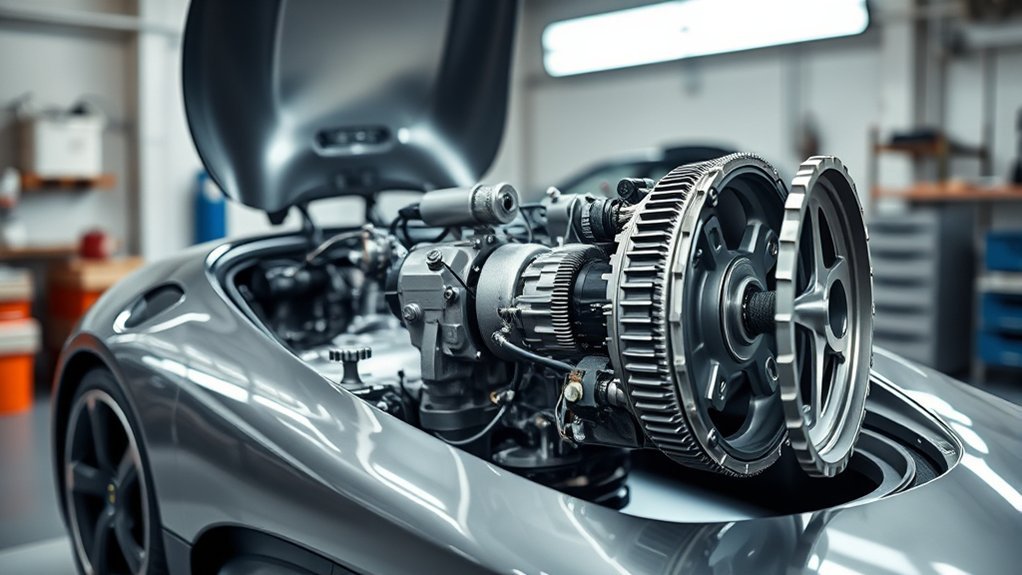
When you think about electric vehicle (EV) transmissions, simplicity is key. The core of this streamlined design lies in the electric motor, which operates efficiently across a broad RPM range. Unlike traditional vehicles requiring complex transmission systems with multiple gear ratios, most EVs use a single-speed gearbox. This means fewer moving parts, leading to energy transfer efficiencies between 70% and 98%.
The basic components of an EV transmission include the electric motor, a straightforward gearbox, and a differential that effectively distributes power to the wheels, enhancing driving dynamics.
While standard models thrive on this simplicity, high-performance EVs like the Porsche Taycan do incorporate multi-speed transmissions to elevate acceleration and top speed.
However, for the everyday driver seeking liberation from mechanical complexity, the single-speed design of most electric vehicles offers an appealing blend of efficiency and performance without the fuss of shifting gears.
How Do Electric Vehicle Transmissions Differ From ICE Vehicles?
When you compare electric vehicle transmissions to those in internal combustion engine vehicles, you’ll notice a significant simplification in gear ratios.
EVs provide instant torque delivery through a single-speed setup, eliminating the need for multiple gears to optimize performance.
This design not only enhances efficiency but also reduces maintenance costs, making electric vehicles a more reliable choice for drivers.
Gear Ratio Simplification
While traditional internal combustion engine (ICE) vehicles rely on complex multi-speed transmissions to manage torque and optimize performance across varying speeds, electric vehicles (EVs) simplify this process with their single-speed transmissions.
This gear ratio simplification means you experience efficient energy transfer and smooth acceleration without shifting gears. Unlike ICE vehicles that require multiple gear ratios as torque multipliers, EVs provide high torque across a wide range of speeds with just one gear.
This design not only results in about 90% fewer moving parts, leading to reduced maintenance and increased reliability, but it also lowers production costs.
Ultimately, the straightforward driving experience of EVs liberates you from the complexities of traditional vehicle transmissions.
Torque Delivery Differences
Electric vehicles (EVs) revolutionize torque delivery by providing peak torque instantly at zero RPM, which transforms the way you experience acceleration.
Unlike internal combustion engine (ICE) vehicles, EVs utilize a single-speed transmission that streamlines power transfer.
Here’s how they differ:
- Immediate Torque: EVs deliver torque instantly, offering exhilarating acceleration.
- Efficiency: Energy transfer in EVs ranges from 70% to 98%, far surpassing ICEs.
- Smoother Driving: The absence of gear shifts results in a seamless driving experience.
- Simplicity: Most EVs maintain a single gear for maximal efficiency, while ICEs manage multiple ratios.
This fundamental difference in torque delivery not only enhances performance but also liberates you from the complexities of traditional driving.
Maintenance Cost Reduction
Although traditional internal combustion engine (ICE) vehicles rely on complex multi-speed transmissions, electric vehicles (EVs) simplify the driving experience with their single-speed systems.
This design not only enhances efficiency but drastically reduces maintenance costs. With about 90% fewer moving parts than ICE vehicles, EVs require considerably less upkeep.
You won’t face the frequent servicing that comes with multi-speed transmissions; instead, the straightforward mechanics of EVs lead to fewer failures and lower repair expenses.
Their impressive energy transfer efficiencies, ranging from 70% to 98%, mean less wear and tear on components.
Plus, without clutches or regular gear shifts, you’ll enjoy a smoother ride while saving time and money on maintenance.
Embrace the liberation that comes with owning an EV!
Why Do Most Electric Cars Operate With a Single-Gear Transmission?
Why do most electric cars rely on a single-gear transmission? The answer lies in the unique characteristics of electric motors, which provide immediate peak torque at zero RPM. Here are a few reasons why this design is ideal:
- Simplicity: A single-gear transmission simplifies the drivetrain, reducing complexity and the number of moving parts.
- Efficiency: Electric vehicles achieve energy transfer efficiencies between 70% to 98%, making a single gear adequate for performance.
- High RPM Capabilities: Electric motors can operate safely at high RPMs, up to 20,000, allowing seamless power delivery throughout the speed range.
- Cost-Effectiveness: Fewer components mean lower maintenance costs compared to traditional multi-speed gearboxes found in combustion engines.
While some models, like the Porsche Taycan, use multi-speed gearboxes for enhanced performance, the single-gear transmission suffices for most electric vehicles, promoting a liberated driving experience.
How Gear Systems Vary Across Electric Vehicle Models?
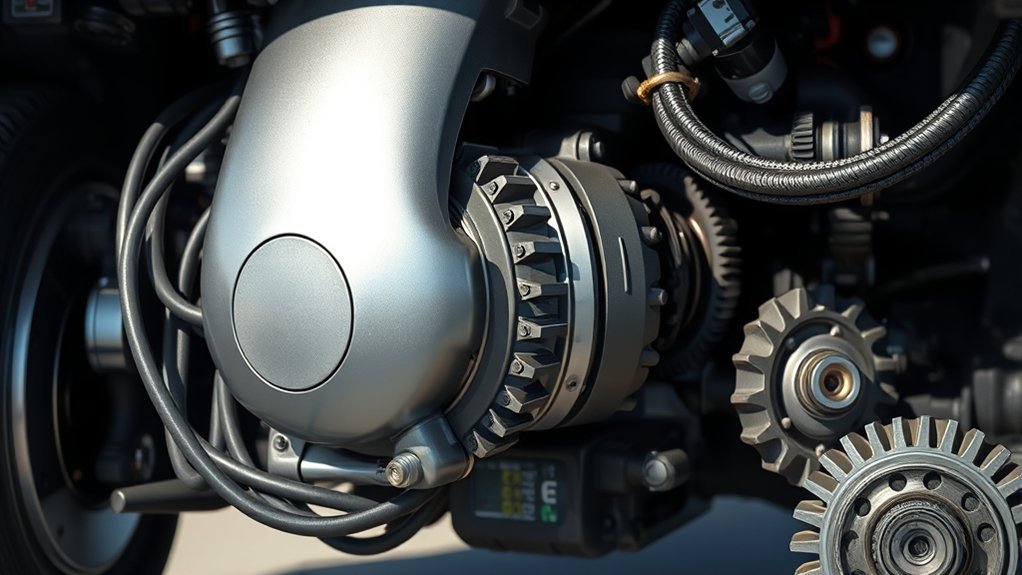
As you explore the world of electric vehicles, you’ll notice that gear systems can vary considerably across different models, each designed to meet specific performance needs. Most EVs utilize a single gear, allowing for seamless acceleration and efficient power delivery. However, high-performance models, like the Porsche Taycan, employ two-speed gearboxes to boost acceleration and top speed.
The early 2008 Tesla Roadster also showcased a multi-speed transmission, optimizing its performance with a two-speed gearbox. On the other hand, dual or tri-motor systems, such as those in the Lucid Air, don’t rely on multiple gears; instead, they effectively distribute torque by optimizing each motor for unique performance characteristics.
| EV Model | Gear System Type |
|---|---|
| Most EVs | Single Gear |
| Porsche Taycan | Two-Speed Gearbox |
| Tesla Roadster | Multi-Speed Transmission |
| Lucid Air | Dual/Tri-Motor System |
| AWD EVs | Varying Gear Ratios |
What Are the Benefits of Single-Gear Transmissions in EVs?
Single-gear transmissions in electric vehicles simplify how power is delivered, making acceleration seamless without the hassle of shifting gears.
This efficiency not only enhances your driving experience but also reduces maintenance needs due to fewer moving parts.
With energy transfer efficiencies reaching up to 98%, you’ll enjoy a more reliable and optimized performance on the road.
Simplified Power Delivery
Electric vehicles (EVs) revolutionize the driving experience with their use of single-speed transmissions, streamlining power delivery for peak performance.
Here’s why this simplified approach is beneficial:
- Instant Torque: Electric motors deliver peak torque at zero RPM, enabling immediate acceleration without gear shifts.
- Fewer Moving Parts: A single-speed transmission reduces maintenance costs and enhances reliability compared to traditional systems.
- High Energy Efficiency: EVs achieve energy transfer efficiencies ranging from 70% to 98%, minimizing energy loss through simplified mechanics.
- Seamless Driving Experience: By eliminating complex gear changes, you enjoy consistent acceleration across various speeds.
With these advantages, single-speed transmissions in electric vehicles (EVs) provide a liberating driving experience that redefines performance on the road.
Enhanced Efficiency
The simplicity of single-speed transmissions in electric vehicles (EVs) brings significant advantages in efficiency. By using single-gear transmissions, EVs reduce the number of moving parts by about 90%, resulting in enhanced efficiency and reliable performance.
These systems can achieve energy transfer efficiencies between 70% and 98%, ensuring efficient power delivery from the battery to the wheels without complex gear shifts. You’ll appreciate the smooth, continuous acceleration thanks to the instant torque from electric motors.
Plus, the absence of traditional gear shifting enhances your driving experience, allowing for uninterrupted enjoyment. This streamlined design not only boosts current efficiency but also paves the way for future advancements in battery technology and electric drivetrain performance.
Embrace the liberation of simplicity!
Reduced Maintenance Needs
While many drivers dread the frequent maintenance of traditional vehicles, those who choose electric cars enjoy a considerable advantage thanks to their single-speed transmissions.
Here’s why opting for an EV means reduced maintenance needs:
- Fewer Parts: A single-speed transmission reduces moving parts by about 90%, minimizing wear and tear.
- Less Lubrication: With fewer components to service, you’ll spend less time at the mechanic.
- Lower Costs: Simplified systems lead to considerably reduced maintenance costs over time.
- Enhanced Reliability: The efficient energy transfer from battery to wheels increases drivetrain longevity.
How Does Instant Torque Impact Electric Vehicle Performance?
When you press the accelerator in an electric vehicle (EV), you’re greeted with immediate power, thanks to instant torque. This feature allows EVs to deliver full power from a standstill, resulting in rapid acceleration without the delays associated with gear shifting in traditional vehicles. The electric motor reaches peak torque at zero RPM, enhancing your driving experience by providing a powerful burst right when you need it.
With a typical operational range of up to 20,000 RPM, electric motors maintain consistent power output across various speeds, enabling smooth acceleration and deceleration. This seamless power delivery not only boosts performance but also improves vehicle control and stability, especially in dynamic driving conditions.
Instant torque minimizes energy losses during acceleration, optimizing energy transfer from the battery to the wheels. Essentially, this unique characteristic of EVs liberates you, transforming driving into a more responsive and enjoyable experience.
How Does Regenerative Braking Boost EV Efficiency?
Regenerative braking transforms the way you think about slowing down; instead of wasting energy, it captures kinetic energy and turns it back into electricity.
This innovative system can recover up to 30% of energy that would otherwise be lost, greatly increasing your electric vehicle’s driving range.
Energy Recovery Mechanism
Electric vehicles (EVs) harness the power of regenerative braking to enhance efficiency and extend their driving range. This energy recovery mechanism works by capturing kinetic energy during braking and converting it back into electrical energy.
Here’s how it boosts your EV experience:
- Efficiency Gains: It can improve energy usage by 10-30%, depending on driving habits.
- Battery Recharge: The electric motor acts as a generator, slowing the vehicle while recharging the battery.
- Enhanced Control: Independent braking force on each wheel improves stability and safety.
- Wasted Energy Recapture: It prevents energy loss as heat, maximizing overall efficiency.
Increased Driving Range
As you navigate through urban environments or stop-and-go traffic, the ability of your electric vehicle to harness kinetic energy during deceleration becomes a game-changer for your driving experience.
Regenerative braking captures this kinetic energy, converting it back into electricity to recharge your battery, effectively extending your driving range. By recouping up to 20% of the energy typically lost during braking, this system enhances efficiency, letting you travel further on a single charge.
Plus, it reduces dependence on traditional braking methods that waste energy through heat. The effectiveness of regenerative braking shines particularly in stop-and-go situations, ensuring your electric vehicle (EV) promotes a more sustainable and economical journey, freeing you from range anxiety.
Enhanced Energy Efficiency
When you drive an electric vehicle, you may not realize how much energy you can reclaim through innovative braking technology. Regenerative braking enhances energy efficiency by converting kinetic energy back into electrical energy, and here’s how it works:
- Energy Recovery: Reclaims up to 30% of energy lost during braking.
- Torque Vectoring: Independently controls braking force on each wheel for maximum energy recovery.
- Electric Motor Role: Transforms the motor from propulsion to energy generation, reducing the need for traditional brakes.
- Smoother Experience: Results in less frequent conventional braking, lowering wear on components.
This revolutionary system not only extends your EV’s range but also contributes to a more sustainable driving experience, liberating you from reliance on traditional transmissions.
Innovations Shaping the Future of EV Transmissions
The landscape of electric vehicle (EV) transmissions is evolving rapidly, driven by groundbreaking innovations that redefine performance and efficiency. You might find future gear systems intriguing, especially as multi-speed transmissions start to appear in high-performance models like the Porsche Taycan, which boasts a two-speed setup. This design enhances acceleration and overall driving experience.
Research into electric drivetrains is also pushing boundaries by reducing vehicle weight and optimizing energy use through alternative gear configurations. Vehicles like the Lucid Air, utilizing dual and tri-motor systems, exemplify how improved torque can be achieved without traditional multi-speed complexities.
Moreover, advancements in battery chemistries promise more efficient power delivery, potentially transforming EV transmission designs. These innovations pave the way for seamless integration of torque and speed across various driving conditions, making your driving experience not just efficient, but exhilarating.
The future of EV transmissions is looking bright and full of promise!
How Do Electric Vehicles Maintain Performance With Fewer Gears?
While many drivers expect multiple gears for peak performance, electric vehicles (EVs) defy this norm by utilizing a single-speed transmission. This design enhances efficiency and delivers smooth power. Here’s how EVs maintain performance without the complexity of multiple gears:
- Instant Acceleration: Electric motors provide high torque from zero RPM, making rapid acceleration effortless.
- Simplified Mechanics: Fewer moving parts mean less wear and tear, improving reliability and maintenance.
- Energy Efficiency: EVs achieve energy transfer efficiencies between 70% to 98%, optimizing performance.
- Seamless Power Delivery: Without interruptions from gear shifts, drivers enjoy a smoother driving experience.
Some performance-oriented models, like the Porsche Taycan, do incorporate multi-speed transmissions for specific enhancements.
However, the majority of EVs prove that fewer gears can still deliver exhilarating performance and liberation from traditional driving constraints.
What Makes Maintenance Easier for Electric Vehicles?
Since electric vehicles (EVs) streamline their design with fewer moving parts, maintaining them becomes considerably easier and more cost-effective.
With around 90% fewer components than internal combustion engine vehicles, EVs demand less frequent maintenance. The simplified single-speed transmission means you won’t deal with complex gear shifting, reducing potential mechanical issues. Plus, you can say goodbye to regular oil changes, as there’s no engine oil needed.
EVs require less maintenance with 90% fewer components, a single-speed transmission, and no need for oil changes.
The regenerative braking system plays an essential role too, extending brake life by minimizing wear on components, which translates to lower maintenance costs.
Many EV manufacturers also provide extensive warranties covering batteries and drivetrain elements, giving you peace of mind.
Frequently Asked Questions
Do EV Cars Have Gears?
Yes, EV cars typically use a single-speed transmission, maximizing electric motor efficiency. While most lack traditional gearboxes, some high-performance models offer two-speed alternatives, enhancing acceleration and top speed while simplifying your driving experience.
Is There Any Electric Car With Gears?
Yes, some electric cars utilize gear ratios for performance enhancement. Models like the Porsche Taycan feature multi-speed transmissions, optimizing electric motors’ efficiency and delivering superior acceleration. This innovation releases greater potential in high-performance electric vehicles.
What Is the Biggest Problem With Electric Cars?
The biggest problem with electric cars is their charging infrastructure challenges. Imagine running low on battery in a remote area. With battery longevity concerns and high ownership costs, many hesitate to fully embrace electric vehicles.
Why Can’t EVS Be Manual?
EVs can’t be manual because their design prioritizes efficiency and simplicity. Without traditional gear shifting, you enjoy a smoother driving experience, as electric motors deliver instant torque, making manual transmission unnecessary and cumbersome.
Conclusion
To sum up, electric vehicles are revolutionizing the way we think about driving. With about 90% of EVs utilizing a single-gear transmission, you get a seamless experience without the hassle of shifting gears. This simplicity not only enhances performance but also reduces maintenance costs. As we move towards a greener future, it’s exciting to realize that these innovations could cut global CO2 emissions by over 1.5 billion tons annually. Embracing EV technology means embracing a cleaner, more efficient world.






Leave a Reply