
Formula 1 cars can reach incredible top speeds of up to 233 mph (375 km/h), showcasing their advanced engineering and performance. For instance, during qualifying, Valtteri Bottas hit a stunning 234.9 mph (378 km/h) in 2016. They can accelerate from 0 to 60 mph in just 1.6 to 2.7 seconds, thanks to hybrid engines producing over 1,000 horsepower and lightweight designs. There’s so much more about the technology and strategies behind this speed—let’s explore those aspects further!
Key Takeaways
- Formula 1 cars reach top speeds of approximately 233 mph (375 km/h), with Valtteri Bottas achieving 234.9 mph (378 km/h) during qualifying in 2016.
- F1 cars can accelerate from 0 to 60 mph in just 1.6 to 2.7 seconds, showcasing their rapid acceleration capabilities.
- Turbocharged hybrid engines in F1 cars produce over 1,000 horsepower, contributing to their high-speed performance.
- Aerodynamic design maximizes downforce and minimizes drag, crucial for maintaining speed and stability on track.
- Compared to other racing series, F1 cars are among the fastest, surpassing speeds of IndyCar and MotoGP vehicles.
Discover the Thrilling Top Speeds of Formula 1 Cars

When you think about the exhilarating world of Formula 1, the mind-boggling top speeds of these cars often take center stage.
Formula One cars are engineered for sheer performance, reaching astonishing top speeds of around 233 mph (375 km/h). Valtteri Bottas made history by hitting a remarkable 372.5 km/h (231 mph) during the 2016 Mexican Grand Prix, showcasing the fastest capabilities of these machines.
Formula One cars exemplify peak performance, reaching speeds of 233 mph, with Valtteri Bottas hitting 372.5 km/h at the 2016 Mexican Grand Prix.
During qualifying for the European Grand Prix at Baku, he pushed the limits further, achieving a jaw-dropping 378 km/h (234.9 mph). This relentless pursuit of speed isn’t just about raw power; it’s a blend of cutting-edge aerodynamic design, including wings and diffusers that minimize drag while maximizing cornering stability.
Each new season brings innovations that challenge previous benchmarks, liberating drivers to experience the thrill of speed like never before. Formula One cars epitomize the fastest automotive technology, making speed an intoxicating element of the sport.
How Do F1 Cars Accelerate From 0 to 60 in Just Seconds?
As F1 cars roar off the starting line, their astonishing ability to accelerate from 0 to 60 mph in just 1.6 to 2.7 seconds captivates both fans and engineers alike.
This mind-blowing acceleration is made possible by modern turbocharged hybrid engines that release over 1,000 horsepower, delivering incredible torque right from the start. The lightweight construction of these cars, with a minimum weight of 798 kg, optimizes the power-to-weight ratio, enhancing quick bursts of speed.
Moreover, advanced tire technology, featuring softer compounds, provides unparalleled grip and traction during acceleration, ensuring that power translates seamlessly to the track.
The aerodynamic design also plays an essential role, as downforce-enhancing components stabilize the car and allow for rapid acceleration without compromising control.
Together, these elements create a thrilling experience, showcasing the pinnacle of automotive engineering and the relentless pursuit of speed.
The Essential Factors Affecting F1 Car Performance
The remarkable acceleration of F1 cars is just one aspect of their overall performance, which hinges on a variety of interrelated factors. You’ll find that aerodynamics, speed, and power output are key components influencing how these machines operate on the track.
| Factor | Description |
|---|---|
| Aerodynamics | Maximizes downforce and minimizes drag. |
| Power Output | Hybrid engines exceed 1,000 horsepower. |
| Tire Technology | Softer compounds enhance grip on varying surfaces. |
| Weight Regulations | Current minimum is 798 kg; changes to 768 kg in 2026. |
| Acceleration | From 0 to 60 mph in just 1.6 seconds. |
Each element affects lap times and overall racing dynamics, contributing to the thrilling spectacle of F1. By understanding these factors, you can appreciate the intricate balance that teams aim for to release their cars’ full potential.
Understanding the Impact of Aerodynamics on F1 Speed
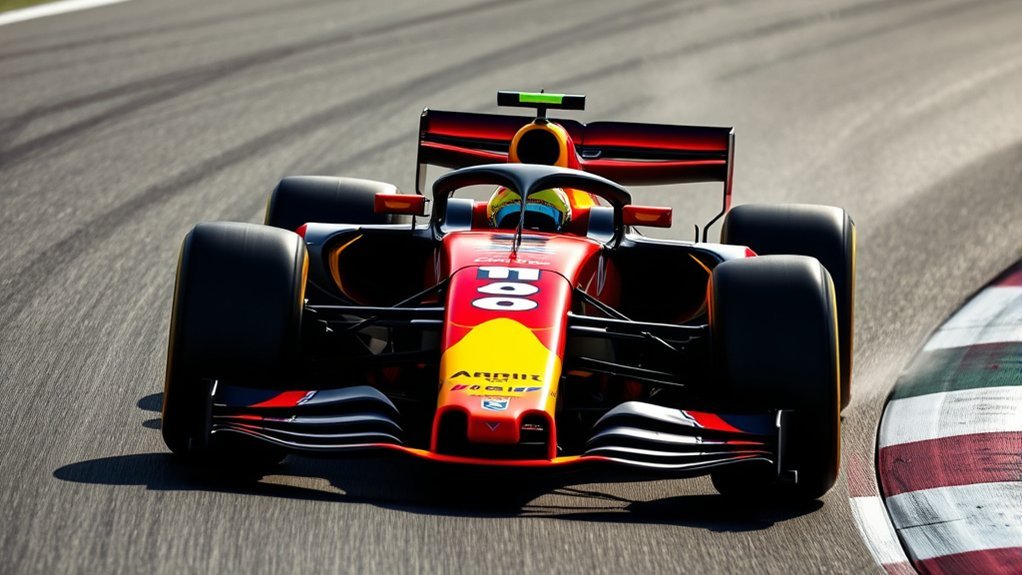
While many factors contribute to an F1 car’s speed, aerodynamics plays a vital role in shaping its on-track performance. The intricate design of aerodynamic components, such as wings and body shapes, is essential for generating significant downforce. This downforce allows you to maintain higher cornering speeds, enhancing stability through turns.
Additionally, features like the Drag Reduction System (DRS) help reduce drag during specific conditions, giving you an edge in straight-line speed. With advancements in aerodynamic technology, modern F1 cars can reach peak speeds of around 233 mph (375 km/h) while expertly balancing between downforce for cornering and minimizing drag.
Continuous development in aerodynamics is important for teams to adapt to varying circuit characteristics, ensuring peak performance. By understanding these aerodynamic principles, you can appreciate how they not only influence speed but also the overall strategy behind each race.
F1 vs. Other Racing Series: How Do They Compare?
When you compare F1 cars to other racing series, the differences in speed and acceleration become clear.
While F1 dominates with impressive top speeds, IndyCar edges ahead on oval tracks, showcasing unique performance capabilities.
This comparison highlights not just the raw speed but also the technological innovations that shape each series.
Speed Comparisons Across Series
In the world of motorsport, speed is an essential factor that often defines a series’s identity and competitiveness.
Fast F1 cars reach remarkable top speeds of around 372 km/h (231 mph), with a record of 378 km/h (234.9 mph) during the 2016 European GP. However, IndyCar cars can edge them out on oval tracks, hitting approximately 380 km/h (236 mph).
Formula 2 cars fall behind, capping at 335 km/h (208 mph), while MotoGP bikes come close with speeds of up to 366 km/h (227.4 mph).
NASCAR, with its top speeds just over 321 km/h (199 mph), highlights the superior engineering and aerodynamics of Formula One vehicles.
Each series brings unique speed dynamics, but F1 remains a benchmark in high-performance racing.
Acceleration Differences Between Categories
Speed isn’t just about top velocity; acceleration plays a significant role in a racing car’s overall performance. Formula 1 cars can rocket from 0 to 60 mph in about 1.8 seconds, showcasing their unmatched acceleration compared to other racing categories.
- Feel the thrill of unmatched speed.
- Experience the power of cutting-edge technology.
- Embrace the art of precision racing.
In contrast, IndyCar reaches 0 to 62 mph in around 3 seconds, while Formula 2 cars take about 2.9 seconds. NASCAR lags further, with a 0 to 60 mph time of 3.4 seconds.
Even MotoGP bikes, quick at 2.6 seconds, can’t quite match the fastest F1 cars. The performance gap is significant, illustrating why F1 reigns supreme in acceleration.
Technological Innovations in Racing
While many racing series showcase impressive technology, Formula 1 stands out with its relentless pursuit of innovation. F1 cars, with their advanced hybrid turbocharged engines producing over 1,000 horsepower, redefine speed records, reaching top speeds around 372 km/h. In contrast, other series like IndyCar and MotoGP prioritize different aspects, such as straight-line speed or agility.
| Racing Series | Top Speed |
|---|---|
| Formula 1 | 372 km/h (231 mph) |
| IndyCar | 380 km/h (236 mph) |
| MotoGP | 366.1 km/h (227.4 mph) |
Through advanced aerodynamics and downforce, F1 cars excel in cornering, showcasing technological innovations that set them apart, liberating drivers to push limits like never before.
Innovations in F1 Technology That Enhance Speed
As Formula 1 continues to push the boundaries of engineering and design, the innovations that enhance speed are nothing short of remarkable.
You’ll marvel at how modern turbocharged hybrid engines exceed 1,000 horsepower, delivering exhilarating acceleration. Advanced aerodynamic designs, featuring intricate wings and diffusers, guarantee stability through corners at high speeds. Plus, KERS (Kinetic Energy Recovery Systems) recovers energy while braking, giving you that extra boost when you need it most.
- Experience the thrill of unmatched horsepower.
- Feel the grip of cutting-edge tire technology.
- Embrace the precision of real-time data analytics.
These innovations not only elevate performance but also liberate the driver’s potential on the track.
Innovations in Formula 1 not only enhance performance but also unleash the driver’s true potential on the track.
With every lap, you’ll witness the perfect fusion of creativity and technology, paving the way for ever-faster racing. In this relentless pursuit of speed, Formula 1 remains a reflection of human ingenuity and passion.
Safety Measures for High-Speed Racing in F1

When you think about the thrill of high-speed racing in F1, it’s essential to recognize the advanced safety features designed to protect drivers.
From reinforced cockpits to fireproof suits, these innovations guarantee that safety isn’t compromised even at incredible speeds.
As you explore the world of F1, you’ll see how these measures reflect the sport’s commitment to driver welfare.
Advanced Safety Features
In the high-octane world of Formula 1 racing, advanced safety features play an essential role in protecting drivers as they navigate the extremes of speed and precision.
These innovations guarantee that drivers must remain focused without compromising their safety. Key elements include:
- Reinforced cockpits that maintain structural integrity during collisions
- Mandatory fireproof suits and helmets to shield against fire hazards and impacts
- The HANS device, which reduces the risk of neck injuries during sudden deceleration
With FIA regulations mandating fire extinguishers and the introduction of the halo device, F1 continually prioritizes driver safety.
These advanced safety features empower drivers, allowing them to push their limits while knowing they’re well-protected in the most demanding racing environment.
Driver Protection Equipment
Formula 1 racing demands not only exceptional skill but also a thorough suite of driver protection equipment that guarantees safety at extreme speeds.
You’ll find that drivers wear fireproof safety suits and helmets adhering to strict FIA standards, ensuring protection against fire and impact. The HANS device plays an essential role in minimizing neck injuries during high-G force collisions, allowing you to push the limits with confidence.
Additionally, F1 cars are equipped with safety roll-bar structures and reinforced cockpits to shield drivers during crashes. FIA regulations also mandate fire extinguisher systems to swiftly tackle any fire emergencies.
With ongoing advancements like the halo device, head protection is continuously enhanced, making the track safer for those who crave the thrill of speed.
Frequently Asked Questions
Can F1 Cars Go 200 Mph?
Yes, F1 cars can exceed 200 mph. Their aerodynamic design and exceptional engine performance allow for incredible speeds, showcasing the thrilling potential of racing technology and pushing the limits of what you thought possible.
Why Is Number 69 Banned in F1?
Ever wonder why the number 69’s banned in F1? It’s all about maintaining family-friendly vibes. F1 regulations restrict driver numbers that might offend, ensuring everyone enjoys the sport without inappropriate associations lurking around.
What’s Faster, F1 or Indy 500?
Indy cars typically achieve higher straight-line speeds, making them faster overall, while F1 excels in acceleration and cornering strategies. Your choice between them depends on whether you value raw speed or intricate racing dynamics.
How Fast Do Formula 1 Cars Go in a Race?
Formula 1 cars race like cheetahs on the track, reaching speeds around 200 mph. Your race speed relies on track conditions and driver skill, creating thrilling comparisons to other motorsports in the fast-paced world of racing.
Conclusion
So, next time you marvel at an F1 car zipping by at 200 mph, remember it’s not just speed—it’s a symphony of engineering genius and split-second decisions. Ironically, while these cars seem to defy physics, it’s the meticulous attention to safety that keeps drivers in one piece. You might think flying around a track at breakneck speeds is reckless, but in the world of F1, it’s the careful balance of thrill and safety that truly defines the race.







Leave a Reply