
When you’re looking at vehicle specs, the average car weighs about 4,094 pounds, but weight can vary markedly based on the type. Small cars can weigh around 2,600 pounds, while larger SUVs and pickup trucks often exceed 5,000 pounds. Weight influences safety, fuel efficiency, and insurance costs. By knowing your vehicle’s weight, you can make smarter choices regarding safety and efficiency. Want to uncover more about how weight impacts your driving experience?
Key Takeaways
- Average vehicle weight in 2022 was approximately 4,094 pounds, varying by type and model.
- Small cars typically weigh around 2,600 pounds, while large cars average 4,400 pounds.
- SUVs generally weigh between 4,000 to 5,000 pounds, with pickup trucks often exceeding 5,000 pounds.
- Curb weight includes standard equipment and a full tank, excluding passengers and cargo.
- Understanding vehicle weight helps in assessing safety, fuel efficiency, and insurance costs.
Understanding Average Vehicle Weight and Its Importance

Understanding the average vehicle weight is vital for every driver, as it affects safety, fuel efficiency, and compliance with regulations. In 2022, the average vehicle weight was about 4,094 pounds, a slight decrease from previous years.
Small cars typically weigh around 2,600 pounds while large cars average 4,400 pounds, demonstrating significant variance. Knowing your car’s curb weight, which includes standard equipment and a full tank, is essential for safe driving.
Heavier vehicles often provide better protection in accidents; studies show larger cars can reduce crash fatality risks compared to smaller models. Additionally, vehicle weight impacts fuel efficiency—reducing weight by just 100 pounds can improve efficiency by 1% to 2%.
How Vehicle Type Influences Weight
When it comes to vehicle weight, the type of vehicle you choose plays a significant role. The average weight of smaller cars hovers around 2,600 pounds, while larger vehicles like SUVs and pickup trucks often tip the scales at 4,000 to over 6,000 pounds. This variance not only affects fuel efficiency but also your driving experience.
Here’s a quick look at how different vehicle types compare:
| Vehicle Type | Average Weight |
|---|---|
| Subcompact Cars | ~2,510 pounds |
| Small Cars | ~2,600 pounds |
| SUVs | 4,000 – 5,000 pounds |
| Pickup Trucks | >5,000 pounds |
Choosing a vehicle that aligns with your needs means understanding these weight differences. Larger vehicles provide more space and capability, while smaller cars often enhance fuel efficiency, giving you the freedom to make the best choice for your lifestyle.
Understanding Key Vehicle Weight Measurements: Curb Weight, GVW, and Payload
To navigate the complexities of vehicle weight, it’s essential to grasp key measurements like curb weight, gross vehicle weight (GVW), and payload.
Understanding these terms can greatly impact your vehicle safety and compliance with regulations.
- Curb Weight: This is the weight of your vehicle with standard equipment and a full tank of fuel, excluding passengers and cargo.
- Gross Vehicle Weight (GVW): This represents the total weight of the vehicle, including any passengers, cargo, and equipment.
- Gross Vehicle Weight Rating (GVWR): This is the maximum weight your vehicle can safely carry, factoring in its curb weight and additional loads.
- Payload: This is the difference between GVWR and curb weight, indicating how much extra weight your vehicle can handle safely.
Typical Vehicle Weights for Popular Car Models
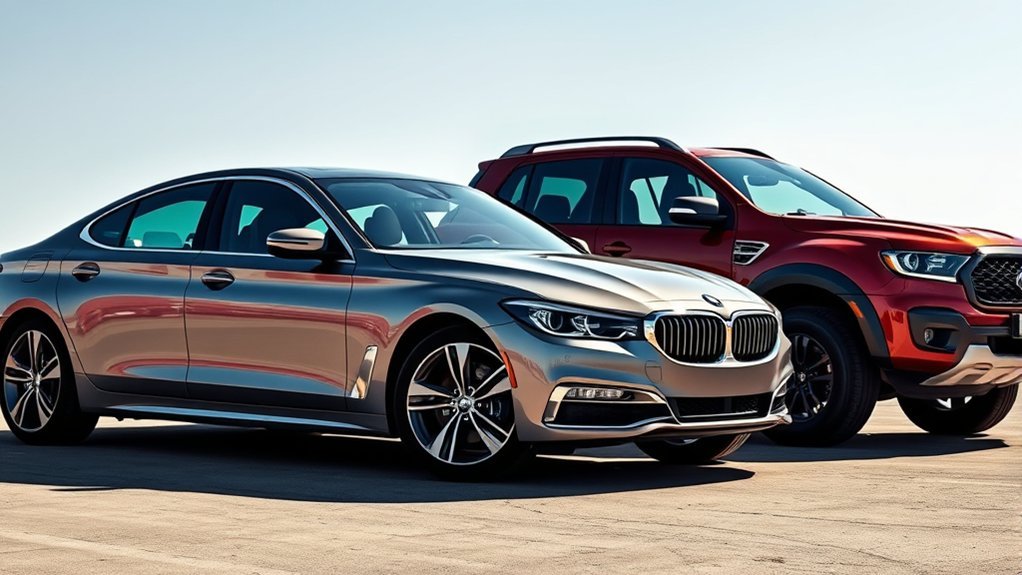
When it comes to vehicle weights, you’ll notice a wide range depending on the model and type.
For instance, trucks like the Ford F-Series can weigh over 6,000 pounds, while sedans like the Honda Accord typically fall between 3,131 and 3,428 pounds.
Understanding these variations not only highlights the diverse designs of popular cars but also their performance and efficiency capabilities.
Average Weights By Model
Understanding the average weights of popular car models can considerably influence your vehicle choice, especially when considering performance, fuel efficiency, and safety.
By knowing the average weights by model, you can make informed decisions tailored to your needs. Here are some typical vehicle weights:
- Ford F-Series: 4,705 to 5,500 pounds, depending on the model and configuration.
- Ford Mustang: 3,520 to 3,800 pounds, a lighter vehicle option for sports enthusiasts.
- Honda Accord: Curb weight ranges from 3,131 to 3,428 pounds, ideal for a midsize sedan.
- Jeep Cherokee: Weighs around 4,250 pounds, robust for SUVs or trucks.
Choosing the right vehicle weight can enhance your driving experience, aligning performance with your lifestyle needs.
Weight Variations By Type
Different vehicle types come with varying weights that greatly impact performance, fuel efficiency, and safety.
The average car weights can differ markedly; for instance, an average small car weighs around 3,000 pounds, while midsize models like the Honda Accord range from 3,131 to 3,428 pounds.
If you opt for larger SUVs, be prepared for weights as hefty as 5,650 pounds, which can affect maneuverability and fuel consumption.
Passenger vehicles fall into distinct categories that determine their weight limits.
Understanding the weight of your vehicle is essential, as it directly affects handling, acceleration, and braking.
Notable Heavyweight Vehicles
Heavyweight vehicles often command attention not just for their size but also for their performance and capabilities.
If you’re curious about notable heavyweight vehicles, here are some key examples:
- Ford F-Series Trucks: The F-150 averages around 4,705 pounds, making it a heavyweight in the light-duty category.
- RAM 1500 Tradesman: Weighing between 4,778 and 5,106 pounds, this full-size pickup showcases robust construction.
- Jeep Cherokee: With a curb weight of about 4,250 pounds, it balances off-road capabilities with a mid-size SUV design.
- Ford Mustang: Ranging from 3,520 to 3,800 pounds, this sporty classic emphasizes performance over sheer weight.
In contrast, sedans like the Honda Accord typically weigh between 3,131 and 3,428 pounds, offering efficiency and comfort.
How Vehicle Weight Impacts Safety
When it comes to vehicle safety, the weight of a car plays an essential role in protecting its occupants during a collision. Heavier vehicles generally sustain less damage, providing better protection compared to their lighter counterparts. This is significant because each 100 pounds of weight reduction can increase the risk of fatality by approximately 1.6%.
| Vehicle Weight | Safety Benefits | Risks |
|---|---|---|
| Over 4,000 lbs | Improved crash protection | 45% more pedestrian fatalities |
| 3,000 – 4,000 lbs | Enhanced vehicle stability | Moderate crash risks |
| Under 3,000 lbs | Lighter handling | Higher injury severity |
Larger vehicles often experience lower death rates in crashes, emphasizing the importance of weight distribution for vehicle stability. While heavier vehicles help protect occupants, they raise concerns for vulnerable road users. Therefore, understanding weight’s impact is essential for informed choices.
How Vehicle Weight Affects Fuel Economy
While many drivers prioritize power and size in their vehicle choices, the weight of a car greatly impacts fuel economy. Understanding how vehicle weight affects your wallet and the environment can empower your decisions.
- Fuel Efficiency: Every reduction of 100 pounds can improve fuel economy by 1% to 2%.
- Heavier Vehicles: Heavier vehicles generally require more energy for acceleration, resulting in lower fuel efficiency.
- Average Weight: In 2022, the average weight of cars was about 4,094 pounds, pushing fuel consumption higher for larger models.
- Environmental Impact: Lighter vehicles not only save fuel but also reduce carbon emissions, promoting a healthier planet.
As consumer preferences shift toward larger SUVs and trucks, it’s essential to reflect on weight management in your choice of vehicle makes.
Embracing lighter vehicles can liberate you from high fuel costs and environmental guilt.
How to Find Your Vehicle’s Weight: A Step-by-Step Guide

To find your vehicle’s weight, start by checking the owner’s manual, where you’ll find key specifications like curb weight and GVWR.
If that’s not handy, the manufacturer’s website is an excellent resource for detailed weight information tailored to your specific model and year.
Knowing your vehicle’s weight not only aids in maintenance but also helps you understand its performance on the road.
Check Owner’s Manual
Finding your vehicle’s weight is crucial for various reasons, and the owner’s manual is a valuable resource that can provide you with this important information.
Here’s how to check your owner’s manual:
- Locate the specifications section – Look for details about your vehicle’s weight, specifically the curb weight.
- Find the weight information sticker – This sticker is generally on the driver’s side door frame and lists both curb weight and Gross Vehicle Weight Rating (GVWR).
- Check for additional resources – Some manuals include references to the manufacturer’s website for further details.
- Consider a professional measurement – If you can’t find the info, visit a junkyard or inspection center for an accurate measurement.
Understanding your vehicle’s weight helps promote safe driving and compliance with regulations.
Use Manufacturer’s Website
If you’re still looking for your vehicle’s weight after checking the owner’s manual, the manufacturer’s website can be a great alternative.
Simply enter your car’s make, model, and year to access detailed vehicle specifications, including curb weight and Gross Vehicle Weight Rating (GVWR).
Look for sections labeled “Owner’s Resources” or “Specifications” on the homepage, as these often house the weight information you need.
It’s essential to verify the specific model year, since weights can vary greatly.
Some sites even offer downloadable owner’s manuals with thorough details.
If you’re still struggling to find the info, use the Vehicle Identification Number (VIN) decoder to get precise weight information tailored to your vehicle.
What Trends Are We Seeing in Vehicle Weight?
As consumers increasingly gravitate toward larger vehicles, trends in vehicle weight reveal a complex landscape. The average vehicle weight has fluctuated over recent years, with 2022 seeing a slight decrease to 4,094 pounds from 2021’s 4,289 pounds.
As consumer preference shifts towards larger vehicles, average vehicle weight saw a slight decrease in 2022.
Here are some key trends to evaluate:
- Pickup trucks have surged in weight, increasing by 30% from 1975 to 2021, now exceeding 5,000 pounds.
- Sedans and SUVs have experienced weight reductions of 12% and 5%, respectively, showcasing shifts in consumer preferences and material advancements.
- Heavier vehicles tend to improve safety, as occupant fatalities in lighter cars have dropped by over 33% since 2000.
- In 2021, SUVs dominated the market, accounting for 56% of new vehicle sales, underscoring the ongoing trend toward heavier vehicles.
These trends reflect an evolving automotive landscape shaped by safety, preferences, and innovation.
How Vehicle Weight Affects Insurance Costs
When considering insurance costs, vehicle weight plays a significant role that often surprises consumers. Heavier vehicles generally come with higher insurance premiums due to increased replacement costs; for instance, mid-size pickups average $1,679 for full coverage compared to $1,922 for medium sedans.
However, heavier vehicles tend to provide better collision protection and are less likely to be totaled, which can balance out those higher repair costs for insurers. This correlation often links to safety ratings, as larger cars excel in protecting occupants during accidents.
On the flip side, luxury small cars usually have higher premiums due to theft risks. Additionally, weight influences design and materials, affecting fuel efficiency while aiming to reduce carbon emissions.
Understanding these dynamics can help you make informed choices about vehicle weight and its impact on your insurance costs.
Future Predictions: The Evolution of Vehicle Weight
As you look toward the future of vehicle design, expect a significant shift toward lightweight materials like advanced composites and aluminum, driven by the need for better fuel efficiency and stricter emissions regulations.
You’ll also notice how electric vehicles are evolving, with innovations likely to reduce battery weight and overall vehicle mass.
With regulatory standards tightening, manufacturers are poised to adapt, ensuring that both sedans and larger vehicles maintain efficiency without sacrificing performance.
Lightweight Materials Adoption
The shift toward lightweight materials in the automotive industry is set to revolutionize vehicle design and performance in the coming decade.
By embracing these innovations, automakers can achieve significant benefits:
- Reduction in Vehicle Weight: Lightweight materials like aluminum and carbon fiber could cut average vehicle weight by up to 15%.
- Advanced High-Strength Steel: This material offers comparable strength to traditional steel but at a lighter weight, enhancing performance.
- Electric Vehicles: The integration of lightweight composites helps offset the weight of large battery packs, improving overall efficiency.
- Regulatory Pressures: Stricter fuel economy standards compel manufacturers to prioritize lightweight materials, driving the industry toward sustainable practices.
Ultimately, these advancements will enhance fuel efficiency, reduce emissions, and pave the way for a more liberated driving experience.
Electric Vehicle Weight Trends
While electric vehicles (EVs) currently tend to weigh more than their gasoline counterparts due to bulky battery packs, a transformative shift is on the horizon. As manufacturers innovate, you can expect average EV weights to stabilize or even decline, thanks to advancements in battery density and the adoption of lighter materials.
| Vehicle Type | Average Weight |
|---|---|
| Compact EV | 3,000 – 3,500 lbs |
| Larger Electric SUVs | 5,000+ lbs |
| Future EV Models | Potentially lighter |
Larger electric SUVs are becoming prevalent, but they impact range and efficiency. By focusing on improving fuel efficiency and integrating lighter materials, the future of EVs looks promising, marrying performance with sustainability.
Regulatory Weight Standards Changes
With vehicle sizes steadily increasing over the past few years, regulatory weight standards are evolving to keep pace.
The U.S. Department of Transportation anticipates changes that reflect the growing average vehicle weight, which rose to about 4,419 pounds in 2024.
Here’s what to expect:
- Lighter Materials: Manufacturers will innovate with light materials to enhance fuel efficiency despite consumer demand for heavier vehicles.
- Stricter Regulations: New safety regulations will push for designs that balance weight with safety.
- Electric Vehicles: The rise of electric vehicles may stabilize traditional vehicle weights due to battery systems.
- Technological Advancements: Ongoing advancements could lead to a decrease in average vehicle weight while achieving regulatory goals.
Frequently Asked Questions
Is 3400 Pounds Heavy for a Car?
No, 3,400 pounds isn’t heavy for a car. It’s average for midsize sedans, lighter than pickup trucks, and more fuel-efficient than compact cars, often providing a good balance of weight distribution and towing capacity.
Can You Write off 100% of a 6000 Lb Vehicle?
Yes, you can write off 100% of a qualifying 6,000-pound vehicle under IRS guidelines, turning business expenses into liberating tax deductions, as long as it meets vehicle classification and depreciation rules.
Are Teslas Heavier Than Normal Cars?
Yes, Teslas are generally heavier than normal cars. Their weight stems from battery contributions and advanced materials. This weight distribution impacts driving range, safety ratings, and overall vehicle dynamics, highlighting significant Tesla model differences.
Is 2 Tons Heavy for a Car?
Two tons isn’t particularly heavy for a car, especially considering SUV trends and luxury sedans. It impacts vehicle weight, car safety, towing capacity, and fuel efficiency, especially compared to lighter compact cars and electric vehicles.
Conclusion
In summary, understanding your vehicle’s weight is essential for safety, performance, and even insurance costs. Just like the steel and wood that built the first cars, today’s materials shape how we drive and protect ourselves on the road. As you consider your next vehicle, remember that weight plays a significant role in efficiency and safety. Stay informed, and you’ll make smarter choices that resonate through time, just like the classic cars that still turn heads today.







Leave a Reply