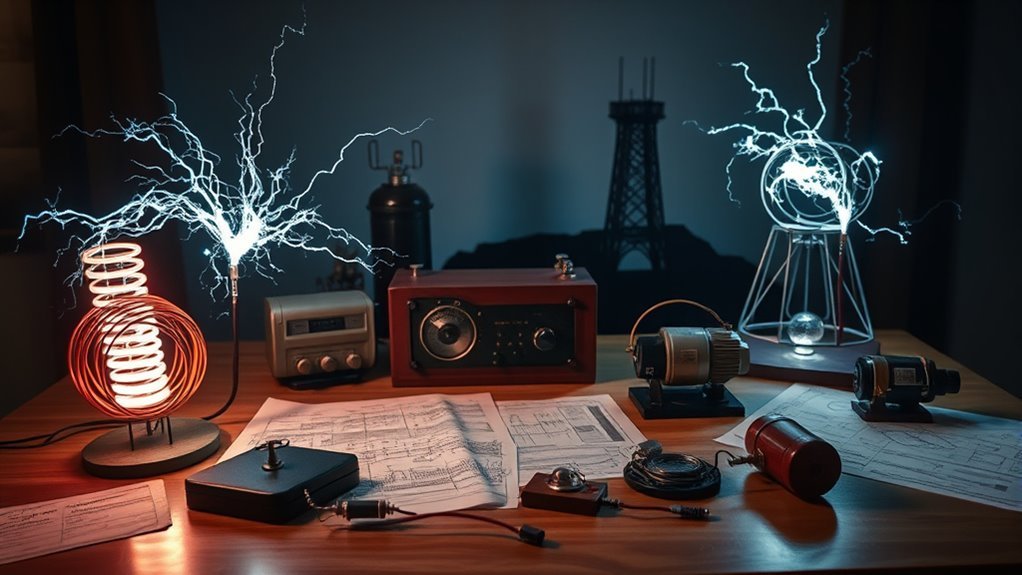
Nikola Tesla pioneered technologies that reshaped the modern world. He created the AC induction motor, transformed power transmission, and developed the Tesla Coil to advance wireless communication. His work in fluorescent lighting and X-ray imaging laid the groundwork for modern medical and industrial tools. Tesla also envisioned wireless energy transmission and designed the efficient Tesla turbine. You will discover the full scope of his inventions and their lasting influence on today’s technology below.
Quick Answer
Nikola Tesla is best known for developing the alternating current (AC) power system, which remains the global standard for electricity distribution. His other major contributions include the AC induction motor, the Tesla Coil, remote control technology, and pioneering work in X-ray imaging. These inventions fundamentally enabled modern electrical grids, mass production, and wireless communication.
Key Takeaways
- Developed the AC induction motor, which serves as the foundation for modern electric motors.
- Invented the Tesla Coil, enabling high-voltage experiments and influencing early radio technology.
- Created the first remote-controlled device in 1898, proving the potential for wireless signals.
- Advanced fluorescent and neon lighting, which improved energy efficiency in public spaces.
- Pioneered early X-ray imaging techniques that influenced future medical diagnostic tools.
The Significance of Nikola Tesla’s Inventions
Many inventors shaped modern technology, but Nikola Tesla stands out for his impact on electrical systems. His creativity led to inventions like the AC induction motor, which allowed for efficient electricity distribution over long distances.
This foresight helped build modern electrical grids and influenced the design of the first hydroelectric power plant at Niagara Falls. Tesla’s invention of the Tesla coil in 1891 facilitated massive leaps in radio technology and wireless communication.
His early work in remote-controlled devices paved the way for modern robotics. With over 100 patents to his name, Tesla’s innovations reflect a unique vision that continues to inspire progress.
Exploring Alternating Current (AC) Technology
Tesla developed the AC induction motor in 1887 by harnessing a rotating magnetic field for smooth operation. His polyphase AC system, patented in 1888, improved motor performance and revolutionized long-distance electricity transmission.
These innovations pushed the world toward the widespread adoption of AC technology. This shift fundamentally changed how we generate and distribute power today.
AC Induction Motor Development
Nikola Tesla transformed electrical engineering by developing the AC induction motor. This motor, patented in May 1888, used a rotating magnetic field to convert electrical energy into mechanical energy.
- Revolutionized AC motor applications in industry.
- Enabled efficient, long-distance power transmission.
- Introduced the squirrel cage rotor design.
Tesla’s collaboration with George Westinghouse accelerated the adoption of AC systems. A successful demonstration at the 1893 World’s Columbian Exposition solidified AC technology as the global standard for power.
Polyphase AC System Impact
The polyphase AC system changed how society generates and uses electricity. It enabled efficient long-distance transmission, which facilitated the growth of modern electrical grids.
At the 1893 World’s Columbian Exposition, Tesla proved the system offered superior safety and efficiency compared to direct current (DC). The use of transformers allowed for easy voltage adjustments, making electricity safe for homes and factories.
How the Induction Motor Changed Industry
The induction motor transformed operational efficiency across global industries. By removing the need for commutators and brushes, Tesla’s design reduced manufacturing costs and improved machine reliability.
This innovation changed factory operations and enabled higher levels of productivity. It served as a primary driver during the industrial shift toward automation.
Enhanced Operational Efficiency
Nikola Tesla’s induction motor played a key role in boosting operational efficiency. It leveraged principles of energy efficiency to transform manufacturing processes.
- Eliminated commutators to improve motor reliability.
- Enabled widespread adoption of AC power grids.
- Facilitated the development of automated assembly lines.
The motor converts electrical energy into mechanical power while minimizing energy losses. It remains an essential component in transportation and heavy manufacturing today.
Reduced Manufacturing Costs
Tesla’s induction motor lowered manufacturing costs by replacing complex DC motor components. The design reduced the wear and tear typically associated with brushes and commutators.
Factories implemented unit drives, which allowed multiple machines to run from a single motor. This streamlined production and lowered energy expenses. Centralized power plants, supported by long-distance transmission, further reduced costs for businesses.
Enabled Mass Production
The induction motor acted as a catalyst for mass production. It optimized industrial machinery and allowed for the reliable operation of multiple devices from a single power source.
Its impact is clear in these areas:
- Lowered maintenance costs through simpler design.
- Improved power delivery via the polyphase system.
- Revolutionized textiles, assembly lines, and heavy manufacturing.
Wireless Communication and Remote Control
By the late 1890s, Tesla began to shift the landscape of communication. He demonstrated the first remote-controlled boat in 1898, showing that radio signals could control physical objects. He used a four-circuit resonance system to build this foundation for modern wireless control.
| Year | Invention/Patent | Significance |
|---|---|---|
| 1897 | Wireless Transmission Patents | Defined radio technology principles |
| 1898 | Remote-Controlled Boat | First public wireless control demo |
| 1900 | Communication Patents | Established his role as a pioneer |
| 1943 | Supreme Court Recognition | Validated his radio contributions |
Lighting Innovations

Tesla’s work in fluorescent and neon lighting changed indoor illumination. He utilized high-frequency electricity to create systems that were more efficient than standard incandescent bulbs.
These innovations paved the way for the lighting technology we use in homes today. His focus on efficiency set new standards for the entire lighting industry.
Fluorescent Lighting Advancements
Nikola Tesla’s early versions of fluorescent lighting improved energy efficiency. These designs allowed for:
- Higher efficiency than traditional incandescent bulbs.
- Longer lifespans and lower maintenance needs.
- A basis for modern CFL and LED technologies.
Neon Lights Popularization
Tesla demonstrated the potential of neon lighting at the 1893 World’s Columbian Exposition. By using high-frequency electricity to excite gas, he removed the need for filaments, making lights more durable.
This breakthrough eventually led to the development of neon signs for advertising. Today, these displays remain a fixture of urban design and visual art.
The Tesla Coil
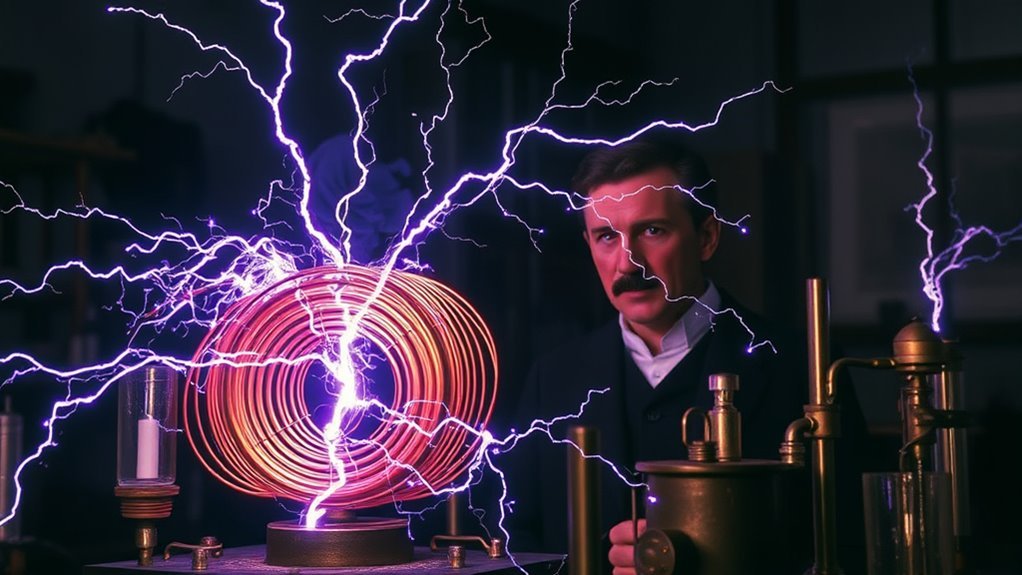
Invented in 1891, the Tesla coil is a resonant transformer circuit. It produces high-voltage, low-current, high-frequency electricity. This circuit enabled groundbreaking high-voltage experiments.
- Generates millions of volts for electrical displays.
- Pioneered the concept of wireless power transmission.
- Serves as a key component in early radio and electronics.
Tesla’s demonstrations at the 1893 World’s Columbian Exposition used these coils to power wireless lighting. This proved that electrical energy could travel through space, pushing the boundaries of engineering. Always consult a qualified electrical engineer before attempting high-voltage experiments.
Pioneering Early X-Ray Technology
Tesla’s experiments with electrical discharge tubes helped develop early X-ray technology. He created shadowgraphs, which were early images produced by visualizing objects through opaque materials.
His research with high-frequency currents and vacuum tubes in the 1890s influenced Wilhelm Conrad Röntgen. While others receive primary credit, Tesla’s early observations on radiation and human tissue were essential for the field.
Vision for Wireless Energy
Tesla envisioned a world powered by wireless energy. He wanted to provide limitless power without the need for traditional infrastructure. His project, the Wardenclyffe Tower, aimed to test this on a global scale.
- Experiments in Colorado Springs supposedly lit 200 bulbs wirelessly.
- The Magnifying Transmitter combined resonance and high voltage to boost energy transfer.
- Funding struggles eventually halted his most ambitious projects.
Although his dreams of a wireless energy grid were never fully realized, they continue to drive current research into wireless power and charging technologies.
The Tesla Turbine
The Tesla Turbine uses a design distinct from traditional turbine blades. It relies on smooth, parallel disks that use the boundary layer effect to capture energy from moving fluids.
This design minimizes turbulence and increases turbine efficiency. Tesla intended for it to run on steam, water, or gas. While it did not achieve commercial dominance, it remains a subject of study in fluid dynamics.
Legacy of Nikola Tesla
Nikola Tesla’s work continues to shape modern technology. His influence is visible in many everyday fields.
- The AC system remains the global standard for power distribution.
- Induction motors run most industrial and household appliances.
- Principles of wireless transmission support modern smartphone and computer networks.
Tesla’s vision for the future remains a guide for researchers in renewable energy and global communication. His legacy is one of continuous, bold innovation.
Frequently Asked Questions
What are 5 things Nikola Tesla invented?
Tesla is credited with the AC induction motor, the Tesla coil, early remote control technology, wireless lighting systems, and polyphase power distribution systems. These inventions are foundational to our modern electrical world.
Did Nikola Tesla invent electricity?
No, Tesla did not invent electricity. He revolutionized how we generate, transmit, and apply electricity, specifically through the creation of the AC system and the induction motor.
What was Tesla’s first invention?
Tesla’s development of the induction motor was his first major breakthrough in electrical engineering. This creation transformed the industry and set the stage for all his later electrical work.
What is Tesla’s most famous product?
The alternating current (AC) induction motor is his most famous contribution. It remains the backbone of electrical systems worldwide, proving the effectiveness of his design for mass power usage.
Conclusion
Nikola Tesla sparked a technological shift that continues to define our modern experience. From his efficient AC system to his visionary concepts of wireless power, his contributions were truly monumental. His work built the foundation for how we use energy, lighting, and communication today. By remembering his impact, we see that Tesla was more than an inventor; he was a leader who designed our electrified future.







Leave a Reply