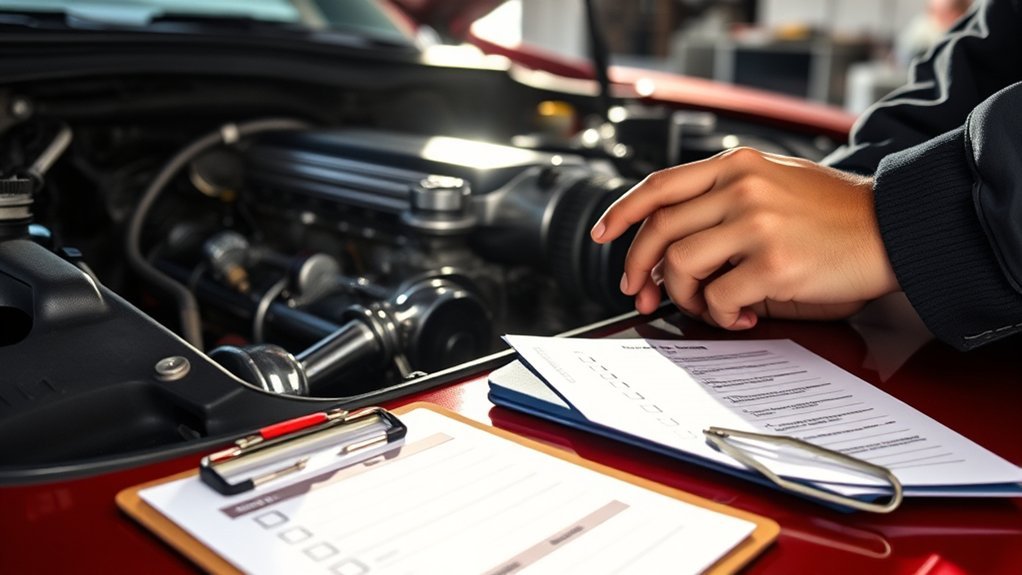
A full car service includes vital tasks like an oil change, brake checks, tire evaluations, and fluid inspections to maintain your vehicle’s performance and safety. You’ll want to guarantee that your engine oil and filters are replaced, brakes are inspected, and tire pressure and tread depth are checked. Additionally, essential fluids like coolant and brake fluid should be topped up. Keep an eye on battery health too. Keep going to discover more about what’s involved in a complete service!
Key Takeaways
- A full car service includes an oil change and filter replacement for optimal engine lubrication and health.
- Brake checks assess pads, discs, and fluid levels to ensure vehicle safety.
- Tire evaluation involves checking tread depth, pressure, and rotating tires as necessary for performance.
- Fluid inspections cover coolant, transmission, power steering, and brake fluids to maintain vehicle operation.
- Air filter maintenance is part of the service to enhance engine efficiency and performance.
What Is Included in a Full Car Service?
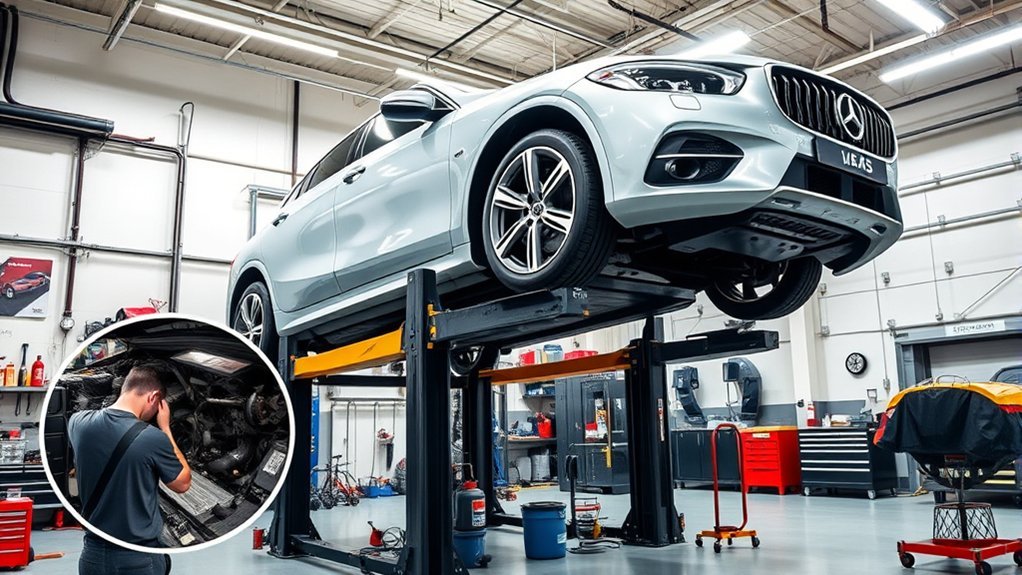
When you schedule a full car service, you’re ensuring your vehicle gets the thorough care it needs to run smoothly. A key component is the oil change, where your engine oil and filter are replaced to enhance engine health.
Brake checks are also essential; mechanics inspect brake pads, discs, and fluid levels, ensuring your safety on the road. They’ll also evaluate tire tread and pressure, rotating them as needed to promote even wear and extend their life.
The service includes checking and replacing air filters to maintain engine efficiency and air quality inside your car. Fluid levels for coolant, transmission, power steering, and brake fluids are meticulously inspected and topped up to prevent potential mechanical issues.
Regularly checking and replacing air filters, along with fluid levels, is crucial for optimal engine performance and vehicle safety.
Following a maintenance schedule like this keeps your vehicle in top shape, empowering you with the freedom to drive confidently.
Why Regular Car Servicing Is Essential
Regular car servicing is essential for your vehicle’s health, as it helps prevent minor issues from turning into costly repairs.
By keeping your car maintained, you boost safety, enhance performance, and increase its resale value.
Plus, scheduled check-ups guarantee you’re following manufacturer guidelines, ultimately extending your vehicle’s lifespan.
Preventative Maintenance Benefits
Maintaining your vehicle through regular servicing is essential for preventing costly repairs and ensuring your safety on the road. A full service typically involves routine maintenance that helps identify potential issues before they escalate.
By staying on top of essential maintenance like oil changes and brake inspections, you can avoid costly repairs and keep your vehicle running smoothly. Additionally, consistent servicing can improve fuel efficiency, allowing your engine to perform at its best while consuming less fuel.
Keeping detailed service records not only enhances reliability but also helps improve resale value, as buyers prefer well-maintained cars. Ultimately, regular preventative maintenance contributes to a longer vehicle lifespan, giving you the freedom to drive with peace of mind.
Improved Vehicle Safety
Guaranteeing your vehicle undergoes routine servicing is essential for enhancing safety on the road. Regular maintenance addresses critical safety components, such as brakes and tires, to maintain ideal performance and prevent accidents. A thorough brake system check boosts stopping power, while monitoring essential fluids prevents overheating and brake failure. By catching potential issues early, you can avoid costly repairs down the line. Plus, a documented service history promotes vehicle safety, reassuring you and future buyers of your car’s well-maintained state.
| Component | Importance |
|---|---|
| Brake System | Enhances stopping power |
| Tires | Guarantees traction and stability |
| Essential Fluids | Prevents overheating |
| Steering Systems | Guarantees directional control |
| Service History | Builds buyer confidence |
Enhanced Resale Value
Routine car servicing not only enhances safety but also greatly boosts your vehicle’s resale value. By keeping up with oil changes and regular checks, you guarantee your car runs smoothly, making it more appealing to potential buyers.
A documented service history can increase your vehicle’s resale value by up to 20%, as buyers prefer cars with proof of reliable service. Maintaining detailed maintenance records helps identify potential issues before they escalate into costly repairs.
A well-maintained car not only lasts longer but also retains better overall condition, ultimately leading to a higher resale price. Providing a complete service history empowers you during negotiations, giving buyers confidence in your vehicle’s upkeep and reliability.
Essential Checklist for a Full Car Service
When you schedule a full car service, it’s important to focus on key maintenance components that keep your vehicle running smoothly.
You’ll want to make sure that essential checks, like oil changes and brake inspections, are on the list.
After service, follow up with post-service procedures to maintain your car’s performance and safety.
Key Maintenance Components
A thorough car service checklist is essential for maintaining your vehicle’s performance and safety. Here are the key maintenance components you’ll want to focus on during your full car service:
| Maintenance Component | Description |
|---|---|
| Engine Oil & Oil Filter | Change to guarantee peak lubrication |
| Brake Fluid | Inspect levels for safe stopping power |
| Tire Pressure & Tread | Check depth and pressure, consider rotations |
| Essential Fluid Levels | Assess and top up coolant, brake, and transmission fluids |
Additionally, inspect battery terminals and air filters to catch potential issues early. Keeping these components in check not only enhances your car’s longevity but also liberates you from unexpected breakdowns. Regular maintenance truly makes a difference!
Post-Service Procedures
After completing your car service, it’s crucial to follow a set of post-service procedures to guarantee everything operates smoothly.
Start by refilling the engine oil and checking its levels to verify they’re within the ideal range for engine health. Next, torque the wheel nuts to the manufacturer’s specifications, ensuring safety and proper attachment.
Conduct a road test to confirm your vehicle runs well after maintenance. Don’t forget to reset the service lights and generate emission reports to maintain compliance with environmental regulations and track future maintenance costs.
Finally, verify the upholstery and controls are clean, enhancing the overall customer experience and leaving you with a sense of liberation in your vehicle’s performance.
The Importance of Oil and Filter Changes
Regular oil and filter changes are crucial for keeping your engine running smoothly and efficiently. By changing the oil every 3,000 to 7,500 miles, you guarantee that your engine health remains a top priority. Fresh oil reduces friction and regulates temperature, enhancing engine performance and prolonging its lifespan.
Regular oil and filter changes are vital for optimal engine performance and longevity. Prioritize these maintenance tasks for a smoother ride.
When you change the oil filter with every oil change, you prevent contaminants from circulating, which is essential for peak lubrication. Neglecting these maintenance tasks can lead to severe wear and tear on engine components, resulting in costly repairs.
Using the correct type of oil specified by your manufacturer further protects your engine, allowing it to operate efficiently. Don’t underestimate the importance of oil and filter changes; they’re a small investment for the peace of mind that comes with a well-maintained vehicle.
Prioritize these changes to enjoy a smoother ride and a longer-lasting engine.
Full Car Service: Brake System Checks to Perform
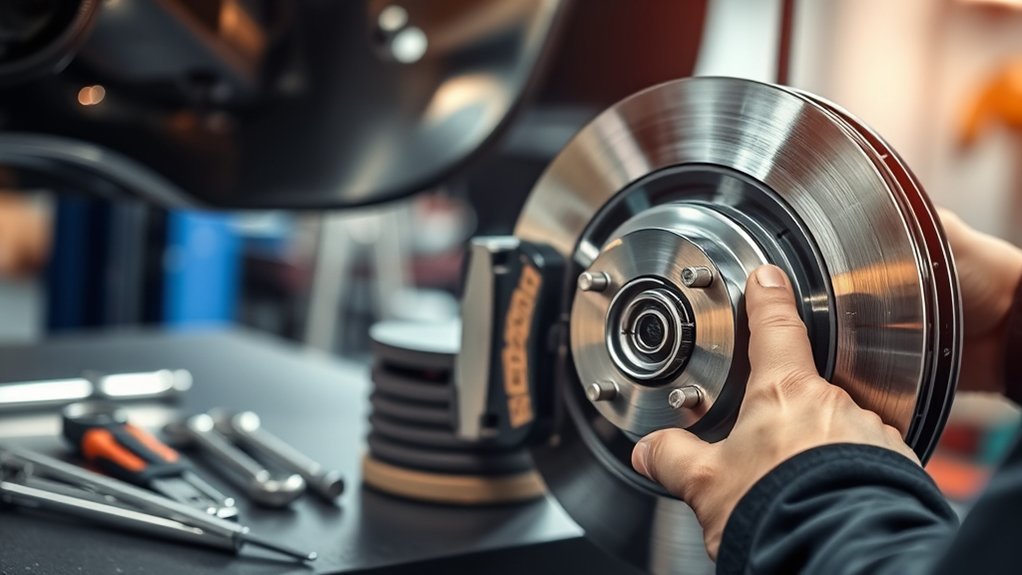
Brake system checks are vital for guaranteeing your vehicle’s safety and performance. During a full car service, mechanics thoroughly inspect your brake pads and discs, confirming they meet safe thickness limits for peak braking performance.
They’ll check your brake fluid level, topping it off if necessary, while evaluating its condition to confirm it’s free from contamination and moisture.
Inspecting brake lines and hoses for any signs of wear, leaks, or corrosion is essential; these issues can compromise braking efficiency.
The braking system’s operation is tested to identify any unusual noises or performance issues that might indicate the need for further repairs.
Additionally, the anti-lock braking system (ABS) is evaluated for proper functionality, guaranteeing all safety features are in working order.
How to Check Your Tire Pressure and Tread Depth?
Checking your tire pressure and tread depth is essential for safe driving.
Use a tire pressure gauge to guarantee your tires are inflated to the recommended PSI, which you can find inside the driver’s door.
For tread depth, try the penny test: if you see all of Lincoln’s head, it’s time to get new tires.
Proper Tire Pressure Guidelines
Maintaining proper tire pressure is essential for your vehicle’s performance and safety. Regularly checking your tire pressure not only enhances fuel efficiency but also prevents the dangers associated with underinflated tires. Here’s a quick guide to help you:
| Task | Frequency | Importance |
|---|---|---|
| Check tire pressure | Monthly & before trips | Prevents blowouts |
| Assess tread depth | Monthly | Guarantees grip on wet roads |
| Inspect tire condition | Monthly | Maintains overall safety |
Use a tire pressure gauge and compare readings to the manufacturer’s recommended PSI found in your manual. For tread depth, use the penny test: if you see all of Lincoln’s head, it’s time for new tires. Prioritize maintenance for safer driving!
Tread Depth Measurement Techniques
Accurate tread depth measurement is essential for your vehicle’s safety and performance.
To guarantee peak handling and fuel efficiency, regularly check your tire tread depth using the penny method. Simply insert a penny into the tread grooves with Lincoln’s head facing down. If you can see the whole head, it’s time for new tires. A tread depth of 2/32 of an inch or less is unsafe, especially in wet conditions.
Additionally, don’t forget to monitor your tire pressure with a gauge. Make sure it matches the recommended levels in your vehicle’s manual or door frame sticker. Aim for monthly checks and before long trips to maintain safety and performance on the road.
Your vehicle deserves it!
Checking and Maintaining Essential Fluid Levels for Your Vehicle
Keeping your vehicle’s essential fluid levels in check is vital for peak performance and longevity. Regular maintenance of fluids like engine oil, coolant, brake fluid, transmission fluid, and power steering fluid can prevent mechanical issues and enhance your driving experience.
| Fluid Type | Importance |
|---|---|
| Engine Oil | Guarantees proper lubrication; change every 3,000 to 7,500 miles. |
| Coolant Levels | Prevents engine overheating; regular checks are necessary. |
| Brake Fluid | Low levels compromise safety; inspect regularly to maintain performance. |
Monitoring these essential fluid levels not only boosts vehicle performance but also guarantees better fuel efficiency and overall safety on the road. By committing to regular checks, you liberate your vehicle from potential breakdowns, paving the way for a smoother ride. Stay proactive with your maintenance, and enjoy the freedom of reliable transportation!
Full Car Service: Assessing and Maintaining Battery Health
While you mightn’t think about your car’s battery often, it plays an important role in ensuring your vehicle starts reliably. During a full service, your technician will check the battery voltage to confirm it’s within the ideal range, usually around 12.6 volts when fully charged.
It’s essential to inspect battery terminals for corrosion, as this can hinder electrical flow and lead to starting issues. The physical condition of the battery is also assessed for any cracks or leaks that could signal a failing battery.
Keep in mind that battery health can be affected by extreme temperatures, making thorough inspections during seasonal changes critical to prevent unexpected failures.
Regular maintenance is key, and replacing your battery every 3 to 5 years can help avoid breakdowns caused by weak or dead batteries. Stay proactive, and your battery will serve you well!
The Role of Diagnostics in Your Full Service

Diagnostics play an essential role in your full car service, as they help identify potential issues before they become serious problems. By employing advanced diagnostic tools, mechanics can perform thorough checks on your vehicle’s major systems, including engine performance and fluid levels.
This process allows for the early detection of hidden faults, such as misfiring cylinders or faulty sensors, which can drastically impact both performance and fuel efficiency.
Regular diagnostics not only enhance vehicle safety but also bolster reliability. By analyzing filters and evaluating critical components, you can guarantee that everything functions effectively.
This proactive approach aids in prevention, allowing minor issues to be resolved before they escalate into costly repairs. Ultimately, investing in detailed diagnostics can prolong your vehicle’s lifespan and save you money, giving you peace of mind on the road.
Preparing Your Vehicle for a Full Service Appointment
Before heading to your full service appointment, it’s important to take a few steps to prepare your vehicle. Start by reviewing your service history to identify any previous maintenance and recurring issues that might need attention.
Clear out personal items to give the mechanic a clean workspace and guarantee easy access to all areas of your vehicle.
Next, check and top off your fluid levels—engine oil, coolant, and brake fluid—so the technician has a clear baseline for what needs addressing.
Ensure all fluid levels—engine oil, coolant, and brake fluid—are topped off for a clear maintenance baseline during your service appointment.
Communicate any specific concerns or unusual observations, like a check engine light or strange noises, as this information will guide the mechanic during their inspection.
Finally, gather all relevant paperwork, including service records and warranty information, to facilitate the process at the repair shop.
These steps will help guarantee your vehicle receives the thorough maintenance it deserves.
Frequently Asked Questions
What Does a Full Auto Service Include?
A full auto service includes an oil change, tire rotation, fluid checks, brake inspection, filter replacement, battery test, spark plugs evaluation, and a performance evaluation to guarantee your vehicle runs smoothly and safely.
What Does a Full Major Service Include?
A full major service includes essential tasks like changing engine oil, inspecting brakes, rotating tires, checking fluid levels, replacing air filters, evaluating spark plugs, conducting a battery check, and performing transmission service for peak performance and safety.
What Is the 30 60 90 Rule for Car Maintenance?
The 30 60 90 rule for car maintenance suggests routine inspections and engine checks at each mileage milestone, ensuring fluid levels, tire rotation, brake assessment, and battery health are optimized for your vehicle’s longevity and performance.
What Parts Do I Need for Full Service?
When it comes to a full service, you’ll need an oil filter, air filter, spark plugs, brake pads, transmission fluid, coolant, and consider tire rotation to keep your vehicle running smoothly and efficiently.
Conclusion
In conclusion, a full car service is like a health check-up for your vehicle, ensuring it runs smoothly and safely. By staying on top of regular maintenance, you’re not just prolonging your car’s life; you’re also safeguarding your peace of mind on the road. So don’t wait for a warning light to flicker—schedule your service today and keep your ride in top shape. Your car deserves the best care, and so do you!






Leave a Reply