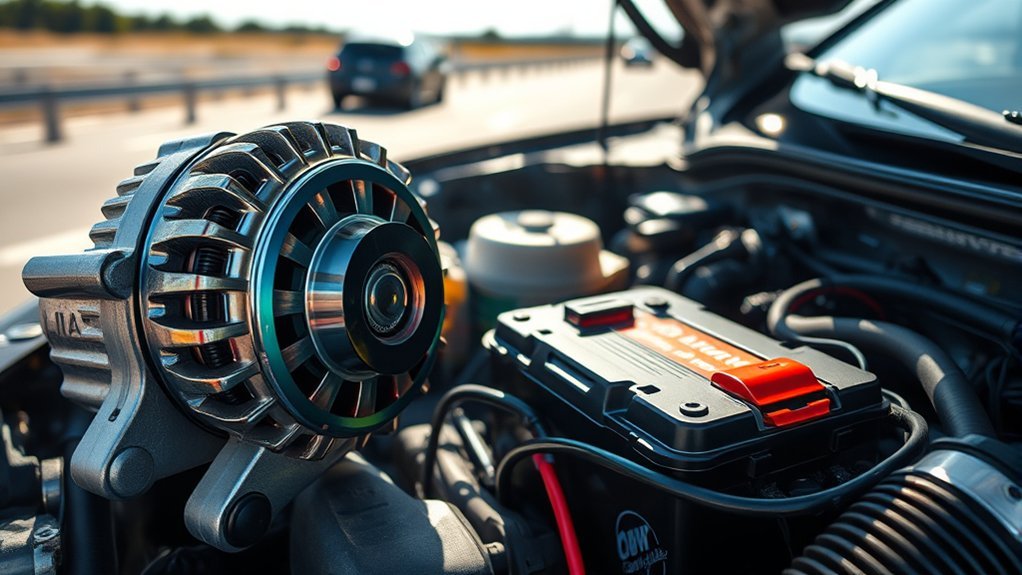
Your car’s alternator charges the battery while the engine runs, but how long it takes depends on the battery’s condition, its starting charge, and the vehicle’s electrical demand. A healthy battery may recover the energy used during a normal start on a routine drive. A deeply discharged battery can need much longer and may require a dedicated charger. Understanding the difference helps you avoid another unexpected breakdown.
Quick Answer
An alternator normally maintains a healthy car battery during regular driving. After a jump-start, a continuous 20–30-minute drive may restore some starting power, but it does not guarantee a full charge. A deeply discharged battery may need several hours of charging. A compatible smart charger is the more reliable way to restore it fully.
Key Takeaways
Key Takeaways
- The alternator powers the vehicle’s electrical systems and replaces energy used by the battery.
- There is no universal driving time, vehicle speed, or engine RPM that guarantees a full charge.
- A 20–30-minute drive after a jump-start may help restore starting power, but a deeply discharged battery needs further attention.
- Idling can charge a battery, although the available charging current may be lower than during normal driving.
- A battery that repeatedly loses charge should be tested along with the alternator and charging system.
- A compatible smart battery charger provides controlled charging and is generally preferable for recovering a substantially discharged battery.
How Does the Alternator Charge a Car Battery While Driving?

When your car’s engine runs, the alternator converts mechanical energy into electrical energy. A belt usually drives the alternator, allowing it to generate electricity as the engine turns.
The alternator produces alternating current (AC), which internal diodes convert into direct current (DC). The vehicle’s charging system regulates this electrical output so it can power electrical components and recharge the battery.
The alternator supplies electricity while the engine runs, helping the battery recover the energy used during starting and supporting the vehicle’s electrical systems.
A conventional 12-volt charging system commonly operates around 13.7–14.7 volts while charging. However, voltage varies by vehicle, temperature, battery condition, and charging-system design.
Modern vehicles may also use computer-controlled alternators and battery-management systems. These systems adjust charging output according to electrical demand and battery condition.
As a result, the charging voltage may not remain constant throughout a drive.
According to Interstate Batteries’ technical FAQ, an alternator is generally capable of keeping a healthy battery charged during normal use. However, a deeply discharged battery may not fully recover through driving alone.
Note: This guide primarily concerns conventional 12-volt starting batteries in alternator-equipped vehicles. Hybrid and electric vehicles may use different 12-volt charging arrangements. Follow the owner’s manual for your specific vehicle.
How to Charge Your Car Battery While Driving
If your vehicle has been jump-started, the next step is to determine whether it can safely continue operating and whether the battery needs further charging.
A jump-start supplies enough power to help start the engine. It does not establish that the battery is healthy or fully charged.
At a Glance
| Time Required | A 20–30-minute drive may help after a jump-start. Full recovery from deep discharge can take several hours or longer. |
| Difficulty | Easy for normal driving; professional assistance may be needed for electrical faults. |
| Tools Needed | Vehicle owner’s manual; optional digital multimeter and compatible smart battery charger. |
| Cost | No additional equipment is required for normal driving. Charger, diagnostic, and repair costs vary. |
Steps to Charge a Car Battery After a Jump-Start
- Check the dashboard. Make sure the charging-system warning light goes out after the engine starts. If it remains illuminated, do not begin a charging drive.
- Check for obvious problems. Look for unusual smells, visible battery damage, or signs of an electrical malfunction. Do not handle damaged battery components.
- Drive normally. If the vehicle is operating correctly, a continuous drive of approximately 20–30 minutes may restore some charge.
- Reduce unnecessary electrical demand. Turn off optional accessories when practical, but keep essential lighting, climate control, and safety equipment operating as needed.
- Avoid repeated short stops. Every additional engine start uses battery energy. A continuous trip generally offers more charging opportunity than repeated short trips.
- Test and recharge the battery. After reaching a safe destination, use a compatible charger if the battery was substantially discharged. Arrange a battery and charging-system test if the cause is uncertain.
AAA’s jump-start guidance discusses a continuous 20–30-minute drive following a successful jump-start. Treat that as a recovery opportunity, not a guarantee of full charging.
Warning: If the battery or charging-system warning light stays on while the engine runs, the vehicle may be operating on limited stored battery power. Stop somewhere safe and arrange assistance. Do not attempt a long drive simply to recharge the battery.
How Long Does Driving Take to Charge a Car Battery?
The answer depends on how much charge is missing and whether the battery can still accept and retain electricity.
| Battery Situation | Charging Expectation | Recommended Action |
|---|---|---|
| Healthy battery after a normal engine start | Usually replenished through ordinary driving. | Continue normal vehicle use. |
| Battery needed a jump-start | A 20–30-minute drive may restore some starting power, but the result is uncertain. | Recharge fully and check the cause of discharge. |
| Substantially discharged battery | May require several hours of charging. Driving alone may be inadequate. | Use a suitable battery charger. |
| Aged or damaged battery | May not accept or retain enough charge. | Arrange battery testing and replace it if necessary. |
| Charging-system warning light illuminated | Normal charging may not be taking place. | Stop safely and arrange charging-system diagnosis. |
Interstate Batteries gives a four-to-eight-hour highway-driving estimate for substantial battery recovery. That estimate illustrates why driving is not an efficient solution for deep discharge. It is not a fixed requirement for every vehicle or battery.
Key Factors Affecting Charging Time While Driving
Several factors determine how much electricity reaches the battery and how quickly it can recover.
1. Battery State of Charge
A battery that has only supplied a normal engine start needs much less energy than one that has been drained by lights left on overnight.
The greater the discharge, the longer recovery is likely to take.
2. Battery Age and Condition
A battery’s state of charge tells you how much energy it currently stores. Its state of health describes how well it can store energy and supply the required starting power.
An aging battery may appear charged but still struggle to crank the engine.
If the battery cannot hold a charge after proper recharging, further driving is unlikely to solve the problem.
3. Alternator Output and Electrical Load
The alternator must support the vehicle’s electrical systems while charging the battery.
Headlights, heated windows, blower motors, and other accessories consume electricity. Higher electrical demand may reduce the current available for battery charging.
However, turning off accessories should never compromise visibility, windshield clearing, or occupant safety.
4. Engine Speed and Charging-System Design
Alternator output generally changes with rotational speed, especially at low engine speeds.
However, the engine RPM shown on the dashboard is not the same as alternator RPM, and alternator designs vary.
There is no universal rule that every vehicle must maintain 1,000, 1,500, or 2,000 engine RPM to charge its battery.
Modern charging systems may also adjust output electronically.
5. Temperature and Driving Pattern
Cold weather can reduce available battery performance and make starting more demanding. High temperatures can accelerate battery deterioration.
Repeated short trips may also leave insufficient time to replace the energy consumed during starting, especially when the battery is already weak.
A vehicle used mainly for brief trips may benefit from periodic charging with a compatible battery charger.
Can You Charge a Car Battery While Idling?
Yes, a car battery can charge while the engine idles. However, charging may be slower because alternator output is often lower at idle.
The actual result depends on the alternator, battery condition, engine idle speed, and electrical demand.
Limited Charging Efficiency
At idle, the alternator must still power essential electrical systems.
If sufficient output remains available, some current can flow into the battery.
In a vehicle with high electrical demand, however, little charging current may be available.
This makes idling an unreliable way to recover a substantially discharged battery.
Minimal Power Output
Alternators commonly provide less output at low engine speeds than at higher operating speeds.
Running the heater blower, rear defroster, headlights, and other accessories can further reduce the electricity available for charging.
Turning off unnecessary accessories may help, but you should not increase engine RPM unnecessarily or leave the vehicle running unattended.
Warning: Never run a vehicle inside an attached garage, even with the garage door open. Exhaust contains carbon monoxide, which can cause serious poisoning or death. Follow the CDC’s carbon monoxide safety guidance.
Ineffective for Deep Discharge
When the battery has been deeply discharged, idling may provide insufficient charging current for timely recovery.
The vehicle may also have a damaged battery or an underlying electrical problem that idling cannot correct.
For this situation, use a compatible smart charger or have the battery professionally tested.
Normal driving may help when the charging system works properly, but there is no need to drive faster than traffic conditions or speed limits allow.
Maximizing Battery Charging While Driving
To improve charging efficiency, focus on maintaining a functioning charging system and avoiding unnecessary electrical demand.
- Drive normally and continuously: A steady trip usually provides more charging opportunity than repeated short journeys.
- Reduce optional electrical loads: Turn off unnecessary entertainment equipment, accessory chargers, and other nonessential devices when practical.
- Keep essential equipment operating: Do not sacrifice headlights, windshield defogging, wipers, or safety systems to save electricity.
- Maintain the charging system: Have loose connections, worn drive belts, and suspected alternator faults inspected.
- Check battery condition: A battery that cannot hold charge needs diagnosis rather than more driving.
You do not need to maintain a fixed highway speed or deliberately increase engine RPM to charge the battery.
Pro Tip: If your driving consists mainly of short trips, a compatible automatic battery maintainer can help keep the battery charged without requiring unnecessary driving.
Risks of Driving With a Weak Battery
A weak battery can affect starting reliability and place additional demands on the vehicle’s electrical system.
However, a discharged battery and a defective battery are not necessarily the same thing.
Reduced Starting Reliability
A battery with insufficient charge or reduced starting capacity may struggle to crank the engine, particularly in cold weather.
Common warning signs include:
- Slow engine cranking.
- Repeated difficulty starting.
- Headlights or interior lights that appear unusually dim.
- Frequent need for jump-starts.
There is no universal 80% charge threshold below which every battery becomes unreliable.
Actual starting performance depends on battery condition, temperature, engine requirements, and available charge.
Increased Component Strain
A substantially discharged battery can increase the charging demand placed on the alternator.
If an electrical fault or failing battery causes sustained high demand, the charging system may experience additional stress.
However, a healthy alternator is designed to recharge the battery during normal vehicle operation.
Do not assume that every weak battery automatically causes alternator failure.
Potential Battery Damage
Repeated deep discharge can shorten the life of a conventional lead-acid starting battery.
A battery left discharged for an extended period may also develop internal deterioration that limits its ability to accept or retain charge.
Potential consequences include:
- Reduced starting power.
- Lower usable battery capacity.
- More frequent charging requirements.
- Premature battery replacement.
Prompt charging and appropriate testing can help determine whether the battery remains serviceable.
How to Spot When Your Car Battery Needs Replacement?
Recognizing battery problems early can help prevent unexpected starting failures.
However, some symptoms that appear to indicate battery failure may actually come from the alternator, wiring, or another electrical component.
Battery Problems vs. Alternator Problems
| Symptom | Possible Cause | What to Do |
|---|---|---|
| Slow cranking | Low charge, weak battery, or poor connections | Check battery charge and starting performance. |
| Battery warning light while driving | Charging-system fault | Stop safely and arrange diagnosis. |
| Dimming or flickering lights | Battery, alternator, wiring, or voltage regulation | Test the electrical system. |
| Battery repeatedly dies while parked | Weak battery or excessive parasitic drain | Test battery condition and key-off electrical draw. |
| Grinding or whining near the alternator | Possible belt, bearing, or other mechanical problem | Arrange mechanical inspection. |
According to AAA’s charging-system guidance, an illuminated charging warning light should not be ignored because the vehicle may be relying on stored battery energy.
When Is Battery Replacement Necessary?
Consider replacing the battery when testing confirms that it cannot provide sufficient starting power or retain an adequate charge after proper charging.
Physical damage, swelling, or leakage also requires professional attention.
Car batteries commonly last around three to five years, but service life varies with climate, usage, charging habits, and battery construction.
Age alone is not proof that replacement is necessary. A battery test gives a more useful indication of its condition.
How to Test Your Car Battery and Alternator
A digital multimeter can provide a basic indication of battery voltage and charging-system operation.
However, voltage alone cannot establish the battery’s remaining starting capacity or overall health.
Step 1: Check Battery Voltage With the Engine Off
- Park safely and turn off the engine and electrical accessories.
- Allow the battery to rest before measuring it.
- Set the multimeter to DC voltage.
- Connect the red probe to the positive terminal and the black probe to the negative terminal.
- Read the voltage.
A fully charged conventional 12-volt lead-acid battery commonly measures around 12.6 volts or slightly higher at rest.
A lower reading may indicate reduced charge, but it does not automatically mean the battery needs replacement.
Step 2: Check Charging Voltage With the Engine Running
With the vehicle safely parked and the engine operating, charging voltage in a conventional system often falls around 13.7–14.7 volts.
However, modern computer-controlled systems may deliberately vary their output.
A single voltage reading should therefore be interpreted using the manufacturer’s specifications.
Warning: Keep hands, clothing, and test leads clear of belts, pulleys, and cooling fans. Never disconnect a battery cable while the engine is running to test the alternator. If you are unfamiliar with electrical testing, have a qualified technician perform the check.
Step 3: Request a Battery and Charging-System Test
If the vehicle repeatedly needs jump-starts, ask a repair shop to test:
- Battery state of charge.
- Battery starting performance and condition.
- Alternator output and charging-system operation.
- Battery connections and cables.
- Excessive electrical draw while the vehicle is parked, when indicated.
This helps distinguish a battery that simply needs charging from one that needs replacement or an electrical system that requires repair.
Best Ways to Keep Your Battery Healthy
Keeping your battery in good condition reduces the risk of unexpected breakdowns and can help maintain reliable starting performance.
Maintaining your car battery is important; knowing when to test or replace it is just as valuable for reliable performance.
- Avoid repeated deep discharge: Do not leave headlights, interior lights, or accessories operating unnecessarily with the engine off.
- Take regular drives: Give the charging system sufficient operating time, particularly if the vehicle is normally used for short trips.
- Maintain battery connections: Check for corrosion, looseness, and visible cable damage.
- Monitor charging-system condition: Address warning lights, unusual noises, and suspected alternator problems promptly.
- Use a compatible battery maintainer: This can be useful for vehicles parked for extended periods.
- Test the battery periodically: Testing becomes particularly valuable as the battery ages or starts showing symptoms.
A dedicated charger may be useful when ordinary driving does not restore the battery’s charge.
However, no charging method can reliably restore a battery that has suffered irreversible internal damage.
Why Use Dedicated Battery Chargers Instead of Relying on Driving?
While driving can recharge a battery, a dedicated smart battery charger offers more controlled charging.
A modern charger can adjust charging current and voltage through different charging stages, helping the battery recover without depending on the vehicle’s electrical demand.
Depending on the charger and battery, a full recharge may take approximately 10–24 hours. Some combinations charge faster, while others require longer.
The actual charging time depends on:
- Battery capacity.
- Starting state of charge.
- Charger output current.
- Battery chemistry and condition.
- Temperature.
- The charger’s charging program.
Choosing the Right Battery Charger
Choose a charger that matches your battery’s voltage, chemistry, and the vehicle manufacturer’s requirements.
For example, conventional flooded lead-acid batteries and AGM batteries may require different charging profiles.
CTEK’s AGM charging guidance explains why an appropriate charging profile helps protect battery performance and service life.
Useful charger features include:
- Automatic charging: Adjusts charging behavior as the battery recovers.
- Battery-type selection: Provides suitable settings for supported battery chemistries.
- Maintenance mode: Helps maintain charge during extended storage.
- Safety protection: Features such as reverse-polarity protection and automatic charging control reduce common charging risks.
How to Use a Dedicated Battery Charger
- Check the battery label, vehicle manual, and charger instructions for compatibility.
- Turn off the vehicle and charger before making connections.
- Connect the charger using the manufacturer’s specified terminals or charging points.
- Select the correct battery type and charging mode.
- Start charging and allow the charger to complete its program.
- Follow the charger manufacturer’s instructions when disconnecting it.
- Test the battery if it fails to retain charge or the original starting problem returns.
Warning: Do not attempt to charge a visibly damaged, leaking, swollen, or frozen battery. Follow the battery and charger manufacturers’ safety instructions. Charging should take place in an appropriate, well-ventilated location away from flames and sparks.
For a battery that has been deeply discharged, controlled charging followed by a battery test is usually more useful than taking an unnecessarily long drive.
Frequently Asked Questions
How Long Does It Take an Alternator to Charge a Battery While Driving?
A healthy battery normally recovers the energy used during starting through routine driving. After a jump-start, a 20–30-minute drive may restore some charge, but full recovery from substantial discharge can take several hours. The exact time depends on battery condition, alternator output, electrical demand, and temperature.
How Far Do You Have to Drive for an Alternator to Charge a Battery?
There is no fixed driving distance that guarantees a particular battery charge. Charging depends on operating time, alternator output, battery condition, and electrical demand. A deeply discharged battery may require a dedicated charger rather than an extended drive.
How Long Do You Need to Drive a Car to Charge the Battery?
A continuous 20–30-minute drive may help restore starting power following a successful jump-start. However, it does not guarantee a full charge. If the battery was deeply discharged, use a compatible charger and have the battery tested if necessary.
Does Idling a Car Charge the Battery?
Yes. A functioning alternator can charge the battery while the engine idles if enough electrical output is available. However, charging may be slower than during normal driving, especially when accessories consume substantial power. Idling is not a reliable method for restoring a deeply discharged battery.
Can a Bad Alternator Drain a New Battery?
Yes. If the alternator or charging system fails to provide sufficient electricity, the vehicle may draw power from the battery until it becomes discharged. A new battery does not correct an underlying charging-system fault.
How Do I Know Whether My Battery Is Fully Charged?
A conventional fully charged 12-volt lead-acid battery commonly measures around 12.6 volts or slightly higher at rest. However, voltage alone cannot confirm battery health. A compatible smart charger and professional battery test can provide more useful information.
Should I Replace My Battery After a Jump-Start?
Not automatically. A healthy battery may recover after being discharged by an accessory left on. However, repeated jump-starts, poor charge retention, or failed battery testing may indicate that replacement is necessary.
Conclusion
Your alternator can recharge your car battery while driving, but charging time depends on battery condition, electrical demand, and the vehicle’s charging system.
A healthy battery usually receives adequate charging through normal driving. After a jump-start, a continuous drive may restore some energy, but a deeply discharged battery often needs a dedicated charger.
Do not rely on a fixed speed, RPM, or driving-time estimate to determine whether the battery is fully charged.
Regular battery testing, proper charging, and prompt attention to electrical warning signs can help maintain reliable starting performance and reduce the risk of being stranded.
Sources
- Interstate Batteries — Frequently Asked Questions — Battery charging, typical voltage, battery condition, charging time, and maintenance.
- Interstate Batteries — How Long You Have to Drive to Charge Your Car Battery — Charging-time estimates and the limitations of relying on driving after substantial discharge. Revised July 16, 2026.
- AAA Automotive — How to Jump a Battery and Get Yourself Back on the Road — Jump-start recovery and post-start driving guidance.
- AAA — What’s Wrong if My Battery or Charging System Light Comes On? — Charging-system warning signs, possible causes, and appropriate action. March 25, 2026.
- CTEK — Charging an AGM Battery: Settings, Safety and Best Practice — Battery chemistry, compatible charging modes, and safe charging practices. July 7, 2026.
- Centers for Disease Control and Prevention — Carbon Monoxide Poisoning Basics — Vehicle exhaust and garage-idling safety. January 12, 2026.







Leave a Reply