
Buying your first used car is about finding something safe, affordable, and easy to live with. For new drivers in the UK, a small hatchback is often a sensible place to start, but the right choice depends on your budget, insurance quotes, driving needs, and the condition of the individual vehicle. This 2026 guide covers used cars worth considering, the checks to complete before buying, and optional accessories for recently qualified drivers.
Quick Answer
The best used car for a new driver is one that combines manageable insurance costs, dependable maintenance history, suitable safety equipment, and an affordable purchase price. Consider small hatchbacks such as the Toyota Aygo, Hyundai i10, Kia Picanto, and Suzuki Swift. Compare insurance quotes and inspect the individual vehicle before committing to a purchase.
Key Takeaways
- Compare insurance quotes before choosing a used car. The cheapest vehicle to buy is not always the cheapest to own.
- Look for anti-lock brakes, electronic stability control, suitable airbags, and a strong safety record for the relevant model year.
- Check the registration details, MOT history, service records, outstanding finance, and safety recalls.
- Arrange an independent inspection when the car’s condition or history is uncertain.
- Green P-plates are optional in Great Britain. Northern Ireland has separate R-plate requirements.
Used Cars Worth Considering for New Drivers
Compact hatchbacks can be a practical starting point because they are generally easier to park and manoeuvre than larger vehicles. However, engine, trim, transmission, age, and insurance costs can vary substantially within the same model range.
The following vehicles are examples to investigate rather than a ranking of individual cars. Their suitability depends on the specific vehicle, its equipment, its history, and the price being asked.
| Used Car | Why Consider It? | What to Check |
|---|---|---|
| Toyota Aygo | Compact dimensions and a practical layout for town driving. | Clutch operation, servicing, tyre condition, and equipment fitted to the particular year. |
| Hyundai i10 | Small exterior dimensions with useful everyday cabin space. | Service records, suspension wear, brakes, and insurance quotes. |
| Kia Picanto | A compact hatchback suitable for drivers who want a manageable first car. | Maintenance history, gearbox operation, and remaining warranty eligibility where applicable. |
| Suzuki Swift | A small hatchback option for drivers who need more everyday versatility. | Insurance cost for the exact engine, tyres, suspension, and service history. |
| Toyota Yaris | Worth investigating when a slightly larger small car is required. | Engine and transmission variant, servicing, and hybrid-system condition if applicable. |
| Honda Jazz | A practical alternative for drivers who value passenger and luggage space. | Transmission condition, maintenance records, insurance, and parking suitability. |
Other small cars, including the Volkswagen up! and Skoda Citigo, may also be worth comparing. Do not assume that every version of a model has the same safety features, fuel economy, or insurance cost.
Pro Tip: Before arranging a viewing, obtain insurance quotes using the exact registration number and your genuine driver details. This can quickly reveal whether a seemingly affordable car fits your budget.
At a Glance: Buying Your First Used Car
At a Glance
| Time Required | Allow time for research, vehicle-history checks, a viewing, a test drive, and an independent inspection where needed. |
| Difficulty | Beginner-friendly when you use a structured checklist and seek professional help with mechanical concerns. |
| Tools Needed | Vehicle registration, insurance quotes, MOT history, service records, V5C details, and an inspection checklist. |
| Cost | Purchase price plus insurance, vehicle tax, fuel, servicing, repairs, and any inspection or vehicle-history fees. |
Factors to Consider When Choosing Used Cars for New Drivers
Safety features, budget, fuel efficiency, size, and reliability all matter when choosing your first car. The aim is to find a vehicle that meets your everyday needs without creating avoidable ownership costs.
Safety Features Importance
Start with the safety equipment fitted to the individual car. Anti-lock braking systems (ABS) help drivers maintain steering control during hard braking, while electronic stability control (ESC) can help reduce the risk of losing control in certain situations.
Also consider:
- Driver, passenger, and side airbags where fitted.
- Electronic stability control and traction-control systems.
- Automatic emergency braking and lane-departure warning where available.
- Parking sensors or a reversing camera.
- Good outward visibility and appropriately positioned mirrors.
Check the vehicle’s Euro NCAP safety rating, paying attention to the tested model, assessment year, and safety equipment.
A five-star rating from an older test should not automatically be treated as equivalent to a five-star rating awarded under newer criteria. Safety equipment can also differ between trim levels.
Warning: Driver-assistance systems support attentive driving; they do not replace observation, safe speed, braking judgement, or control of the vehicle.
Budget-Friendly Options Available
If your purchase budget is around £2,000–£5,000, focus on condition, maintenance records, and realistic running costs rather than expecting every model or trim level to fall within that range.
Older cars may be affordable to purchase but can require substantial spending on tyres, brakes, suspension, or other repairs.
Set aside money for:
- Insurance.
- Vehicle Excise Duty (vehicle tax).
- Fuel.
- Servicing and MOT tests.
- Tyres, brakes, and unexpected repairs.
- Breakdown cover if required.
MoneyHelper’s car-budget guidance explains why purchase price and ongoing ownership costs should be considered together.
Depreciation also matters. A vehicle with good maintenance records and a reasonable purchase price may be easier to sell later, although future resale value cannot be guaranteed.
Fuel Efficiency Considerations
Fuel efficiency affects the ongoing cost of owning a car. Smaller petrol hatchbacks can be worth considering for shorter everyday journeys, although the actual result depends on engine, transmission, vehicle condition, traffic, and driving style.
Compare official fuel-consumption figures for the exact model and engine rather than relying on a general manufacturer claim.
The UK government’s fuel and emissions service provides information for comparing vehicles.
Keeping tyres correctly inflated, following the maintenance schedule, and avoiding unnecessary aggressive acceleration can also help with fuel use.
Size and Maneuverability Factors
Smaller cars are often easier to position in narrow streets and parking spaces. However, overall length is not the only consideration.
During a test drive, check:
- Whether you can see clearly in every direction.
- How easily you can judge the front and rear of the car.
- Whether the steering feels predictable.
- How comfortable you feel during parking.
- Whether the seating position and controls suit your height and reach.
Parking sensors and reversing cameras can help, but they should complement direct observation rather than replace it.
Reliability and Maintenance History
A dependable used car is not simply one with a well-known badge. Its maintenance history, previous use, age, mileage, and mechanical condition all influence reliability.
Ask for:
- Service records and invoices.
- Evidence of important scheduled maintenance.
- Information about previous repairs.
- MOT records.
- Receipts for major components recently replaced.
Check whether maintenance was completed according to the manufacturer’s requirements.
An independent mechanic can identify problems that may not appear in the paperwork, including suspension wear, leaks, corrosion, and mechanical faults.
Insurance Costs and Options
Insurance can be one of the largest expenses for a newly qualified driver. Premiums depend on more than the vehicle’s purchase price or insurance group.
Insurers may consider your age, driving history, postcode, annual mileage, parking arrangements, occupation, vehicle, and chosen cover.
Before buying:
- Compare fully comprehensive and other suitable policy options.
- Check quotes for the exact registration and driver details.
- Compare voluntary excess amounts carefully.
- Ask whether a telematics or black-box policy suits your driving needs.
- Check the policy’s restrictions, exclusions, and cancellation terms.
Insurance groups can help narrow your shortlist, but they do not guarantee a low premium. Compare real quotes rather than assuming that a particular group will always be affordable.
How to Check a Used Car Before Buying
Do not rely only on the seller’s description or the appearance of the vehicle. Check its recorded history and inspect it carefully before paying.
1. Check the DVLA Vehicle Details
Ask the seller for the registration number and compare the vehicle’s details with the official DVLA vehicle information service.
Check that the make, model, fuel type, registration details, and other available information match the vehicle being offered.
2. Review the MOT History
Use the free GOV.UK MOT history service.
Look for:
- Repeated failures or recurring advisories.
- Mileage readings that do not follow a reasonable pattern.
- Significant corrosion or structural concerns.
- Brake, tyre, steering, and suspension issues.
- Repairs that should have been completed after previous tests.
Remember that an MOT is a test of the vehicle’s condition against the applicable requirements at the time of testing. It does not replace a full mechanical inspection.
3. Check the V5C and Vehicle Identification Number
Ask to see the V5C registration certificate, commonly called the logbook.
Compare its details with the vehicle and check that the Vehicle Identification Number (VIN) matches.
Follow the official GOV.UK used-vehicle buying checklist.
Be cautious if the seller cannot explain missing documents, inconsistent registration details, or a VIN discrepancy.
4. Check Outstanding Finance and Accident History
Consider an independent UK vehicle-history report that checks available finance and insurance write-off information.
These reports may reveal problems that ordinary MOT records do not show.
However, no single report can establish every accident, repair, or ownership detail. A vehicle may have undergone body repairs that were never recorded in an insurance database.
Inspect panel alignment, paint condition, structural areas, and signs of previous repairs. Ask the seller about known damage and request supporting invoices where relevant.
5. Check Safety Recalls
Use the official vehicle recall service to investigate safety recalls affecting the vehicle.
If a recall is outstanding, ask the manufacturer or authorised repairer what action is required.
Do not drive a vehicle where the manufacturer has instructed owners to stop using it because of a serious safety defect.
Used Car Inspection Checklist
A thorough inspection helps uncover faults before they become your responsibility.
Exterior Checks
- Inspect tyres for damage and uneven wear.
- Look for corrosion around the body and structural areas.
- Check whether the doors, bonnet, and boot open and close properly.
- Examine paintwork for unusual colour differences or poorly aligned panels.
- Check the windscreen, windows, lights, and mirrors.
Interior Checks
- Test the seat belts and seat adjustments.
- Check the dashboard for warning lights.
- Operate the heater, demister, windows, and other electrical equipment.
- Look for damp carpets or signs of water leaks.
- Check that the steering wheel and pedals feel normal.
Mechanical Checks
- Check for visible fluid leaks.
- Listen for unusual engine noises.
- Look for signs of poor servicing.
- Check clutch and gearbox operation.
- Inspect the condition of accessible hoses and other visible components.
Warning: Do not reach into moving engine components, open a hot cooling system, or touch high-voltage parts on hybrid or electric vehicles. Leave unfamiliar mechanical checks to a qualified professional.
What to Check During a Test Drive
A test drive should help you decide whether the car feels safe, comfortable, and mechanically sound.
Make sure you have valid insurance and permission to drive the vehicle.
- Check the seating position and visibility before moving.
- Start the engine and watch for warning lights that remain illuminated.
- Check that the clutch or automatic transmission operates smoothly.
- Listen for unusual noises while accelerating and turning.
- Check that the brakes feel predictable and the car does not pull unexpectedly.
- Try normal parking and low-speed manoeuvres.
- Confirm that the vehicle is comfortable enough for your regular journeys.
Where possible, inspect the vehicle before it has been warmed up. Some faults may be easier to notice during a cold start.
Arrange an independent inspection if you are uncertain about its mechanical condition.
Buying From a Dealer Versus a Private Seller
Both options can provide suitable vehicles, but the legal protections and buying experience differ.
Buying From a Dealer
A dealer may provide additional services, finance options, or a warranty, depending on the vehicle and seller.
Used cars sold by traders must meet applicable consumer-law requirements, including being as described and of satisfactory quality, taking account of factors such as age, mileage, and price.
A warranty does not replace statutory consumer rights.
Buying Privately
Private purchases may offer different prices, but buyers generally have fewer consumer protections than when purchasing from a trader.
Check the seller’s identity, the V5C, the vehicle’s condition, and its history carefully.
Be particularly cautious if someone appears to be operating as a trader while presenting the transaction as a private sale.
For additional guidance, see Citizens Advice: Buying a Used Car.
How to Negotiate the Price of a Used Car
Research similar vehicles with matching age, engine, mileage, specification, and condition before making an offer.
Use genuine findings from the inspection or vehicle history to support your negotiation.
For example, worn tyres, overdue servicing, or repairs identified during an inspection may affect the amount you are prepared to pay.
Ask for repairs or agreed conditions to be recorded in writing before completing the purchase.
Do not rush because a seller says another buyer is waiting. If the paperwork, condition, or explanation does not make sense, consider another vehicle.
What to Do After Buying Your First Used Car
Before driving the car away, make sure the keeper transfer, insurance, vehicle tax, and other legal requirements are addressed.
- Complete the registered-keeper transfer correctly.
- Keep the appropriate new-keeper documentation.
- Arrange valid insurance before driving on the road.
- Tax the vehicle in your name before using it on the road.
- Check that the vehicle meets its MOT requirements.
- Save the purchase receipt, service documents, and inspection report.
- Arrange any necessary maintenance or safety repairs.
Vehicle tax does not transfer to the new keeper when a vehicle is sold. Follow the official GOV.UK vehicle-buying process.
Optional Accessories for New Drivers
Once you have chosen your vehicle, you may want to consider accessories that make your new-driver status visible to other road users.
The following products are driving signs and magnetic plates, not used cars. They are included separately from the vehicle-buying recommendations.
Affiliate disclosure: Some links below are affiliate links. We may earn a commission if you make a qualifying purchase, at no additional cost to you.
Note: In England, Scotland, and Wales, green P-plates are optional for recently qualified drivers. Learners must display the appropriate L-plates, or permitted D-plates in Wales. P-plates do not replace learner plates or change the rules that apply to a provisional licence.
Northern Ireland: Newly qualified drivers have separate R-plate requirements. As of September 2026, the existing requirement is to display R-plates for one year. From 1 October 2026, the new Graduated Driver Licensing scheme introduces a two-year R-plate period for newly qualified drivers under the new arrangements. Follow the applicable Northern Ireland rules rather than relying on optional green P-plates.
| Simply TL1100 Magnetic Car P-Plates Twin Pack | 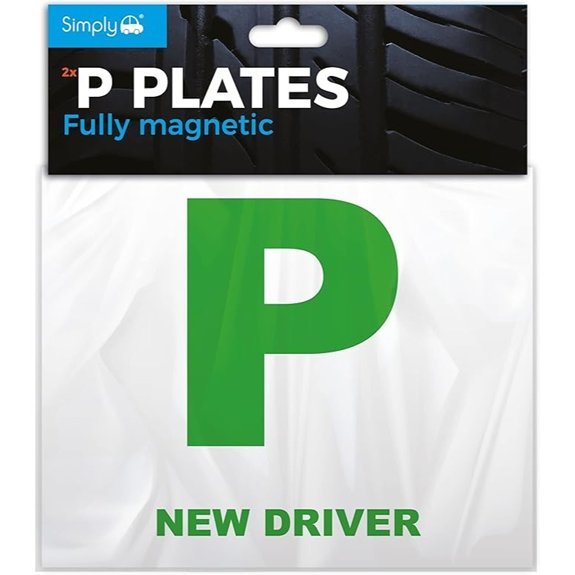 |
Magnetic P-Plates | Material: Magnetic construction | Design: Green P-plates | Quantity: Twin pack | VIEW LATEST PRICE | Read Our Analysis |
| AA Magnetic P Plates for Recently Qualified Drivers | 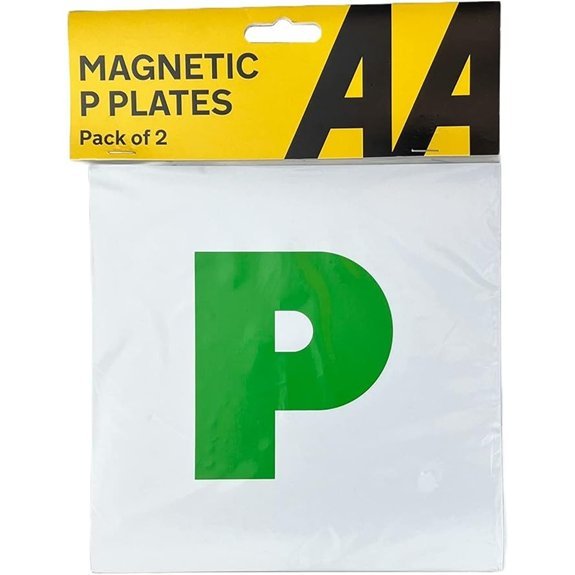 |
Reusable P-Plates | Material: Magnetic construction | Design: Green P-plates | Quantity: Twin pack | VIEW LATEST PRICE | Read Our Analysis |
| Patient Driver Please Be Patient Decal Magnets |  |
Decorative Driving Sign | Material: Listed as magnetic vinyl | Design: Patient-driver message | Quantity: Two-pack listed | VIEW LATEST PRICE | Read Our Analysis |
| 4pcs Magnetic Waterproof Learner Driver Car Magnets |  |
Mixed Driving Signs | Material: Listed as PVC and magnetic rubber | Design: Learner and new-driver signs | Quantity: Four-pack listed | VIEW LATEST PRICE | Read Our Analysis |
More Details on These Optional Accessories
-
Simply TL1100 Magnetic Car P-Plates Twin Pack
The Simply TL1100 Magnetic Car P-Plates are designed for motorists who have recently passed their driving test and want to display optional green P-plates.
The twin pack uses fully magnetic construction for attachment to suitable metal body panels. The manufacturer describes the plates as weatherproof and recommends applying them to a clean, dry surface.
Check that the vehicle has suitable metal panels before buying. Magnetic plates will not attach directly to plastic or aluminium body panels.
Remove the plates when cleaning the vehicle and inspect the contact surfaces regularly for trapped dirt.
- Material: Magnetic construction
- Design: Green P-plates
- Weather Resistance: Manufacturer describes the plates as weatherproof
- Easy Attachment: Designed for suitable metal panels
- Removable: Reusable magnetic design
- Quantity: Twin pack (2)
- Additional Feature: No adhesive required
- Additional Feature: Intended for recently qualified drivers
- Additional Feature: Clean and dry the panel before fitting
-
AA Magnetic P Plates for Recently Qualified Drivers
AA Magnetic P Plates provide a straightforward way for recently qualified drivers to display green P-plates.
The AA0347 product is identified as a twin pack of fully magnetic plates. The reusable design allows the plates to be attached and removed without using permanent adhesive.
Apply them only to suitable, clean metal body panels. Check that the edges sit flat and that the signs do not cover lights, registration plates, or important vehicle features.
Retailer availability, packaging, and return conditions may change, so check the current listing before purchasing.
- Material: Magnetic construction
- Design: Green P-plates
- Weather Resistance: Check current product specifications
- Easy Attachment: Magnetic fitting
- Removable: Reusable design
- Quantity: Twin pack (2)
- Additional Feature: AA0347 product identification
- Additional Feature: No adhesive required
- Additional Feature: Intended for recently qualified drivers
-
Patient Driver Please Be Patient Decal Magnets
The Patient Driver Please Be Patient magnets offer a decorative way to tell other road users that the driver would appreciate patience.
The original listing describes cat-shaped magnets with a weather-resistant vinyl design. Check the current listing for exact dimensions, materials, and included quantity.
These signs are decorative accessories. They are not a substitute for official learner-driver or restricted-driver identification where required.
Position them where they do not obstruct the registration plate, lights, windows, or the driver’s view.
A friendly message may communicate your experience level, but it cannot guarantee how other motorists will behave.
- Material: Listed as magnetic vinyl
- Design: Patient-driver message
- Weather Resistance: Check current seller specifications
- Easy Attachment: Magnetic fitting on compatible panels
- Removable: Check fit and panel condition before removal
- Quantity: Two-pack listed
- Additional Feature: Cat-shaped decorative design
- Additional Feature: Communicates a request for patience
- Additional Feature: Not a replacement for required driving plates
-
4pcs Magnetic Waterproof Learner Driver Car Magnets
The MAJORMENCH magnetic driving-sign set is listed as a four-piece pack made with PVC and magnetic rubber.
The original listing describes red and green driving signs. Check the current product images and specifications to confirm exactly which plates are supplied.
Choose signs that match your actual driving status. Learners must use compliant learner plates, while newly qualified motorists in Great Britain may choose to display green P-plates.
A decorative or mixed-sign pack should not automatically be assumed to meet every applicable legal requirement.
Apply magnetic signs to suitable clean body panels and check their fit before driving.
- Material: Listed as PVC and magnetic rubber
- Design: Magnetic driving signs
- Weather Resistance: Listed as waterproof; verify current specifications
- Easy Attachment: Magnetic fitting on compatible surfaces
- Removable: Reusable design
- Quantity: Four-pack listed
- Additional Feature: Red and green signs described in the listing
- Additional Feature: Check compliance before learner use
- Additional Feature: Suitable placement must not obstruct vehicle equipment
How to Choose and Fit P-Plates Safely
If you decide to use optional P-plates, check your vehicle’s body material before choosing a magnetic set.
Magnetic signs generally require suitable ferrous metal surfaces. Cars with aluminium, plastic, or composite exterior panels may need another attachment method.
Before fitting a magnetic sign:
- Clean and dry the body panel.
- Check for grit or debris beneath the magnet.
- Place the sign on a suitable flat surface.
- Make sure it sits securely without lifting edges.
- Keep it clear of lights, registration plates, cameras, and sensors.
- Remove and clean it periodically according to the manufacturer’s instructions.
Do not use a P-plate or decorative sign to cover bodywork damage that should be inspected or repaired.
Frequently Asked Questions
What Is the Best Budget for a Used Car for New Drivers?
There is no universal budget. A £2,000–£5,000 purchase budget may provide some options, but availability and condition vary. Include insurance, vehicle tax, maintenance, fuel, and a repair reserve when deciding what you can afford.
How Can I Verify a Used Car’s Accident History?
Start with the DVLA records, MOT history, V5C, and service documents. Consider a UK vehicle-history report for available insurance write-off and outstanding-finance information. Inspect the vehicle for signs of previous repairs and arrange an independent inspection when necessary. Not every accident or repair will appear in a database.
What Are the Top Safety Features to Look for in Used Cars?
Look for anti-lock brakes, electronic stability control, suitable airbags, and strong crash-test performance for the relevant model year. Automatic emergency braking, reversing cameras, and other driver-assistance features may also be useful where fitted.
Are There Specific Makes or Models Recommended for New Drivers?
Consider comparing small cars such as the Toyota Aygo, Hyundai i10, Kia Picanto, Suzuki Swift, Toyota Yaris, and Honda Jazz. The right choice depends on the exact engine, model year, condition, safety equipment, and insurance cost. Do not assume every version of a model is equally affordable to insure.
How Can I Negotiate the Price of a Used Car Effectively?
Compare similar vehicles, review the service and MOT records, and use genuine inspection findings to support your offer. Be polite, ask for agreed repairs in writing, and avoid paying before resolving important questions about the vehicle.
Is a Valid MOT Enough When Buying a Used Car?
No. An MOT is useful evidence about the vehicle at the time of testing, but it does not replace maintenance records, a vehicle-history check, or an independent mechanical inspection.
Do New Drivers Have to Display P-Plates?
Green P-plates are optional in England, Scotland, and Wales. Northern Ireland has separate mandatory R-plate requirements for newly qualified drivers. Learners must display the appropriate learner plates.
Can I Drive My Used Car Home Immediately After Buying It?
Only after meeting the applicable legal requirements. You must have valid insurance, the vehicle must be taxed in your name, and it must meet the relevant MOT and roadworthiness requirements. Vehicle tax does not transfer from the previous keeper.
How Many Penalty Points Can a New Driver Receive?
Under the New Drivers Act, a licence is revoked if a new driver accumulates six or more applicable penalty points within two years of passing their first driving test. Points carried over from a provisional licence can also count toward this total.
Conclusion
Choosing your first used car is easier when you focus on the complete ownership cost rather than the purchase price alone.
Start with manageable vehicles, compare real insurance quotes, and check the safety equipment fitted to the exact model you are considering. Then review its MOT and maintenance history, inspect its condition, and arrange professional help where needed.
Optional P-plates can identify recently qualified drivers in Great Britain, but they are accessories rather than a substitute for good driving habits or the legal requirements that apply to your licence.
The right first car should fit your budget, meet your practical needs, and give you a sound starting point for building driving experience.
Sources
- GOV.UK — Check a Used Vehicle You’re Buying — official vehicle checks, V5C guidance, and purchase requirements.
- GOV.UK — Check the MOT History of a Vehicle — MOT results, mileage records, failures, and advisories.
- Euro NCAP — How to Read the Stars — vehicle safety ratings, test-year differences, and safety equipment.
- MoneyHelper — Costs of Buying and Running a Car — insurance, tax, fuel, and ongoing ownership expenses.
- GOV.UK — Using L and P Plates — official learner and probationary plate guidance.
- nidirect — Graduated Driver Licensing for Newly Qualified Drivers — Northern Ireland R-plate requirements and the changes taking effect from 1 October 2026.





Leave a Reply