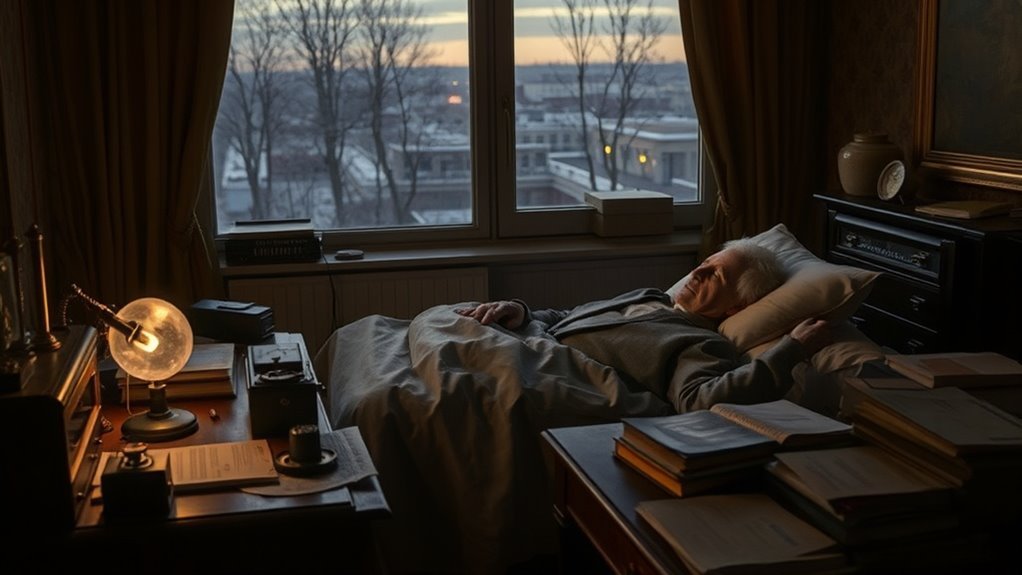
Nikola Tesla died on January 7, 1943, from coronary thrombosis. He was found in his room at the New Yorker Hotel, with a “do not disturb” sign outside his door. While some speculated about foul play, a medical examiner confirmed his death resulted from age-related health decline. After his passing, the U.S. government confiscated his papers due to concerns over potential military applications. There’s more to uncover about Tesla’s life and the impact of his legacy.
Key Takeaways
- Nikola Tesla died on January 7, 1943, from coronary thrombosis at the age of 86.
- He was found in his room at the New Yorker Hotel with a “do not disturb” sign.
- Speculation arose about potential assassination theories, but the medical examiner confirmed natural causes.
- The U.S. government confiscated Tesla’s papers posthumously, fearing military applications of his inventions.
- Tesla’s health had significantly declined in his later years, leading to isolation and limited mobility.
The Circumstances Surrounding Tesla’s Death
Although Nikola Tesla’s death on January 7, 1943, might seem shrouded in mystery, the circumstances surrounding it reveal a straightforward narrative marked by natural causes.
Tesla passed away from coronary thrombosis in his room at the New Yorker Hotel, discovered by a maid named Alice Monaghan, who overlooked the “do not disturb” sign outside his door.
Tesla’s life came to an end from coronary thrombosis, found by a maid despite a “do not disturb” sign.
Speculations of assassination theories emerged, particularly the notion that a German spy might’ve been involved. However, the medical examiner clarified that Tesla’s death resulted from natural health decline due to his advanced age.
Shortly after his passing, U.S. government agents confiscated his papers and property, driven by concerns over his claims of a particle beam weapon and its military implications.
This concise timeline of events highlights the simplicity of Tesla’s death while acknowledging the intrigue that often clouds historical narratives.
What Happened to Tesla’s Papers After His Death?
Immediately following Nikola Tesla’s death, the U.S. government took significant actions regarding his papers and research materials, driven by concerns about their potential military applications. The Office of Alien Property Custodian seized Tesla’s belongings, fearing enemy nations could exploit his inventions.
John G. Trump evaluated the papers, concluding they primarily contained speculative concepts rather than solid plans.
- The mystery surrounding the missing documents stirs curiosity and intrigue.
- Only 60 out of 80 cases were returned to Tesla’s nephew, Sava Kosanović, igniting questions about government transparency.
- The government’s fixation on Tesla’s superweapons casts a shadow over the true legacy of his innovative spirit.
These actions reflect a deep-seated anxiety about the implications of Tesla’s work, leaving a lingering uncertainty about the fate of his more dangerous inventions and the potential knowledge lost in the government seizure.
What Were the Wild Theories About Tesla’s Death Ray?
How could a seemingly eccentric inventor like Nikola Tesla propose a weapon so formidable it captured the attention of governments worldwide?
Tesla’s death ray, a particle beam weapon, was said to have the capacity to destroy numerous aircraft simultaneously. He envisioned it as a means to promote peace rather than warfare, which raises questions about his true intentions.
In 1934, he claimed to possess a pocket-sized device capable of leveling the Empire State Building, underscoring the destructive potential he believed his inventions held. The Soviet Union’s reported funding of $25,000 for his death ray plans only fueled conspiracy theories regarding the weapon’s existence and power.
After his death, U.S. agents hurriedly collected his notes, fearing they might fall into enemy hands. The mysterious absence of many documents, noted by Tesla’s nephew, further intensified speculation about the fate of his more dangerous inventions and the potential implications for global security.
Health Decline and Isolation in Tesla’s Final Years
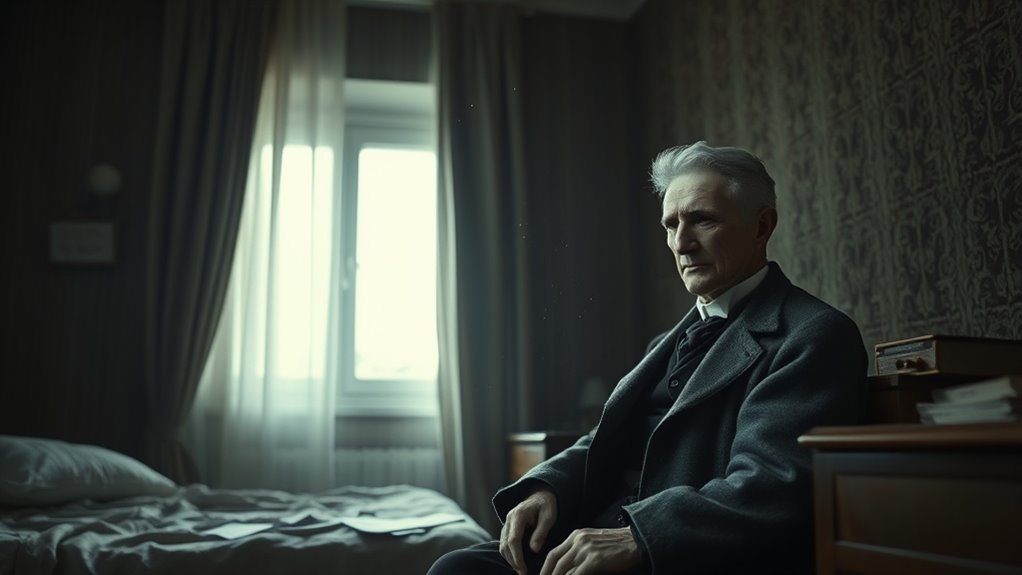
As Nikola Tesla entered his later years, his health visibly deteriorated, leading to a stark isolation from the world that once celebrated his genius. By 1942, he was largely immobile, and his social withdrawal intensified, as he limited interactions to preserve his strict diet of cooked vegetables.
After a 1937 accident, Tesla stubbornly refused medical treatment, which only exacerbated his health deterioration.
- His once-brilliant mind now faced significant cognitive decline.
- Memories of friendships with figures like Mark Twain faded into solitude.
- The isolation starkly contrasted his earlier life filled with innovation and collaboration.
This decline not only affected his physical well-being but also his mental landscape, reflecting a tragic end to the life of a visionary who’d once dreamed of a brighter future for humanity.
The Lasting Legacy of Nikola Tesla
Although Nikola Tesla‘s life ended in relative obscurity, his contributions continue to shape the modern world in profound ways.
Tesla’s inventions, particularly the alternating current (AC) system and induction motor, revolutionized power generation and transmission, laying the groundwork for contemporary electrical engineering. His 112 patents, covering a range of technologies from transformers to early radio-controlled devices, remain foundational to our current technological landscape.
Moreover, Tesla’s pioneering work in wireless communication and energy transfer inspires ongoing advancements in renewable energy and sustainability, reflecting his vision of accessible energy for all.
The posthumous honor of naming the SI unit of magnetic flux density “tesla” in 1960 further cements his significant contributions to electromagnetism.
Tesla’s cultural impact resonates globally, influencing inventors and scientists alike, and establishing him as a symbol of innovation and the limitless potential of human ingenuity.
Frequently Asked Questions
What Was the Mysterious Death of Nikola Tesla?
Tesla’s mysterious death sparked unsolved mysteries surrounding his legacy. Speculations about foul play emerged, yet natural causes prevailed. His papers’ seizure highlighted fears his groundbreaking ideas could change the world, revealing society’s struggle with innovation.
What Was Nikola Tesla’s Last Word?
Tesla’s last words, “I have the feeling that I am going to die,” reflect his awareness in his final days. This poignant moment underscores the solitude he faced, contrasting sharply with his influential legacy in technology.
What Is the Sad Story of Nikola Tesla?
Like a candle burning at both ends, Tesla’s loneliness and financial struggles consumed him. In his final years, he withdrew from society, battling isolation, while his genius faded away, leaving behind a legacy shrouded in obscurity.
How Many Hours Did Nikola Tesla Sleep?
Nikola Tesla typically slept only about two hours nightly, showcasing unique sleep habits. His insomnia struggles fueled his relentless pursuit of innovation, reflecting a mindset that prioritized productivity over rest, ultimately defining his eccentric genius.
Conclusion
In examining Tesla’s life and death, you uncover a narrative marked by genius overshadowed by isolation and health decline. His innovations continue to electrify the world, yet the mysteries surrounding his passing and the fate of his papers evoke intrigue. While wild theories about his death ray may seem preposterous, they highlight society’s fascination with Tesla’s legacy. Ultimately, his contributions are not just historical footnotes; they’re monumental beacons of inspiration that illuminate our technological future.







Leave a Reply