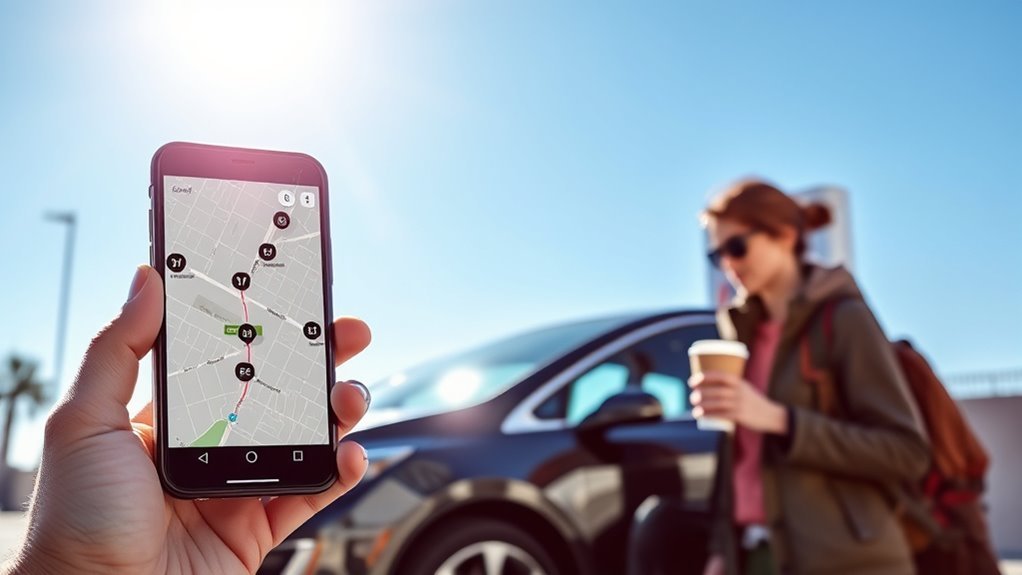
To find EV charging stations, start by using apps like PlugShare and ChargePoint for real-time availability and detailed station information. Familiarize yourself with charger types, like Level 2 for slower charging and Level 3 for quick top-ups. Map out charging stops strategically to align with meals or errands, and keep track of your battery level, aiming to charge before it drops below 15%. Want to explore more tools and tips? Continue to discover expert strategies.
Understanding the Importance of Finding EV Charging Stations on Your Journey
When you’re planning a road trip in an electric vehicle (EV), knowing how to find charging stations is essential, as it can make the difference between a smooth journey and a frustrating experience. Proper planning alleviates charging anxiety, ensuring you won’t run out of battery mid-trip.
Planning your EV road trip involves knowing charging station locations to ensure a seamless journey without battery concerns.
Familiarizing yourself with charging locations at home, work, and along your route enhances travel convenience and opens up more opportunities for exploration.
Utilizing mobile apps like PlugShare and ChargePoint can be game-changers. They offer real-time updates on charger availability, helping you efficiently locate stations when you need them most.
Engaging in pre-trip planning not only saves time but can also reduce costs by pinpointing low-cost or free charging options. By recognizing charger types and their respective speeds, you can strategically plan your stops, maximizing your journey and embracing the freedom that comes with electric travel.
Understanding Different Charger Types: Level 2 vs. Level 3
Understanding the distinctions between Level 2 and Level 3 chargers is essential for optimizing your EV charging experience.
Level 2 chargers provide about 25 miles of range per hour, making them ideal for longer stops at workplaces or shopping centers. This offers significant Level 2 benefits, allowing you to recharge while you go about your day.
On the other hand, Level 3 chargers, also known as DC Fast Chargers, deliver remarkable Level 3 efficiency. They can charge your EV to 80% in roughly 30 minutes, perfect for those long-distance trips.
However, keep in mind that charging efficiency diminishes after reaching 80%, so plan your stops wisely to maximize your time at these fast chargers.
Most new non-Tesla EVs utilize the Combined Charging System (CCS) for Level 3 charging, while the J1772 connector is standard for Level 2.
Understanding these differences helps you tailor your charging strategy effectively.
The Top 3 Apps to Locate Charging Stations
Finding the right app to locate EV charging stations can streamline your charging experience and save you time.
PlugShare is a top choice, boasting an extensive database of over 140,000 charging stations worldwide, complete with real-time updates and community user reviews. This feature allows you to find the best nearby options based on real user experiences.
ChargePoint is another excellent option, offering detailed information about charger types and availability, plus a route planning feature that guarantees efficient charging stops during your travels.
If you’re looking for quick top-ups, Electrify America focuses on fast charging and has the second-largest network of Level 3 chargers in the U.S.
Finally, the EVgo app supports reservations at charging spots, ensuring you won’t face availability issues.
Utilizing these app features will greatly enhance your charging efficiency and empower your EV journey.
Maximizing Your Charging Efficiency With Plugshare
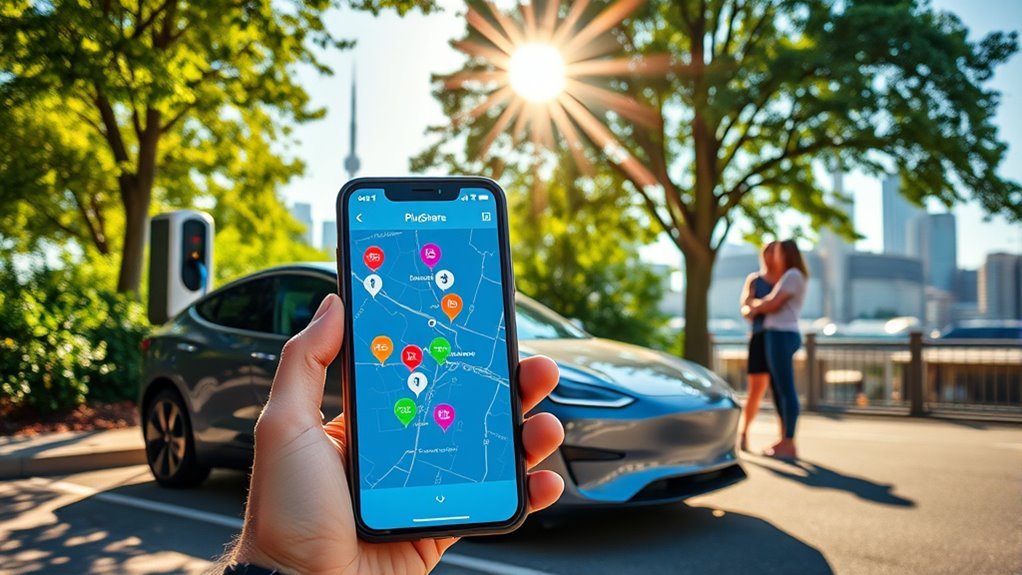
PlugShare stands out as a powerful tool for maximizing your EV charging efficiency. With an extensive database of over 140,000 charging stations worldwide, it provides real-time updates on availability and user reviews that enhance your charging strategy.
You can filter charging stations based on vehicle type, charger speed, and pricing, including options for free chargers, ensuring a tailored experience.
The detailed map interface displays station locations, availability, and user feedback, making it easy to identify the most suitable options nearby. You can also organize driving routes with planned charging stops, optimizing your travel time and ensuring your charging needs are met efficiently.
Some stations even enable in-app payments, streamlining the process and reducing wait times. By leveraging PlugShare features, you’ll navigate charging stations like a pro, liberating you from the anxiety of running low on battery during your journeys.
How to Plan Your Charging Stops Effectively?
To plan your charging stops effectively, start by leveraging charging apps like PlugShare and ChargePoint to pinpoint stations compatible with your EV.
Strategically map out your route, integrating charging breaks for Level 2 or Level 3 chargers based on your travel needs.
Regularly monitor the availability of these chargers to guarantee you avoid delays and keep your journey seamless.
Utilize Charging Apps Effectively
How can you make the most of charging apps to optimize your travel experience? Start by using apps like PlugShare and ChargePoint, which offer extensive databases of charging stations and real-time availability updates.
Filter searches by charger type—Level 2 for longer breaks and Level 3 for quick top-ups—to enhance efficiency. Always check app user reviews for insights into charging station etiquette, ensuring a positive experience for yourself and others.
Organize charging stops around meals or errands to minimize downtime. Download multiple apps to access diverse networks, as some may be isolated or face outages.
Finally, monitor your battery levels and aim to charge before reaching 10-15% to avoid potential delays on your journey.
Plan Routes With Stops
When planning your route, it’s essential to strategically incorporate charging stops to maintain your EV’s range and enhance your travel efficiency.
Utilize apps like PlugShare and ChargePoint to find ideal charging stations based on charger types and real-time availability, ensuring maximum charging efficiency.
Plan your stops around locations with Level 2 chargers for longer breaks or Level 3 chargers for quick top-ups. Consider stations near restaurants or shopping areas; you can multitask by dining or shopping while your vehicle charges.
Keep an eye on your battery levels and aim to charge when they drop below 15%, preventing delays.
With effective route optimization, you’ll enjoy a smoother journey while embracing the freedom of electric travel.
Monitor Charging Availability Regularly
While planning your charging stops, staying informed about the availability of charging stations is essential for a seamless journey.
Utilize apps like PlugShare and ChargePoint for real-time charging station updates, allowing you to access the latest information before hitting the road. Regularly monitor user check-ins and live status indicators to determine if stations are occupied, which helps you strategically plan your stops.
Remember to take into account the efficiency of charger types; Level 2 Chargers work well for longer breaks, while DC Fast Chargers can deliver up to 80% charge in about 30 minutes.
Pre-plan your route with integrated charging stops using tools like A Better Route Planner (ABRP) to optimize your strategy and minimize downtime.
Alternative Methods to Find Charging Stations Beyond Apps
Although many drivers rely on dedicated apps to locate EV charging stations, several alternative methods can enhance your charging experience. The U.S. Department of Energy’s Alternative Fueling Stations Tool provides extensive station maps that include EV chargers, serving as a valuable resource. Google Maps and Waze can also help you find nearby charging stations, although their coverage might be more limited.
Here’s a comparison of these alternative methods:
| Method | Features |
|---|---|
| U.S. Department of Energy | Extensive station maps |
| Google Maps | Directions to nearby stations |
| Waze | Navigation integration for en route |
| Built-in Navigation Systems | Integrated charging station locations |
Additionally, many electric vehicle manufacturers incorporate charging station locations into their built-in navigation systems, offering seamless navigation integration without relying solely on apps. Embrace these methods for a more liberated charging experience.
Tips to Confidently Navigate the EV Charging Landscape
To confidently navigate the EV charging landscape, start by utilizing essential apps like PlugShare and ChargePoint for real-time station availability and compatibility filtering.
Understanding connector types, such as J1772 and CCS, is vital for ensuring you can access the right chargers for your vehicle.
Regularly checking the status of charging stations will help you avoid delays and maximize your charging efficiency.
Essential Apps Overview
Maneuvering the evolving landscape of EV charging can feel overwhelming, but essential apps like PlugShare, ChargePoint, and Electrify America simplify the process.
These tools allow you to confidently navigate charging station types and access invaluable user reviews. Here’s what you can expect:
- PlugShare: With over 140,000 charging stations globally, it offers real-time updates and community insights to help you find nearby options.
- ChargePoint: This app provides route planning features and detailed information on availability and pricing, guaranteeing efficient charger location.
- Electrify America: Focused on fast charging, it features the second-largest network of Level 3 chargers, perfect for quick stops during your travels.
Utilizing these apps guarantees a smoother EV experience, empowering your journey.
Connector Compatibility Awareness
As you navigate the EV charging landscape, understanding connector compatibility is essential for a smooth charging experience.
Familiarize yourself with key connector types: the J1772 is standard for most non-Tesla EVs on Level 2 chargers, ensuring broad charging compatibility.
For quicker options, the CCS (Combined Charging System) is prevalent in DC fast charging for newer models.
Tesla uses the NACS (North American Charging Standard), now being adopted by brands like Ford and GM.
While the CHAdeMO connector was once common for Nissan and Mitsubishi, it’s losing relevance.
Many EVs come with adapters to support various plugs, enhancing your charging flexibility.
Stay informed about these connectors to confidently find the right charging stations for your needs.
Real-Time Availability Checks
Finding the right EV charging station goes beyond knowing connector compatibility; real-time availability checks play a significant role in ensuring you don’t waste time searching for an open charger.
Here are three effective strategies for leveraging real-time updates:
- Use Dedicated Apps: Apps like PlugShare and ChargePoint provide live information, including user check-ins, allowing you to assess charger status before you arrive.
- In-Car Navigation: Some EVs come equipped with navigation systems that automatically refresh data on charging station availability, streamlining your search.
- Community Feedback: Participate in app communities to share experiences and receive updates on charger availability, enhancing your ability to navigate the EV landscape effectively.
Frequently Asked Questions
What Is the 80 20 Rule EV Charging?
The 80/20 rule in EV charging suggests you maximize route optimization by charging from 20% to 80% capacity, as charging speed greatly slows down afterward, enhancing your travel efficiency and minimizing unnecessary delays.
Can EV Trip Planners Find Charging Stations?
You can certainly find charging stations using EV trip planners. These charging apps utilize location services, offering real-time updates and ideal routes, ensuring you never miss a chance to recharge on your journey.
What Is the Best Way to Find Charging Stations?
To find charging stations effectively, use location apps like PlugShare and ChargePoint. They provide real-time updates and broad charging networks. Diversify your resources for thorough coverage and guarantee compatibility with your EV’s connector types.
Which Tool Can Help EV Drivers Find Charging Stations?
To find charging stations, use mobile apps like PlugShare or ChargePoint. These tools help you access extensive charging networks, providing real-time updates, availability, and user reviews, ensuring you stay charged and liberated on your journey.
Conclusion
Finding EV charging stations is as essential to your journey as refueling a gas-powered vehicle. By leveraging apps, understanding charger types, and planning your stops, you can navigate the charging landscape with confidence. Just like a well-prepared map guides you through unfamiliar territory, these tools guarantee you’re never left stranded. Embrace the future of driving; with a little foresight and the right resources, you’ll power your adventures without a hitch. Happy charging!





Leave a Reply