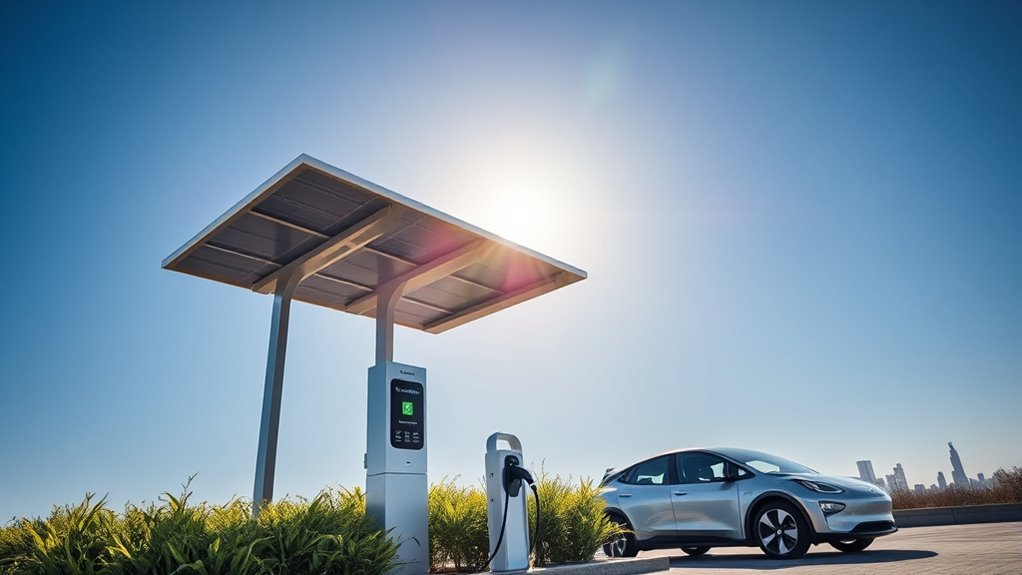
Solar-powered EV charging stations use sunlight to generate electricity for charging electric vehicles. They can reduce your dependence on purchased grid electricity, but their performance depends on sunlight, system size, charging demand, and whether battery storage is installed. Understanding how these systems work helps you choose the right setup for your home, workplace, or commercial charging location.
Quick Answer
Solar-powered EV charging stations use photovoltaic panels to turn sunlight into electricity. An inverter converts the generated power for a compatible AC charger, while the vehicle’s onboard charger supplies DC electricity to its battery. Optional battery storage saves excess solar energy for later use. Grid-connected systems can also draw electricity when sunlight is insufficient.
Key Takeaways
- Solar panels generate electricity, while inverters and charging equipment make that energy usable for an EV.
- Battery storage is optional for grid-connected charging but useful for storing daytime generation.
- The number of panels you need depends on your driving habits, vehicle efficiency, and local solar production.
- Solar charging can lower long-term electricity expenses, but installation costs and local utility policies determine actual savings.
- Backup charging during an outage requires compatible equipment and sufficient available battery capacity.
How Solar-Powered EV Charging Stations Work
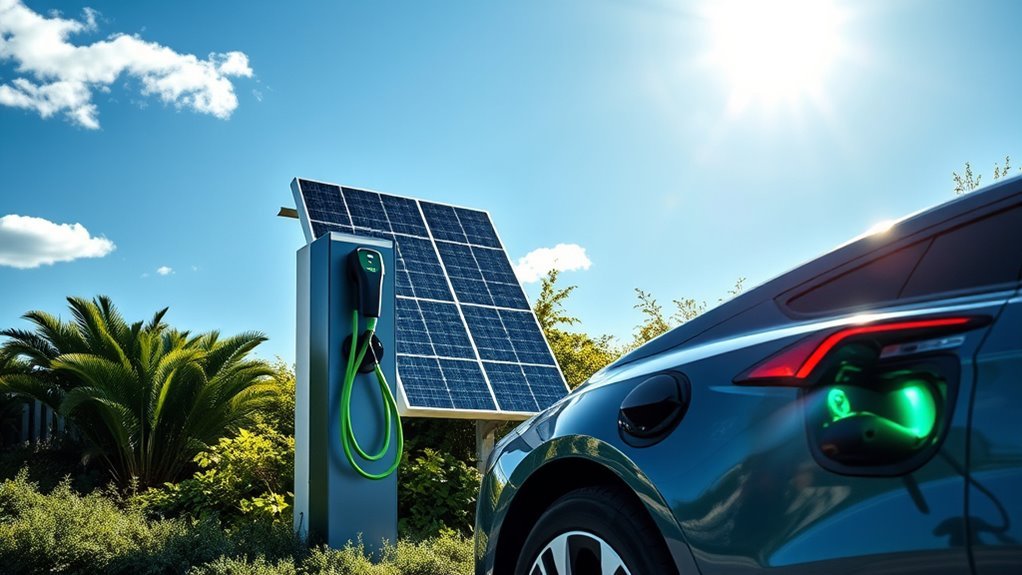
When you consider how solar-powered EV charging stations function, the process begins with photovoltaic (PV) cells. These cells capture sunlight and convert it into direct current (DC) electricity.
Solar panels generate electricity, but the inverter, charging equipment, and vehicle battery determine how that energy is delivered and stored.
In a typical grid-connected setup, the electricity follows five steps:
- Solar generation: PV panels produce DC electricity when sunlight reaches their cells.
- Power conversion: A solar inverter converts the generated DC electricity into AC electricity.
- Energy management: The electrical system supplies available solar power to the property and EV charger. A compatible controller can adjust charging to match solar generation.
- Vehicle charging: A Level 2 charging station supplies AC electricity to the EV. The vehicle’s onboard charger converts it into DC electricity for its battery.
- Energy balancing: Excess solar generation may charge a stationary battery or flow to the utility grid, depending on the system configuration and utility rules.
The U.S. Department of Energy’s Alternative Fuels Data Center explains the differences between AC Level 2 equipment and DC fast charging.
DC fast-charging stations use a different power-conversion arrangement. They supply regulated DC electricity to the vehicle’s battery system rather than relying on the vehicle’s onboard AC charger for the main conversion.
A solar array cannot simply be connected directly to an EV battery. Compatible power electronics and charging controls are required to manage voltage, current, communication, and charging safety.
Types of Solar EV Charging Systems
Not every solar charging station operates the same way. The right configuration depends on when you charge, how much energy you need, and whether backup power matters.
| System Type | How It Works | Main Consideration |
|---|---|---|
| Grid-connected solar | Combines solar generation with utility electricity. | Usually depends on the grid when solar output is insufficient. |
| Solar with battery storage | Stores excess generation for later charging. | Adds cost and has limited storage capacity. |
| Off-grid solar charging | Operates independently of utility electricity. | Requires careful solar, battery, and load sizing. |
| Commercial solar carport | Uses panels mounted above parking spaces. | Must account for multiple vehicles and charging demand. |
For most homeowners, a grid-connected system is a practical starting point because it provides access to utility electricity when solar generation is low.
Key Components of Solar EV Charging Stations
A solar EV charging station combines electricity generation, power conversion, charging equipment, and energy management.
The basic components include:
- Solar panel arrays
- A compatible solar inverter
- Level 2 EV charging equipment or a suitable DC charging system
- Electrical protection and distribution equipment
- Optional stationary battery storage
- Optional smart charging and monitoring controls
Solar Panel Arrays
Solar panel arrays serve as the backbone of solar-powered EV charging stations. Their photovoltaic cells convert sunlight into DC electricity.
The amount of electricity generated depends on several factors:
- Installed solar capacity, measured in kilowatts (kW).
- Local sunlight and seasonal weather.
- Panel orientation, tilt, and shading.
- Panel temperature and system losses.
- The efficiency and condition of the equipment.
There is no universal requirement for 20 to 30 solar panels per electric vehicle. A smaller array may cover one driver’s annual charging demand, while larger installations may be appropriate for an entire home, multiple EVs, or a commercial site.
For example, eight 400-watt panels provide a rated solar capacity of 3.2 kW. Their actual annual electricity production depends on the installation location and operating conditions.
Use the PVWatts solar calculator to estimate annual generation for your location and proposed system size.
Installing panels on rooftops or solar carports can make use of existing space. Solar carports also provide shade and some weather protection for parked vehicles.
Energy Storage Systems
Energy storage systems capture excess solar electricity generated during the day so it can be used later.
For example, if your solar panels generate more electricity than your home and EV currently need, compatible battery storage can save part of that surplus.
You can then use the stored electricity after sunset or during periods of reduced solar production.
Lithium iron phosphate (LiFePO4 or LFP) batteries are one option for stationary energy storage. They are used in many applications where cycle life and thermal stability are important.
However, battery life varies with operating temperature, charge and discharge cycles, depth of discharge, and manufacturer design. Compare usable capacity, power output, warranty terms, and operating limits rather than assuming every battery will last more than ten years.
Battery capacity is especially important for EV charging.
A stationary battery with 10 kWh of usable energy cannot fully recharge a vehicle that needs 40 kWh. Conversion losses further reduce the energy available to the vehicle.
For larger charging demands, a grid connection or a substantially larger storage system may be necessary.
Smart Inverters and Charging Controllers
Smart inverters and controllers help manage electricity between solar panels, the property, the EV charger, the utility grid, and any stationary batteries.
Depending on the equipment, they may provide:
- Solar generation and consumption monitoring.
- Automatic adjustment of EV charging power.
- Battery charging and discharging control.
- Charging schedules based on electricity rates.
- Management of several charging ports at commercial locations.
- Alerts about system performance or equipment faults.
Some smart charging systems can reduce EV charging power when solar production falls. This helps avoid unnecessary grid purchases when the goal is to maximize direct solar consumption.
More advanced commercial systems can also distribute available power between connected vehicles and manage charging queues.
How Many Solar Panels Do You Need to Charge an EV?
The best way to size a solar-powered EV charging station is to estimate how much electricity your vehicle uses each year.
Start with your annual driving distance and the vehicle’s energy consumption. Then account for charging losses and local solar production.
At a Glance: Planning Your Solar EV Charging System
| Time Required | Approximately 30–60 minutes for an initial energy estimate; site assessment and professional installation take longer. |
| Difficulty | Moderate for planning; professional expertise required for electrical installation. |
| Tools Needed | Annual mileage, vehicle efficiency information, electricity bill, and PVWatts. |
| Cost | Depends on system capacity, installation conditions, electrical upgrades, equipment, and optional battery storage. |
Step 1: Estimate Your Annual EV Energy Use
Suppose you drive 12,000 miles annually and your EV consumes an average of 0.30 kWh per mile.
Your estimated annual battery energy consumption is:
12,000 miles × 0.30 kWh per mile = 3,600 kWh.
Electricity is also lost during charging and power conversion.
Using an illustrative 90% overall charging efficiency:
3,600 ÷ 0.90 = 4,000 kWh per year.
In this example, approximately 4,000 kWh of electricity must be supplied annually to cover the vehicle’s charging demand.
Your actual consumption may differ because of driving speed, temperature, vehicle model, terrain, and charging conditions.
Step 2: Estimate Solar Electricity Production
Next, determine how much electricity a solar array could generate at your location.
For illustration, assume each installed kilowatt of solar capacity produces 1,300 kWh annually after modeled system losses.
The required array capacity would be:
4,000 ÷ 1,300 = approximately 3.1 kW.
Using 400-watt panels, eight panels provide a 3.2 kW array.
This is a planning example, not a universal panel recommendation. Actual results should be modeled using local solar data, shading, mounting conditions, and expected system losses.
Pro Tip: Calculate your household electricity use and EV charging demand separately. A solar array sized only for the vehicle may not cover the rest of your home’s consumption.
Step 3: Match Solar Output With Charging Demand
Solar generation changes throughout the day. A system rated at 3.2 kW does not continuously generate 3.2 kW from sunrise to sunset.
A Level 2 charger capable of delivering 7.2 kW may therefore draw additional electricity from the grid when solar generation is lower than charging demand.
Alternatively, a compatible smart charger may reduce its charging rate to match available solar production.
A properly configured battery system can also help meet short-term charging demand, subject to its available energy and discharge-power limits.
Benefits of Solar Power for EV Charging
Solar EV charging can offer several benefits, especially when the charging system is sized around actual electricity demand.
These benefits include lower purchased electricity consumption, reduced exposure to changing utility prices, and the opportunity to use renewable energy for transportation.
Cost Savings Over Time
While many EV owners face changing utility and public charging prices, solar power can reduce the amount of electricity they need to purchase.
However, solar electricity is not automatically free. Installation costs, financing, maintenance, equipment replacement, and storage expenses must be considered.
To understand the potential savings, consider the earlier example of an EV requiring 4,000 kWh annually.
If grid electricity costs an illustrative $0.20 per kWh:
4,000 × $0.20 = $800 per year.
If public charging costs an illustrative $0.35 per kWh:
4,000 × $0.35 = $1,400 per year.
These are example energy costs, not national averages or guaranteed annual expenses. Actual public charging bills may also include session, parking, or idle fees.
Solar charging can offset some of these purchases. The financial value depends on how much solar electricity you use directly, how your utility compensates exports, and the total installed system cost.
According to the Department of Energy’s Homeowner’s Guide to Solar, savings depend on electricity rates, solar generation, system ownership, and local utility compensation policies.
Federal Tax Credits and Incentives
Federal solar incentive information is particularly important when calculating project costs in 2026.
The former 30% Residential Clean Energy Credit under Internal Revenue Code Section 25D is not available for qualifying residential installations completed after December 31, 2025.
The IRS also states that the federal Alternative Fuel Vehicle Refueling Property Credit under Section 30C does not apply to property placed in service after June 30, 2026.
See the IRS Residential Clean Energy Credit guidance for the residential credit’s termination rules.
State, local, utility, and other program-specific incentives may still be available, but eligibility and funding vary by location and project type.
Do not calculate a new project’s expected savings using an expired federal credit.
Environmental Impact Reduction
Harnessing solar power for EV charging can also reduce the emissions associated with producing the electricity used by your vehicle.
Electric vehicles produce no tailpipe emissions while driving, but their total environmental impact includes electricity generation, vehicle manufacturing, and battery production.
Using solar electricity can reduce reliance on fossil-fuel-generated electricity when solar production replaces that energy.
The main environmental advantages include:
- Lower electricity-related emissions: Solar generation produces electricity without directly burning fossil fuels during operation.
- Reduced grid electricity demand: Direct solar charging can offset electricity that would otherwise be purchased from the utility.
- More productive use of parking space: Solar carports generate electricity while providing shade and weather protection.
Solar panels and batteries still have manufacturing and end-of-life impacts. Their environmental benefits should therefore be considered across the complete equipment lifecycle.
The U.S. Environmental Protection Agency explains how electricity generation and vehicle manufacturing affect EV greenhouse gas emissions.
How to Plan and Install a Solar EV Charging Station
Before purchasing equipment, assess the available space, electrical system, and charging requirements.
A well-designed installation should account for both everyday use and future changes, such as adding another EV.
Evaluate Your Installation Site
Start by examining your roof, driveway, parking area, or proposed solar carport location.
Check for:
- Available area for the proposed panel capacity.
- Shading from trees, buildings, and nearby structures.
- Roof condition and structural suitability.
- Suitable mounting orientation and panel tilt.
- Safe cable routes between the array and electrical equipment.
- Convenient placement of the EV charging equipment.
For commercial stations, also consider parking access, pedestrian movement, accessibility requirements, vehicle circulation, and the location of electrical distribution equipment.
Check Your Electrical System
Your existing electrical service must support the proposed charging equipment and other property loads.
A qualified installer should evaluate the electrical panel, available capacity, circuit protection, and whether service upgrades are necessary.
Solar equipment and charging hardware must also be compatible with each other and with the applicable local electrical requirements.
Warning: Solar arrays, stationary batteries, and EV charging circuits involve potentially dangerous electrical voltages. Do not connect solar panels directly to a vehicle battery or modify charging equipment yourself. Use qualified professionals for system design, installation, electrical protection, and required inspections.
Choose the Right Charger and Storage
Select charging equipment based on the vehicle’s capabilities, available electrical capacity, and how quickly you need to recharge.
For typical home use, Level 2 AC charging is a common option.
For commercial locations serving multiple drivers, additional ports, load management, and potentially DC fast charging may be appropriate.
If you want stationary storage, calculate the usable battery capacity needed for your intended charging schedule. Also check the battery’s continuous power output, charging limits, warranty, and compatibility with the inverter.
Permits, Interconnection, and Commissioning
Solar installations commonly require local approvals and, for grid-connected systems, utility interconnection procedures.
Once installation is complete, the system should be inspected and commissioned according to applicable requirements.
The installer should verify that charging controls, inverter settings, electrical protection, and any backup-power functions operate as intended.
Can Solar EV Charging Work at Night or During an Outage?
Yes, but the available equipment determines how the charging station operates.
At night, solar panels stop producing meaningful electricity. A grid-connected charger can continue operating using utility electricity.
If stationary storage is installed, the charger may instead use previously stored solar energy.
During cloudy weather, the panels may continue generating electricity at a reduced rate. The grid or battery can supply additional energy when available.
What Happens During a Power Outage?
A standard grid-connected solar installation generally shuts down when utility power fails. This helps prevent electricity from being sent into lines that utility workers may be repairing.
A backup-capable system requires suitable equipment, such as a compatible inverter, storage system, and approved isolation arrangement.
Even with backup equipment, EV charging may be limited by battery capacity and power-management settings.
The Department of Energy’s Solar and Resilience Basics explains why solar panels alone generally cannot provide ordinary grid-independent backup power.
Note: A solar system that offsets your annual EV electricity consumption is not necessarily capable of charging the vehicle during every nighttime period, cloudy day, or power outage. Annual energy production and real-time available charging power are different measurements.
What Makes Solar EV Charging Stations Challenging?
Although solar-powered EV charging offers several advantages, practical challenges can affect cost, reliability, and system performance.
The most common limitations include:
- Weather and daylight: Solar generation varies throughout the day and across seasons.
- Space requirements: Larger arrays need suitable roof, ground, or carport area.
- Initial investment: Solar equipment, mounting, electrical work, charging hardware, and batteries increase installation costs.
- Permits and interconnection: Local approval and utility procedures can affect project schedules.
- Charging demand: Several vehicles charging simultaneously may require more power than the solar array can produce.
- Maintenance: Panels, electrical connections, inverters, and batteries need appropriate inspection and monitoring.
Site selection is especially important. Poor orientation or extensive shading can reduce electricity production and weaken the financial case for installation.
Commercial charging stations face additional challenges because customer demand may not match peak solar generation.
For example, a station may generate its most electricity around midday while experiencing heavy charging demand during evening hours.
Battery storage, grid connections, and smart load management can help address this mismatch, although each adds design considerations or cost.
Maintenance and Troubleshooting
Solar EV charging stations generally benefit from regular monitoring and preventive maintenance.
Useful maintenance practices include:
- Checking solar production through the inverter or monitoring app.
- Inspecting panels for unusual dirt buildup, visible damage, or new shading.
- Checking charging cables and connectors for wear or damage.
- Reviewing inverter and battery fault notifications.
- Following manufacturer instructions for cleaning, inspection, and servicing.
If charging stops unexpectedly, first check the vehicle’s charging schedule, station status, and any visible error messages.
If the system repeatedly trips a breaker, reports electrical faults, or shows signs of overheating, stop using the affected equipment and arrange professional inspection.
Do not open high-voltage equipment or attempt internal electrical repairs.
Emerging Innovations Shaping the Future of Solar EV Charging
Improvements in power electronics, energy storage, and charging software continue to expand the capabilities of solar EV charging systems.
Several developments are particularly relevant:
- Smart inverters: Advanced controls help manage electricity production, consumption, and grid interaction.
- Hybrid solar and storage systems: Batteries provide greater flexibility when generation and charging demand do not occur at the same time.
- Advanced monitoring: Software tracks solar output, battery levels, charging activity, and equipment performance.
- Dynamic load management: Compatible systems can adjust charging power to available electrical capacity.
- Modular infrastructure: Charging locations can be designed to support future expansion as demand grows.
Solar carports are another useful development. They combine electricity generation with parking infrastructure and can provide shade for vehicles.
For commercial operators, pairing carports with multiple charging ports and centralized energy management can help make better use of available space.
However, higher charging demand still requires adequate electrical infrastructure. Smart controls improve energy distribution but cannot create electricity beyond what the system generates, stores, or imports.
How Does Solar Charging Compare to Traditional Methods?
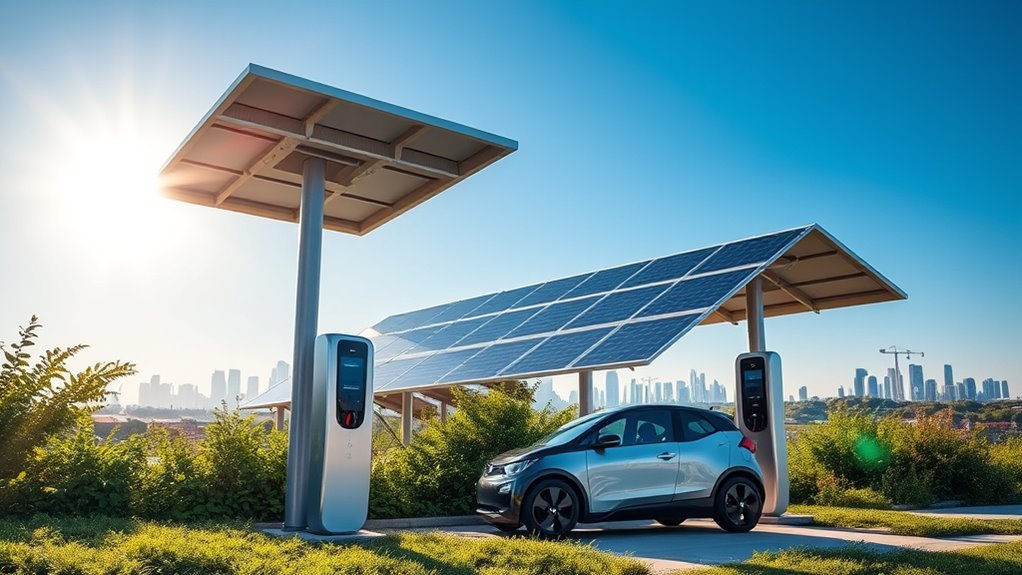
Solar EV charging provides an alternative to relying entirely on conventional grid electricity or paid public charging stations.
Each method has advantages, and the most suitable option depends on your driving habits, electricity rates, installation costs, and access to charging equipment.
| Charging Method | Main Advantage | Main Limitation |
|---|---|---|
| Home grid charging | Convenient charging without installing solar panels. | Electricity purchases depend on utility rates. |
| Public charging | Useful for travel and drivers without home charging. | Prices and availability vary by provider and location. |
| Solar-powered home charging | Can reduce purchased electricity consumption. | Requires suitable installation space and upfront investment. |
| Solar charging with storage | Allows some daytime solar energy to be used later. | Battery cost, capacity, and conversion losses affect value. |
For homeowners who drive during the day and charge overnight, solar panels can still offset annual electricity purchases through daytime self-consumption and eligible utility export arrangements.
However, exporting electricity during the day and importing it at night is not the same as physically storing solar electricity.
Any bill credits depend on the applicable utility tariff.
Adding battery storage allows more direct use of generated electricity after sunset, but the extra equipment must be included in the financial calculation.
Ultimately, solar charging is most useful when the system matches the owner’s electricity consumption, available space, and budget.
Frequently Asked Questions
Do Solar Powered EV Chargers Work?
Yes. Solar-powered EV chargers use electricity generated by photovoltaic panels. A compatible inverter and charging system deliver energy to the vehicle. Charging performance depends on available solar power, charger capacity, and whether the system can also use the grid or stationary battery storage.
What Is the 80/20 Rule for EV Charging?
The 80/20 guideline commonly refers to keeping some EV batteries between approximately 20% and 80% during routine use. It is not a universal requirement. Follow your vehicle manufacturer’s recommendations, which may differ by battery chemistry. Many EVs also reduce DC fast-charging power above approximately 80%, making the final portion of a charging session slower. Charging to 100% may still be appropriate when the vehicle manufacturer recommends it or when additional driving range is needed.
What Are the Disadvantages of Solar Chargers?
The main disadvantages include upfront installation costs, changing solar production, space requirements, permitting, and potential electrical upgrades. Battery storage adds expense and has limited capacity. A grid-connected solar system without compatible backup equipment generally cannot operate during a utility outage.
How Does a Solar Charging Station Work?
Solar panels convert sunlight into DC electricity. In a common AC charging installation, an inverter converts that electricity into AC power, which the charging equipment supplies to the vehicle. The EV’s onboard charger converts the incoming AC electricity into DC for its battery. Optional stationary storage saves excess solar energy for later use.
Can a Solar EV Charger Work at Night?
Yes, if it has access to grid electricity or a sufficiently charged stationary battery. Solar panels themselves do not generate meaningful electricity at night. A solar-only system without storage or another electricity source cannot provide normal nighttime charging.
How Many Solar Panels Are Needed to Charge an Electric Car?
There is no fixed number. Calculate the vehicle’s annual electricity consumption, account for charging losses, and estimate local solar production. For example, an EV needing approximately 4,000 kWh annually could require around 3.1 kW of solar capacity if each installed kilowatt produces 1,300 kWh per year. Eight 400-watt panels provide 3.2 kW of rated capacity, although actual output varies by site.
Will Solar Panels Charge My EV During a Power Outage?
Not automatically. Standard grid-connected solar installations generally shut down when utility power fails. Outage charging requires compatible backup equipment, appropriate electrical isolation, and enough available power and stored energy to support the charger.
Conclusion
Solar-powered EV charging stations offer a practical way to combine renewable electricity with electric transportation. Solar panels generate electricity, while inverters, charging equipment, and optional batteries determine how and when that energy reaches your vehicle.
The main benefits are reduced reliance on purchased electricity, greater control over charging, and the potential to lower electricity-related emissions. However, results depend on system size, driving habits, local solar conditions, installation costs, and utility policies.
Before investing, calculate your vehicle’s annual electricity demand, estimate local solar production, and choose equipment that matches your charging needs. A properly designed system can provide reliable everyday charging while allowing room for future expansion.
Sources
- U.S. Department of Energy — Solar Photovoltaic System Design Basics — PV generation, inverters, system design, and energy storage.
- PVWatts Calculator — Location-specific estimates of solar electricity production.
- Alternative Fuels Data Center — Electric Vehicle Charging Stations — Charging equipment and charging-level information.
- U.S. Department of Energy — Solar and Resilience Basics — Solar storage and grid-outage operation.
- Internal Revenue Service — Residential Clean Energy Credit — Federal residential solar-credit eligibility and termination.
- U.S. Environmental Protection Agency — Electric Vehicle Myths — Electricity-related emissions and environmental considerations.







Leave a Reply