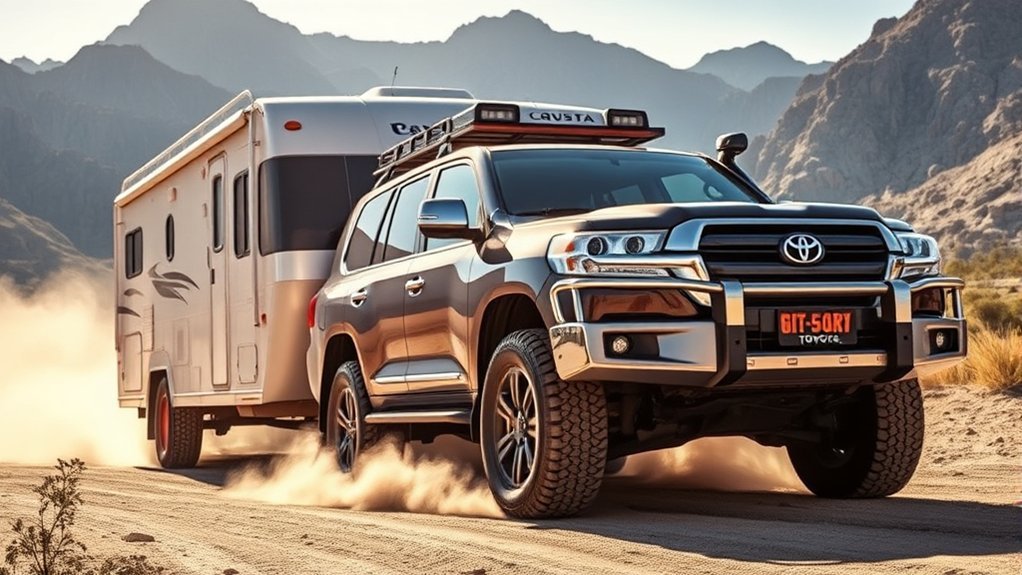
The 2024 Toyota Land Cruiser is built for off-road adventures, but it can also handle a travel trailer, utility trailer, or boat. Before hitching up, you need to understand its actual towing limit, trailer equipment, and available payload. Getting these details right matters more than simply having a powerful engine.
Quick Answer
The 2024 U.S.-market Toyota Land Cruiser has a maximum towing capacity of 6,000 pounds when properly equipped. Its 2.4-liter turbocharged hybrid powertrain produces 326 horsepower and 465 lb-ft of torque. Safe towing also depends on trailer brakes, tongue weight, payload, hitch ratings, and proper weight distribution. The older V8 Land Cruiser had a higher 8,100-pound rating.
Key Takeaways
- The 2024 Land Cruiser can tow up to 6,000 pounds, subject to its vehicle and equipment ratings.
- Toyota recommends tongue weight of approximately 9–11% of the loaded trailer weight.
- Toyota requires adequate sway control above 2,000 pounds and a suitable weight-distributing hitch above 5,000 pounds.
- The factory trailer brake controller must be configured correctly before towing a trailer with compatible brakes.
- Always check actual loaded weights, not just a trailer’s advertised dry weight.
Understanding the Toyota Land Cruiser’s Towing Capacity and Performance
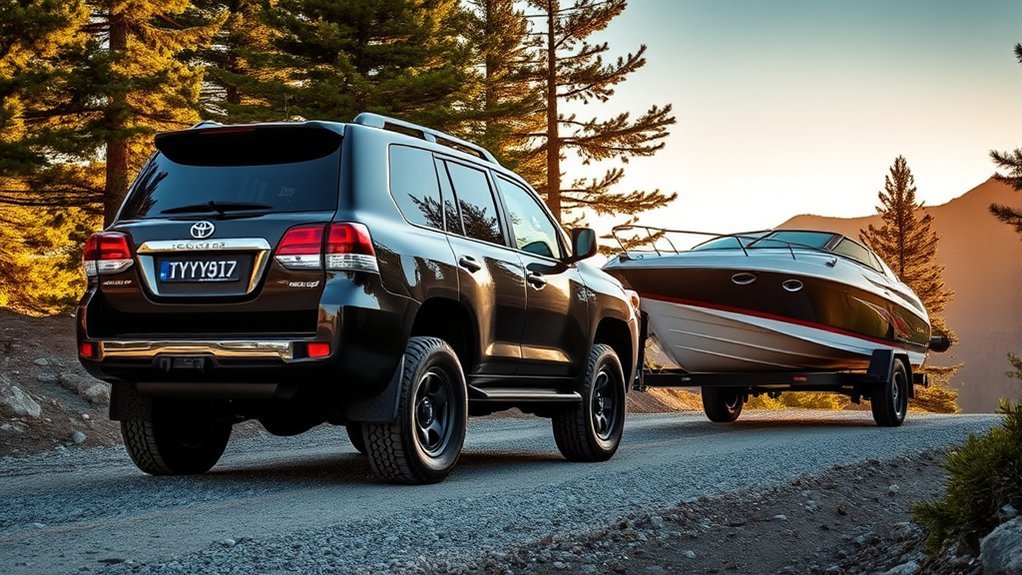
According to Toyota’s official 2024 Land Cruiser specifications, the U.S. model has a maximum towing capacity of 6,000 pounds.
This rating applies to the 2024 Land Cruiser lineup, including the 1958, Land Cruiser, and First Edition grades.
The vehicle uses Toyota’s i-FORCE MAX hybrid powertrain, which combines a turbocharged 2.4-liter four-cylinder engine with an electric motor and an eight-speed automatic transmission.
Its combined output is 326 horsepower and 465 lb-ft of torque. The electric motor helps deliver strong low-speed response, which can be useful when accelerating with a trailer or climbing hills.
However, torque alone does not determine towing capacity. The frame, suspension, brakes, cooling system, vehicle weight, and hitch equipment also affect the safe towing limit.
2024 vs. Older Land Cruiser Towing Capacity
| Model | Powertrain | Maximum Towing Capacity |
|---|---|---|
| 2024 U.S. Land Cruiser | 2.4L turbocharged hybrid | 6,000 lb |
| 2019 U.S. Land Cruiser | 5.7L V8 | 8,100 lb |
The 8,100-pound rating belongs to the earlier V8-powered generation. It is confirmed in Toyota’s 2019 Land Cruiser brochure.
Do not use an older model’s rating when planning a towing setup for the 2024 vehicle.
Warning: The 6,000-pound rating is a maximum, not a guarantee that every loaded trailer weighing 6,000 pounds can be safely towed. Vehicle payload, axle loads, combined weight, and hitch ratings must also remain within their limits.
Key Features for Enhanced Towing Performance
The 2024 Land Cruiser includes useful towing hardware and electronic systems. These features help with trailer connections, braking, and vehicle control when properly configured.
| Feature | Description | Benefit |
|---|---|---|
| Towing Capacity | Up to 6,000 lb | Supports a range of properly loaded trailers |
| Hybrid Powertrain | 326 hp and 465 lb-ft | Strong low-speed response |
| Trailer Brake Controller | Toyota factory-installed system | Controls compatible trailer brakes |
| Trailer Wiring | Four- and seven-pin connections | Supports trailer electrical connections |
| Tow/Haul Mode | Dedicated towing drive mode | Adjusts vehicle operation for towing |
| Trailer Sway Control | Electronic stability assistance | Helps manage certain sway conditions |
Toyota’s factory trailer brake controller works through the seven-pin connector. It allows the driver to select the trailer brake type and adjust braking gain.
The vehicle also provides a manual trailer-brake slider. Toyota explains these controls in its 2024 Land Cruiser Quick Reference Guide.
What Does Tow/Haul Mode Do?
Tow/Haul mode changes engine, transmission, and steering behavior to better suit towing or carrying a heavy load.
Press the TOW HAUL switch before driving with a trailer. Confirm that the indicator appears in the instrument cluster.
This mode helps the vehicle respond to towing demands, but it does not increase the maximum towing capacity or replace proper trailer brakes.
Understanding Payload, Tongue Weight, and Weight Ratings
A trailer can weigh less than 6,000 pounds and still overload your Land Cruiser if its tongue weight or your vehicle’s total cargo load is too high.
Before towing, understand these important ratings:
- TWR: Trailer Weight Rating, the maximum permitted loaded trailer weight.
- GVWR: Gross Vehicle Weight Rating, the maximum permitted loaded vehicle weight.
- GAWR: Gross Axle Weight Rating, the maximum load permitted on each axle.
- GCWR: Gross Combination Weight Rating, the maximum combined weight of the loaded vehicle and trailer.
- Payload: The weight available for people, luggage, equipment, and applicable trailer tongue load.
- Tongue weight: The downward load applied by the trailer to the hitch ball.
Your vehicle’s actual payload depends on its configuration and installed equipment. Check the tire and loading information label on your Land Cruiser rather than assuming that another vehicle’s published payload applies to yours.
How Much Tongue Weight Should a Land Cruiser Have?
Toyota’s 2024 owner’s manual recommends distributing the loaded trailer weight so that approximately 9–11% rests on the hitch.
Use this calculation:
Loaded trailer weight × tongue-weight percentage = target tongue weight.
| Loaded Trailer Weight | 9% Tongue Weight | 11% Tongue Weight |
|---|---|---|
| 2,000 lb | 180 lb | 220 lb |
| 3,000 lb | 270 lb | 330 lb |
| 4,000 lb | 360 lb | 440 lb |
| 5,000 lb | 450 lb | 550 lb |
| 6,000 lb | 540 lb | 660 lb |
These figures are calculations, not approved hitch-load ratings. The actual tongue weight must also remain within the limits of your vehicle, receiver, ball mount, hitch ball, and other equipment.
For example, a 6,000-pound trailer at 10% tongue weight places approximately 600 pounds on the hitch. You must confirm that your particular setup permits that load.
If the hitch equipment has a lower tongue-weight rating, that lower rating controls. Do not exceed it simply to reach a preferred percentage.
Pro Tip: Weigh your trailer after loading camping gear, water, batteries, propane, and other supplies. A trailer’s advertised dry weight does not represent its actual departure weight.
Common Trailer Types You Can Tow With a Land Cruiser
With a maximum towing capacity of 6,000 pounds, the 2024 Toyota Land Cruiser can handle several types of recreational and utility trailers when their actual loaded weights and equipment requirements remain within the vehicle’s limits.
| Trailer Type | What to Check | Important Consideration |
|---|---|---|
| Small Travel Trailer | Loaded weight, tongue weight, and height | Large frontal area can increase wind resistance |
| Pop-Up Camper | Loaded weight and hitch rating | Usually presents less frontal area than a tall travel trailer |
| Utility Trailer | Equipment weight and cargo placement | Concentrated loads can affect tongue weight |
| Boat Trailer | Boat, engine, fuel, gear, and trailer weight | Check trailer brakes and launching conditions |
| Enclosed Cargo Trailer | Loaded weight, height, and wind exposure | Broad sides may increase trailer sway |
These are examples of trailer categories, not blanket approvals for every trailer in each category.
A tall travel trailer weighing 4,500 pounds may be more demanding to tow in crosswinds than a lower-profile utility trailer of similar weight.
For that reason, check the trailer’s loaded weight, dimensions, tire condition, braking system, and cargo placement before making your decision.
How to Properly Set Up Your Towing Experience
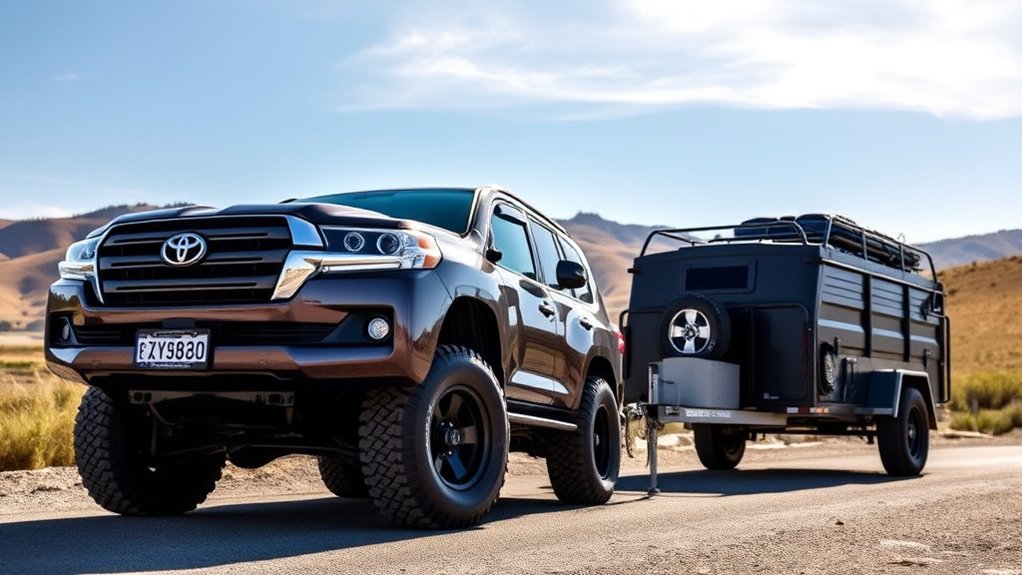
Proper setup is essential before towing with your Toyota Land Cruiser. A correctly attached trailer with balanced weight and working brakes is easier to control than an overloaded or poorly adjusted setup.
At a Glance
| Time Required | Allow extra time for initial setup, weighing, and brake testing. |
| Difficulty | Moderate; professional assistance is useful for first-time hitch installation and adjustment. |
| Tools Needed | Compatible hitch equipment, hitch pin, safety chains, trailer wiring, tire-pressure gauge, and access to a suitable scale. |
| Cost | Varies with existing equipment, trailer type, hitch requirements, and weighing services. |
Step 1: Check All Weight Ratings
Start with the 6,000-pound maximum towing rating, then confirm your specific vehicle’s payload, GVWR, GAWR, GCWR, and hitch ratings.
Include passengers, luggage, accessories, and trailer tongue weight in your vehicle-loading calculation.
When possible, use a vehicle scale to confirm the actual loaded weights.
Step 2: Select the Correct Trailer Hitch
Use a compatible hitch receiver, ball mount, and hitch ball with ratings suitable for your loaded trailer.
Match the hitch ball diameter to the trailer coupler and confirm that the trailer sits level when connected.
Toyota requires a properly rated weight-distributing hitch when the gross trailer weight exceeds 5,000 pounds.
For a weight-distribution setup, follow the hitch manufacturer’s installation instructions and Toyota’s guidance for restoring the front axle load.
Step 3: Connect the Trailer
- Position the Land Cruiser and trailer on a stable surface.
- Lower the coupler fully onto the correct hitch ball.
- Close and secure the coupler latch.
- Install the hitch pin and safety clip.
- Connect the safety chains securely, following the trailer manufacturer’s instructions.
- Connect the trailer’s electrical plug.
- Attach the emergency breakaway cable if the trailer uses one.
- Raise and secure the trailer jack before moving.
Check that all connections have enough clearance for turning without dragging or contacting the road.
Step 4: Configure the Trailer Brake Controller
The Land Cruiser includes a Toyota Genuine Trailer Brake Controller for compatible trailer braking systems.
Use the multi-information display to select the appropriate trailer brake type, such as electric or electric-over-hydraulic.
Set the controller gain according to Toyota’s instructions and the trailer manufacturer’s recommendations.
If your vehicle uses a trailer profile or selection menu, confirm the correct trailer is selected. A published Cars.com test reported that its controller did not operate until a trailer was selected in the instrument cluster.
Use the manual brake slider to verify the trailer brake response during a controlled, low-speed test in a safe area.
Do not rely on the trailer brakes until you have confirmed that they operate correctly.
Warning: Toyota does not recommend using a third-party trailer brake controller alongside its factory controller because the systems may interact unexpectedly.
Step 5: Check the Trailer Lights
Test the brake lights, turn signals, running lights, and other required trailer lighting.
If a light does not work, inspect the trailer plug, wiring, and vehicle connection before departure.
Do not tow with faulty required lighting.
Step 6: Adjust the Trailer Load
Place heavier cargo low and close to the trailer axle, while maintaining the correct tongue weight.
Secure every item so it cannot move during braking, turning, or travel over rough pavement.
Verify that the trailer is level and that the Land Cruiser is not overloaded at either axle.
Step 7: Enable Tow/Haul Mode
Press the TOW HAUL switch and check the instrument-cluster indicator.
Use the appropriate driving mode for your towing conditions. Avoid assuming that low-range four-wheel drive or off-road modes are suitable for ordinary paved-road towing.
Step 8: Complete a Test Drive
Begin with a short drive in a safe area.
Check acceleration, braking, turning clearance, and trailer stability. Stop and inspect the hitch, chains, wiring, tires, and load again after driving a short distance.
If the trailer sways, brakes poorly, or causes unusual vehicle handling, correct the problem before continuing.
Real-World Toyota Land Cruiser Towing Experiences
Published testing provides useful information about how the 2024 Land Cruiser performs beyond its official towing rating.
In a December 2024 Cars.com towing test, the reviewer used an approximately 4,700-pound travel trailer with a tongue weight of about 490 pounds.
The trailer was approximately 22 feet long, 8 feet wide, and 10 feet tall, making it a useful example of a relatively light but aerodynamically demanding travel trailer.
| Towing Scenario | Documented Test Observation |
|---|---|
| Travel Trailer | Approximately 4,700 lb loaded trailer |
| Tongue Weight | Approximately 490 lb |
| Mountain Climb | The vehicle maintained the posted 45-mph speed on the tested climb. |
| Highway Stability | The reviewer reported limited sway, with some movement from a passing truck. |
| Trailer Braking | The factory controller worked well after proper configuration. |
| Fuel Economy | 11.4 mpg indicated during the short test route. |
The test included a mountain route and highway driving. The reviewer found that the Land Cruiser could maintain speed on the climb, although additional acceleration at full throttle was limited.
The reported 11.4-mpg figure came from the vehicle’s trip computer during a relatively short test. It should not be treated as a guaranteed towing fuel-economy figure.
Your results will vary with trailer weight, frontal area, wind, road grade, speed, temperature, and driving conditions.
The test also showed why the factory trailer brake controller must be configured before departure. Simply plugging in a trailer is not a substitute for checking the controller’s operating status.
What Safety Tips Should You Follow When Towing?
Even a properly equipped Land Cruiser will handle differently with a trailer attached. Stopping distance increases, turning requires more space, and a tall trailer can react strongly to wind.
Follow the Required Hitch and Brake Rules
The 2024 Toyota Land Cruiser owner’s manual specifies these important towing requirements:
- Use trailer service brakes when the loaded trailer exceeds the vehicle’s unbraked towing rating.
- Use an adequately rated sway-control device when trailer weight exceeds 2,000 pounds.
- Use an adequately rated weight-distributing hitch when trailer weight exceeds 5,000 pounds.
- Keep the loaded trailer, vehicle, axles, and hitch within their respective ratings.
The manual lists an unbraked trailer weight rating of 1,650 pounds. Local laws may impose additional or stricter trailer-braking requirements.
Electronic Trailer Sway Control can assist when instability occurs, but it cannot compensate for an overloaded trailer, incorrect tongue weight, unsuitable tires, or unsafe driving.
Respect the Break-In Period
If your Land Cruiser is new or has received certain new powertrain components, follow Toyota’s break-in instructions.
Toyota recommends avoiding trailer towing during the first 500 miles.
During the following 500 miles of towing, keep towing speed below 45 mph and avoid full-throttle acceleration, as specified in the owner’s manual.
Drive Carefully on Hills
Slow down before descending a long or steep grade. Use the appropriate transmission range for additional engine braking, following Toyota’s instructions.
Avoid riding the brakes continuously because excessive heat can reduce braking effectiveness.
Leave additional distance from vehicles ahead and allow extra room when turning or passing.
Follow the Correct Towing Speed
Toyota’s 2024 manual recommends a maximum vehicle-trailer speed of 65 mph on a flat, straight, dry road.
Follow whichever limit is lower: Toyota’s recommendation, the posted towing speed limit, or the trailer manufacturer’s speed limit.
Reduce speed further in strong winds, rain, heavy traffic, or challenging road conditions.
What Should You Do if Your Trailer Starts Swaying?
If the trailer begins to sway, keep the steering wheel steady and gradually release the accelerator to reduce speed.
Avoid sudden steering corrections, acceleration, or abrupt braking. Follow the trailer-sway recovery instructions in your vehicle’s owner’s manual.
Once the combination is stable, stop in a safe location and inspect the load, tires, hitch, and tongue weight before continuing.
A trailer’s actual loaded weight and tongue weight matter more than its advertised dry weight.
Predeparture Towing Safety Checklist
- Confirm vehicle and trailer weights are within all applicable ratings.
- Inspect the hitch receiver, ball mount, coupler, and locking hardware.
- Connect and inspect safety chains and the breakaway cable.
- Check trailer brake operation and controller settings.
- Test all required trailer lights.
- Check tow-vehicle and trailer tire pressures and condition.
- Secure all cargo and verify tongue weight.
- Check mirrors and visibility around the trailer.
- Confirm the trailer jack is raised and secured.
- Check that the trailer is level and has adequate turning clearance.
Regular maintenance is also important. Toyota notes that towing places additional demands on the vehicle and may require more frequent service.
Towing Capacity and Safety: What Else Should You Know?
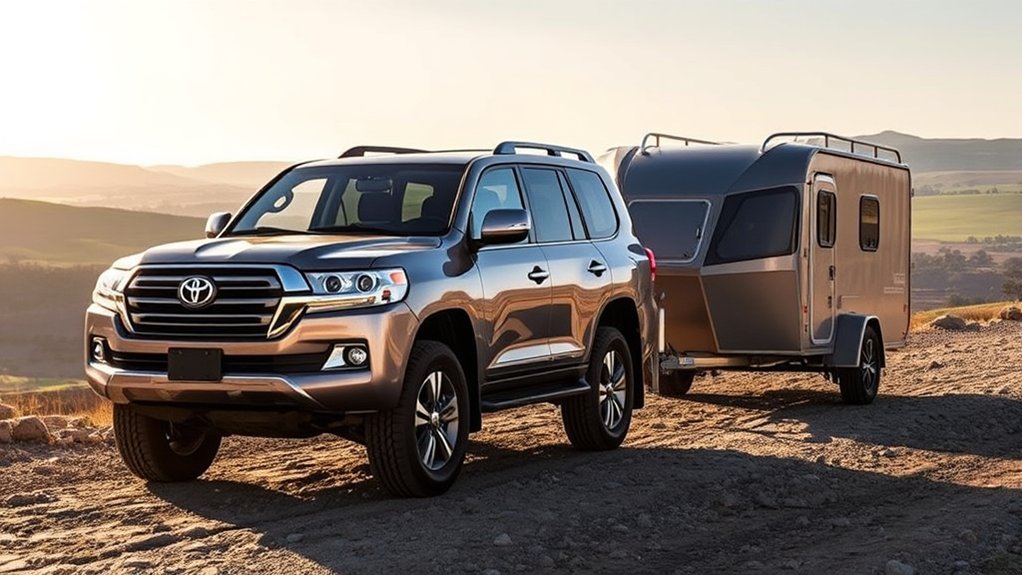
Understanding the towing limit is only part of preparing your Land Cruiser for a trailer. You also need to check the complete vehicle-and-trailer combination.
Towing Capacity Overview
The 2024 Land Cruiser’s official towing rating is 6,000 pounds, but the actual trailer weight you can carry depends on the fully loaded vehicle and the equipment installed.
| Specification | Value | Notes |
|---|---|---|
| Maximum Towing Capacity | 6,000 lb | 2024 U.S. model |
| Unbraked Trailer Rating | 1,650 lb | Subject to applicable braking laws |
| Recommended Tongue Weight | 9–11% | Percentage of loaded trailer weight |
| Payload | Vehicle-specific | Check the tire and loading label |
| GVWR and GAWR | Vehicle-specific | Check the certification label |
A heavier trailer is not automatically suitable simply because its weight is below 6,000 pounds. Calculate the complete load and check your hitch equipment before towing.
Safety Considerations While Towing
Safe towing depends on the condition and setup of both the Land Cruiser and its trailer.
- Inspect trailer brakes and electrical connections before departure.
- Use the required weight-distribution and sway-control equipment.
- Keep cargo secure and maintain appropriate tongue weight.
- Check tire condition and inflation pressure.
- Adjust driving speed and following distance for the trailer.
- Follow Toyota’s instructions for driver-assistance systems while towing.
Some driver-assistance features may not operate as intended with a trailer. Consult the owner’s manual for the systems Toyota instructs drivers to disable while towing, including relevant lane-assistance and radar-cruise functions.
Frequently Asked Questions
Is the Toyota Land Cruiser Good for Towing?
The 2024 Land Cruiser can tow up to 6,000 pounds when properly equipped. Its hybrid powertrain provides 465 lb-ft of torque, and the vehicle includes a factory trailer brake controller. Whether it suits your trailer depends on actual loaded weight, tongue weight, payload, trailer size, and driving conditions.
Is the 2.8 Auto Better Than the V8 Land Cruiser?
The 2.8-liter diesel automatic and older V8 Land Cruisers belong to different configurations and markets. Their towing ratings, fuel consumption, and performance vary by model and location. The 2024 U.S. Land Cruiser uses a 2.4-liter turbocharged hybrid engine and has a 6,000-pound towing rating. Compare exact model-year and market specifications rather than assuming one engine has universally higher towing capability.
How Much Weight Can a Toyota Land Cruiser Pull?
The 2024 U.S. Toyota Land Cruiser can tow up to 6,000 pounds. Older U.S. V8 models, including the 2019 Land Cruiser, were rated for up to 8,100 pounds. Always check the exact model year and vehicle’s towing documentation.
What Toyota Can Tow 10,000 Pounds?
An appropriately configured Toyota Tundra can tow 10,000 pounds. For example, Toyota lists a maximum towing capacity of up to 12,000 pounds for certain 2024 Tundra configurations. The actual rating depends on engine, cab, drivetrain, bed configuration, and equipment. The 2024 Land Cruiser is not rated to tow 10,000 pounds.
Can a 2024 Land Cruiser Tow a 7,000-Pound Trailer?
No. A 7,000-pound loaded trailer exceeds the 2024 U.S. Land Cruiser’s 6,000-pound maximum towing rating. Use a properly rated tow vehicle instead.
Do I Need a Weight-Distribution Hitch With a Land Cruiser?
Toyota requires a properly rated weight-distributing hitch when the gross trailer weight exceeds 5,000 pounds. A suitable sway-control device is also required above 2,000 pounds. Follow Toyota’s instructions and the hitch manufacturer’s requirements.
Conclusion
The 2024 Toyota Land Cruiser combines a capable hybrid powertrain with useful towing equipment, but its maximum towing capacity is 6,000 pounds, not the 8,100-pound rating of the older V8 generation.
Before your next towing adventure, verify your loaded trailer weight, calculate tongue weight, inspect the hitch, and configure the trailer brake controller. Follow Toyota’s sway-control and weight-distribution requirements, and respect every applicable vehicle and equipment rating.
With the right trailer and proper preparation, your Land Cruiser can handle both the journey and the destination safely.
Sources
- Toyota USA Newsroom — 2024 Land Cruiser Returns to Its Origin — official towing capacity, powertrain, and vehicle specifications.
- Toyota 2024 Land Cruiser Owner’s Manual (OM60U35U) — towing weight limits, tongue weight, hitch requirements, break-in guidance, and safety precautions.
- Toyota 2024 Land Cruiser Quick Reference Guide — trailer brake-controller operation and Tow/Haul mode.
- Toyota 2019 Land Cruiser Brochure — earlier-generation V8 specifications and 8,100-pound towing capacity.
- Toyota 2024 Tundra Brochure — towing ratings for appropriately configured Tundra models.
- Cars.com — 2024 Toyota Land Cruiser: How Well Does It Tow? — documented December 2024 towing test and observations.







Leave a Reply