
Toyota moves millions of vehicles across the globe each year. The United States market acts as the main engine for this massive operation. American buyers purchase about one-fifth of all Toyota cars worldwide. Read on to see how U.S. sales shape the automaker’s global revenue and future growth.
Quick Answer
The United States accounts for about 20% of Toyota’s global vehicle sales volume. North America generates nearly 39% of the automaker’s total worldwide revenue. Strong demand for hybrid models and SUVs keeps the U.S. market crucial to Toyota’s global financial success.
Total Toyota Sales Volume in the United States

Toyota maintains a massive footprint in the American automotive landscape. According to recent year-end corporate reports, Toyota Motor North America sold 2,248,477 vehicles across the country. This total represents a solid 6.6% increase over the previous year.
The Toyota Division led the charge with 1,928,228 vehicles sold. The Lexus Division also saw strong demand. Lexus dealers moved 320,249 luxury units to American drivers.
Hybrid and electric models drove much of this success. Buyers chose 657,327 electrified vehicles throughout the year. These sustainable options now account for nearly 30% of the company’s total U.S. volume.
How Much of Toyota’s Global Revenue Comes From the U.S.?
North America plays an outsized role in Toyota’s financial health. The region generated roughly 17.7 trillion JPY in revenue during the recent fiscal year. This figure represents about 39% of the company’s global revenue.
American buyers purchased over 2.2 million of the 11.2 million vehicles Toyota sold worldwide. This means the U.S. market accounts for 20% of the brand’s global volume.
Understanding this relationship reveals why Toyota tailors so many vehicles for American roads. The company relies heavily on this specific region to fund research and global expansion.
North American Revenue Impact
The U.S. market anchors Toyota’s corporate earnings. High-margin vehicles like full-size trucks and premium SUVs generate massive profits. Models like the Tundra and Lexus RX keep North American revenue streams strong.
Toyota limits vehicle inventory to keep dealer lots balanced. This strategy reduces the need for steep discounts. Lower incentives mean higher profit margins on every car sold.
Always review official corporate filings for exact investment data, as financial figures fluctuate based on currency exchange rates.
Toyota’s Overall Global Market Share
Toyota remains the best-selling automaker worldwide. The company has held this global crown for four consecutive years. U.S. volume provides the solid foundation for this global dominance.
Key facts about Toyota’s global reach include:
- Total global volume surpassed 11.2 million vehicles last year.
- The United States buys more Toyota vehicles than any other single country.
- Strong American sales help fund a corporate valuation exceeding 300 billion U.S. dollars.
Top Selling Toyota and Lexus Models
Vehicle sales data shows clear preferences among American buyers. SUVs and crossover models easily outpace traditional sedans. However, certain passenger cars still move in massive numbers.
The RAV4 completely dominates the compact SUV segment. Meanwhile, the Camry holds onto its title as America’s favorite passenger car.
Most Popular Toyota Passenger Cars and SUVs
A few specific models carry the bulk of the brand’s sales volume. Buyers consistently choose these proven nameplates for daily driving.
The top-performing models in recent data include:
- RAV4: The undisputed leader with 434,943 units sold.
- Camry: The top passenger car moving 290,649 units.
- Corolla: A budget-friendly staple reaching 232,370 sales.
- Highlander: A reliable family favorite with 169,543 deliveries.
These specific models form the backbone of the company’s American success.
Recent Shifts in Consumer Vehicle Preferences
American drivers continue to abandon small cars for larger SUVs. Toyota adjusted its lineup to meet this changing demand. The introduction of the Grand Highlander provides a perfect example.
This new three-row SUV quickly captured a new segment of buyers. The Grand Highlander sold over 48,000 units in its debut year. It offers the extra space families want without requiring an upgrade to the massive Sequoia.
Lexus also shifted focus toward premium crossovers. The RX and NX models completely dominate the luxury division’s sales charts.
Growth of Toyota Electrified Vehicle Sales
Hybrid technology serves as Toyota’s strongest advantage in the modern market. The company offers 26 different electrified options across both brands. Buyers clearly want these fuel-efficient vehicles.
In recent months, electrified models jumped past 30% of total U.S. sales volume. The redesigned Prius hybrid recently saw an incredible triple-digit sales increase. Buyers appreciate the updated look and improved fuel economy.
Lexus buyers also demand hybrid powertrains. Electrified vehicles now make up nearly half of all Lexus sales in America.
Historical Toyota Sales Growth in America
Toyota steadily grew its American presence over the last six decades. The company originally struggled to sell small cars in the 1960s. Today, it battles Ford and GM for top sales honors.
Recent years brought unique supply chain challenges to the industry. A global microchip shortage temporarily restricted vehicle production. Dealerships operated with historically low inventory levels for months.
Toyota recovered faster than many rivals. The automaker relies on deep relationships with trusted parts suppliers. This robust supply chain allowed production facilities to ramp back up quickly.
Key Factors Driving Toyota Customer Demand

Several market forces keep Toyota vehicles in high demand. Buyers flock to the brand when economic conditions tighten and budgets shrink.
The primary drivers of this consistent demand include:
- Long-term reliability: Owners expect Toyota engines to easily surpass 200,000 miles.
- High resale value: Used Toyota models retain their value better than most competitors.
- Diverse price points: The lineup ranges from a $22,000 Corolla to an $80,000 Land Cruiser.
These core traits build deep brand loyalty. Many customers buy nothing but Toyota products throughout their entire driving lives.
How Toyota Compares to U.S. Auto Competitors
Toyota competes directly with General Motors and Ford for total U.S. market share. General Motors typically holds the absolute top spot due to heavy fleet sales to rental companies. Toyota consistently fights for a strong second place.
Ford relies heavily on the F-150 truck to maintain its massive volume. Toyota takes a more balanced approach to the market. The Japanese automaker spreads its sales volume evenly across sedans, SUVs, and midsize trucks.
Toyota completely dominates Honda in total volume. Honda lacks the full-size truck and large SUV options needed to match Toyota’s impressive numbers.
The Impact of Hybrid Models on Toyota’s Success
Toyota gambled heavily on hybrid technology two decades ago with the first Prius. That early investment pays massive dividends today. Fully electric vehicle sales have recently cooled across the broader auto industry.
Buyers prefer traditional hybrids because they require no charging cables. You simply fill the gas tank and enjoy 40 to 50 miles per gallon. This convenience makes hybrid models incredibly easy for dealerships to sell.
The RAV4 Hybrid now stands as one of the most sought-after vehicles in the entire lineup. Dealers often keep waiting lists for this specific trim level.
Regional Toyota Sales Performance in America
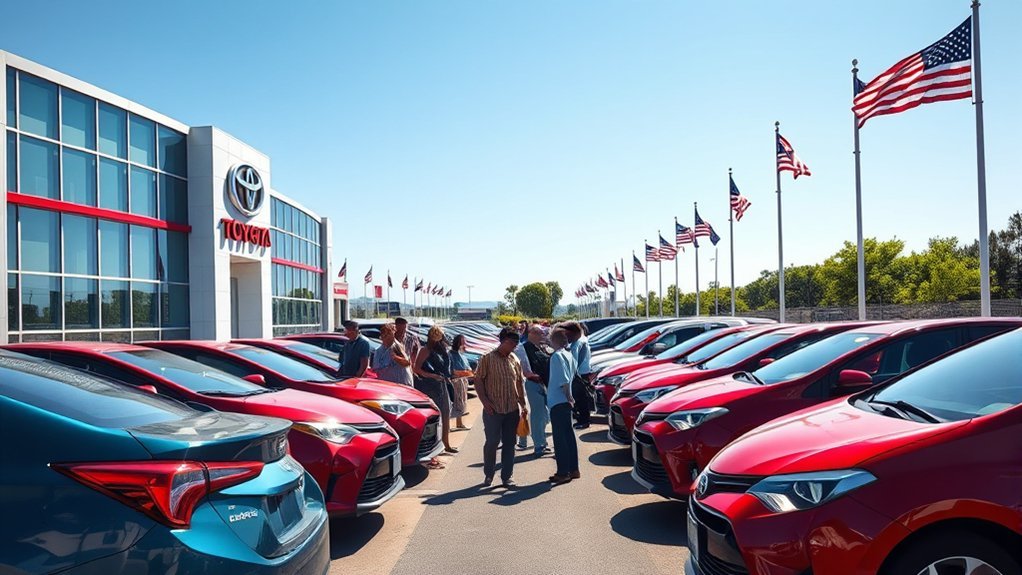
Vehicle preferences change drastically depending on the U.S. region. Toyota adjusts its local inventory to perfectly match these geographic tastes.
Southern and Midwestern states buy massive quantities of Tundra and Tacoma trucks. Western states, especially California, purchase the highest volume of Prius and specialized hybrid models.
Northeastern drivers demand all-wheel-drive capability for winter weather. Dealers in these states stock heavily up on RAV4 and Highlander models. This targeted regional strategy prevents unsold cars from sitting idle on dealer lots.
The Role of U.S. Manufacturing Facilities
Importing millions of cars from Japan would quickly ruin Toyota’s profit margins. To solve this, the company builds most of its popular vehicles right here in America. The automaker operates ten massive manufacturing plants across the United States.
Workers assemble the top-selling Camry in Kentucky and the massive Tundra in Texas. Local production shields the company from international shipping delays and expensive import tariffs. It also creates thousands of American manufacturing jobs.
Future Forecast for Toyota’s U.S. Market Strategy
Toyota faces new challenges as the automotive industry pivots toward battery-electric vehicles. The company plans to release several new fully electric models soon. It will also expand plug-in hybrid options across the broader lineup.
Solid-state batteries represent the brand’s next major technological leap. These new batteries promise faster charging times and longer driving ranges. Toyota plans to introduce this advanced technology before the end of the decade.
The brand will also drastically increase local battery production. A new multi-billion dollar battery plant currently under construction in North Carolina will supply the next generation of American-made hybrids.
Frequently Asked Questions
What Percentage of Toyotas Sold in the USA Are Made in the USA?
Toyota builds about 70% of the vehicles it sells in America at North American manufacturing plants. This local production strategy reduces expensive shipping costs and supports thousands of regional manufacturing jobs.
Who Sells the Most Toyotas in the US?
Longo Toyota in El Monte, California, currently holds the title as the largest Toyota dealership in the world. This specific dealership consistently moves the highest volume of new vehicles each year by catering to diverse customer demographics.
What Country Does Toyota Sell the Most?
The United States serves as Toyota’s single largest market by sales volume. American buyers purchase roughly 20% of all the passenger vehicles and trucks Toyota produces globally each year.
What Is the #1 Selling Car in the USA?
The Toyota Camry remains the best-selling passenger car in the United States. However, the Ford F-150 holds the title for the best-selling overall vehicle when pickup trucks are included in the data.
Key Takeaways on Toyota’s U.S. Market Position
Toyota’s massive success in the U.S. market stems from engine reliability, smart vehicle pricing, and class-leading hybrid technology. The company wisely builds its most popular models locally to protect profit margins and support American jobs. If you want to see exactly how these vehicles perform, test drive a hybrid RAV4 or Camry at your local dealership. Toyota’s commitment to continuous improvement ensures the brand will remain a dominant force on American roads for decades.







Leave a Reply