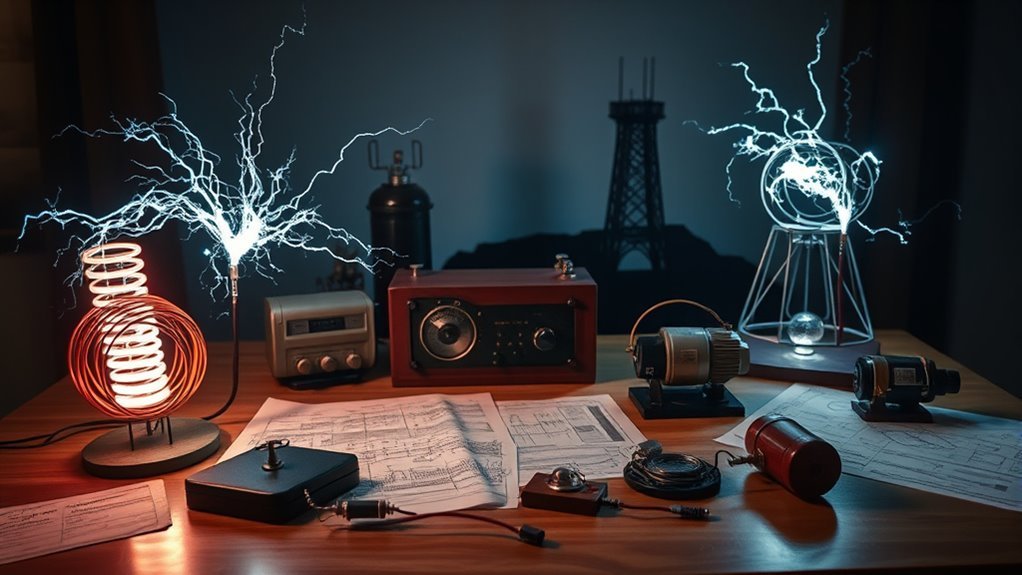
Nikola Tesla invented several groundbreaking technologies that transformed our world. He developed the AC induction motor, revolutionized power transmission, and created the Tesla Coil, which advanced wireless communication. His work in lighting, including fluorescent and neon lights, changed illumination methods, while his contributions to X-ray technology paved the way for medical imaging. Tesla also envisioned wireless energy transmission and designed the innovative Tesla turbine. Explore the full scope of his inventions and their lasting impact on modern technology.
Key Takeaways
- Developed the AC induction motor, revolutionizing efficient electricity distribution and laying the foundation for modern electric motors.
- Invented the Tesla Coil, enabling wireless transmission of electricity and influencing radio technology and high-voltage experiments.
- Created the first remote-controlled device in 1898, showcasing the potential for wireless control and communication.
- Advanced fluorescent and neon lighting technologies, enhancing energy efficiency and transforming illumination in public spaces.
- Pioneered early X-ray imaging techniques and envisioned wireless energy transmission, influencing future innovations in medical and energy fields.
The Significance of Nikola Tesla’s Inventions
Although many inventors have shaped modern technology, Nikola Tesla‘s contributions stand out for their profound impact on electrical systems and communication. His creativity manifested in inventions like the AC induction motor, which revolutionized power transmission, enabling efficient electricity distribution over long distances.
Nikola Tesla’s groundbreaking inventions, including the AC induction motor, transformed electrical systems and communication for future generations.
This foresight not only laid the groundwork for modern electrical systems but also underscored the importance of renewable energy with the design of the first hydroelectric power plant at Niagara Falls.
Additionally, Tesla’s invention of the Tesla coil in 1891 facilitated advancements in radio technology and wireless communication, showcasing his ability to anticipate future needs.
His pioneering work in remote-controlled devices paved the way for robotics, emphasizing his forward-thinking approach. With over 100 patents, Tesla’s innovations serve as a reflection of his unique vision, inspiring generations to harness technology for liberation and progress.
Exploring Alternating Current (AC) Technology
When you explore Tesla’s development of the AC induction motor in 1887, you see how he harnessed a rotating magnetic field for efficient operation.
His polyphase AC system, patented in 1888, didn’t just improve motor designs but also revolutionized electricity transmission over long distances.
Together, these innovations laid the groundwork for the widespread adoption of AC technology, fundamentally changing power generation and distribution.
AC Induction Motor Development
As Nikola Tesla commenced on his groundbreaking work in the late 1880s, he transformed the landscape of electrical engineering by developing the AC induction motor, a pivotal invention that harnessed the power of alternating current (AC) technology. This motor, patented in May 1888, utilized a rotating magnetic field to convert electrical energy into mechanical energy.
- Revolutionized AC motor applications
- Enabled long-distance power transmission
- Introduced the squirrel cage rotor design
Tesla’s engineering innovations didn’t just enhance efficiency; they laid the groundwork for modern electric motors.
His collaboration with George Westinghouse accelerated the adoption of AC systems, culminating in a successful demonstration at the 1893 World’s Columbian Exposition, solidifying AC technology’s global dominance.
Polyphase AC System Impact
The introduction of Nikola Tesla’s polyphase AC system marked a watershed moment in electrical engineering, fundamentally altering how electricity is generated, transmitted, and utilized.
By enabling efficient long-distance transmission, the polyphase advantages became clear, as it facilitated the development of modern electrical grids. Demonstrated at the 1893 World’s Columbian Exposition, Tesla’s system showcased safety and electrical efficiency, proving its superiority over direct current (DC) systems.
His design for the AC induction motor and the incorporation of transformers allowed for voltage adjustments, ensuring safe use in homes and industries.
Collaborating with George Westinghouse, Tesla’s vision led to the widespread adoption of AC technology, liberating society from the limitations of Edison’s DC and paving the way for an electrified world.
How the Induction Motor Revolutionized Industry
When you consider the induction motor, you see how it transformed operational efficiency in industries.
By eliminating the complexity of commutators and brushes, Tesla’s design not only reduced manufacturing costs but also paved the way for mass production techniques.
This innovation fundamentally changed how factories operated, leading to unprecedented levels of productivity.
Enhanced Operational Efficiency
Revolutionizing industry, Nikola Tesla’s induction motor has played a pivotal role in enhancing operational efficiency across various sectors. By leveraging the principles of energy efficiency and industrial automation, this groundbreaking invention has transformed manufacturing processes.
- Eliminated need for commutators, improving reliability
- Enabled widespread adoption of AC power for long-distance transmission
- Facilitated the development of automated machinery and assembly lines
The induction motor converts electrical energy into mechanical power through a rotating magnetic field, minimizing energy losses and reducing maintenance costs.
This innovation not only increased production rates but also laid the foundation for modern electrical systems, making it indispensable in industries like transportation and manufacturing.
Tesla’s vision continues to empower efficiency and productivity today.
Reduced Manufacturing Costs
Tesla’s induction motor not only enhanced operational efficiency but also greatly reduced manufacturing costs across various industries.
By operating on alternating current (AC) and utilizing a rotating magnetic field, it increased manufacturing efficiency while eliminating the need for commutators. This design markedly reduced wear and maintenance costs associated with traditional direct current (DC) motors.
Factories could implement unit drives, allowing multiple machines to run from a single motor, further streamlining production. Additionally, the induction motor enabled long-distance power transmission, leading to centralized power plants that lowered energy costs.
The reliability and efficiency of Tesla’s induction motor revolutionized industries, fostering a shift towards automation and ultimately achieving substantial cost reduction for manufacturers seeking liberation from outdated systems.
Enabled Mass Production
Although many inventions contributed to the rise of mass production, the induction motor stands out as a catalyst for transforming industrial operations. This revolutionary device, powered by alternating current (AC), optimized industrial machinery and enabled simultaneous power for multiple machines.
Its impact is evident in several key areas:
- Reduced maintenance costs by eliminating commutators.
- Enhanced efficiency through Tesla’s polyphase system for improved power transmission.
- Revolutionized production in textiles, manufacturing, and assembly lines.
The induction motor’s design marked a pivotal shift during the Second Industrial Revolution, facilitating the automation of factories and supporting the burgeoning modern electrical grid.
The Birth of Wireless Communication and Remote Control
As the dawn of the 20th century approached, the domain of communication was on the brink of transformation, thanks in large part to Nikola Tesla’s groundbreaking innovations. His invention of the first remote-controlled device—a small boat demonstrated in 1898—showcased the untapped potential of wireless communication. Utilizing a four-circuit resonance system, he laid the foundations for modern wireless control.
Here’s a summary of Tesla’s contributions:
| Year | Invention/Patent | Significance |
|---|---|---|
| 1897 | Wireless Transmission Patents | Established principles for radio tech |
| 1898 | Remote-Controlled Boat | First demonstration of remote control |
| 1900 | U.S. Patents on Communication | Solidified his role as a pioneer |
| 1943 | Supreme Court Recognition | Acknowledged his contributions |
Tesla’s visionary work not only revolutionized remote control but also paved the way for future advancements in wireless communication, liberating technology from physical constraints.
How Tesla’s Lighting Innovations Changed Everyday Life
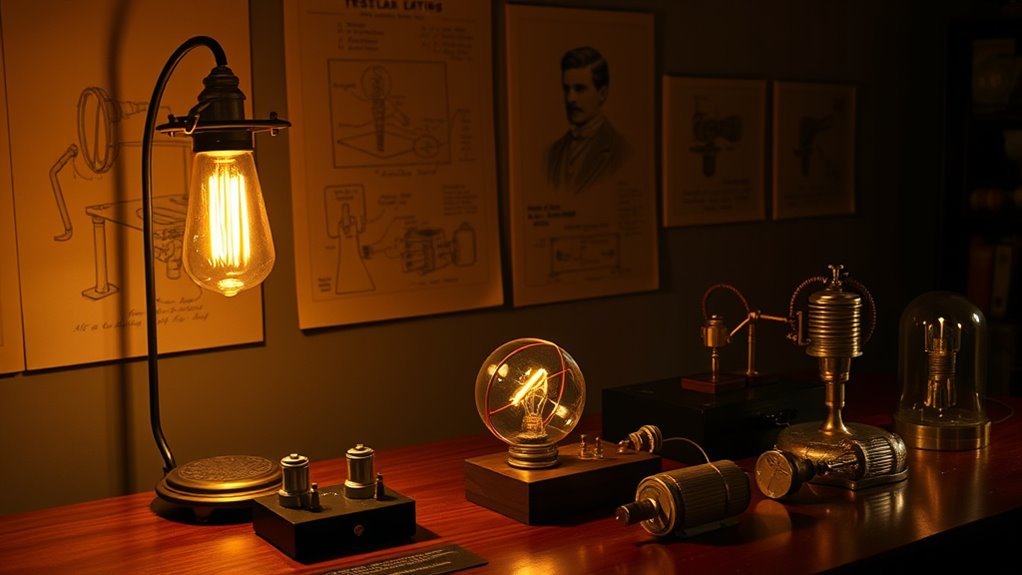
Tesla’s advancements in fluorescent and neon lighting revolutionized how you experience illumination in your daily life.
By utilizing high-frequency electricity, he created systems that not only enhanced energy efficiency but also paved the way for their popular adoption in homes and public spaces.
These innovations didn’t just change your surroundings; they set the stage for future developments in lighting technology that continue to impact your world today.
Fluorescent Lighting Advancements
While many inventions have shaped modern lighting, Nikola Tesla‘s early versions of fluorescent lighting stand out for their significant impact on energy efficiency and everyday life.
His innovations paved the way for a new era in illumination, allowing for:
- Greater energy efficiency compared to incandescent bulbs
- Longer lifespan and reduced maintenance costs
- A foundation for future lighting technologies, including CFLs and LEDs
Neon Lights Popularization
Though often overshadowed by other inventions, the popularization of neon lights represents a significant shift in how we experience illumination in our daily lives.
Tesla’s early demonstrations at the 1893 World’s Columbian Exposition showcased neon lighting’s potential to revolutionize electric illumination. His innovations in high-frequency electricity eliminated the need for filaments, enhancing efficiency and durability.
This breakthrough paved the way for vibrant neon signage, which transformed advertising and public spaces. Today, these striking artistic displays infuse urban environments with life and color, enhancing our visual experience.
Nikola Tesla’s Coil: Revolutionizing High-Voltage Applications
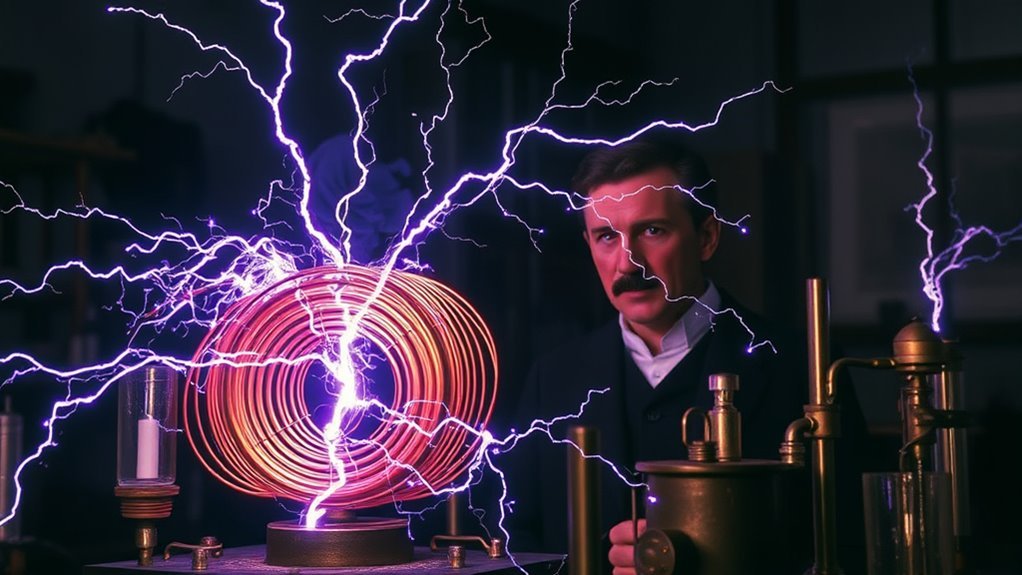
Invented in 1891, the Tesla coil stands as a groundbreaking achievement in electrical engineering, fundamentally transforming high-voltage applications. This resonant transformer circuit produces high-voltage, low-current, high-frequency alternating current electricity, enabling astonishing high voltage experiments.
- Generates millions of volts, creating impressive electric arcs.
- Pioneered wireless transmission of electricity, influencing modern power distribution.
- Essential in radio transmission and various electronic devices.
The Tesla coil’s ability to induce a much higher voltage in the secondary coil revolutionized how we perceive and utilize electrical energy.
The Tesla coil’s remarkable voltage induction redefined our understanding and application of electrical energy.
Tesla’s demonstrations at the 1893 World’s Columbian Exposition showcased not just innovation but an exhilarating vision of wireless lighting.
By harnessing the Tesla coil’s power, you can explore the boundaries of electrical engineering, pushing towards a future where energy flows freely and efficiently.
Embracing Tesla’s legacy means recognizing the profound implications of these high-voltage applications in our everyday lives.
How Tesla Pioneered Early X-Ray Technology
As Tesla explored the domains of electricity in the late 19th century, his innovative experiments laid essential groundwork for early X-ray technology. Through his work with electrical discharge tubes, Tesla developed shadowgraphs, early imaging forms that showcased the ability to visualize objects through opaque materials. His groundbreaking Tesla experiments with high-frequency currents and vacuum tubes during the 1890s directly influenced the later discovery of X-rays by Wilhelm Conrad Röntgen.
| Tesla’s Contributions | Impact on X-Ray Technology |
|---|---|
| Developed shadowgraphs | Paved the way for X-ray imaging |
| High-frequency currents | Enhanced understanding of radiation |
| Observed effects on tissues | Highlighted medical X-ray applications |
Though not credited with the invention itself, Tesla’s work profoundly shaped the landscape of X-ray applications, demonstrating the potential of electromagnetic radiation in medical imaging.
Tesla’s Vision for Wireless Energy?
Tesla’s innovative spirit didn’t stop with his contributions to X-ray technology; he also envisioned a future powered by wireless energy. He sought to create a world where wireless transmission provided limitless power, freeing people from the constraints of traditional energy sources. His most ambitious project, the Wardenclyffe Tower, aimed to transmit electricity globally without wires.
- Tesla’s experiments in Colorado Springs demonstrated the feasibility of remote lighting, claiming to illuminate 200 bulbs wirelessly.
- The Magnifying Transmitter was designed to enhance energy transfer by combining resonance and high voltage.
- Despite his groundbreaking concepts, Tesla faced significant challenges in securing funding for his visionary projects.
Ultimately, his dreams of a liberated energy future remained unfulfilled, but they continue to inspire modern innovations in wireless power technologies.
Tesla’s legacy endures as a reminder of what could have been—a world unbound by the limitations of conventional energy infrastructure.
The Turbine: A New Approach to Fluid Dynamics
The Tesla Turbine represents a significant departure from traditional turbine designs, showcasing an innovative approach to fluid dynamics. Unlike conventional turbines that rely on blades, this turbine employs smooth, parallel disks that harness the boundary layer effect, allowing fluid to glide effortlessly over its surface.
The Tesla Turbine revolutionizes fluid dynamics with its blade-free design and efficient boundary layer utilization.
You’ll find that this unique design enhances turbine efficiency by minimizing turbulence and maximizing energy transfer.
With a central inlet directing fluid between the disks, motion is generated that can be utilized across various applications, from steam engines to power generation systems. Tesla envisioned his turbine as a versatile solution, capable of operating with steam, water, or gas, thereby broadening its potential impact.
Though the Tesla Turbine never gained commercial traction, its revolutionary concept continues to inspire contemporary research in fluid dynamics technology.
Legacy of Nikola Tesla: Lasting Impact on Modern Technology
Nikola Tesla’s legacy resonates profoundly in modern technology, shaping how we harness and distribute energy today. His timeless relevance is evident in various sectors, from industrial applications to personal devices.
- The alternating current (AC) system revolutionized electrical power distribution.
- Induction motors serve as the backbone of countless appliances and machinery.
- Wireless communication principles laid the groundwork for today’s smartphones and computers.
Tesla’s inventions, particularly his AC system, have become the global standard, enabling efficient long-distance energy transmission.
Additionally, the Tesla coil remains integral in radio technology, highlighting his enduring influence on electrical engineering.
His visionary ideas, like wireless energy transmission, continue to inspire cutting-edge research in renewable energy.
Frequently Asked Questions
What Are 5 Things Nikola Tesla Invented?
You’ll find Tesla’s impact evident in the induction motor, Tesla coil, remote control, wireless lighting, and polyphase systems. His invention legacy revolutionized technology, facilitating modern communication and electrical systems, empowering societies worldwide.
Did Nikola Tesla Invent Electricity?
No, Tesla didn’t invent electricity itself, but his contributions revolutionized its generation and application. His electrical innovations, particularly the AC system and induction motor, transformed energy distribution and laid the foundation for modern electrical systems.
What Was Tesla’s First Invention?
Tesla’s first invention, an induction motor, revolutionized electrical engineering with its innovative designs. You’ll marvel at how this ingenious creation paved the way for his future breakthroughs, transforming how we harness and distribute electricity.
What Is Tesla’s Most Famous Product?
Tesla’s most famous product is the alternating current induction motor, pivotal in revolutionizing energy systems. This innovation underpins his legacy, enabling efficient wireless transmission and empowering a liberated approach to electricity and technology in everyday life.
Conclusion
In examining Nikola Tesla’s inventions, you can see how his genius sparked a technological revolution that still shapes our world today. From the groundbreaking AC technology to his visionary ideas about wireless energy, Tesla’s contributions are nothing short of monumental. His work laid the foundation for modern communication, lighting, and even medical advancements. As you reflect on his legacy, it’s clear that Tesla wasn’t just an inventor; he was a true architect of our electrifying future.







Leave a Reply