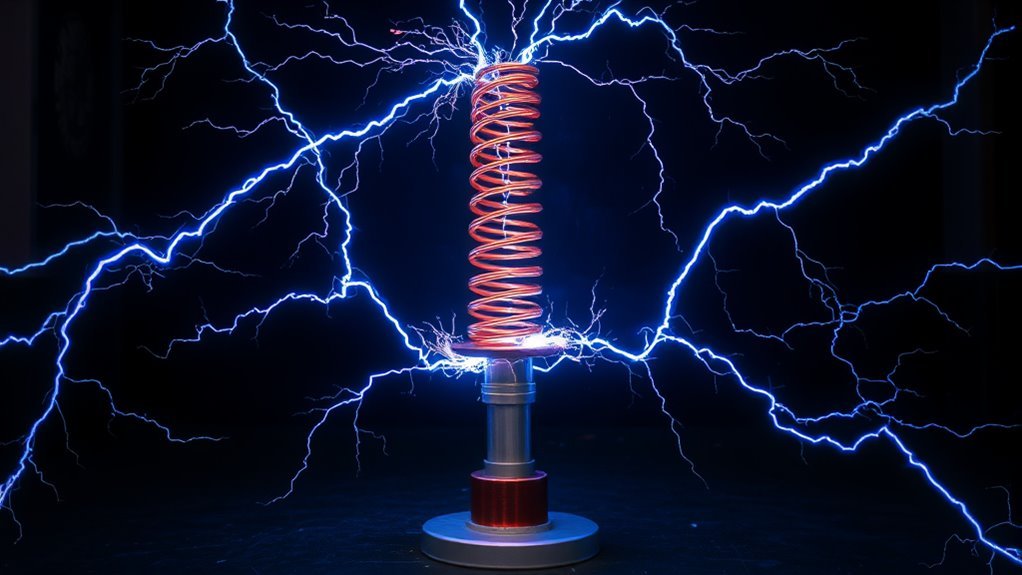
A Tesla coil is a resonant transformer that produces high-voltage, low-current alternating current (AC) electricity, with voltages exceeding one million volts. It operates by charging a capacitor connected to a primary coil, which then discharges through a spark gap to create oscillations. This increases the voltage in the secondary coil, achieving resonance while allowing energy transfer. The design and tuning of its components optimize its performance and efficiency. There’s more to discover about its types and applications.
Key Takeaways
- A Tesla coil is a resonant transformer that generates high-voltage, low-current alternating current electricity.
- It operates by charging a capacitor and creating oscillations through a spark gap, producing high-frequency AC.
- The secondary coil voltage increases significantly due to the relationship between capacitance in the primary and secondary circuits.
- Proper tuning of both coils to their resonant frequencies maximizes energy transfer and enhances voltage output.
- Tesla coils are used for educational demonstrations, wireless power transmission, and various applications in electrical engineering.
Understanding the Principles of Tesla Coils
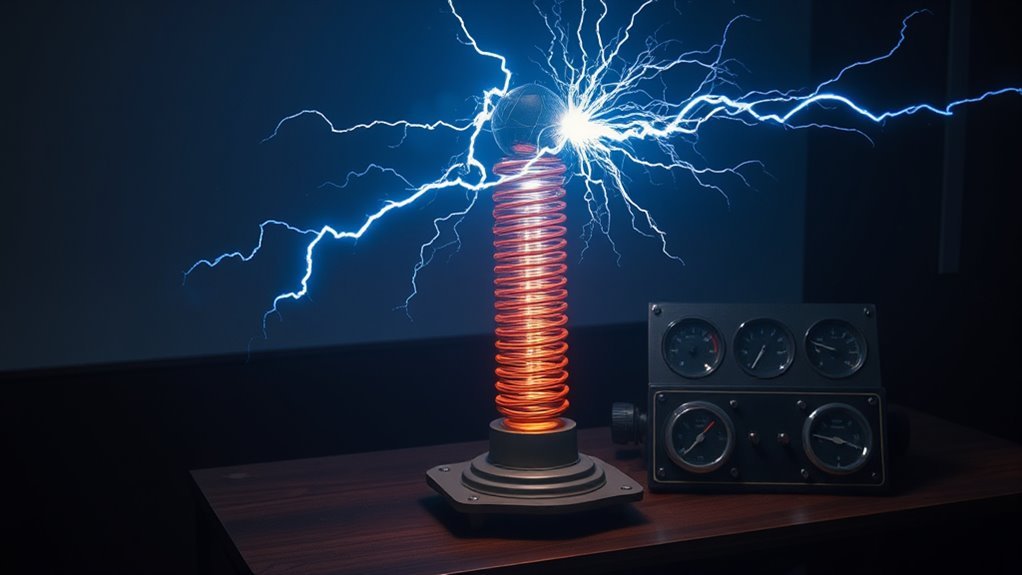
To understand the principles of Tesla coils, you should start by recognizing their role as resonant transformers that generate high-voltage, low-current alternating current (AC) electricity.
The operation kicks off when a high-voltage supply transformer charges a capacitor linked to the primary coil. This charge discharges through a spark gap, setting off oscillations. The resonant frequency, typically between 50 kHz and 1 MHz, allows for efficient energy transfer from the primary to the secondary circuit via electromagnetic induction.
A high-voltage transformer charges a capacitor, triggering oscillations that enable efficient energy transfer through resonant induction.
In this process, the secondary coil’s voltage considerably surpasses that of the primary due to the capacitance relationship between the two circuits. The design of the top electrode—often toroidal or spherical—increases the secondary coil’s capacitance while minimizing electric field strength, facilitating higher voltage build-up.
Tesla coil applications, from wireless energy transfer to dramatic electrical displays, showcase their potential to liberate energy in innovative ways, challenging conventional energy paradigms.
Key Components of a Tesla Coil Explained
Understanding the key components of a Tesla coil is essential for grasping its operation.
You’ll find that the transformer greatly boosts voltage, while the capacitor stores energy for rapid discharge through the spark gap.
This interplay between these elements generates the high-frequency alternating current that characterizes Tesla coils.
Transformer and Capacitor Function
While many components contribute to the operation of a Tesla coil, the transformer and capacitor play vital roles in generating high-voltage electric arcs. The transformer boosts the input voltage, often escalating it from 100 volts to over 50,000 volts, greatly enhancing transformer efficiency. This high voltage is essential for inducing a corresponding voltage in the secondary coil through electromagnetic induction.
The capacitor, connected to the primary coil, stores electrical energy and discharges it once a sufficient voltage is achieved. The capacitor types you choose directly affect the resonant frequency, typically between 50 kHz and 1 MHz, optimizing energy transfer.
The energy stored, dictated by the equation (W_1 = 1/2 C_1 V_1²), facilitates the eventual output voltage, potentially exceeding millions of volts.
Spark Gap Operation
The spark gap acts as a pivotal switch in the Tesla coil system, enabling high-voltage electricity to flow when the voltage surpasses the breakdown level of the air between its electrodes.
This spark gap technology is essential for efficient energy transfer, facilitating:
- Rapid oscillating currents in the primary coil
- High-frequency alternating current (AC) generation, typically 50 kHz to 1 MHz
- Discharges that create spectacular arcs
- Voltage enhancement through ideal spark gap design
- Continuous oscillation in the secondary coil after conduction ceases
When the spark gap triggers, the primary capacitor discharges, inducing a high voltage in the secondary coil.
The design and timing of the spark gap directly impact the overall efficiency and output voltage of your Tesla coil system.
How Resonance Affects Tesla Coil Performance
Resonance greatly influences the performance of a Tesla coil by ensuring that the primary and secondary circuits operate at the same frequency, which maximizes energy transfer. The resonant frequency typically ranges from 50 kHz to 1 MHz, facilitating efficient oscillation and high voltage output.
Achieving resonance requires precise tuning, as the energy stored in the primary capacitor must equal that in the secondary coil. This balance leads to peak voltage output, calculable via the formula ( V_2 = V_1 sqrt{frac{C_1}{C_2}} ).
Moreover, the Q factor of the circuit plays an essential role; a higher Q factor indicates lower resistive losses, enhancing overall efficiency. Proper tuning minimizes damping, allowing oscillating current in the secondary coil to persist even after the primary current ceases.
How High Voltage Is Generated in Tesla Coils
By utilizing the principles of electromagnetic induction, Tesla coils generate high voltage through the careful interplay of their primary and secondary circuits. This process hinges on resonance frequency, allowing energy to transfer efficiently between the coils.
- The primary capacitor stores initial energy, calculated as ( W_1 = frac{1}{2}C_1V_1^2 ).
- Once the spark gap triggers, oscillations commence, building voltage in the secondary coil.
- The peak voltage in the secondary is determined by ( V_2 = V_1 sqrt{frac{C_1}{C_2}} ).
- High voltage outputs can range from 50 kV to several million volts.
- The top electrode’s design enhances capacitance and electric field management, preventing premature discharges.
Through this intricate mechanism, Tesla coils release the potential of high voltage, illustrating the power of resonance and electromagnetic induction in action.
Types of Tesla Coils
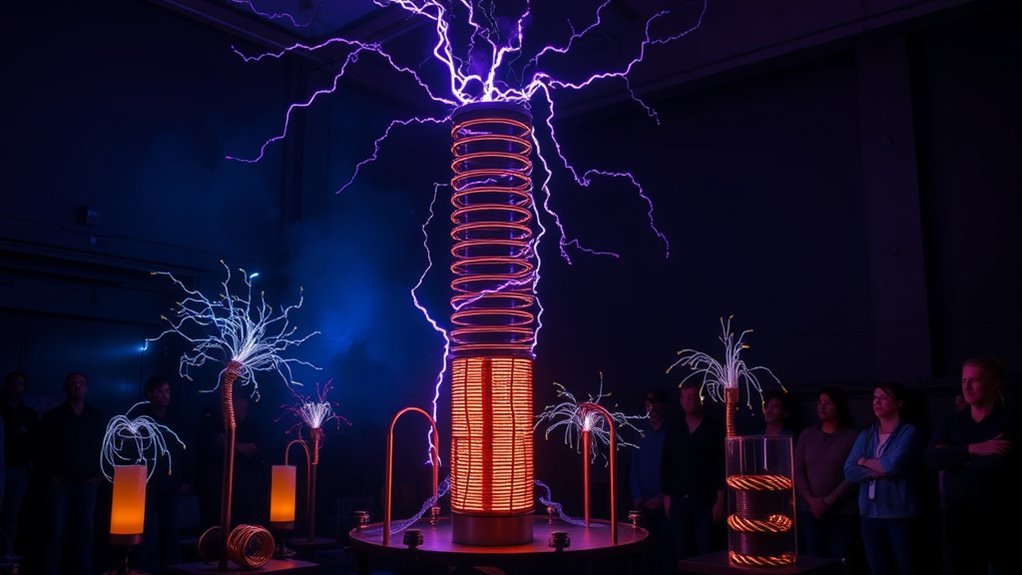
Single Resonant Tesla Coils (SSTC) operate on a single resonant frequency, simplifying design and producing compact devices for lower power needs.
Dual Resonant Solid State Tesla Coils (DRSSTC) leverage two resonant circuits, achieving higher output voltages and improved control over oscillation, making them effective for advanced uses.
Finally, Class E Tesla Coils employ a unique switching technique that minimizes power loss, enabling high frequencies, suitable for compact designs in wireless power transmission.
Each type serves distinct practical applications, reflecting the evolving landscape of electrical engineering.
Understanding the Spark Gap’s Role in Tesla Coils
In a Tesla coil, the spark gap functions as a critical switch that enables current to flow through the primary coil once the voltage surpasses a specific threshold.
This ionization of air creates a conductive path, initiating oscillations that facilitate energy transfer to the secondary coil.
Understanding the timing and duration of the spark gap’s operation is essential for maximizing output voltage and overall system efficiency.
Spark Gap Functionality
While understanding the Tesla coil’s operation, the spark gap emerges as an integral component that acts as a high-voltage switch. It initiates the oscillation process when the voltage reaches a significant breakdown level.
- Generates a rapid arc discharge, releasing energy pulses.
- The short-lived arc allows current flow through the primary coil.
- Spark gap adjustments alter the breakdown voltage needed for discharge.
- It cools down, ceasing conduction and enabling capacitor recharge.
- Facilitates resonant energy transfer between primary and secondary coils.
This functionality is vital for achieving high voltages in the secondary circuit, allowing for efficient energy coupling.
Oscillation and Energy Transfer
Understanding the oscillation and energy transfer in a Tesla coil hinges on the spark gap‘s functionality as a high-voltage switch. When the voltage surpasses a critical threshold, the spark gap conducts, allowing current to flow through the primary coil.
This generates oscillation effects as the energy stored in the capacitor rapidly discharges, producing high-frequency alternating current (AC). The resulting oscillating current creates a magnetic field that induces high voltage in the secondary coil via electromagnetic induction, facilitating energy dynamics between the circuits.
Even after the primary current stops, oscillations continue in the secondary as energy dissipates in damped sinusoidal waves. Maximizing this energy transfer requires tuning both circuits to their resonant frequencies, enhancing voltage build-up in the secondary coil.
How Are Tesla Coils Used Today?
Tesla coils are utilized today in various innovative ways that extend beyond their original purpose. You’ll find these devices in multiple domains, showcasing their versatility and impact on modern technology.
Tesla coils showcase their versatility, impacting education, entertainment, wireless power, medicine, and engineering innovation.
- Educational demonstrations: They vividly illustrate principles of electricity and electromagnetic induction at science exhibitions.
- Entertainment: Tesla coils create mesmerizing visual displays of electrical arcs, enhancing theatrical performances and concerts.
- Wireless power: They serve as foundational technology for transmitting energy without wires, pushing the boundaries of energy transfer.
- Medical devices: High-voltage experiments powered by Tesla coils are integral to specific medical equipment and ignition systems.
- Engineering inspiration: Their design and functionality continue to influence research in high-voltage phenomena and electromagnetism.
These applications not only highlight Tesla coils’ utility but also their role in advancing knowledge and technology, empowering innovators in various fields.
Safety Precautions When Using Tesla Coils
When operating a Tesla coil, prioritizing safety is essential to prevent serious injuries. Always maintain a safe distance of at least 10 feet from the coil during operation. This distance helps you avoid accidental electric discharges that can be fatal.
Wear insulated gloves and utilize non-conductive tools to minimize the risk of electrical shock from the high-voltage output. Ensure that all nearby conductive materials and electronic devices, including pacemakers, are kept at a safe distance to prevent hazardous interference.
Implement proper grounding techniques to dissipate stray electrical charges safely, reducing the risk of electric shock or fire. Additionally, conduct demonstrations in a controlled environment with safety barriers and protective gear.
Following these safety measures and operational guidelines will help you create a secure atmosphere for both yourself and your audience, allowing you to explore the fascinating world of Tesla coils with confidence.
Common Misconceptions About Tesla Coils
You might think that high voltage from a Tesla coil equates to extreme danger, but the low current levels often minimize risk.
Many also assume these devices are solely for entertainment, overlooking their educational potential and ability to demonstrate principles of electricity.
Additionally, it’s a common error to believe Tesla coils only produce static electricity, when in reality, they generate high-frequency alternating current.
High Voltage Equals Danger
While many associate high voltage with immediate danger, it’s essential to understand the nuances of Tesla coils. Here’s what you should know about their operation and electrical safety:
- Tesla coils can exceed one million volts, creating impressive arcs.
- The current output is relatively low, allowing safer interaction at a distance.
- High-frequency AC causes electricity to flow on your skin’s surface.
- Serious injuries are less likely compared to lower frequency currents.
- Strict safety protocols, like maintaining distance and using insulated tools, are crucial.
Understanding these aspects demystifies the high voltage associated with Tesla coils.
Only For Entertainment Purposes
Despite their enchanting displays, Tesla coils are often misunderstood, leading to various misconceptions about their capabilities and applications. Many believe these devices can transmit electricity over long distances without loss, but they’re primarily designed for entertainment demonstrations and educational exhibitions.
You might think it’s safe to touch a Tesla coil; however, they can deliver dangerous shocks, especially to individuals with medical devices. Additionally, the output voltage of Tesla coils varies greatly, with some reaching over a million volts while others produce much less.
It’s a common myth that they serve as efficient wireless power sources, but their practicality is limited. Remember, Tesla coils generate high-frequency oscillating currents, not pure AC, which can interfere with nearby electronics.
Produces Static Electricity Only
Many people mistakenly associate Tesla coils with static electricity, believing these devices merely accumulate charge like traditional static electricity generators. However, this is a significant misconception.
Tesla coils generate high-frequency alternating current (AC) electricity, allowing for continuous flow. Here are key distinctions:
- High voltages exceeding one million volts
- Resonance between primary and secondary coils
- Creation of arcs and discharges through the air
- Utilization of electromagnetic induction for energy transfer
- Demonstrations of oscillating electrical energy
Unlike static electricity’s stationary charge, Tesla coils showcase dynamic electrical activity.
Their primary purpose lies in experiments and demonstrations, emphasizing the powerful, oscillating nature of the electricity they produce rather than the inert qualities associated with static electricity.
Tesla Coils in Popular Culture and Media
Tesla coils have captivated audiences across various forms of media, serving as both symbols of scientific innovation and dramatic visual elements. Their cultural significance is evident in films like “Star Trek: The Motion Picture,” where they create striking lighting effects, enhancing the narrative’s futuristic ambiance.
In video games, these coils often represent advanced technology, manifesting as high-tech weapons that release formidable lightning bolts, signifying power and innovation.
Moreover, Tesla coils inspire artistic representations, appearing in installations and performances that showcase their spectacular electrical discharges. Live concerts sometimes feature these coils, synchronizing their arcs with music to create electrifying audio-visual experiences.
Additionally, their inclusion in educational exhibits illustrates principles of electricity and magnetism, further solidifying their role in popular culture. Overall, Tesla coils embody a fusion of art and science, igniting imaginations and reflecting humanity’s quest for technological liberation.
Frequently Asked Questions
What Is a Tesla Coil in Simple Words?
A Tesla coil’s a device that generates high-voltage electricity, enabling wireless transmission. It uses resonant circuits to create electric arcs, demonstrating principles of electricity generation while showcasing the potential for energy without physical connections.
Why Don’t We Use a Tesla Coil?
You don’t use a Tesla coil due to safety concerns and its impractical applications. High voltages can spark danger, while interference disrupts electronics, making other efficient technologies preferable for reliable power transmission in your life.
Can You Touch a Tesla Coil?
You shouldn’t touch a Tesla coil without proper safety precautions. While you might experience a mild electric shock, the risks of burns or injury outweigh the potential thrill, especially if you have medical devices.
Why Did Nikola Tesla Invent the Tesla Coil?
Nikola Tesla invented the Tesla coil to realize his vision of wireless electricity, contrasting today’s limitations with future possibilities. This device sparked electrical innovations, showcasing how energy could flow freely, liberating technology from physical constraints.
Conclusion
In understanding Tesla coils, you’re not just exploring the brilliance of Nikola Tesla; you’re delving into the pulse of electricity that dances through the air. As you’ve learned, the principles behind these devices reveal both their potential and peril. Will you harness their power responsibly, or will you succumb to the allure of their chaotic beauty? The choice is yours, but remember: with great power comes great responsibility, and the sparks of innovation can ignite both wonder and danger.







Leave a Reply