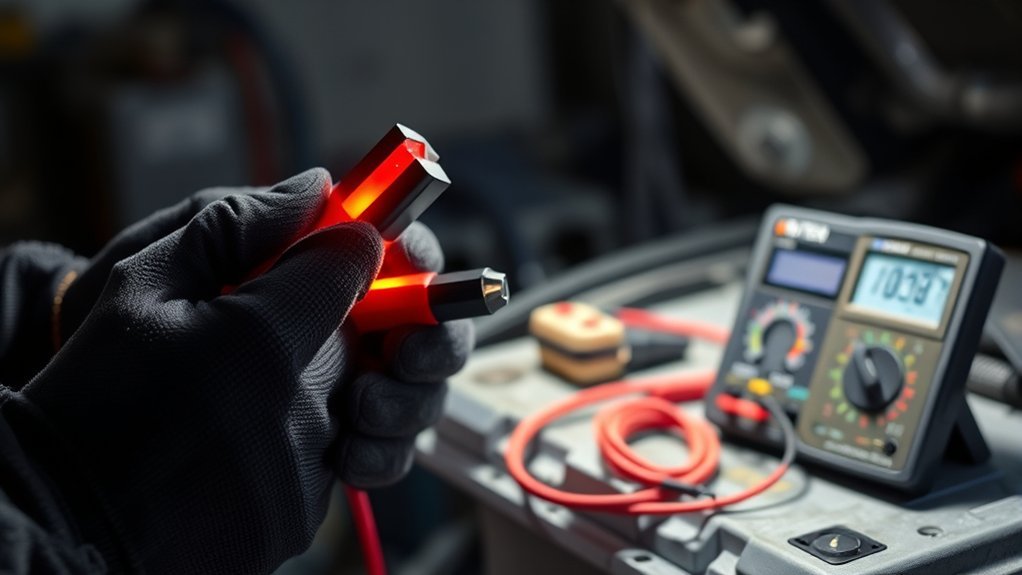
To use a car battery charger, first identify the battery terminals and ensure the charger is off. Connect the red clamp to the positive terminal and the black clamp to the negative terminal. Plug in the charger, select the appropriate settings, and turn it on. Always charge in a ventilated space while wearing safety gear. Once fully charged, disconnect clamps in reverse order. Follow these steps closely for efficiency, plus more tips to ensure your battery stays healthy await.
Key Takeaways
- Ensure safety by wearing goggles and gloves while charging to protect against acid spills and electrical hazards.
- Identify and connect the positive (+) clamp first, followed by the negative (-) clamp, ensuring correct terminal connections.
- Charge the battery in a well-ventilated area to minimize inhalation risks from harmful gases emitted during charging.
- Monitor the charging process and use a smart charger to prevent overcharging and ensure optimal battery health.
- Disconnect the negative terminal first after charging to reduce the risk of short circuits and ensure safe removal of clamps.
Why Regular Car Battery Charging Matters
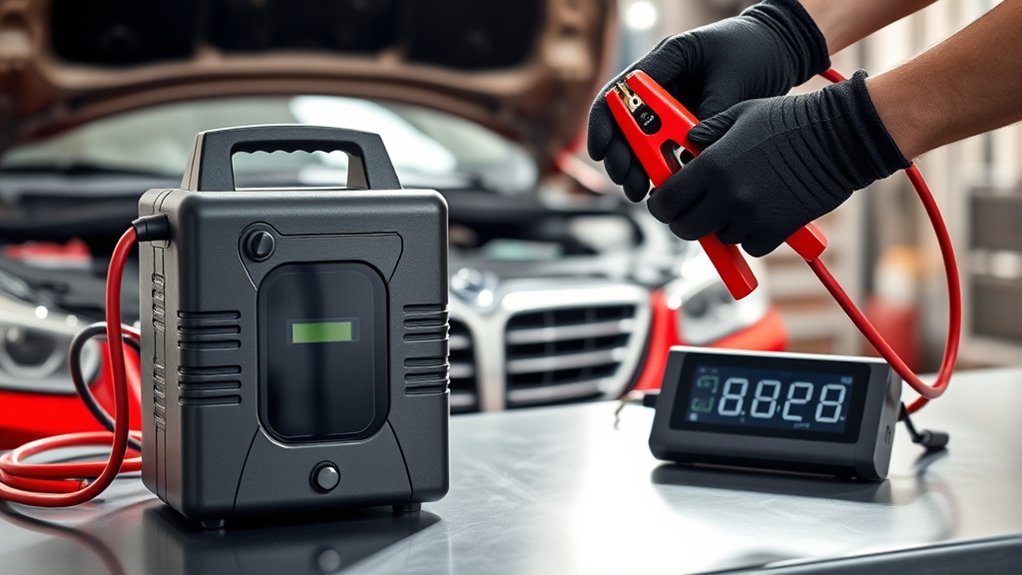
While you may not think about it often, regular car battery charging is crucial to ensure your vehicle starts reliably. Your battery can lose power over time, especially when parked for extended periods.
Even during short trips, your alternator mightn’t provide sufficient charging, making it essential to monitor your charging frequency. Cold weather also hampers battery performance, so keeping an eye on your battery status is vital during winter months.
Complete battery drainage can drastically reduce battery longevity and damage components. Statistics reveal that nearly 43.22% of vehicle breakdowns stem from battery issues, emphasizing the importance of consistent charging practices.
Signs Your Car Battery Needs Charging: Key Indicators

When you notice dimming headlights while driving, especially at idle, it’s a clear sign your battery might be struggling.
Additionally, if your engine hesitates or struggles to start, these symptoms indicate a need for immediate charging.
Staying alert to these indicators can prevent unexpected breakdowns and ensure your vehicle stays reliable.
Dimming Headlights Indicate Weakness
Dimming headlights are one of the most telling signs that your car battery may be struggling to hold a charge. If you notice a decrease in headlight brightness, especially when using electrical accessories, it indicates your battery mightn’t be supplying adequate power. This symptom often correlates with potential battery failure.
Additionally, if your headlights flicker during vehicle operation, it’s a clear signal for battery diagnostics. Pay attention to any dashboard warning lights; an illuminated battery icon suggests that your battery isn’t charging correctly.
Regularly monitoring your headlights can serve as an early warning system, allowing you to address battery issues before they escalate into unexpected breakdowns. Stay vigilant to maintain your vehicle’s reliability.
Engine Struggles to Start
If your headlights are dimming, it’s important to pay attention to other signs that your car battery may need charging, particularly when starting the engine.
Here are three key indicators to look out for:
- Ticking Noise: If you hear a tick-tick-tick sound when attempting to start your engine, it usually means your battery is weak or dead.
- Slow Engine Chugging: A sluggish engine that struggles to start suggests insufficient battery power, indicating it’s time for a recharge or replacement.
- Dashboard Warning Light: An illuminated red battery light signals a battery issue, necessitating immediate charging or inspection.
Regular checks of these symptoms can significantly enhance your battery health, preventing unexpected breakdowns often caused by battery failures.
Essential Tools for Charging Your Car Battery

To successfully charge your car battery, you’ll need specific tools that ensure safety and efficiency. First, select a battery charger that matches your battery type and voltage, typically 12V for most vehicles.
Safety gear like gloves and goggles is crucial to protect against battery acid and potential sparks. A pocket screwdriver may be necessary to remove the battery cover, allowing you to connect the charger clamps securely.
Additionally, a magnetic light can improve visibility, helping you make proper connections to the battery terminals. Lastly, if your vehicle is parked far from a power source, an extension cord will be essential.
These tools are vital for effective battery maintenance and using various charger types safely.
Step-by-Step Guide to Charging Your Car Battery
Once you’ve gathered the necessary tools for charging your car battery, it’s time to get started with the charging process. Follow these steps for a safe and effective charge:
- Locate the battery and identify the positive (+) and negative (-) terminals.
- Ensure the battery charger is unplugged and off before attaching the red clamp to the positive terminal and the black clamp to the negative terminal.
- Plug in the charger and turn it on, selecting a higher amperage for faster charging time if needed.
Always charge in a well-ventilated area and wear safety gear, such as gloves and goggles.
Once charging is complete, remove the black clamp first, then the red clamp, and unplug the charger from the outlet.
Key Features to Look for in a Battery Charger
When choosing a battery charger, focus on smart charging technology that automatically adjusts the current and prevents overcharging.
Make sure the charger is compatible with your battery types and has necessary safety features like short-circuit protection.
Additionally, look for user-friendly indicators that provide clear information on the charging status.
Smart Charging Technology
Smart charging technology has revolutionized the way you maintain car batteries, making it essential to choose a charger equipped with advanced features.
Here are three key features to look for:
- Multi-Stage Charging: This optimizes charging efficiency by adjusting current and voltage, protecting your battery from overcharging.
- Battery Management System (BMS): A BMS monitors temperature and voltage, ensuring safe charging while extending your battery’s lifespan.
- Automatic Shut-Off: This feature disengages the charger once the battery reaches a full charge, preventing damage and enhancing smart charger benefits.
Compatibility With Battery Types
Choosing the right battery charger goes beyond just smart technology; compatibility with your battery type is vital for optimal performance.
First, check the voltage of your vehicle’s battery—most cars use 6V or 12V. Next, ensure the charger offers multiple charging modes, such as trickle charging for maintenance and higher amperage settings for faster charging.
Smart chargers adjust the current based on battery condition, preventing overcharging and extending battery life. Additionally, verify that the charger is suitable for your specific battery types—lead-acid, AGM, or lithium-ion—as some chargers are designed for particular chemistries.
Safety Features And Indicators
To ensure safe and effective charging, it’s essential to look for specific safety features and indicators in a battery charger.
Here are three key features to prioritize:
- Smart Charging Technology: Opt for chargers that automatically adjust the charging current based on the battery’s state of charge, preventing overcharging and extending battery life.
- Multi-Stage Charging: Select models that utilize multi-stage charging technology to transition through different charge phases, enhancing battery health and adhering to safety protocols.
- Safety Features: Ensure your charger includes reverse polarity protection to prevent incorrect connections, and look for indicator types like LED lights or digital displays that provide real-time feedback on charging status and battery health for easier monitoring.
How to Choose the Right Charger for Your Vehicle
Selecting the right car battery charger is crucial for maintaining your vehicle’s battery health and ensuring reliable performance. Start by considering your battery type and voltage; most vehicles use 12V batteries, but some applications may require 6V or 24V chargers.
Pay attention to battery charger ratings, as trickle chargers typically operate at 1-3 amps for maintenance, while automatic chargers offer higher outputs for quicker charging. Opt for a smart charger with multi-stage charging capabilities to prevent overcharging and extend battery lifespan, especially if your vehicle sits unused for long periods.
Ensure compatibility with your specific battery type, like AGM, gel, or lead-acid. Always review user manuals and specifications to adhere to charging safety precautions and manufacturer recommendations.
Common Mistakes to Avoid When Charging a Car Battery
When charging a car battery, it’s crucial to prioritize safety by following proper procedures.
Many people overlook the importance of connecting the clamps correctly, which can lead to short circuits or damage.
Additionally, neglecting safety precautions like monitoring ventilation can pose serious risks during the charging process.
Ignoring Safety Precautions
While charging a car battery might seem straightforward, neglecting safety precautions can lead to serious consequences. To ensure battery safety and minimize charging hazards, follow these guidelines:
- Wear safety goggles and gloves: Protect yourself from acid spills and electrical hazards.
- Charge in a well-ventilated area: This reduces the risk of inhaling harmful gases that may escape during charging.
- Avoid using an inappropriate charger: Ensure the charger’s amperage matches your battery type to prevent overheating and damage.
Always remember to connect and disconnect charger clamps only when the charger is unplugged to prevent sparks.
Taking these precautions can significantly reduce the risk of accidents and ensure a safe charging experience.
Incorrect Terminal Connections
Neglecting safety precautions can lead to mistakes, especially regarding terminal connections.
Always connect the red (positive) clamp to the positive terminal first and the black (negative) clamp to the negative terminal. Double-check the terminal labels on the battery to avoid connecting clamps incorrectly, which can cause sparks or damage.
If your charger features reverse polarity protection, ensure it’s functioning correctly to mitigate risks from incorrect connections.
After charging, remember to disconnect the black clamp first to reduce the risk of short circuits.
Always consult your vehicle and charger’s owner’s manual for specific guidelines to confirm correct terminal connections.
Following these steps will help you maintain safety while effectively charging your car battery.
Effective Maintenance Tips for Prolonging Car Battery Life
To ensure your car battery lasts as long as possible, it’s essential to implement a few effective maintenance practices.
Here are three key tips for optimal battery maintenance:
- Regularly check and clean battery terminals: This prevents corrosion, enhancing charging efficiency and prolonging battery life.
- Charge your battery every two months: If you’re parking long-term, this maintains optimal charge levels and avoids complete drainage.
- Monitor the charge level: Keep it between 20% and 80% to prevent deep discharges that can significantly reduce lifespan.
Additionally, consider using a battery maintainer in cold weather to ensure your battery remains charged and functional, as low temperatures can negatively impact battery performance.
Troubleshooting Your Car Battery Charger
Maintaining your car battery is just the beginning; knowing how to troubleshoot your car battery charger is key to ensuring reliable performance.
If your charger doesn’t power on, check if it’s properly plugged into a functional outlet. If it shows no signs of activity, inspect for visible damage like frayed wires or burnt fuses, which may need professional repair.
If it’s plugged in but not charging, ensure the battery terminals are clean and free of corrosion.
If your charger indicates a full charge but the battery is unresponsive, use a multimeter to test for a voltage below 12.4 volts.
For issues with mid-cycle stoppages, consider a smart charger for enhanced safety and effective charger maintenance with automated adjustments.
Your Car Battery Charging Questions Answered
Ever wondered how long it actually takes to charge a car battery? Charging time varies based on the charger’s amperage and the battery’s state of charge, typically ranging from 1 to 6 hours.
Here are a few battery maintenance tips to keep in mind:
- Charge in a well-ventilated area: This prevents harmful gas buildup, especially with lead-acid batteries.
- Disconnect the negative terminal first: This reduces the risk of short circuits.
- Regular charging frequency: For infrequently used vehicles, charge regularly to avoid complete battery drainage, which can cause damage.
Using a smart charger can further enhance battery life by preventing overcharging, as it switches to maintenance mode when fully charged.
Frequently Asked Questions
Can I Charge a Frozen Car Battery?
You shouldn’t charge a frozen battery due to potential risks like internal damage. Instead, allow it to thaw at room temperature, then use appropriate charging methods to restore its functionality safely. Always prioritize safety.
How Long Does It Take to Charge a Car Battery?
Charging time varies depending on your battery capacity. Typically, it takes about 4 to 12 hours for a standard car battery. However, stay tuned—some factors can speed up or slow down that process significantly!
Is It Safe to Charge a Battery in the Car?
Yes, it’s safe to charge a battery in the car, provided you follow battery charging safety guidelines. Ensure proper ventilation and avoid sparks, as this helps maintain optimal car battery maintenance and prevents potential hazards.
Can I Use a Regular Charger for a Deep Cycle Battery?
You can’t use a regular charger for a deep cycle battery due to battery compatibility issues. Deep cycle batteries require specific chargers designed to handle their unique charging needs and prevent damage or reduced lifespan.
What Happens if I Connect the Cables Incorrectly?
If you connect the cables incorrectly, reversing cable polarity can cause severe battery damage, potentially leading to leaks, explosions, or complete failure. Always double-check your connections before charging to avoid these dangerous outcomes.
Conclusion
In summary, regularly charging your car battery is crucial for maintaining optimal performance and longevity. Did you know that nearly 40% of battery failures occur due to improper charging practices? By following the proper procedures and avoiding common mistakes, you can significantly enhance your battery’s lifespan. Remember to choose the right charger and perform routine maintenance. With these tips, you’ll ensure your vehicle starts reliably every time, keeping you safe on the road.


Leave a Reply