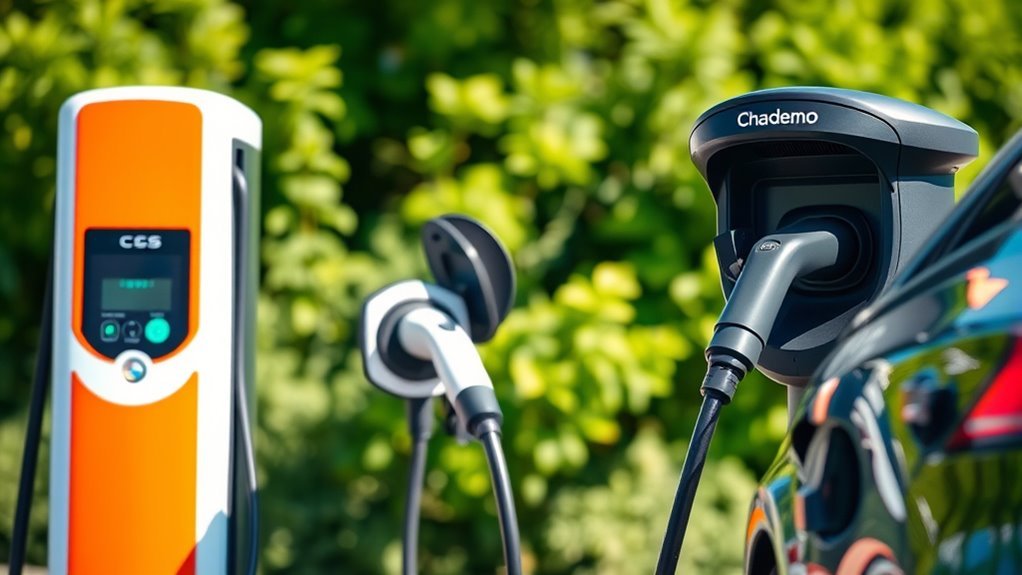
CHAdeMO and CCS are two different charging standards for electric vehicles. CHAdeMO, popular in Japan, offers slower speeds and is compatible mostly with older Japanese models. In contrast, CCS supports faster charging and is widely adopted in Europe and North America, ensuring better infrastructure availability. If you’re choosing a charging standard, consider factors like vehicle compatibility and charging speed. For a deeper exploration into the pros and cons of each, keep exploring the details.
What’s the Deal With CHADEMO and CCS Charging Standards?
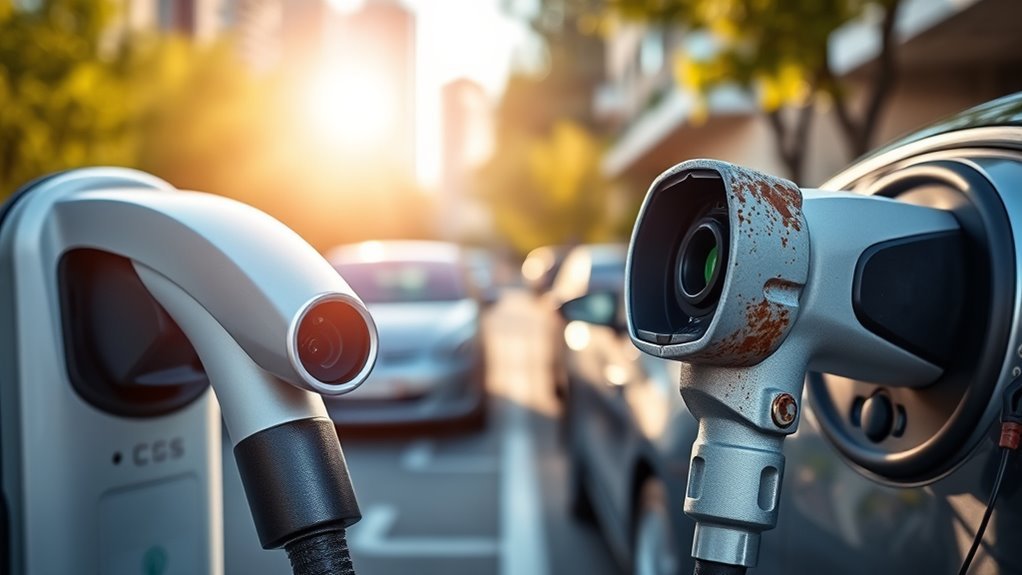
When it comes to charging your electric vehicle, what do you need to know about CHAdeMO and CCS standards?
CHAdeMO, developed by Japanese manufacturers, is a DC fast charging standard that excels in Japan and Asia, allowing you to achieve 80% charge in under an hour. Its unique nine-pin connector design makes it efficient, but its global adoption is declining outside Japan.
CHAdeMO offers rapid DC fast charging, allowing 80% charge in under an hour, but its global appeal is waning.
On the other hand, CCS combines AC and DC charging in one connector, making it a versatile choice. With speeds that can exceed 350 kW, CCS can fully charge your vehicle in less than 30 minutes, and it’s rapidly becoming the dominant standard in charging networks worldwide.
While CHAdeMO offers bidirectional charging (V2G), a feature lacking in CCS, the flexibility and speed of CCS cater to a growing audience enthusiastic for liberation from traditional fuel sources.
Your choice could shape the future of electric mobility.
How Do CHAdeMO and CCS Compare in Use?
While both CHAdeMO and CCS serve the critical function of charging electric vehicles, their application in real-world scenarios reveals distinct differences.
If you’re considering your charging preferences, it’s essential to recognize that CHAdeMO, primarily used in Japan, can charge your vehicle to 80% in under an hour. In contrast, CCS, dominant in Europe and North America, often achieves the same level in under 30 minutes due to higher power capabilities.
However, infrastructure challenges arise as the availability of CHAdeMO stations decreases outside Asia, while CCS is rapidly expanding. Additionally, the distinct connectors—CHAdeMO’s nine-pin design versus CCS’s hybrid approach—impacts compatibility with various charging systems.
Ultimately, your choice may hinge on location and charging speed, as CCS provides more flexibility and faster options for newer electric vehicles, whereas CHAdeMO offers unique bidirectional charging features.
Selecting the right standard can empower your electric driving experience.
What Are the Charging Speeds and Efficiency of CHAdeMO vs. CCS?
When comparing CHAdeMO and CCS, charging speeds and efficiency play vital roles in your electric vehicle experience.
CHAdeMO generally offers speeds from 50 kW to 400 kW, while CCS can exceed 350 kW, allowing for quicker top-ups.
Understanding these differences helps you choose the right charging option for your needs and travel plans.
CHAdeMO Charging Speed Overview
Charging speed is a crucial factor for electric vehicle (EV) owners, especially when considering the differences between CHAdeMO and CCS.
CHAdeMO typically delivers charging speeds of up to 100 kW, with newer versions reaching up to 400 kW, allowing you to achieve a full charge in under an hour for compatible vehicles. Many short-range EVs can reach 80% capacity in about 30 minutes, making it a practical choice for quick top-ups.
However, installation challenges and varying charging costs can affect your experience. While CHAdeMO offers fast DC charging, it’s essential to weigh its capabilities against CCS, which provides both AC and DC options, enhancing overall efficiency and flexibility for your charging needs.
CCS Charging Speed Overview
CCS technology stands out for its impressive charging speeds and efficiency, making it a popular choice among electric vehicle (EV) owners.
With charging speeds exceeding 350 kW, you can achieve an 80% charge in less than 30 minutes with compatible vehicles. This rapid charging capability considerably reduces your overall charging time compared to other standards.
The connector design of CCS is another advantage, supporting both AC and DC charging through a single connector, giving you enhanced flexibility.
In contrast, CHAdeMO typically delivers up to 100 kW, which can extend charging times. Plus, CCS generally offers higher efficiency, enabling faster range recovery during short charging sessions, ensuring you’re back on the road quickly and conveniently.
Efficiency Comparison Between Standards
The efficiency of electric vehicle charging systems can considerably influence your driving experience, especially during long trips.
CCS typically outpaces CHAdeMO in charging efficiency, delivering speeds exceeding 500 kW compared to CHAdeMO’s maximum of 400 kW. With CCS, you can achieve a full charge in under 30 minutes at higher-rated stations, while CHAdeMO generally takes less than an hour to reach 80%. This makes CCS more suitable for long-distance travel, as it allows for quicker range recovery.
Additionally, CCS combines both AC and DC charging capabilities in one connector, enhancing flexibility and standard advantages over CHAdeMO, which is limited to DC fast charging only.
Ultimately, choosing CCS can elevate your charging experience and liberate your journey.
Compatible Vehicles for CHAdeMO and CCS Standards
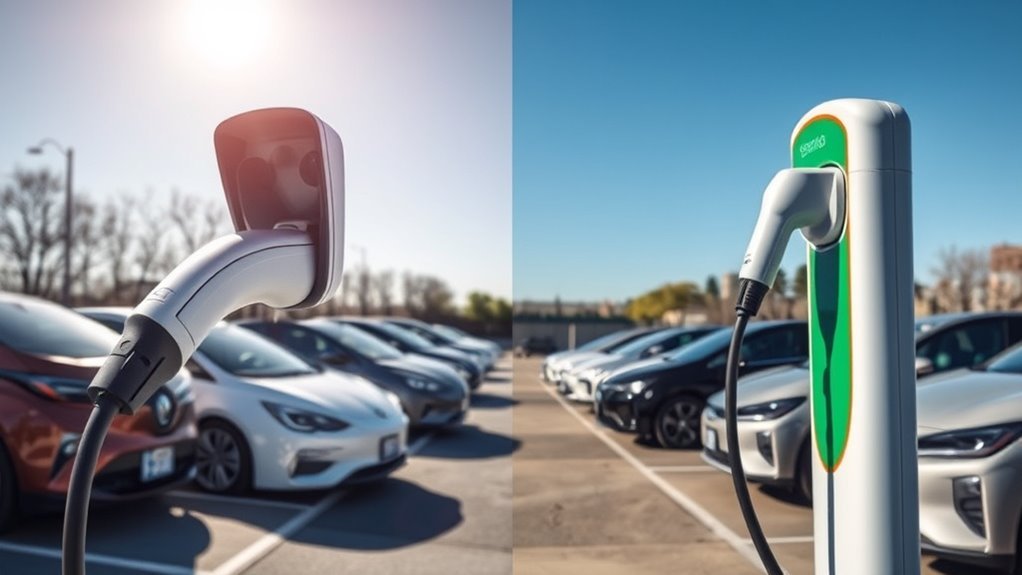
While many electric vehicle (EV) owners focus on charging speed, the compatibility of their vehicles with different charging standards can greatly impact their experience.
CHAdeMO connects primarily with Japanese models like the Nissan Leaf and Mitsubishi Outlander, which feature dedicated ports for fast charging. On the other hand, CCS dominates the market, embraced by manufacturers like Volkswagen with the ID.4, BMW with the i3, Ford with the Mustang, and General Motors.
CHAdeMO is favored by Japanese models, while CCS is widely adopted by major manufacturers like Volkswagen and Ford.
Newer entries, such as the Nissan Ariya and Mitsubishi Eclipse Cross, are also adopting CCS, signaling a shift away from CHAdeMO. Tesla vehicles in North America and Europe mainly use CCS, while older models in Japan can utilize CHAdeMO with an adapter.
As the EV landscape evolves, you’re likely to find more CCS options, making it essential to know your vehicle’s compatibility to optimize your charging experience.
Where Can You Find CHAdeMO and CCS Chargers?
Finding CHAdeMO and CCS chargers is essential for ensuring a smooth electric vehicle (EV) experience.
If you’re in Europe or North America, you’ll likely find CCS chargers widely available, especially in urban areas and along major highways. These locations are supported by leading automakers, making CCS the most common charging standard in these regions.
In contrast, CHAdeMO chargers are primarily concentrated in Japan and parts of Asia, with their presence dwindling in Europe and North America.
In Ireland, you may still encounter some CHAdeMO stations, but expect fewer options as the network shifts towards CCS infrastructure.
For flexibility, look for dual-standard charging stations that accommodate both CHAdeMO and CCS connectors.
This way, you can enjoy greater network availability, regardless of your vehicle type, ensuring that your EV journey remains liberating and hassle-free.
How to Choose Between CHAdeMO and CCS for Your Electric Vehicle?
Choosing between CHAdeMO and CCS for your electric vehicle (EV) hinges on several key factors. Your charging preferences and future trends in the industry will guide your choice.
Here are four essential considerations:
- Vehicle Compatibility: If you own a Japanese brand, CHAdeMO is likely your best bet. For European or North American models, CCS is the way to go.
- Charging Speed: Need rapid top-ups? CCS often exceeds 350 kW, while CHAdeMO maxes out at 100 kW.
- Infrastructure: Check local charging station availability; CCS is becoming the global standard, ensuring easier access.
- Bidirectional Charging: If sending power back to the grid matters to you, CHAdeMO supports this technology.
Frequently Asked Questions
Should I Use CCS or CHADEMO?
You should use CCS for its superior charging compatibility and extensive EV infrastructure in Europe and North America. It offers faster charging speeds and broader support for newer electric vehicles, enhancing your driving experience.
What Are the Disadvantages of CCS Charging?
CCS charging has compatibility issues with older electric vehicles, limiting your options. While it offers faster charging speeds, the infrastructure isn’t fully developed yet, which could leave you waiting longer in less populated areas.
Can My Nissan Leaf Use a CCS Charger?
Your Nissan Leaf can’t natively use a CCS charger due to compatibility issues. However, you can explore charging options with adapters, though they may limit charging speeds. Always check compatibility before relying on CCS infrastructure.
Which EVS Use CHADEMO?
Don’t worry if you’re unsure; many popular EVs use CHAdeMO. Vehicles like the Nissan Leaf, Mitsubishi Outlander, and Kia Soul EV showcase CHAdeMO compatibility, offering fast charging advantages that enhance your driving freedom.
Conclusion
In the electric vehicle world, choosing between CHAdeMO and CCS is like picking your favorite route on a scenic drive. Both standards offer unique advantages, but your choice should align with your vehicle and charging needs. CHAdeMO might feel like a cozy back road, while CCS is the sleek highway of fast charging. By understanding their differences, you’ll navigate the charging landscape with confidence, ensuring your journey is smooth and efficient no matter which path you take.







Leave a Reply