Elon Musk remains the largest individual shareholder of Tesla, currently owning about 12% of the company’s outstanding shares. His stake allows him to exert significant influence over the company’s long-term strategy and product development. Understanding these ownership dynamics helps you assess the risks and potential growth of your investments in the electric vehicle sector.
Quick Answer
Elon Musk is the largest individual shareholder of Tesla with a stake of approximately 12%. Large institutional firms like Vanguard Group and BlackRock also hold significant portions of the company’s stock. This concentrated ownership structure means that Musk and major investment firms play the primary roles in governing Tesla’s strategic direction.
Key Takeaways
- Elon Musk holds approximately 519.7 million shares, representing about 12% of the company.
- Institutional investors, led by the Vanguard Group and BlackRock, collectively own a large percentage of Tesla’s outstanding shares.
- Concentrated ownership by Musk and major investment firms dictates Tesla’s governance and long-term innovation strategy.
- Tesla’s board composition and ownership structure significantly influence how the company manages market risks and capital allocation.
Breakdown of Tesla Ownership
As of 2026, Elon Musk remains the primary individual shareholder with roughly 519.7 million shares. This position allows him to direct Tesla’s focus toward ambitious projects and complex engineering challenges.
Other individual stakeholders include Kimbal Musk and Tesla executives, though their holdings remain small compared to Elon Musk’s stake. Kimbal Musk owns about 1.4 million shares, while CFO Vaibhav Taneja holds 133,317 shares.
Major institutional investors, such as Vanguard, BlackRock, and State Street, hold hundreds of millions of shares. These entities often prioritize long-term stability and consistent returns, which helps balance the high-risk innovations pursued by Musk.
Key Individual Shareholders of Tesla
Individual shareholder influence at Tesla centers on the Musk family. While Elon Musk holds the largest stake, other individuals occupy leadership roles that align their interests with the company’s performance.
| Shareholder | Shares Held | Percentage Ownership |
|---|---|---|
| Elon Musk | 519,743,904 | 12% |
| Kimbal Musk | 1,448,435 | 0.05% |
| Vaibhav Taneja | 133,317 | 0.003% |
| Tom Zhu | 47,599 | 0.002% |
These figures illustrate a highly concentrated ownership model. Always consult a qualified financial advisor before making investment decisions based on individual shareholder data.
Major Institutional Investors in Tesla
Institutional investors provide the bulk of the market capitalization for Tesla. These firms manage funds that track major indices, ensuring Tesla remains a staple in diversified investment portfolios.
The Vanguard Group holds approximately 252.39 million shares, or about 7.59% of the company. BlackRock follows with roughly 206.74 million shares, representing 6.22%. State Street also maintains a significant position with 113.76 million shares.
These institutions often use their voting power to influence corporate governance. Because they hold shares on behalf of millions of individual investors, their involvement adds a layer of oversight to Tesla’s operations.
Elon Musk’s Role and Career
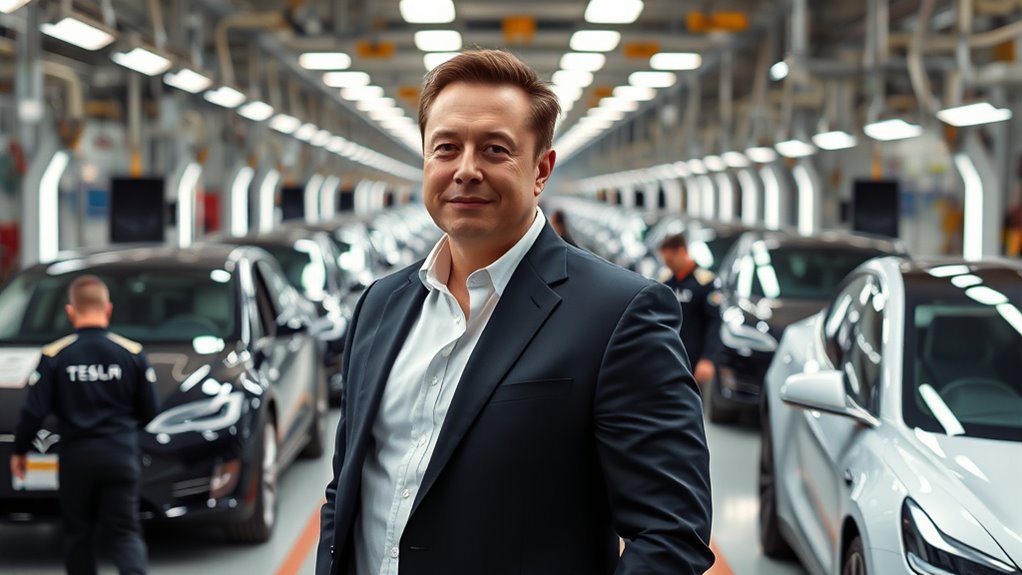
Elon Musk joined Tesla in 2004 and became CEO in 2008. His leadership style focuses on rapid iteration and vertical integration of manufacturing processes.
Before his tenure at Tesla, Musk co-founded companies like Zip2 and PayPal. These early ventures provided the capital and management experience necessary to tackle the automotive industry.
Early Life and Education
Musk was born in Pretoria, South Africa, in 1971. He moved to Canada before eventually attending the University of Pennsylvania in the United States.
He earned degrees in both physics and economics. This dual academic background influences how he approaches product design and market expansion.
Career Highlights
- Early Investment: He provided early funding for Tesla in 2004.
- Product Expansion: He oversaw the launch of the Model S, Model 3, and Cybertruck.
- Market Growth: He led the company to become the most valuable automaker globally by 2020.
Board of Directors and Governance
The Board of Directors manages Tesla’s long-term risks and executive compensation. Board members possess diverse backgrounds in technology and finance to ensure the company remains competitive.
Governance Factors
- Expertise: Directors bring experience in software and manufacturing to guide product roadmaps.
- Diversity: A variety of viewpoints helps the board identify potential market pitfalls.
- Alignment: The board must balance Musk’s vision with the fiduciary duties they owe to institutional shareholders.
Stock Performance and Ownership Dynamics
Tesla’s stock price often reacts to public statements from major shareholders. Because Musk holds such a large percentage of shares, market sentiment can shift based on his public activities or plans for the company.
Investors should monitor the 52-week price range and institutional trading patterns. Changes in how much stock these institutions hold can signal shifts in confidence regarding Tesla’s future performance.
Considerations for Individual Investors
As an investor, you should recognize that Tesla’s ownership structure creates a unique risk profile. Musk’s heavy involvement allows for fast decision-making, but it also ties the company’s success closely to his personal activities.
Institutional backing provides a level of support that can stabilize the stock during market downturns. Diversification remains your best tool to manage the risks associated with investing in a company with such concentrated ownership.
The Future of Tesla
Musk aims to pivot Tesla toward artificial intelligence and autonomous driving. These initiatives will likely define the company’s growth in the coming years.
- Robotaxis: Tesla continues to develop autonomous transport solutions.
- AI Integration: New software tools aim to improve user interaction within the vehicle cabin.
- Charging Infrastructure: Plans to expand the Supercharger network remain a core part of the long-term strategy.
Frequently Asked Questions
Who owns the majority of Tesla?
No single person owns a majority of Tesla. Elon Musk is the largest individual shareholder with 12%, while institutional investors hold the remaining majority of shares.
What other companies does Elon Musk lead?
Musk serves as the head of several companies, including SpaceX, which focuses on space exploration, and Neuralink, which develops brain-machine interface technology.
What would a $1,000 investment from five years ago be worth?
Due to the stock’s growth over the last five years, a $1,000 investment would show significant appreciation. Check your brokerage account or current financial data platforms for specific historical returns based on your exact entry date.
Did Elon Musk start Tesla alone?
No, Tesla was founded by Martin Eberhard and Marc Tarpenning. Musk joined the company shortly after as an early investor and eventually assumed the role of CEO.
Conclusion
Tesla’s ownership structure centers on a blend of visionary leadership and institutional support. Musk holds enough stock to drive innovation, while institutional investors provide the capital and governance needed for global scaling. By keeping an eye on these stakeholders, you can better understand the forces behind Tesla’s stock movements. Evaluate your portfolio to ensure your holdings align with your long-term goals.






Leave a Reply