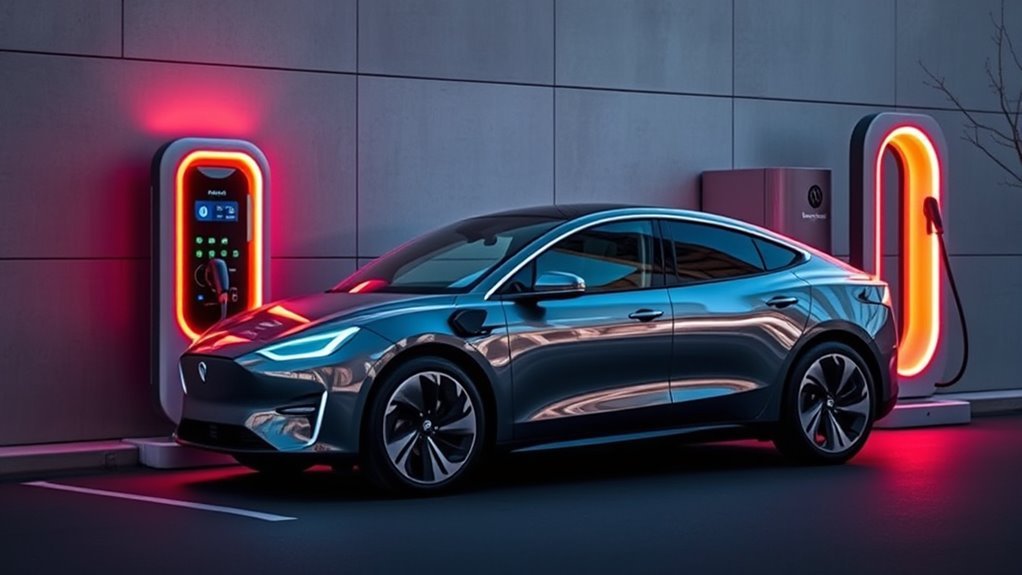
When it comes to EV charging, you’ll encounter AC and DC types. Level 1 and Level 2 chargers use AC power, with Level 1 being the slowest, suitable for minimal driving. Level 2 offers faster charging for daily use. DC fast charging provides rapid refueling, reaching 80% in 20 minutes to an hour, which is essential for long trips. Ultra-rapid charging takes it a step further, offering even quicker top-ups. Explore further for more insights into these options.
Understanding AC Charging: How It Works and Its Benefits
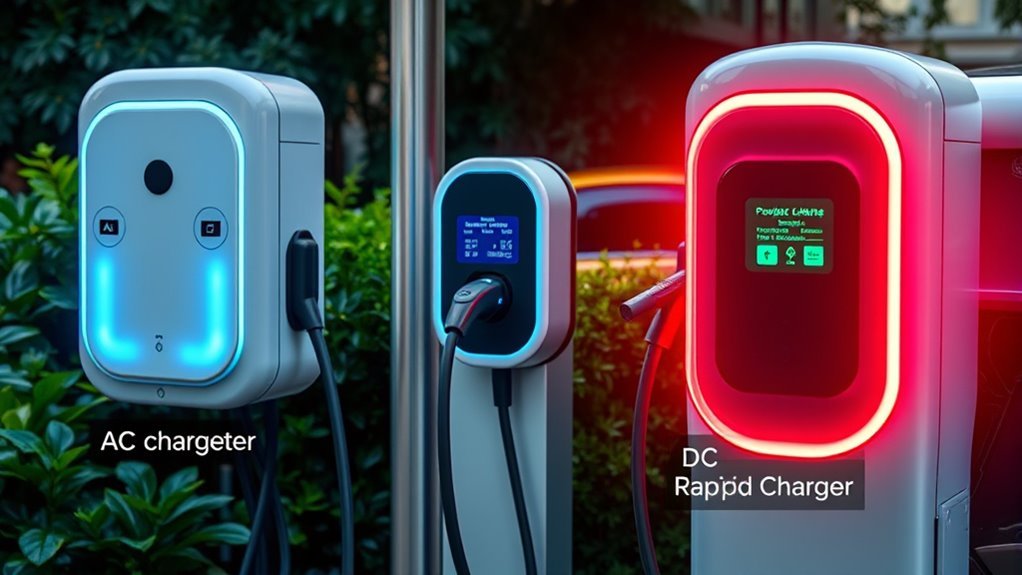
Although you may not think about it often, understanding how AC charging works can greatly enhance your EV experience.
AC charging converts alternating current from the grid to direct current for your vehicle’s battery, using the onboard charger. For home charging, Level 1 AC chargers provide 1 kW to 1.8 kW, taking 22-40 hours for a full charge.
In contrast, Level 2 AC chargers, with outputs up to 19.2 kW, can fully charge your EV in about 2-3 hours, making them ideal for workplace installation.
AC charging is compatible with all electric vehicles, providing a seamless experience for users. This method is perfect for scenarios where your car is parked for extended periods, such as overnight at home or during work hours, offering 35-40 miles of range per hour.
Embracing AC charging can empower you to maximize your EV’s potential while enjoying the freedom of electric driving.
Why DC Fast Charging Is Essential for EV Owners
DC fast charging is essential for EV owners who value time efficiency during travel. By charging your Battery Electric Vehicle (BEV) to 80% in around 20 minutes, you can minimize downtime and keep your journey on track.
As the demand for enhanced charging infrastructure grows, fast charging stations are increasingly available along major routes, making long-distance travel more convenient.
Time Efficiency During Travel
When you’re on a long trip, time efficiency is crucial, making DC fast charging an essential feature for electric vehicle (EV) owners.
With the capability to charge a Battery Electric Vehicle (BEV) to 80% in just 20 minutes, you can considerably reduce downtime. DC fast chargers, delivering speeds from 15 kW to over 360 kW, offer the rapid refueling necessary for effective intercity travel, aligning with your tight schedule.
Unlike AC charging, which often takes hours, DC fast charging provides a quick top-up option, perfect for highway rest stops and transit hubs.
The growing demand for this infrastructure reflects the need for seamless travel efficiency and charging convenience, ensuring your journeys remain smooth and uninterrupted.
Enhanced Charging Infrastructure Demand
As the electric vehicle (EV) market continues to grow, the demand for enhanced charging infrastructure becomes increasingly crucial.
To support your journey, DC Fast Charging solutions charge battery electric vehicles (BEVs) to 80% in just 20 minutes to 1 hour, minimizing your downtime.
With more EVs on the road, strategically installed fast chargers along highways and transit hubs alleviate range anxiety and enable long-distance travel.
DC fast charging stations, offering power outputs over 360 kW, are essential for high vehicle turnover, maximizing revenue for charging network operators.
Investing in robust charging network expansion is imperative, ensuring you have convenient, efficient charging options that meet your expectations for quick refueling, just like traditional gas stations.
Key Differences Between Level 1, Level 2, and Level 3 Chargers
Three main types of electric vehicle (EV) chargers—Level 1, Level 2, and Level 3—offer varying charging speeds and capabilities tailored to different needs.
Level 1 chargers utilize a standard 120-volt AC outlet, delivering 1-1.8 kW and taking 22-40 hours to fully charge a Battery Electric Vehicle (BEV). This option is best for home use or as a backup.
Level 1 chargers, ideal for home use, deliver 1-1.8 kW, taking 22-40 hours to fully charge a BEV.
In contrast, Level 2 chargers operate on 208-240 volts AC, providing 10-75 miles of range per hour, achieving 80% charge in 4-10 hours, commonly found in public stations.
Level 3 chargers, or Direct Current Fast Chargers (DCFC), use 480 volts, allowing rapid charging to 80% in just 20 minutes to 1 hour, ideal for long trips.
This charging speed comparison highlights that choosing the right level affects your charging experience, while installation requirements vary considerably across these types.
How Long Does It Take to Charge Your EV?
Understanding how long it takes to charge your electric vehicle (EV) is essential for planning your driving needs. Charging speeds vary greatly based on the type of charger you use.
Level 1 charging can take 22-40 hours to fully charge your Battery Electric Vehicle (BEV), providing only 3-7 miles of range per hour. In contrast, Level 2 charging is more accessible, fully charging your BEV in about 4-10 hours, delivering 10-75 miles of range per hour—ideal for home or workplace use.
For quicker options, Direct Current Fast Charging (DCFC) can get you to 80% in 20 minutes to 1 hour, while Rapid AC chargers allow for 80% in about 20-40 minutes. Ultra-rapid chargers, exceeding 100 kW, can achieve this in just 10-15 minutes.
Knowing these times helps you optimize your EV experience and guarantees charging accessibility aligns with your lifestyle.
Rapid vs. Ultra-Rapid Charging: Key Differences and Benefits
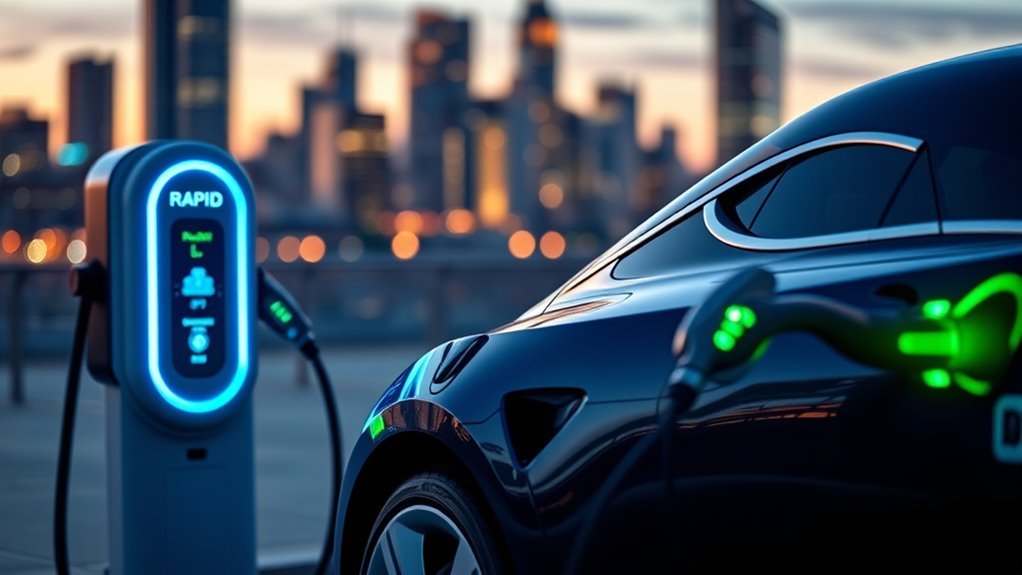
When comparing rapid and ultra-rapid charging, it’s essential to recognize their distinct capabilities and benefits. These two charging technologies cater to different user experiences, especially for those on the go.
- Power Output: Rapid chargers deliver up to 50 kW, while ultra-rapid chargers exceed 100 kW.
- Charging Time: Rapid charging takes about 20 minutes to an hour for 80%, whereas ultra-rapid charging can achieve this in just 10-15 minutes.
- Connector Types: Rapid chargers often use CHAdeMO or CCS connectors; ultra-rapid chargers mainly utilize CCS, becoming the standard for modern EVs.
- Cost Consideration: Ultra-rapid chargers have higher installation and operational costs, which may reflect in user fees.
Ultimately, choosing between these options depends on your charging needs and travel plans.
Understanding these differences can enhance your overall EV charging experience.
How to Choose the Right EV Charging Option for Your Lifestyle
When choosing the right EV charging option, consider how often you charge and the type of vehicle you have.
If you primarily charge at home and your EV supports it, Level 2 charging is efficient for daily use.
For longer trips or if your vehicle is compatible, DC fast charging can greatly cut down your charging time on the go.
Charging Frequency Considerations
Choosing the right EV charging option for your lifestyle hinges on how often you drive and your charging habits.
To optimize your charging patterns based on your frequency preferences, consider these options:
- Level 1 Charging: Ideal for minimal driving; uses a standard outlet but takes 22-40 hours for a full charge.
- Level 2 Charging: Best for daily commutes; provides 10-75 miles of range per hour and fully charges in 2-10 hours.
- DC Fast Charging: Essential for long trips; charges to 80% in 20-60 minutes for quick refueling during travels.
- Evaluate Infrastructure: Confirm your vehicle supports the charging type and check local availability to avoid disruption in your routine.
Vehicle Type Compatibility
Understanding your vehicle’s compatibility with various charging options is essential for optimizing your EV experience. Different vehicles support diverse charging standards, which can influence your choice considerably. Here’s a quick comparison:
| Charging Type | Ideal Vehicle Type |
|---|---|
| Level 1 | PHEVs |
| Level 2 | BEVs & PHEVs |
| DC Fast | BEVs |
| Ultra-Rapid | Selected modern BEVs |
Battery Electric Vehicles (BEVs) typically support Level 2 and DC fast charging, allowing for quicker recharging times. Plug-in Hybrid Electric Vehicles (PHEVs) usually rely on Level 1 and Level 2 charging. Choose the charging option that aligns with your lifestyle for seamless vehicle compatibility and convenience.
Frequently Asked Questions
Is It Better to Charge EV With AC or DC?
If you prioritize AC advantages like cost-effectiveness and home convenience, go for AC charging. However, if you need DC efficiency for quick top-ups during long trips, opt for DC fast charging stations.
What Is the Difference Between Rapid and Ultra Chargers?
Rapid chargers offer charging speeds up to 50 kW, while ultra-rapid chargers exceed 100 kW. Charger compatibility varies, with ultra-rapid options increasingly using CCS for more efficient and faster charging of modern electric vehicles.
What Are the Three Types of EV Charging?
Think of EV charging like a ladder. You’ve got Level 1 charging for long overnight sessions, Level 2 charging for quicker home or public fills, and Level 3 charging for lightning-fast stops on the go.
Is AC Fast Charging Better Than DC Fast Charging?
AC fast charging isn’t inherently better than DC fast charging; it depends on your needs. While AC offers efficiency for longer charging sessions, DC provides quicker charging speeds, ideal for fast top-ups during travel.
Conclusion
In the world of EV charging, understanding your options can feel like maneuvering through a maze. By choosing between AC and DC, and recognizing the nuances of rapid versus ultra-rapid charging, you can power your journey efficiently. Just as a well-tuned engine drives a car, the right charging solution fuels your electric vehicle experience. So, take a moment to assess your lifestyle and charging needs—it’ll make all the difference on your road ahead.






Leave a Reply