To set up home EV charging efficiently, consider Level 2 chargers for faster charging and assess installation costs between $800 to $2,500. Verify compliance with local safety codes and regulations, and consult a qualified electrician. Regular maintenance and GFCI protection minimize risks, while understanding your energy costs helps budget effectively. Home charging can provide significant savings against public stations. If you want to optimize your setup, explore essential tips and best practices further.
Understanding EV Charging Basics
When you’re considering electric vehicle (EV) charging, it’s essential to understand the different levels of charging stations available.
Level 1 charging utilizes a standard 120V outlet, offering about 2-5 miles of range per hour. While it’s convenient, this method can take over 50 hours for a full charge, making it less ideal for daily driving.
Level 1 charging is convenient but can take over 50 hours for a full charge, making it less suitable for daily use.
In contrast, Level 2 charging employs a 240V outlet, delivering 20-60 miles of range per hour and typically charges an EV in 3 to 7 hours.
For long-distance travel, Level 3 charging, or DC Fast Charging, allows you to power up to 80% in just 30-60 minutes.
As you engage in EV charging, remember to practice proper charging etiquette, like not monopolizing charging stations and ensuring you unplug when done.
Understanding these basics empowers you in your EV journey and enhances your experience as an eco-conscious driver.
Choosing Between Level 1 and Level 2 Chargers
Deciding between Level 1 and Level 2 chargers is essential for optimizing your electric vehicle (EV) charging experience. Level 1 chargers offer advantages like low upfront costs and easy installation, making them suitable for casual users. However, they provide a slow charging speed, typically 2-5 miles of range per hour, which might not meet daily driving needs.
In contrast, Level 2 chargers deliver faster charging—20-60 miles of range per hour—allowing full charges in about 3 to 7 hours. Despite their higher installation costs, typically ranging from $800 to $2,500, they provide better cost efficiency in the long run.
Here’s a charging speed comparison and cost efficiency analysis:
| Charger Type | Charging Speed | Cost Estimate |
|---|---|---|
| Level 1 | 2-5 miles/hour | $30 – $900 |
| Level 2 | 20-60 miles/hour | $800 – $2,500 |
Evaluate your needs carefully to make the right choice.
Understanding Installation Costs
Understanding the installation costs for a home EV charging station is vital for budgeting your project effectively. The average total cost ranges from $800 to $2,500, with $1,700 being typical for most installations.
Your cost breakdown should include equipment prices for Level 2 chargers, starting at around $299 and potentially exceeding $799, depending on features. Installation factors like permitting costs, which vary by jurisdiction from $50 to $800 (averaging $310), must also be considered.
Hiring a licensed electrician is imperative, as they guarantee compliance with local codes and conduct load calculations for your electrical infrastructure. If you plan to install a Level 2 charger, upgrading to a 200-amp electrical panel might be necessary to support charging alongside other home electrical demands.
Safety Considerations for Home Charging
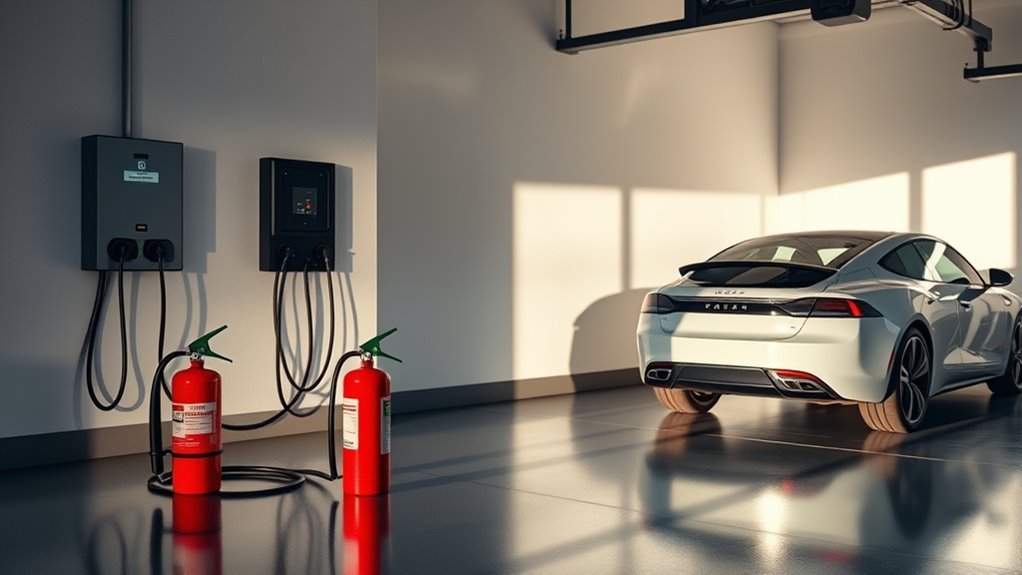
Installing a Level 2 EV charging station involves not just the financial aspect but also a strong focus on safety. Prioritize charging station safety by guaranteeing compliance with local and state electrical codes. This often requires permits and inspections. Always use safety-certified equipment, like ENERGY STAR products, to reduce electrical hazards.
Here’s a quick reference table for your safety checklist:
| Safety Measure | Importance |
|---|---|
| Use a qualified electrician | Prevents circuit overloads |
| Inspect charging equipment | Avoids fire hazards |
| Install GFCIs | Protects against electrical faults |
| Check electrical capacity | Guarantees safe operation |
| Regular maintenance | Minimizes risks from wear and damage |
Be proactive about electrical hazard awareness to keep your home charging setup safe and efficient. Embrace these precautions for peace of mind as you power your electric vehicle.
Navigating Local Permitting and Regulations
Before proceeding with the installation of your EV charging station, it’s vital to familiarize yourself with local permitting requirements and regulations, as these can differ widely by jurisdiction.
Understanding the permit process is fundamental to avoid delays or complications. Here’s what you should consider:
Understanding the permit process is crucial to ensure a smooth and timely installation of your EV charging station.
- Review specific local codes and regulations.
- Guarantee compliance with the National Electrical Code (NEC) Article 625, which classifies EV charging as a continuous load.
- Prepare to submit a site installation plan for approval by local building and permitting authorities.
- Consult local utility companies for additional requirements or incentives that could impact your installation.
Navigating these local regulations not only guarantees safety and compliance but also paves the way for a smooth installation experience.
Taking these steps will empower you to install your EV charging station confidently and responsibly.
Evaluate Your Home’s Electrical Capacity
To guarantee your home can support an EV charger, you need to assess your existing electrical load first.
This evaluation helps identify whether your current panel can accommodate the additional demand, particularly for Level 2 charging.
Consulting a qualified electrician is essential for a thorough assessment and to discuss any necessary upgrades for safety and compliance.
Assess Existing Electrical Load
Evaluating your home’s electrical capacity is essential before installing an EV charger. Start by examining your electrical panel’s ampacity, especially if you live in an older home. A load calculation will help you determine if your system can handle the additional demand.
Consider these points:
- Modern homes usually have 100-amp panels, while older ones might be 30 or 60 amps.
- Level 2 EV chargers can draw between 16 to 80 amps.
- Upgrading to a 200-amp panel guarantees safe charging and operation of other household circuits.
- Consult a licensed electrician for compliance with local codes and accurate evaluations.
Consult Qualified Electrician
Consulting a qualified electrician is essential for guaranteeing your home’s electrical system can handle the demands of a Level 2 EV charger. They’ll perform a load calculation to assess your home’s capacity, which often varies between older 30-amp panels and modern 200-amp panels. Upgrading to a 200-amp panel not only supports EV charging but also guarantees compatibility with other household circuits. This upgrade safeguards against future electrical demands, while compliance with local codes is maintained.
| Panel Capacity | Amps Supported | Ideal for EV Charging |
|---|---|---|
| 30 Amps | Limited | Not Recommended |
| 60 Amps | Limited | Not Recommended |
| 100 Amps | Moderate | Possible |
| 200 Amps | High | Highly Recommended |
Hiring a licensed electrician helps guarantee safety and compatibility.
Energy Costs: Calculating Your Charging Expenses
To estimate your charging expenses, start by calculating the cost per mile based on your vehicle’s efficiency and current electricity rates.
For instance, if your EV consumes 27 kWh to travel 100 miles and your rate is $0.10 per kWh, you’ll spend about $0.03 per mile.
You can then multiply this cost by your monthly mileage to determine your total charging expenses.
Charging Cost Per Mile
Understanding the cost per mile for charging your electric vehicle (EV) is essential for managing your overall expenses effectively. To calculate this, divide the electricity cost per kilowatt-hour (kWh) by your vehicle’s charging efficiency in kWh per 100 miles.
For instance:
- If electricity costs $0.10 per kWh
- Your vehicle consumes 27 kWh per 100 miles
- Your cost per mile is approximately $0.03
Charging at home is generally cheaper than public stations.
Utilizing time-of-use electricity rates can maximize savings, allowing you to charge during off-peak hours. Regularly monitoring local electricity rates and optimizing your charging times can greatly improve your cost comparison, making your EV a more economical choice for daily driving needs.
Full Charge Expense Estimate
When estimating the expense of a full charge for your electric vehicle (EV), it is crucial to accurately calculate the electricity consumption in kilowatt-hours (kWh) and multiply it by your local electricity rate. By tracking your charging habits and expenses, you can make informed decisions.
| Battery Size (kWh) | Cost to Charge ($) |
|---|---|
| 54 | 5.40 |
| 100 | 10.80 |
| 27 (per 100 miles) | 2.70 |
Home charging typically costs less than public charging, which can range from $10 to $30. Consider time-of-use rates for even lower expenses, especially if you charge overnight. Knowing these costs can help enhance your EV ownership experience.
Benefits of Home EV Charging vs. Public Charging
While many EV owners appreciate the accessibility of public charging stations, the benefits of home EV charging often outweigh those conveniences.
Home charging convenience not only simplifies your routine but also offers considerable financial advantages.
Home charging not only streamlines your daily routine but also delivers significant financial benefits.
Consider these benefits:
- Cost Savings: Average monthly charging costs at home are around $60, compared to $10 to $30 per public charging session.
- Overnight Charging: You can fully charge your vehicle overnight without extra fees, ensuring it’s ready each morning.
- Faster Charging: Level 2 home chargers provide 20-60 miles of range per hour, considerably reducing downtime.
- Simplified Experience: Charging at home eliminates complex payment systems and membership requirements typical at public stations.
Essential Tips for Effective Home EV Charging
To maximize the efficiency and convenience of home EV charging, you should consider several essential tips.
First, install a Level 2 charging station; it delivers 20-60 miles of range per hour, markedly outperforming the Level 1 option’s 2-5 miles. Conduct a load calculation to verify your home’s electrical panel can handle this demand—typically, a 200-amp panel is necessary.
Next, factor in installation costs, which can run between $800 and $2,500 based on complexity.
To enhance energy efficiency, utilize off-peak electricity rates, making home charging more economical than public options which can cost $10 to $30 per session.
Finally, adopt mindful charging habits by regularly monitoring your EV battery health to extend its lifespan and maintain peak performance.
Following these tips empowers you to charge effectively while reaping the benefits of your electric vehicle.
Tips for Maintaining Your Home Charging Station
To maintain your home charging station effectively, regularly inspect the unit and cables for any signs of wear or damage.
Cleaning the connectors and cables guarantees reliable connections and efficient charging.
Regular Inspections and Testing
Regular inspections and testing are essential for maintaining the safety and efficiency of your home charging station.
To guarantee peak performance and prevent electrical hazards, follow these guidelines:
- Conduct monthly GFCI testing to verify it functions correctly.
- Regularly inspect your charging station for signs of wear, such as frayed cables or loose connections.
- Schedule professional charging station inspections at least once a year to assess electrical connections and compliance with local codes.
- Monitor charging speed and efficiency; noticeable drops may indicate a need for maintenance or replacement.
Clean Connectors and Cables
Keeping your connectors and cables clean is essential for the ideal performance of your home charging station. Regular connector maintenance is crucial; inspect for wear or damage, as frayed wires can jeopardize safety and charging efficiency.
Clean connectors and cables using a soft cloth and a mild detergent solution to eliminate dirt and corrosion, ensuring secure connections. Avoid using excessive force when plugging or unplugging, as this can damage both the cable and your vehicle’s charging port.
Store charging cables in a dry, cool place to prevent moisture and temperature extremes from degrading materials. Consider cable care techniques, like management solutions, to keep cables organized, prevent tangling, and promote safety while prolonging the lifespan of your charging equipment.
Frequently Asked Questions
Can I Install a Charger Myself Instead of Hiring an Electrician?
You can attempt DIY installation, but be aware of local electrician requirements. Proper knowledge of electrical systems is vital to guarantee safety and compliance. Mistakes can lead to hazards or costly repairs, so consider professional help.
What Type of Outlet Do I Need for a Level 1 Charger?
For a Level 1 charger, you’ll need a standard 120-volt outlet type, typically a NEMA 5-15. This setup provides slower charging speeds, but it’s an easy solution if you’re looking to keep it simple.
How Long Does It Take to Charge an EV at Home?
Charging an EV at home typically takes 4 to 12 hours, depending on the charging speed and battery capacity. Higher capacity batteries may require longer, while faster chargers can reduce charging time considerably.
Will My Home Insurance Cover the EV Charging Station?
Your home insurance might cover the EV charging station, but it depends on your insurance policy’s coverage limits. Over 60% of homeowners find their policies include such coverage, so check with your provider for specifics.
Can I Use My Existing Home Wiring for a Level 2 Charger?
You can use your existing wiring for a Level 2 charger if it’s compatible with the charger’s requirements. Verify the wiring meets voltage and amperage specifications, and consult a professional to confirm safety and compatibility.
Conclusion
In your journey towards electric vehicle ownership, mastering home charging is key to unfastening convenience and savings. By setting up a reliable charging station, you’ll not only embrace sustainability but also step into the future—much like the heroes of sci-fi who envisioned a world powered by clean energy. Remember, with careful planning and attention to safety, you can transform your home into a charging hub that keeps you on the road without a hitch.






Leave a Reply