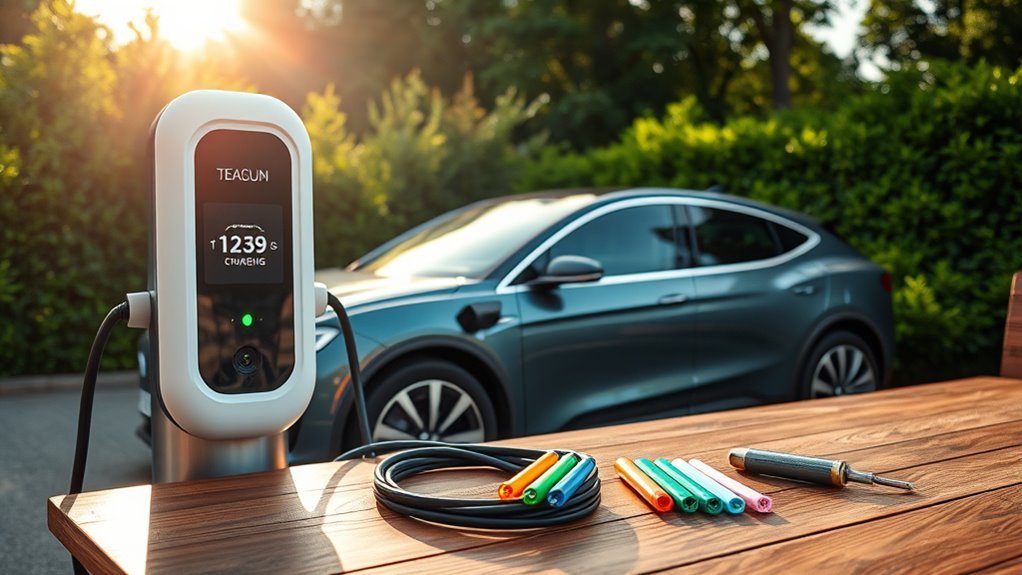
To charge your EV faster, install a Level 2 charger, ideally on a 200-amp service panel. Schedule your charging during off-peak hours to save on costs, and aim for 80% battery level to enhance efficiency. Always prioritize safety with a dedicated home charging station and regular inspections of cables. Understanding the costs associated with home charging can help you budget effectively. There’s more to learn about maintaining your equipment and optimizing your charging practices.
How to Choose the Best Home EV Charging Level for Your Needs
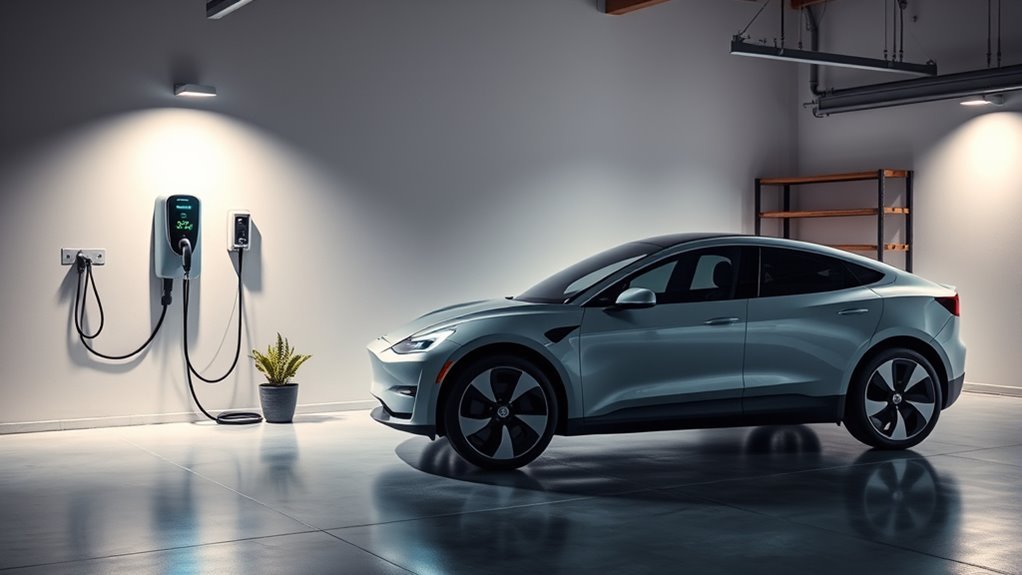
When determining the best home EV charging level for your needs, what factors should you consider? First, evaluate your daily driving habits. If you have longer commutes, a Level 2 charger (240 volts) is ideal, offering charging speeds that add 25-40 miles of range per hour.
In contrast, a Level 1 charger (120 volts) only provides 3-5 miles per hour, which may fall short for most users.
Next, consider the amperage options available. Level 2 chargers can range from 16 to 80 amps, enabling faster charging based on your vehicle’s acceptance rate and your home’s electrical capacity.
Consider the amperage of Level 2 chargers, ranging from 16 to 80 amps, for optimal charging speed based on your vehicle and home’s capacity.
Verify your electrical system supports a Level 2 charger, typically requiring a 200-amp service panel.
Investing in a smart Level 2 charger can further enhance your experience, allowing you to schedule charging sessions during off-peak hours, optimizing your costs and liberating you from high electricity rates.
Optimizing Your Charging Schedule for Cost Savings
To maximize your savings on electric vehicle (EV) charging costs, you should strategically schedule your charging sessions during off-peak hours. By doing so, you can benefit from lower electricity rates, such as Economy 7 tariffs, which can reduce your costs to around 11p per kWh compared to over 24.5p during peak times.
Utilize smart home chargers to set specific charging times aligned with your utility’s time-of-use rates, enhancing your charging efficiency. Charging to 80% instead of 100% can also improve efficiency, allowing for faster charging and reduced energy loss.
Investing in a dedicated Level 2 charging station can further amplify your off-peak benefits, delivering 10-60 miles of range per hour. Finally, explore available rebates for home charging equipment, as they can offset initial costs and contribute to long-term savings.
Embrace these strategies to liberate your budget while enjoying the convenience of EV ownership.
Essential Safety Tips for Home EV Charging
Guaranteeing safety while charging your electric vehicle at home is essential for both your vehicle’s longevity and your personal safety.
Always use a dedicated home EV charging station for Level 2 charging; it offers faster rates and minimizes the risk of electrical overloads compared to standard outlets.
Using a dedicated home EV charging station ensures faster charging and reduces the risk of electrical overloads compared to standard outlets.
Regularly inspect your charging cables and connectors for any signs of damage or wear, as frayed equipment can pose serious hazards to your vehicle and electrical system.
Verify that your home’s electrical system capacity can handle the load, ideally having a minimum of 200 amps in your panel to prevent overheating and electrical fires.
Additionally, install a Ground Fault Circuit Interrupter (GFCI) outlet for your charging station setup to protect against electrical shocks, especially in damp conditions.
Finally, keep the area around your charging station clear of obstructions and debris to guarantee safe operation and prevent accidents.
Key Factors Influencing the Costs of Home EV Charging
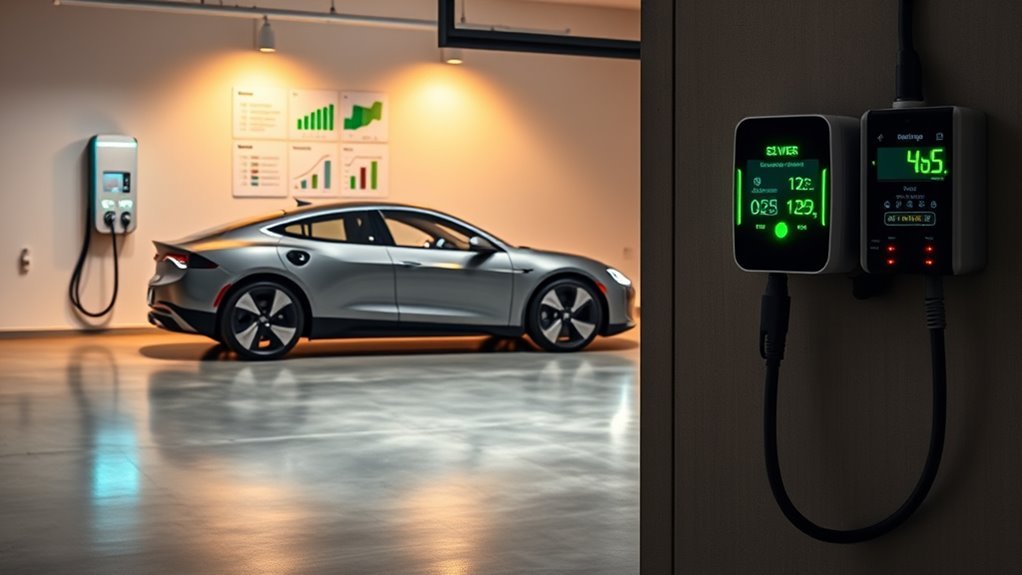
Understanding the key factors that influence home EV charging costs can help you manage your expenses effectively.
The average electricity rate for home charging is around $0.16 per kWh, considerably lower than public rates, which can soar to $0.60 per kWh. With average usage of 11.81 kWh daily, your monthly charging costs may reach approximately $56.
To reduce these expenses, consider utilizing time-of-use (TOU) rates by charging during off-peak hours, where rates can drop to about 11 cents per kWh. Additionally, be mindful of your charging habits; frequently charging to 100% can inflate your electricity bills.
Finally, the installation of home charging stations can cost between $550 and $1,380, but potential rebates or incentives can alleviate these initial expenses.
How to Maintain Your Charging Equipment for Longevity
Maintaining your charging equipment is essential for maximizing its lifespan and guaranteeing safe operation. Start with regular cable inspections; check for frayed cables or damaged connectors that can pose safety risks and reduce charging efficiency.
Keep your charging station and surrounding area clean and dry to prevent corrosion, as moisture can lead to electrical issues. Schedule routine checks with a qualified electrician to assess your electrical panel’s capacity, making sure your home charging setup meets safety standards.
Utilize smart technology to monitor energy usage and optimize charging schedules. This not only enhances the longevity of your charging equipment but also benefits your EV battery.
Finally, always follow manufacturer guidelines for maintenance and operation, including updating software for smart chargers, to guarantee compatibility and efficiency over time. By adopting these practices, you’ll enjoy a safer and more reliable charging experience while supporting the longevity of your equipment.
Frequently Asked Questions
What Is the Cheapest Way to Fast Charge an EV?
The cheapest way to fast charge your EV is at home using a Level 2 charger. Manage your time by charging during off-peak hours, reducing costs considerably compared to public charging options.
What Is the 20/80 Rule for Charging?
The 20/80 rule for charging advises you to keep your EV battery between 20% and 80% for ideal charging habits. This practice enhances battery longevity, reducing degradation and ensuring efficient charging over the vehicle’s lifespan.
Is It Cheaper to Charge Your EV at Home or at a Charging Station?
Charging your EV at home is cheaper than using public charging stations, costing around $0.16 per kWh versus $0.30 to $0.60. You’ll save considerably by charging overnight during off-peak electricity hours.
How to Optimize EV Charging for Lower Costs?
To optimize EV charging for lower costs, shift your charging habits to off-peak hours, leveraging time of use rates. Investing in a Level 2 charger also boosts efficiency, reducing overall energy consumption and expenses.
Conclusion
To summarize, by choosing the right charging level, optimizing your schedule, prioritizing safety, and understanding costs, you can elevate your EV charging experience. Just like a well-tuned engine, maintaining your charging equipment will guarantee it runs smoothly for years. Remember, a little planning now can save you a bundle later, making your home charging setup as efficient as a smartphone app. So, plug in, charge up, and drive smarter!






Leave a Reply