EV charging efficiency typically ranges from 80% to over 94%, with Level 2 chargers averaging 91-94% while Level 1 chargers sit around 80%. Charging losses of 10-20% can considerably impact costs, adding approximately $1.14 per charge. To improve efficiency, embrace dedicated Level 2 chargers, avoid topping off beyond 80%, and charge within moderate temperature ranges. Investing in quality equipment and adopting effective charging practices can maximize savings. You might be surprised by the future trends transforming EV charging.
Understanding EV Charging Efficiency
When you charge an electric vehicle (EV), understanding charging efficiency is vital for optimizing energy use and performance. EV charging efficiency typically ranges from 80% to over 94%. Level 2 chargers average around 91-94% efficiency, while Level 1 chargers hover around 80%.
Understanding EV charging efficiency is crucial, with rates from 80% to over 94%, significantly impacting energy use and performance.
DC fast charging systems exceed 90% efficiency by bypassing the AC-to-DC conversion process, minimizing energy losses. However, charging losses can reach 15%, meaning a notable portion of electricity doesn’t power your battery.
Consumer awareness of these efficiencies is essential, especially when utilizing charging networks. Factors like ambient temperature and charging voltage play significant roles; extreme cold can drop efficiency to as low as 60%.
If you’re seeking liberation in your energy use, consider implementing higher amperage charging, which can boost efficiency to nearly 94%. By understanding these dynamics, you’ll maximize your EV’s performance and sustainability.
Key Factors Contributing to Energy Losses During EV Charging
When you charge your EV, several key factors can markedly impact energy losses.
The quality of your charging equipment, ambient temperature, and voltage levels all play essential roles in determining efficiency.
Understanding how these elements interact can help you optimize your charging practices and reduce energy waste.
Charging Equipment Quality
Although charging equipment quality may seem like a minor detail, it plays an essential role in determining energy losses during electric vehicle (EV) charging. The efficiency of on-board chargers (OBC) and charging cables directly impacts energy transfer, with Level 2 home chargers operating at only 83-94% efficiency.
Using household sockets exacerbates losses, as seen with a Renault Zoe that experienced 24.2% losses compared to 9.7% with a dedicated wall box.
Charger design also matters; higher power outputs generate heat, leading to increased losses. Thicker charging cables reduce resistance, minimizing waste and highlighting the importance of quality in both design and construction for peak efficiency.
Prioritizing these factors can considerably enhance your charging experience.
Temperature Effects
Temperature considerably influences the efficiency of EV charging, as extreme conditions can drastically reduce energy transfer rates.
In cold weather, charging efficiency can plummet to below 40%, while at a moderate 77°F, it exceeds 90%. Low temperatures necessitate additional energy for battery warming, increasing overall energy consumption.
Conversely, high temperatures activate battery cooling systems, which also contribute to energy losses during the charging process. Effective temperature management through thermally controlled battery packs helps maintain ideal conditions, but these systems require energy to operate.
Understanding these dynamics is essential for improving charging performance and minimizing energy losses, ensuring that you make the most of your EV charging experience.
Voltage Levels
As you explore the various voltage levels for EV charging, it’s essential to understand how these levels directly impact energy efficiency.
Charging standards reveal that Level 1 (120V) averages around 80% efficiency, while Level 2 (240V) can exceed 90%, with studies showing efficiencies between 93% and 95%.
Higher voltage levels greatly reduce energy losses due to decreased resistive heating, making Level 2 and DC fast charging (400V) preferable.
Even though DC fast charging incurs around 10% losses, it bypasses AC-to-DC conversion, enhancing overall efficiency.
Furthermore, the quality of charging equipment, including cables and connectors, plays a critical role in mitigating energy losses.
Understanding the voltage impact helps you choose the most efficient charging option for your electric vehicle.
The Impact of Charging Losses on Performance
When you charge your electric vehicle, energy consumption can vary considerably due to charging losses, impacting your overall efficiency.
By understanding the differences between charger types and their efficiencies, you can optimize your charging strategy to minimize these losses.
Implementing effective charging practices can’t only enhance performance but also reduce your monthly electricity costs.
Energy Consumption Variability
While charging an electric vehicle (EV), you mightn’t realize that energy losses can considerably impact the amount of usable energy stored in the battery.
In fact, charging can incur losses between 10-20%, meaning your energy consumption doesn’t fully translate to battery power. For instance, a Tesla Model Y requires about 87.868 kWh to deliver only 77.702 kWh, reflecting a 13% loss.
Temperature also plays a critical role; in cold conditions, efficiency can drop below 40%. Your charging behavior influences efficiency too; Level 1 charging typically yields 80% efficiency, while Level 2 can exceed 90%.
When utilizing DC fast charging, you can enjoy efficiencies averaging over 90%, with losses generally around 10%, highlighting the importance of choosing the right charging method.
Charging Efficiency Optimization Strategies
Energy losses during EV charging can greatly hinder performance, making optimization strategies essential for maximizing efficiency.
By understanding and implementing these strategies, you can notably reduce energy waste within the charging network:
- Opt for dedicated Level 2 wall-mounted chargers, achieving 83-94% efficiency.
- Utilize DC fast charging for efficiencies above 90%, minimizing losses.
- Avoid charging above 80% state of charge to maximize battery lifespan.
- Charge in moderate temperatures to enhance overall performance.
Measuring EV Charging Efficiency
How can you accurately measure the efficiency of EV charging? To determine charging efficiency, you’ll want to focus on key charging metrics. Start by comparing the energy consumed from the grid to the energy stored in your vehicle’s battery. This will reveal losses, typically ranging from 10-20%, depending on the charger type and conditions.
For instance, Level 2 chargers achieve efficiencies between 83-94%, while Level 1 chargers average around 80%. DC fast chargers generally exceed 90%, bypassing AC to DC conversion losses.
To gain deeper insights, consider using energy monitoring devices that can track actual energy consumption during charging. This data can help you evaluate your charging practices against established efficiency benchmarks.
Comparing Charging Efficiency: Level 1, Level 2, and DC Fast Charging
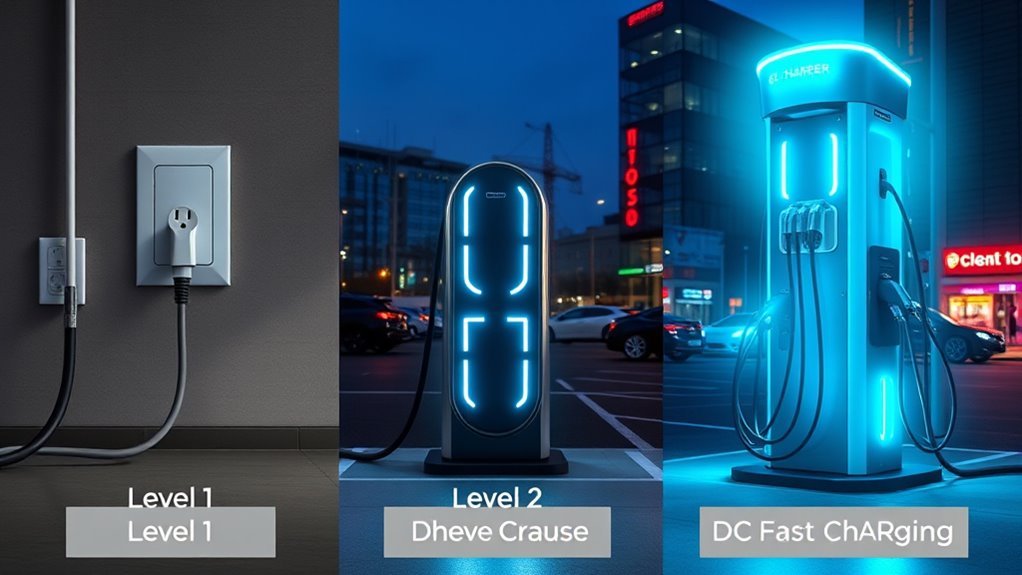
When you consider charging options, Level 1 charging operates at around 80% efficiency, making it the least effective choice.
In contrast, DC fast charging offers significant advantages, achieving efficiencies typically exceeding 90%, thanks to its streamlined process.
Understanding these differences is essential for optimizing your EV charging strategy.
Efficiency of Level 1 Charging
Although Level 1 charging, which operates at 120V, may seem convenient for overnight use, its efficiency is considerably lower than that of Level 2 and DC fast charging options.
Here are some key level 1 drawbacks to evaluate:
- Average efficiency hovers around 80%, resulting in significant energy loss.
- Charging losses can reach 20%, meaning you’ll consume about 125.2 kWh to add just 105.2 kWh to your battery.
- Longer charging duration compared to Level 2 and DC fast charging can impede daily use.
- It’s generally not recommended for frequent use if you aim to minimize charging costs and maximize battery longevity.
Given these factors, exploring higher efficiency charging options could be beneficial for your electric vehicle experience.
Advantages of DC Fast Charging
As you consider charging options for your electric vehicle, it’s important to recognize that DC fast charging stands out for its superior efficiency.
With efficiencies often exceeding 90%, and typically around 93% at ambient temperatures, it outperforms Level 1 and Level 2 charging methods.
While Level 1 operates at about 80% efficiency and Level 2 ranges from 91.6% to 92.2%, DC fast charging eliminates AC-to-DC conversion losses, minimizing energy waste.
This efficient energy transfer is especially significant when topping off batteries, as losses can double from 80% to 100% state of charge.
Embracing the DC charging benefits not only maximizes your vehicle’s range but also offers unparalleled fast charging convenience, empowering your driving experience.
Temperature Effects on Charging Efficiency
Extreme temperatures greatly affect EV charging efficiency, impacting both the charging process and overall energy consumption. Understanding these effects is essential for improving your charging experience. Here are key insights:
- In cold conditions, charging efficiency can plummet to as low as 60%, as energy is diverted to warm the battery.
- At -13°F, expect efficiency to drop below 40%, while ideal ambient temperatures around 77°F can yield efficiencies over 90%.
- High ambient temperatures require thermal management systems to cool the battery, leading to increased energy losses.
- Using thermally controlled battery packs helps maintain perfect charging temperatures, enhancing efficiency and reducing waste.
How Charging Losses Affect Your Wallet
Battery temperature impacts charging efficiency, but it’s also important to take into account how charging losses can hit your wallet. Charging losses can add 10-20% to your energy consumption, making your charging cost higher than expected. If you’re charging a 60 kWh battery, you might actually use around 69 kWh, costing you about $1.14 more at a typical rate of $0.127/kWh. Over a year, these losses can lead to an extra expense of less than $100 for 15,000 miles, a minor burden compared to gasoline costs.
| Charging Method | Efficiency |
|---|---|
| Level 1 | 80% |
| Level 2 | 83-94% |
| Charging Losses | 10-20% |
| Extra Cost | ~$1.14 per charge |
| Annual Impact | <$100/year for 15,000 miles |
Investing in high-quality equipment can maximize your energy savings, ensuring more of your expense goes directly into charging your EV.
Best Practices for Optimizing Charging Efficiency
Maximizing charging efficiency is crucial for reducing costs and enhancing the lifespan of your electric vehicle (EV). By adopting smart charging habits, you can achieve significant cost savings and improve your EV’s performance.
Here are some best practices to take into account:
- Use Level 2 (240V) chargers, which operate at 90% efficiency or higher.
- Charge your EV within the ideal temperature range of 15°C to 45°C to prevent efficiency drops.
- Install dedicated wall-mounted chargers instead of relying on household sockets to minimize energy losses.
- Avoid frequent fast charging, as it generates heat and can lead to energy waste; opt for gradual charging instead.
Implementing these strategies not only boosts your charging efficiency but also contributes to the longevity of your battery.
The Role of Charging Equipment in Overall Efficiency
While many factors influence the efficiency of electric vehicle (EV) charging, the role of charging equipment is essential. The efficiency of your charging technology can greatly affect overall energy consumption. Dedicated wall-mounted chargers outperform household sockets, which can incur losses as high as 24.2%. Level 2 home chargers operate at efficiencies between 83% and 94%, while Level 3 DC fast chargers excel above 90%.
| Charging Type | Efficiency Range |
|---|---|
| Level 2 Chargers | 83% – 94% |
| Level 3 DC Fast Chargers | > 90% |
| Household Sockets | Up to 75.8% |
Additionally, the quality of charging infrastructure, like on-board chargers and EVSE components, plays an essential role in meeting efficiency standards. Shorter, thicker cables minimize energy losses due to resistance, striking a balance between efficiency and battery longevity.
Future Trends in EV Charging Efficiency and Technology
As advancements in EV charging technology continue to evolve, you can expect significant improvements in charging efficiency that will reshape the landscape of electric vehicle ownership.
Future innovations are set to transform charging infrastructure, ensuring faster, more efficient charging experiences. Here are some key trends to watch:
- DC fast chargers may achieve efficiencies above 95% with new designs.
- Ultra-fast charging systems (250-400 kW) will drastically reduce charging times while maintaining high efficiency.
- Enhanced thermal management systems will minimize energy losses during charging by addressing temperature variations.
- Smart charging systems will optimize charging based on grid demand and energy costs, lowering operational expenses for you.
These advancements not only promise to enhance your EV experience but also align with a sustainable future, making electric vehicle ownership more accessible and liberating.
Frequently Asked Questions
How Efficient Is Charging an EV?
Charging efficiency for EVs typically ranges from 80% to over 90%, with energy losses averaging 10-20%. Factors like temperature and charging equipment type notably impact how effectively you can charge your vehicle.
Should I Charge My EV to 80% EVery Night?
Think of your battery as a delicate flower; nurturing it to 80% every night fosters its longevity. By adopting these EV charging habits, you’ll cultivate robust performance while minimizing energy waste and enhancing efficiency.
Is It Cheaper to Charge a Car at Home or a Charging Station?
Charging your car at home’s generally cheaper due to home charging benefits, with costs around $0.127 per kWh. Public charging costs can be considerably higher, especially when factoring in potential premium pricing at stations.
Is EV Charging Really Cheaper Than Gas?
Yes, EV charging’s generally cheaper than gas. Analyzing fuel prices, you’ll find EVs cost about one-third to one-half of gasoline, resulting in significant savings, especially over time with increased efficiency and lower energy losses.
Conclusion
As you navigate the winding road of EV charging, think of efficiency as the fuel that keeps your journey smooth. Every lost watt is a missed opportunity, impacting not just your wallet but the environment too. By embracing best practices and understanding the technology at play, you can steer towards a greener future. Remember, each charge is a step toward sustainability; optimize it, and you’ll transform the energy landscape, ensuring the journey ahead is as bright as the destination.






Leave a Reply