
Regenerative braking does charge the battery, but it’s not a complete solution. It converts kinetic energy into electrical power during braking, sending it back to the battery. While you can recover up to 70% of energy under ideal conditions, typical recovery rates are lower. This system works best in urban environments with frequent stops. You’ll find that maximizing energy recovery involves understanding specific strategies and conditions for peak performance. There’s more to discover about its benefits and limitations.
What Is Regenerative Braking and How Does It Work?

Regenerative braking is an essential technology in hybrid and electric vehicles that transforms kinetic energy into electrical power during braking.
When you lift off the accelerator or apply the brakes, the electric motor reverses its role, functioning as a generator. This process allows for energy recovery, converting kinetic energy back into stored energy in the battery. Under ideal conditions, you can recover 60–70% of kinetic energy, though typical scenarios yield about 10–30%.
This system excels in urban environments with frequent stops and starts, as well as on hilly routes, maximizing energy recovery.
However, its efficiency drops at low speeds or when the battery is fully charged. While regenerative braking considerably contributes to battery recharging, it can’t fully replenish the battery during long downhill drives, serving as a complementary technology to traditional braking systems for safe vehicle stopping.
How Does Regenerative Braking Charge the Battery?
When you engage regenerative braking, the process not only slows the vehicle but also channels the captured kinetic energy back into the battery. This innovative system enhances energy recovery during deceleration by converting motion into electrical energy, thereby improving your driving experience.
Engaging regenerative braking not only decelerates your vehicle but also recycles kinetic energy into electrical power for a sustainable driving experience.
- The electric motor switches to generator mode when you lift off the accelerator or press the brake.
- Approximately 10–30% of energy used during braking can be recaptured.
- This technique can extend your range by an additional 10–40 miles, especially in urban environments.
- The energy flows as DC through the inverter to the battery pack, ensuring efficient battery management.
Through this efficient process, you’re not just braking; you’re actively contributing to your vehicle’s power supply, making every stop a step towards sustainability and liberation from traditional energy constraints.
Comparing Regenerative Braking in Electric Vehicles and Hybrids
While both electric vehicles (EVs) and hybrids implement regenerative braking to recycle energy, their approaches and efficiencies differ markedly.
In EVs, regenerative braking captures kinetic energy during deceleration, converting it back into electrical energy with recovery rates of up to 70% under ideal conditions.
However, in hybrid performance analysis, while similar, the system often relies on the internal combustion engine, which can diminish regenerative efficiency. This means that during high-speed driving or when the battery’s fully charged, hybrids may experience reduced energy recovery compared to EVs.
Both systems excel in urban environments with frequent stops, where energy recovery is maximized.
When Does Regenerative Braking Fall Short?

Although regenerative braking offers significant advantages in energy recovery, it has limitations that can hinder its effectiveness in certain driving conditions. Understanding these regenerative braking drawbacks is vital for maximizing your vehicle’s efficiency.
- At lower speeds, the kinetic energy available for recovery is minimal.
- Flat highways reduce the potential for effective energy recapture during steady driving.
- Cold temperatures impair battery charging efficiency, limiting recovery.
- Fully charged batteries may disable regenerative systems, forcing reliance on traditional brakes.
These energy recovery limitations mean that in specific scenarios, you mightn’t benefit as much from regenerative braking as anticipated.
In certain situations, the expected advantages of regenerative braking may not be fully realized.
For instance, during aggressive acceleration or when needing substantial stopping power, you may find yourself resorting to conventional braking methods. Recognizing these conditions helps you adapt your driving habits to enhance overall energy efficiency and vehicle performance.
How Do Driving Conditions Affect Regenerative Braking Efficiency?
Driving conditions greatly influence the efficiency of regenerative braking, as varying environments and situations create distinct opportunities for energy recovery.
In city driving, frequent stops and starts enable more effective energy recovery, maximizing the system’s potential. Here, regenerative braking can markedly recharge your battery during deceleration.
Conversely, hilly routes present another advantageous scenario. During descents, you can recapture up to 60–70% of the kinetic energy typically lost, enhancing overall efficiency.
However, at lower speeds, the system’s effectiveness diminishes, yielding only 10–30% energy recovery, which isn’t ideal.
Additionally, cold temperatures or fully charged batteries may hinder your regenerative braking capability, further limiting its performance.
Understanding these driving conditions allows you to optimize your energy recovery strategies and take full advantage of your vehicle’s regenerative braking system.
Debunking Common Myths About Regenerative Braking
You might think regenerative braking can fully recharge your electric vehicle’s battery, but it typically only recovers 10-30% of the energy used during driving.
Additionally, while aggressive acceleration may seem like it would enhance efficiency, the system is actually designed for gentle energy recovery.
Understanding these limitations is essential for optimizing your vehicle’s performance.
Full Battery Recharge Myth
Many drivers mistakenly believe that regenerative braking can fully recharge their electric vehicle’s battery. This full charge misconception overlooks critical battery recharge limitations. In reality, regenerative braking only recovers about 10–30% of the energy spent during braking.
- The smooth hum of energy recovery during gentle deceleration
- The slight resistance felt as the vehicle slows down
- The green energy indicator lighting up briefly
- The reassuring knowledge of extending your driving range
While regenerative braking enhances overall battery health, it’s not a substitute for traditional charging methods. Understanding this guarantees you harness its benefits without falling prey to misconceptions, empowering you to optimize your driving experience.
Aggressive Acceleration Efficiency Fallacy
The belief that aggressive acceleration enhances regenerative braking efficiency is a widespread misconception among electric vehicle enthusiasts.
In practice, regenerative braking systems are optimized for smooth engagement, recovering only 10–30% of the total energy used during driving, regardless of acceleration patterns. The efficiency of energy recovery relies more on vehicle speed and driving conditions than on how aggressively you accelerate.
Furthermore, heavy acceleration can deplete your battery faster, reducing the potential for energy recovery in subsequent braking events.
It’s essential to recognize that aggressive driving may lead to increased wear on components without greatly improving energy recovery, ultimately undermining the sustainability of your electric vehicle.
Embracing moderate acceleration can yield better long-term efficiency and performance.
Regenerative Braking System Limitations
While regenerative braking systems offer a valuable means of energy recovery, they come with inherent limitations that are often misunderstood. Understanding these regenerative limitations is vital for maximizing braking efficiency.
- You can recover only 10-30% of braking energy during typical driving.
- Regenerative braking won’t fully recharge your battery; it offers just a limited range increase.
- Cold temperatures or fully charged batteries can greatly reduce effectiveness.
- It’s essential to pair regenerative braking with traditional brakes, especially for sudden stops.
These factors highlight that regenerative braking isn’t a miracle solution. Instead, it’s a complementary technology that requires awareness of its constraints to optimize performance and enhance your driving experience.
How to Maximize Energy Recovery With Regenerative Braking
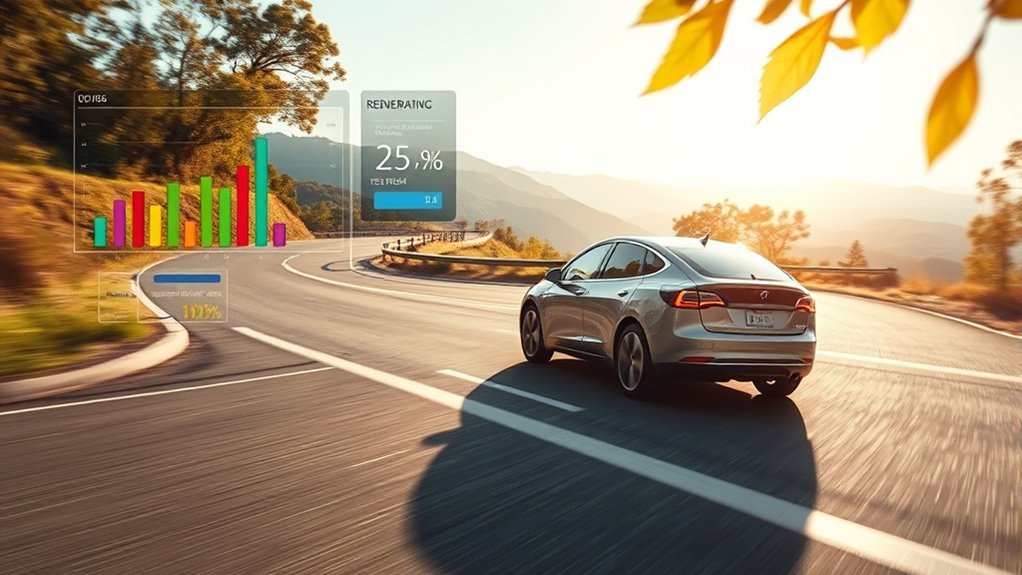
Maximizing energy recovery with regenerative braking is essential for enhancing the efficiency of your electric vehicle. To achieve this, adopt specific driving habits that enhance energy flow. Focus on city driving where frequent stops can boost energy capture by up to 30%. Adjust your vehicle’s regenerative braking settings to higher levels for stronger deceleration during braking events. Consider driving on hilly routes; descending hills can recapture 60-70% of kinetic energy spent on ascent.
| Strategy | Energy Recovery Potential |
|---|---|
| City Driving | Up to 30% |
| Higher Regenerative Settings | Increased Efficiency |
| Hilly Routes | 60-70% |
| Charge to 80% | Maximum Performance |
Avoid fully charging your battery, as it can temporarily reduce regenerative effectiveness. Monitor energy flow indicators for real-time feedback to refine your driving habits further.
Benefits of Regenerative Braking for Battery Health
Regenerative braking not only enhances energy recovery but also positively influences battery health. By reducing the depth of discharges and limiting fast charging, you can greatly extend your battery’s longevity.
Regenerative braking boosts energy recovery and battery health, extending longevity by minimizing discharges and fast charging.
Here’s how regenerative braking contributes to energy conservation and overall battery health:
- Reduced wear on battery cells: Regenerative braking prevents excessive charging rates, minimizing degradation.
- Short bursts of charge: Unlike fast charging, these brief charges lead to less overall battery wear.
- Longer driving range: You might gain an additional 10–40 miles on a full charge, depending on driving conditions.
- Less maintenance: With decreased wear on traditional brake components, your maintenance intervals can extend, saving you costs over time.
Frequently Asked Questions
Does Regenerative Braking Charge the Battery?
Yes, regenerative braking does charge the battery by facilitating energy recovery during deceleration. This process enhances battery efficiency, allowing you to maximize energy use, extend driving range, and optimize performance in electric vehicles.
What Are the Downsides of Regenerative Braking?
Like a double-edged sword, regenerative braking offers energy efficiency but has downsides. You might face maintenance concerns, reduced effectiveness at low speeds, and different braking feel, which can affect your driving experience during critical moments.
How Does Regenerative Braking Actually Work?
Regenerative braking works by converting kinetic energy into electrical energy during deceleration, enhancing energy recovery and braking efficiency. When you lift off the accelerator, the electric motor switches to generator mode, slowing the vehicle while charging the battery.
What Is the 80 20 Rule for Electric Cars?
The 80/20 rule for electric cars is a game-changer. By charging to 80%, you boost electric car efficiency and greatly enhance battery lifespan, ensuring ideal performance without the hassle of frequent charging stops.
Conclusion
In conclusion, regenerative braking is a crucial technology that not only enhances vehicle efficiency but also contributes to battery longevity. By converting kinetic energy into electrical energy, it helps recharge your battery during deceleration. But isn’t it remarkable how much energy can be recovered with proper techniques? Understanding its limitations and ideal use can further improve your driving experience. Ultimately, embracing regenerative braking can lead to a more sustainable and efficient future for electric and hybrid vehicles alike.






Leave a Reply