Single-phase EV chargers typically deliver up to 7.4 kW, taking around eight hours to fully charge a standard 24 kWh battery. In contrast, three-phase chargers provide faster charging at up to 22 kW, completing the same task in roughly two hours, and even faster at commercial stations. If you’re prioritizing speed and efficiency, three-phase systems are the superior option. For a deeper understanding of installation costs and compatibility, there’s more to explore.
Understanding Single-Phase and Three-Phase EV Charging Systems
When deciding between single-phase and three-phase EV charging systems, it’s essential to understand their fundamental differences and how they impact your charging experience.
Single-phase systems typically deliver a maximum power output of 7.4 kW, making them suitable for overnight charging at home. However, these systems have single phase limitations, as they rely on a single AC waveform and two wires, which can lead to power fluctuations and inefficiencies.
Single-phase systems offer up to 7.4 kW for home charging, but face limitations due to power fluctuations and inefficiencies.
On the other hand, three-phase systems offer significant advantages, providing up to 22 kW of power. This capability drastically reduces charging times, particularly beneficial for larger battery electric vehicles.
By utilizing three conductors, three-phase chargers enable smoother power delivery and increased efficiency, making them more future-proof for users with higher charging demands.
Ultimately, your choice should align with your charging needs, especially if you anticipate larger battery capacities and faster charging requirements in the future.
Installation Considerations for Single-Phase vs. Three-Phase Chargers
While evaluating your options for EV charger installation, consider the distinct requirements of single-phase and three-phase systems.
Single-phase chargers typically align with existing residential infrastructure, making installation easier and less costly. They operate at 120 to 240 volts, which generally suffices for home setups.
In contrast, three-phase chargers necessitate a three-phase power supply and higher installation prerequisites, including specialized equipment for systems that function at around 400 volts or more. This complexity can lead to increased installation costs.
Properly evaluating your home’s electrical capacity is essential for both types of chargers. Inadequate infrastructure can limit charging performance and may require costly upgrades.
As a result, understanding these installation considerations will empower you to make an informed decision that aligns with your energy needs and budget.
Cost Comparison: Single-Phase vs. Three-Phase Charging
The cost of installing an EV charger can vary considerably between single-phase and three-phase systems. Single-phase chargers typically offer greater cost efficiency, with average installation costs around EUR 700, thanks to existing residential infrastructure.
In contrast, three-phase chargers start at about EUR 1,200, reflecting the installation challenges associated with specialized electrical connections.
While single-phase systems may seem more affordable initially, they can lead to higher long-term operational costs due to inefficiencies and longer charging times, which may increase electricity bills.
Conversely, three-phase chargers, despite their higher upfront investment, provide faster charging speeds and improved energy efficiency. This can translate into lower overall costs as EV adoption grows.
Ultimately, your decision should weigh both the initial investment against potential long-term benefits, as three-phase systems may be better suited for future EV technologies and larger battery capacities.
Charging Speed: Single-Phase vs. Three-Phase
When comparing charging speeds, the power capacity of your charger plays a critical role.
A single-phase charger delivers a maximum of 7.4 kW, taking around eight hours to fully charge a 24 kWh battery, while a three-phase charger can provide up to 22 kW, reducing that time to just two hours.
This significant difference in efficiency and performance makes three-phase charging the preferred option for larger battery electric vehicles requiring quicker recharges.
Charging Power Capacity
Charging power capacity plays an essential role in determining how quickly your electric vehicle can replenish its battery.
Single-phase chargers typically deliver up to 7.4 kW, while three-phase chargers can provide up to 22 kW. This significant difference in power delivery directly impacts your charging capacity.
For instance, a single-phase charger can take up to eight hours to fully charge a 24 kWh battery, whereas a three-phase charger accomplishes this in just two hours.
The maximum output for single-phase charging is limited to 32 A at 240 volts, while three-phase systems can reach 48 A.
Additionally, three-phase systems offer higher efficiency due to smoother power delivery, minimizing voltage fluctuations that can hinder charging performance.
Time Required for Charging
While you might appreciate the convenience of electric vehicle (EV) charging, understanding the time required for different charging options is essential.
The choice between single-phase and three-phase charging directly influences your charging duration and overall user convenience.
- Single-phase chargers deliver a maximum of 7.4 kW, taking about eight hours for a 24 kWh battery.
- Three-phase chargers provide up to 22 kW, charging the same battery in roughly two hours.
- Commercial three-phase stations can cut this down to approximately 30 minutes.
- The efficiency of three-phase systems makes them ideal for quick recharges at home or public stations.
Ultimately, three-phase charging is the superior option for those seeking faster, more efficient EV charging solutions.
Efficiency and Performance
Although both single-phase and three-phase chargers serve the essential function of powering electric vehicles (EVs), their efficiency and performance differ notably.
Single-phase chargers deliver a maximum of 7.4 kW, requiring about eight hours to fully charge a 24 kWh battery, making them ideal for overnight charging. In contrast, three-phase chargers provide up to 22 kW, enabling a full charge in approximately two hours—perfect for those needing quicker recharges.
Voltage fluctuations can greatly limit single-phase chargers, while three-phase systems guarantee smoother and more efficient energy consumption. As EV technology evolves, three-phase chargers are increasingly recommended for charging infrastructure, accommodating larger battery capacities and meeting future demands.
Ultimately, the charging speed hinges on the weakest link in the charging chain.
Efficiency: Why Three-Phase Charging Wins
When you consider efficiency in EV charging, three-phase systems clearly outperform single-phase options.
Their ability to deliver power smoothly minimizes voltage fluctuations and guarantees faster charging times, dramatically reducing wait periods for larger battery EVs.
Additionally, three-phase chargers enhance overall energy efficiency, potentially lowering your long-term electricity costs despite their higher initial setup expense.
Smoother Power Delivery
Three-phase charging greatly enhances power delivery efficiency, allowing electric vehicles (EVs) to charge more quickly and reliably. This system utilizes three conductors, which considerably minimizes voltage fluctuations, ensuring power stability and voltage consistency.
- Delivers up to 22 kW, far exceeding the 7.4 kW single-phase limit.
- Reduces overheating risks, promoting battery longevity.
- Efficiently manages larger batteries and higher power demands, ideal for multiple EVs charging simultaneously.
- Contributes to lower long-term energy costs by reducing wasted energy through heat generation.
With smoother power delivery, three-phase charging not only accelerates the charging process but also enhances the overall performance and durability of both EVs and chargers, making it a superior choice for your electrification needs.
Faster Charging Times
Given the increasing demand for rapid charging solutions, three-phase charging stands out as the superior option for efficiency and speed. With the ability to deliver up to 22 kW, three-phase systems dramatically reduce charging times compared to single-phase options, which max out at 7.4 kW. This efficiency translates to user convenience, as you can fully charge a 24 kWh battery in about two hours, versus eight hours with single-phase. Commercial stations can even complete a charge in 30 minutes, making them ideal for quick top-ups.
| Charging Type | Time to Fully Charge 24 kWh Battery |
|---|---|
| Single-Phase | 8 hours |
| Three-Phase | 2 hours |
| Commercial Three-Phase | 30 minutes |
| User Convenience | High |
Enhanced Energy Efficiency
Although many drivers may not realize it, enhanced energy efficiency is a significant advantage of three-phase charging systems over their single-phase counterparts.
By optimizing power delivery, three-phase chargers offer notable efficiency benefits that translate into energy savings. Consider the following:
- Smoother power delivery minimizes voltage fluctuations.
- Maximum power output of 22 kW allows quicker charging of larger batteries.
- A 24 kWh battery charges in about two hours versus eight with single-phase.
- Higher amperage capabilities, up to 48 A, enhance effective power delivery.
These factors combine to reduce overall charging duration, leading to long-term electricity cost reductions.
Why Choose Three-Phase for Future-Proof EV Charging?
As electric vehicle (EV) technology evolves, choosing three-phase charging becomes essential for accommodating future power demands. Three-phase chargers deliver power outputs of up to 22 kW, dramatically reducing charging time, especially as battery capacities increase. This technology is pivotal for users who seek efficient solutions as EVs advance.
| Feature | Single-Phase |
|---|---|
| Max Power Output | 7.4 kW |
| Charging Time (24 kWh) | 3.2 hours |
| Future Compatibility | Limited |
Regional Variations in Power Systems and Their Impact on EV Charging
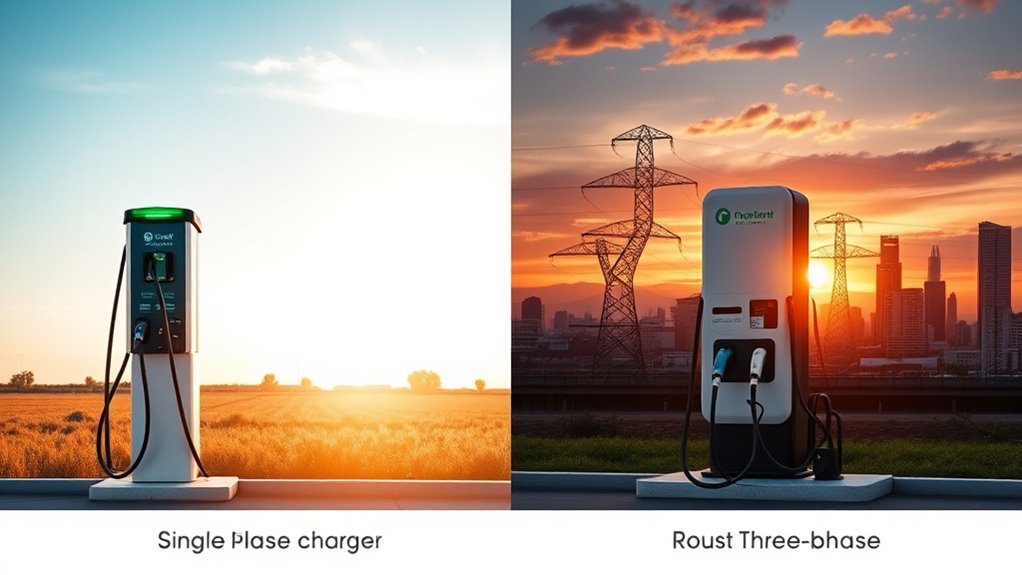
Regional variations in power systems greatly influence the efficiency and speed of EV charging, affecting how quickly you can recharge your vehicle.
The type of regional power available determines charging accessibility and overall performance. Here’s how different regions differ:
- North America: Mainly single-phase power limits charging to 7.4 kW in residential homes.
- Europe: Largely three-phase systems enable faster charging rates, often exceeding 22 kW.
- Japan: A mix of single and three-phase systems impacts home charging speeds, favoring single-phase in residential settings.
- China: An extensive three-phase network supports rapid charging capabilities across the country.
These regional power differences greatly impact the infrastructure and technology surrounding EV charging, ultimately shaping your experience as an EV owner.
Understanding these variations empowers you to make informed decisions about your charging options and future-proof your electric mobility.
Compatibility: Which Electric Vehicles Work With Each Charger Type?
Understanding regional variations in power systems sets the stage for exploring compatibility between electric vehicles (EVs) and charging infrastructure. Most EVs can utilize both single-phase and three-phase chargers, offering you flexibility.
Single-phase chargers typically provide a maximum output of 7.4 kW, catering to the basic charging needs of many residential vehicles. Conversely, three-phase chargers can deliver up to 22 kW or more, making them ideal for larger battery packs requiring faster charging.
Single-phase chargers offer up to 7.4 kW, while three-phase chargers can exceed 22 kW, perfect for faster battery charging.
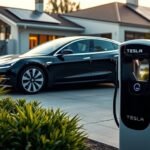
However, always check your vehicle specifications. For instance, Tesla vehicles exclusively charge through Tesla’s three-phase stations, highlighting the significance of charger compatibility.
Additionally, if your EV has a single-phase onboard charger, it will only charge at single-phase speeds, even when plugged into a more powerful three-phase charger. Understanding these nuances is essential for optimizing your charging experience and ensuring you’re using the right infrastructure for your EV.
Real-World Charging Times: Comparing Single-Phase and Three-Phase
When you compare charging times between single-phase and three-phase systems, you’ll notice significant differences that impact daily use.
A single-phase charger can take up to eight hours for a full charge, while a three-phase charger can complete the same task in just two hours.
Understanding these variations is essential for adapting to your future charging needs, especially if you rely on larger battery EVs.
Charging Time Differences
Charging time differences between single-phase and three-phase EV chargers reveal significant implications for users.
Understanding these variations can enhance your charging strategy and efficiency factors:
- Single-phase chargers typically deliver a maximum of 7.4 kW, requiring about eight hours to charge a 24 kWh battery.
- Three-phase chargers provide up to 22 kW, reducing the charging time for the same battery to around two hours.
- Commercial three-phase stations can cut this down to approximately 30 minutes for a full charge.
- The choice between single-phase and three-phase systems greatly impacts your overall charging time and convenience.
Incorporating these insights guarantees you maximize your charging efficiency, aligning with your needs and lifestyle, while potentially liberating you from long wait times.
Impact on Daily Use
While single-phase chargers might suit overnight home charging needs, their longer wait times can become a considerable drawback in daily use, especially for those with larger battery electric vehicles.
A single-phase unit typically provides up to 7.4 kW, requiring about eight hours to fully charge a 24 kWh battery. In contrast, three-phase chargers deliver up to 22 kW, enabling the same battery to charge in roughly two hours.
This efficiency impacts your daily charging routine, allowing you to spend less time tethered to a charging station. For public charging, three-phase systems dominate, offering faster turnaround times that align better with your needs.
Ultimately, choosing the right system can greatly enhance your daily electric vehicle experience.
Future Charging Needs
How do evolving battery technologies influence your charging needs? As battery sizes increase, your charging solutions must adapt to future trends and innovations.
Single-phase chargers deliver up to 7.4 kW, taking about eight hours for a complete charge. In contrast, three-phase chargers can provide up to 22 kW, enabling a full charge in just two hours at home.
Consider these points:
- Public three-phase stations can charge in approximately 30 minutes.
- Three-phase systems reduce voltage fluctuations for smoother power delivery.
- They’re better equipped for larger batteries and faster charging requirements.
- Innovations in charging technology guarantee compatibility with future EV models.
Embracing three-phase charging not only meets your immediate needs but also future-proofs your EV experience.
How to Choose the Right Charging System for You?
Choosing the right EV charging system hinges on several critical factors tailored to your specific needs. Start by evaluating your charging preferences and user habits. If you primarily charge overnight and don’t require rapid recharging, a single-phase charger, offering up to 7.4 kW, may suffice.
However, if you often need quick top-ups, a three-phase charger, capable of delivering up to 22 kW, will greatly enhance your charging speed.
For those requiring fast charging, a three-phase charger offers up to 22 kW, significantly improving your recharging efficiency.
Next, consider your home’s electrical infrastructure. Single-phase chargers are generally simpler and less expensive to install, while three-phase installations can be costlier and may require specialized work.
Additionally, think about future-proofing; three-phase chargers are more adept at handling larger battery EVs and evolving power demands.
Finally, verify compatibility with your EV, as most models support both systems, but some may have limitations based on their onboard chargers.
Frequently Asked Questions
What Is the Difference Between 1-Phase and 3-Phase EV Charging?
1-phase EV charging provides lower power distribution, limiting charging efficiency to 7.4 kW. In contrast, 3-phase charging enhances efficiency and supports up to 22 kW, facilitating faster charging for larger battery electric vehicles.
Which Charges Faster, 1.0 a or 2.4 A?
In your quest for efficiency, the 2.4 A charge outpaces the 1.0 A, leveraging higher current capacity for faster charging. Embrace the power of amperage to optimize your electric vehicle’s charging experience.
How Fast Is a 3-Phase EV Charger?
A 3-phase EV charger typically delivers up to 22 kW, charging your vehicle considerably faster than single-phase options. This efficient power distribution enhances charging infrastructure, allowing rapid top-ups and supporting growing electric vehicle adoption effectively.
What Determines EV Charging Speed?
Charging speed’s determined by your charger’s power output, the vehicle’s onboard capacity, and energy transfer efficiency. Higher power levels and smoother energy transfer drastically enhance your charging experience, liberating you from long waits at stations.
Conclusion
To summarize, while it might seem that single-phase charging suffices for basic needs, the advantages of three-phase systems are undeniable. With faster charging speeds and greater efficiency, three-phase chargers are often the better investment for those looking to optimize their EV experience. If you’re considering an upgrade, remember that the initial cost may be outweighed by the long-term benefits, especially in areas where three-phase power is readily available. It’s clear: three-phase charging is the future of EV infrastructure.






Leave a Reply