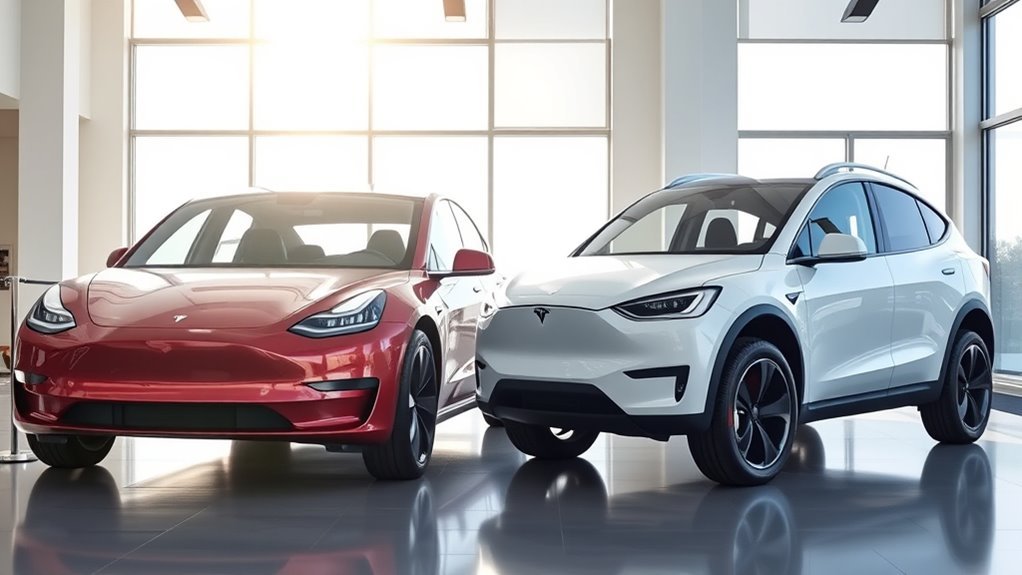
When choosing between the 2026 Tesla Model 3 and Model Y, it boils down to your priorities. If you crave sporty performance and efficiency, the Model 3 is your best bet. In contrast, the Model Y shines with superior space and family-friendly features. Its larger cargo capacity and optional third row cater to those needing versatility. Consider your lifestyle needs carefully, and you’ll find the ideal model for you. Discover more about what each offers!
Key Takeaways
- Model 3 is sportier, offering agile handling and faster acceleration, making it ideal for driving enthusiasts seeking performance.
- Model Y provides more space, accommodating up to seven passengers with a maximum cargo capacity of 68 cubic feet, perfect for families.
- Model 3 has a longer range, achieving up to 346 miles, compared to Model Y’s 357 miles in Long Range AWD, but with higher efficiency overall.
- Both models feature advanced technology, including updated Autopilot systems and safety features, ensuring a modern driving experience.
- Choose based on lifestyle: Model 3 suits those prioritizing performance, while Model Y is better for utility and family needs.
Key Differences Between the 2026 Tesla Model 3 and Model Y
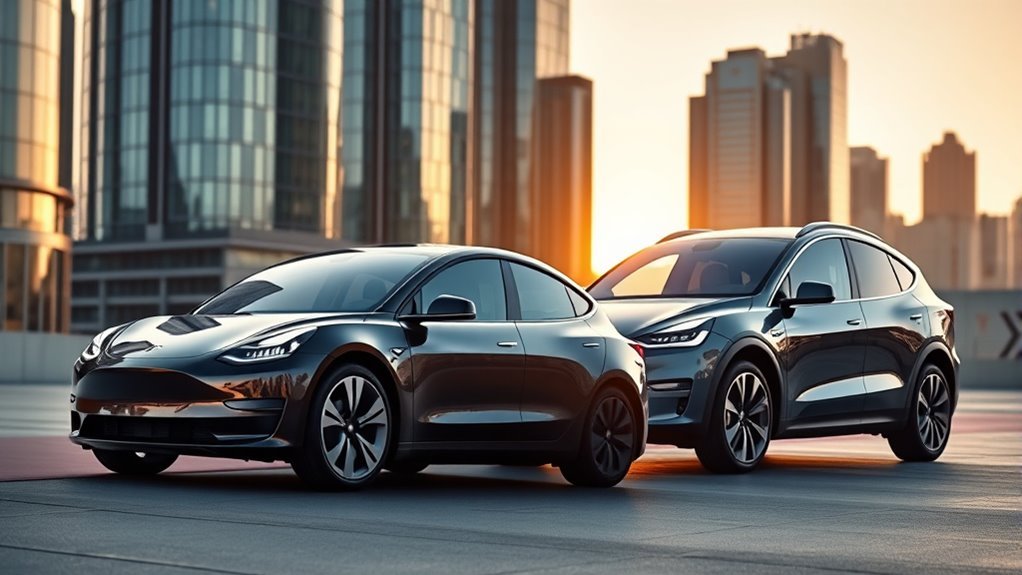
When comparing the 2026 Tesla Model 3 and Model Y, you’ll quickly notice that each vehicle caters to different preferences and needs.
The Model 3 shines with its sleek design aesthetics, embodying sportiness and efficiency that appeals to those craving a dynamic driving experience. In contrast, the Model Y, as a compact SUV, offers a taller seating position and enhanced cargo versatility, prioritizing practicality without sacrificing style.
Driving dynamics also differ greatly. The Model 3’s lower center of gravity delivers a more agile handling, while the Model Y’s height lends itself to a commanding road view, making it ideal for families or adventurers.
You’ll appreciate the Model Y’s towing capacity of 3,500 pounds, enhancing its utility. Ultimately, your choice will hinge on whether you value sporty performance or versatile functionality, as both models promise a unique electric driving experience.
Performance Specs: Comparing Power and Acceleration
When you compare the performance specs of the Tesla Model 3 and Model Y, the differences in horsepower and acceleration become evident.
The Model 3, especially the Performance variant, offers exhilarating speed with up to 510 horsepower, while the Model Y prioritizes utility with powerful, yet slightly less aggressive, performance figures.
Understanding these metrics will help you decide which model aligns better with your driving preferences and lifestyle needs.
Horsepower Comparison
In the domain of electric vehicles, the horsepower and acceleration of the Tesla Model 3 and Model Y reveal significant differences that cater to distinct driving preferences.
The Model Y Long Range AWD offers 397 horsepower, but the Model 3 Performance variant leads with an impressive 510 horsepower, showcasing its horsepower advantages.
While the Model Y emphasizes utility, the Model 3’s performance-oriented trims, like the Long Range AWD with 425 horsepower, deliver quicker acceleration times.
You’ll notice performance trade-offs: the Model Y excels in space and comfort, while the Model 3 prioritizes a sportier drive.
For driving enthusiasts craving exhilaration, the Model 3 proves to be the superior choice, marrying power with agility effortlessly.
Acceleration Times
Acceleration times play a pivotal role in showcasing the performance capabilities of the Tesla Model 3 and Model Y.
In an acceleration comparison, the 2026 Model 3 Performance model dominates with a blistering 0-60 mph in just 2.9 seconds. Meanwhile, the Model Y Performance variant impresses as well, achieving the same feat in 3.3 seconds.
If you opt for the Model Y Long Range AWD, you’ll enjoy 397 horsepower, but the Model 3 Long Range AWD offers a slight edge with 425 horsepower.
Even the standard Model 3 RWD, at 5.8 seconds, holds its own against the base variants of the Model Y.
Range and Efficiency: Which Model Offers Greater Mileage?
When it comes to range and efficiency, the Tesla Model 3 generally outperforms the Model Y across various trims.
While the Model Y offers more utility, its mileage often takes a hit compared to the sportier Model 3.
Let’s break down the specifics to see which model truly delivers the best mileage for your driving needs.
Model Y Range Comparison
How does the Tesla Model Y stack up against the Model 3 in terms of range and efficiency? The 2026 Model Y offers impressive mileage but trades some of it for greater cargo space and utility. The Long Range AWD Model Y boasts a range of 357 miles, while the Performance variant reaches 306 miles. In contrast, the Model 3 Long Range AWD maxes out at 346 miles, with the Standard RWD at 321 miles. If you prioritize range, the Model 3 edges ahead.
| Model | Estimated Range |
|---|---|
| Model Y Long Range AWD | 357 miles |
| Model Y Performance | 306 miles |
| Model 3 Standard RWD | 321 miles |
| Model 3 Long Range AWD | 346 miles |
| Model 3 Performance | 315 miles |
Model 3 Efficiency Analysis
While the Model Y impresses with its spaciousness and versatility, the Model 3 stands out for its efficiency, making it a compelling option for those who prioritize mileage.
With the 2026 Model 3 Standard RWD offering an EPA-estimated range of 321 miles, you can confidently tackle long distances without succumbing to range anxiety. The Long Range AWD variant even extends that to 346 miles, surpassing the Model Y Performance’s 306 miles.
This efficiency is complemented by a lower starting price of $36,990, making it a cost-effective choice. Plus, with robust charging infrastructure, you’ll find it easier to recharge on the go, empowering your journey and liberating you from the fears of inadequate mileage.
Pricing: Which Is More Affordable-Model 3 or Model Y?
Which Tesla model offers better value for your money, the Model 3 or the Model Y? In this affordability analysis, the clear winner emerges: the Model 3.
Starting at $36,990, it’s $3,000 less than the entry-level Model Y, which begins at $39,990. If you’re considering premium trims, the Model 3 ranges from $44,990 to $54,990, while the Model Y peaks at $57,490.
This pricing comparison reveals that the Model 3 not only offers a more budget-friendly option but also maintains impressive performance without significant trade-offs.
For those seeking a balance between cost and capability, the Model 3 stands out as the economical choice. If liberation from high expenses is your goal, the Model 3’s lower starting price and affordable trims make it a compelling option in today’s electric vehicle market.
Interior Space in Model 3 Vs. Model Y: Which Offers More Comfort?
When considering comfort, the interior space of the Tesla Model 3 and Model Y plays an essential role.
You’ll find the Model Y offers more passenger room and cargo capacity, making it a better choice for families or those needing extra space.
In contrast, the Model 3’s sleek design may appeal to solo drivers or couples who prioritize a sporty feel over spaciousness.
Passenger Space Comparison
In the domain of passenger space, the Tesla Model Y clearly outshines the Model 3, especially for those seeking comfort during longer drives.
If you value spaciousness and versatility, consider these features:
- Passenger Dimensions: The Model Y offers greater headroom and legroom, making it more suitable for taller individuals.
- Seating Arrangements: With a capacity for up to five adults, the Model Y comfortably accommodates families, while the Model 3 is ideal for solo drivers or couples.
- Interior Comfort: The Model Y’s design enhances overall comfort, especially on extended journeys, compared to the sportier, more compact Model 3.
When choosing, think about how these factors align with your lifestyle and passenger needs.
Cargo Capacity Analysis
Cargo space plays an essential role in determining the practicality of a vehicle, and the Tesla Model Y clearly takes the lead over the Model 3 in this area.
With a maximum cargo capacity of 68 cubic feet, the Model Y offers remarkable cargo versatility, making it ideal for families or those who often transport larger items. Its hatchback design allows for easier loading and unloading, while the taller seating position provides greater headroom for comfort.
In contrast, the Model 3, with only 15 cubic feet of cargo space, sacrifices capacity for a sportier silhouette.
While both models boast refined interiors, the Model Y’s additional space makes it the better choice for everyday use and family suitability, offering you the freedom to carry what you need.
Seating Comfort Factors
While the cargo capacity of the Tesla Model Y makes it a standout for practicality, seating comfort is another significant factor that can influence your driving experience.
If you’re prioritizing comfort, consider these aspects:
- Tall Passenger Comfort: The Model Y features a taller seating position and additional headroom, making it ideal for taller passengers or those who appreciate an SUV’s spaciousness.
- Seating Capacity: Unlike the Model 3, which seats up to five, the Model Y can accommodate up to seven with an optional third row, perfect for larger families.
- Interior Space: The Model Y’s larger cabin offers a more relaxed atmosphere, while the Model 3 leans towards a sportier, compact design.
In essence, the Model Y excels in SUV seating advantages, enhancing your overall comfort.
2026 Technology Enhancements in Tesla Model 3 and Model Y
As you explore the evolving landscape of electric vehicles, you’ll find that the 2026 Tesla Model 3 and Model Y showcase impressive technology enhancements that elevate the driving experience. Both models feature updated software with enhanced user interfaces, making navigation and entertainment easier than ever. Here are six standout technology enhancements:
| Feature | Model 3 Performance | Model Y Performance |
|---|---|---|
| Horsepower | 510 HP | Adaptive Dampers |
| Over-the-Air Updates | Yes | Yes |
| Autopilot System | Latest Version | Latest Version |
| Standard Trim Availability | Yes | Yes |
With seamless software updates, you can enjoy improvements without a service visit. Plus, both models’ budget-friendly trims deliver essential tech features, allowing you to embrace innovation without breaking the bank. The future of driving is here, and it’s liberating.
Safety Ratings and Features: Which Model Keeps You Safer?
When it comes to safety, which Tesla model truly stands out: the Model 3 or the Model Y? Both models offer impressive safety ratings, but their features cater to different needs. Here’s a breakdown for your safety comparisons:
- Advanced Safety Features: Both models include automatic emergency braking and lane departure warnings, ensuring you’re protected on the road.
- Driving Position and Visibility: The Model Y, as an SUV, provides a higher driving position and ample passenger space, enhancing visibility and comfort, particularly for families.
- Emergency Accessibility: The Model Y’s rear hatch design allows for easier cargo loading, which can be essential during emergency situations.
Ultimately, while both models excel in safety, the Model Y might edge out slightly due to its design and family-friendly features.
With Tesla’s Autopilot and Full Self-Driving capabilities, your safety’s in good hands, no matter which choice you make.
Driving Experience: Performance Insights for Tesla Model 3 and Model Y
The driving experience in the Tesla Model 3 and Model Y reveals distinct characteristics that cater to different preferences and needs.
If you’re after exhilarating performance, the Model 3 Performance variant, with 510 horsepower, accelerates from 0-60 mph in just 2.9 seconds, offering sharp driving dynamics and exceptional handling characteristics. It’s built for those who crave a sportier ride.
On the other hand, the Model Y Long Range AWD, generating 397 horsepower, delivers a respectable 0-60 mph in 3.8 seconds. While it’s not as quick as the Model 3, it strikes a balance between performance and utility, making it ideal for drivers who prioritize versatility.
The Model Y Performance variant enhances the thrill further, achieving 0-60 mph in 3.3 seconds.
Ultimately, your choice hinges on whether you value outright speed or a combination of performance and practicality in your driving experience.
Practicality: Which Model Suits Your Lifestyle Better?
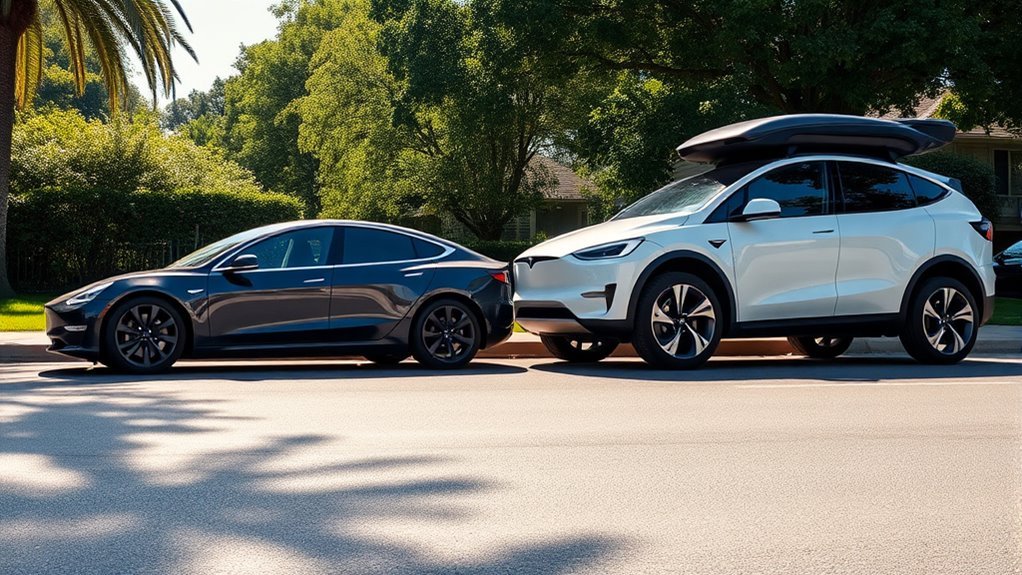
Choosing between the Tesla Model 3 and Model Y goes beyond performance; it’s about how well each model fits your lifestyle.
If you’re weighing family needs against your lifestyle choices, consider these factors:
- Space and Versatility: The Model Y offers a hatch-style rear and more cargo room, perfect for families with kids or pets needing extra flexibility.
- Driving Experience: The Model 3 caters to solo drivers or couples seeking a sporty edge, delivering a dynamic ride without the bulk.
- Budget Considerations: With the Model 3 starting at $36,990, it’s a wallet-friendly option for those prioritizing efficiency over space.
Ultimately, your decision hinges on whether you value utility and space for family needs or prefer a compact, performance-oriented vehicle for lifestyle choices.
Assess what matters most to you before making this significant investment.
Key Factors in Choosing Between the 2026 Tesla Model 3 and Model Y?
Which factors matter most to you in a vehicle: performance, space, or budget? When considering the 2026 Tesla Model 3 and Model Y, these elements are essential.
If you crave thrilling drives, the Model 3’s 510 horsepower and 0-60 mph in just 2.9 seconds might ignite your passion. On the other hand, the Model Y, while slightly less powerful at 460 horsepower, offers a versatile design with more cargo space—perfect for families or adventures.
Budget-conscious buyers should also note that the Model 3 starts at $36,990, making it the more affordable option. Feature comparisons reveal that both models now include lower-cost trims, allowing you to balance price and amenities.
With sleek design aesthetics, both vehicles appeal to the eye, but your choice ultimately hinges on whether you prioritize performance or utility. Decide what matters most, and let that guide your liberation in choosing the right Tesla for you.
Frequently Asked Questions
What Is the Difference Between Model 3 2026 and Model Y 2026?
The 2026 Model Y offers more interior space and versatility, while the Model 3 excels in performance with higher horsepower. For a practical choice, consider the Y; for speed, the 3’s your best bet.
Should I Buy Model Y or Model 3?
Choosing between the Model Y’s versatility and the Model 3’s performance can be thrilling. If you crave excitement, the Model 3 shines. But if space is what you need, the Model Y’s got you covered.
Are the New Models Y 2025 or 2026?
The new models are 2026 versions. They showcase exciting new features and subtle design updates, enhancing performance and utility while retaining the essence of previous iterations, ultimately offering you refined choices for your driving experience.
Why Is Model Y More Popular Than 3?
The Model Y’s popularity stems from shifting electric vehicle trends and consumer preferences for spaciousness, practicality, and performance. It meets family needs better, offering comfort and versatility, making it a top choice among buyers.
Conclusion
In the end, choosing between the 2026 Tesla Model 3 and Model Y is like picking between two brilliant stars—each shines brightly in its own right. If you crave agility and a sleek profile, the Model 3 may be your guiding light. However, if spaciousness and versatility call to you, the Model Y could be your celestial companion. Ultimately, it boils down to your lifestyle; embrace the one that aligns with your journey, and let it drive you toward the future.






Leave a Reply