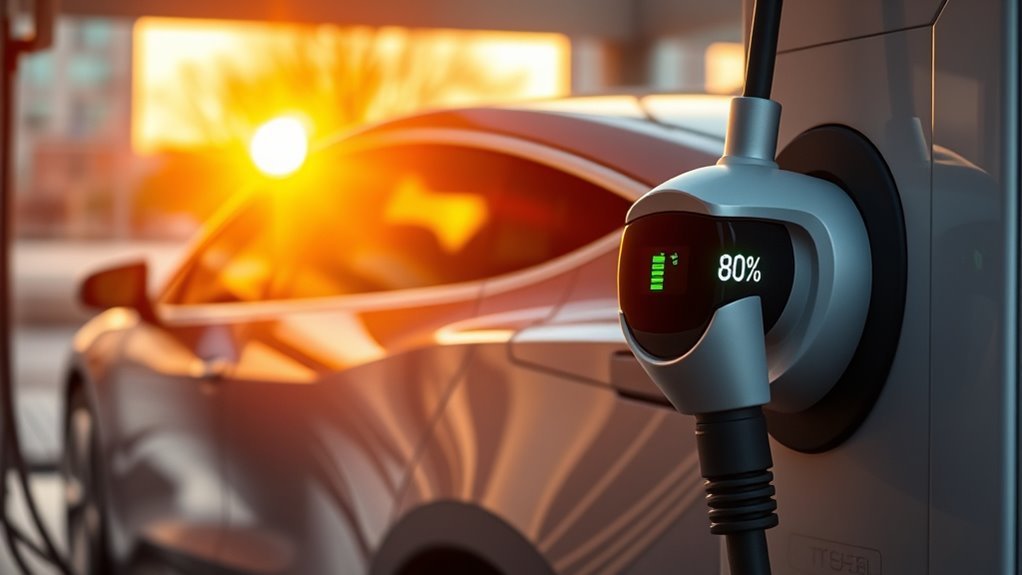
Most EVs stop charging at 80% to protect battery health. Charging beyond this level generates excess heat, which can lead to faster degradation. Stopping at 80% optimizes both charging speed and battery longevity, ensuring you get more life out of your battery. It also supports daily driving needs and keeps energy consumption efficient. If you’re curious about managing your charging limits or when to charge fully, there’s more to explore.
Why Most EVs Charge to 80%: Understanding the Basics
When it comes to charging your electric vehicle (EV), you might wonder why most manufacturers recommend stopping at 80%.
This guideline stems from essential charging protocols designed to optimize battery management. Charging beyond 80% generates excess heat, which can accelerate battery degradation.
The charging curve shows that your EV charges quickly up to this point, but after that, the rate slows considerably, making it inefficient to reach full capacity.
Benefits of 80% EV Charging for Battery Health
Charging your EV to 80% offers noteworthy benefits for battery health, making it a smart practice for every electric vehicle owner. By keeping your battery within this range, you reduce stress and considerably enhance battery longevity. High charge levels can cause degradation, but maintaining a charge between 20% and 80% guarantees ideal performance and efficiency. Your battery operates best without excessive heating or strain.
Additionally, charging to 80% means faster charging times, as the rate slows greatly beyond this point. This can save you valuable time during daily use.
Plus, when your battery isn’t fully charged, regenerative braking becomes more effective, allowing for better energy recovery during deceleration. Adhering to the 80% charging guideline also helps prevent unnecessary wear, preserving your battery’s capacity and range over time.
Embracing this practice not only supports your vehicle’s health but also liberates you from frequent charging hassles.
Unlock Daily Efficiency by Charging to 80
Charging your EV to 80% not only meets most of your daily driving needs but also maximizes efficiency.
You’ll notice that stopping at this level allows for quicker charging times, letting you get back on the road faster.
Plus, this practice helps maintain your battery health, ensuring you enjoy the full benefits of regenerative braking and longevity.
Maximize Daily Driving Range
By keeping your electric vehicle’s charge to around 80%, you can considerably enhance your daily driving efficiency. This practice aligns perfectly with your daily driving habits and minimizes energy consumption.
Here’s how charging to 80% can maximize your range:
- Covers daily needs: Charging to 80% typically accommodates most of your daily distances, avoiding unnecessary battery cycling.
- Improves performance: Maintaining a charge below 100% enhances regenerative braking efficiency, allowing your vehicle to perform better.
- Extends battery life: Keeping the battery in the 20-80% range reduces degradation, ensuring peak performance over time.
Fast Charging Convenience Benefits
Maintaining your electric vehicle at an 80% charge not only enhances your daily driving range but also reveals significant convenience when it comes to fast charging. By stopping at 80%, you’ll experience quicker charging sessions, as the initial portion fills up rapidly thanks to advanced fast charging technology.
This approach minimizes your wait times at charging stations, making your daily routines more efficient. Plus, an 80% charge improves regenerative braking performance, further extending your driving range. Most of your daily driving needs can be met comfortably without frequent full charges, preserving battery health.
Ultimately, charging to 80% boosts turnover at public stations, enhancing overall charging station accessibility and fostering a more efficient network for all users.
Effects of Charging Beyond 80% on Battery Life
Charging your EV beyond 80% can lead to increased heat generation, which stresses the battery and accelerates degradation.
This process not only reduces your battery’s lifespan but also makes charging less efficient, as the last 20% takes considerably longer.
Increased Heat Generation
While it might seem convenient to top off your electric vehicle’s battery to 100%, doing so can lead to increased heat generation that ultimately harms battery life.
The final 20% of charging is slower, causing your battery management system (BMS) to work harder on thermal regulation, which generates more heat.
This excess heat can stress the battery, leading to:
- Accelerated degradation and reduced capacity over time
- Increased risk of overheating, impacting performance
- Diminished battery health and longevity
Accelerated Degradation Rates
Exceeding the 80% charge threshold can greatly impact your electric vehicle’s battery life due to accelerated degradation rates.
When you consistently push your battery past this limit, you invite heat generation, which exacerbates degradation mechanisms inherent in lithium-ion battery chemistry. The last 20% of charging is particularly slower and puts additional stress on your battery, leading to faster capacity loss over time.
Frequent full charges strain battery components, accelerating wear and reducing lifespan. To maximize your battery’s health, it’s wise to maintain a charge between 20% and 80%.
This practice minimizes chemical strain and helps preserve your vehicle’s range, ensuring that you enjoy a robust battery life without unnecessary risks. Embracing this knowledge liberates you to make informed charging decisions.
Reduced Charging Efficiency
When you push your electric vehicle’s battery beyond the 80% mark, you encounter a significant drop in charging efficiency.
The battery management system (BMS) slows down the charging speed to prevent overheating, which ultimately impacts your battery’s health.
Here’s what you need to know:
- Charging to 100% generates excess heat, accelerating battery degradation.
- The last 20% of charging takes considerably longer, slowing your overall process.
- Maintaining a charge between 20% and 80% maximizes efficiency and extends battery life.
How to Change Your Charging Limits for Convenience
Many electric vehicle (EV) owners appreciate the flexibility of setting charging limits to enhance convenience and battery longevity.
To adjust your charging preferences, immerse yourself in your vehicle’s user interface via the infotainment system or mobile app. Here, you’ll typically find options to set your charging levels, ranging from 60% to 100%, depending on your model.
Setting your limit to around 80% can help maintain battery health, reducing stress and heat build-up.
For added convenience, explore features that allow scheduled charging. This way, you can automate charging times and levels based on your daily driving needs.
Always refer to your user manual for specific instructions, as the process may vary by manufacturer.
When to Charge to 100%: Long Trips and Special Cases?
Charging to 100% can be a game changer for those planning long road trips, as it maximizes your vehicle’s range and guarantees you won’t run out of power on the open road.
Maximizing your vehicle’s range by charging to 100% is essential for long road trips, ensuring you stay powered on the journey.
For effective trip preparation, consider these charging strategies:
- Use manual charge limits: Adjust your settings to allow a full charge for specific journeys.
- Plan charging stops: Identify charging stations along your route to avoid surprises.
- Balance convenience and battery health: Full charges are beneficial for long trips, but stick to 80% for daily driving.
Effective Strategies to Prolong Your EV Battery Life
To maximize the lifespan of your EV battery, it’s crucial to adopt effective charging habits that minimize stress and degradation. By charging your EV to 80% instead of 100%, you greatly reduce battery stress, helping to prolong its overall lifespan. Aim to keep your battery charge between 20% and 80%, known as the “green zone,” to enhance performance.
| Charging Strategy | Benefits | Tips |
|---|---|---|
| Charge to 80% | Reduces heat and degradation | Set charge limit |
| Utilize Regenerative Braking | Enhances performance | Use when not fully charged |
| Regular Efficient Charging | Quicker sessions, less stress | Schedule regular charges |
With these battery maintenance tips, you can streamline daily usage and improve accessibility to chargers. Embrace these strategies for a longer-lasting, high-performing EV life!
Frequently Asked Questions
Why Do EVS Stop Charging at 80%?
EVs stop charging at 80% to enhance battery health and improve charging efficiency. This practice reduces stress and heat, ensuring your battery lasts longer while providing enough power for your daily driving needs.
Why Does My Charger Stop Working at 80%?
Your charger stops at 80% due to its smart battery management system’s limitations, protecting your battery. Ironically, this restriction guarantees longevity and performance, giving you freedom without sacrificing safety. Embrace the balance for your EV’s health!
Why Won’t My Car Charge Past 80%?
Your car won’t charge past 80% to maintain battery health and optimize charging efficiency. This limit prevents stress and heat, ensuring a longer lifespan. You can adjust settings for full charges when needed.
Why Does My Charging Stop at 80%?
Your charging stops at 80% to enhance charging efficiency and promote battery longevity. This limit reduces heat buildup and stress on the battery, ensuring a longer lifespan while still providing ample range for your needs.
Conclusion
As you glide into the future with your electric vehicle, remember that charging to 80% isn’t just a number—it’s a gateway to longevity and efficiency. Picture your battery thriving, like a well-tended garden, flourishing with each careful charge. While the allure of a full tank may beckon, embracing the 80% rule nurtures your battery’s health. So, next time you plug in, think of it as investing in a longer, more vibrant journey ahead. Your EV will thank you!






Leave a Reply