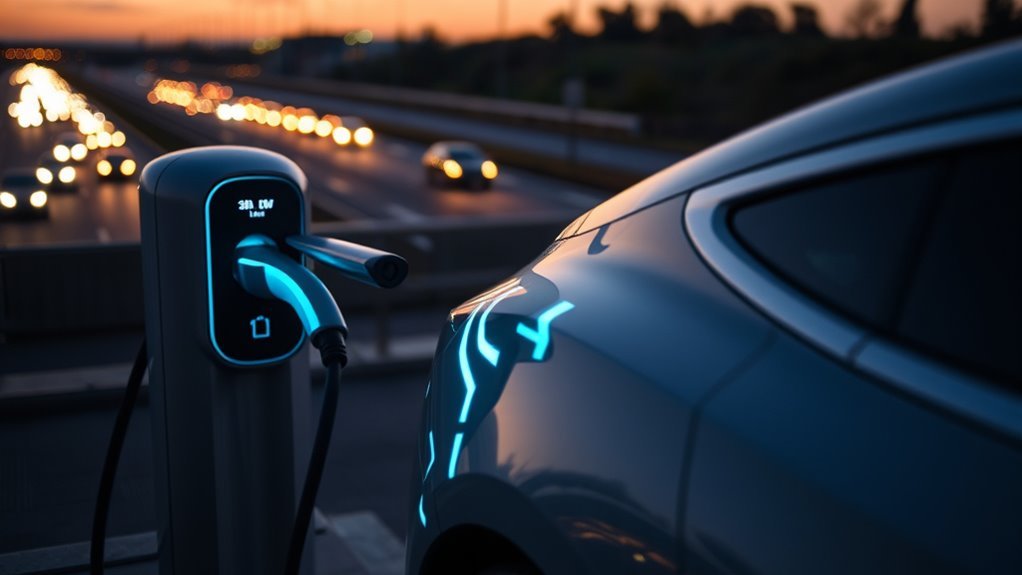
EV charging can take longer than expected due to several key factors. The type of charger you use plays a significant role, with Level 1 chargers being the slowest, while DC fast chargers are the quickest. Additionally, your battery’s state of charge, temperature, and age affect charging speeds. If you’re charging multiple EVs at the same station, it can slow things down even further. Stick around to uncover more insights on optimizing your charging experience.
Common Misconceptions About EV Charging Times
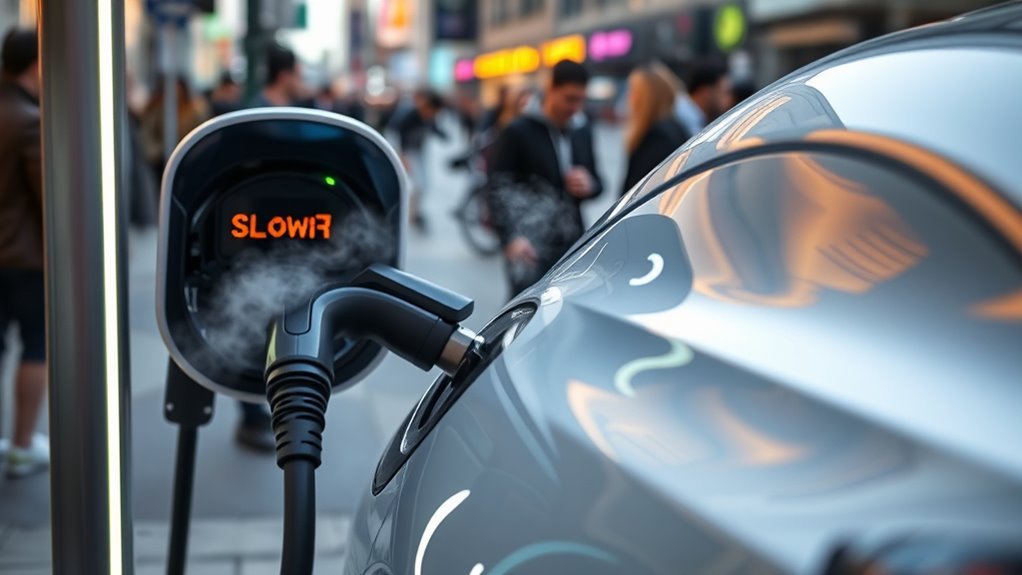
Why does charging an electric vehicle (EV) often take longer than you might expect? Many charging myths lead to unrealistic refueling comparisons with gas vehicles.
For instance, not all chargers are created equal; while Level 1 chargers may only add 2 to 5 miles per hour, Level 2 chargers can deliver 10 to 60 miles in the same timeframe.
You might also think that charging from 80% to 100% is quick, but that final 20% can stretch out, as the battery management system throttles the speed to prevent overheating.
Additionally, charging speeds aren’t constant; they vary based on factors like battery state of charge and temperature.
Lastly, remember that battery age and health play a significant role in charging efficiency, as older batteries accept charges less effectively.
Understanding these common misconceptions will empower you to make better choices regarding EV charging.
Top Factors That Slow Down EV Charging Speeds
While you might expect a quick charge when plugging in your electric vehicle, several factors can markedly slow down the process.
First, your battery’s State of Charge (SoC) plays an essential role; charging is fastest when the battery is nearly empty and slows notably as it approaches 80% capacity.
The State of Charge (SoC) significantly affects charging speed, with optimal rates occurring when the battery is close to empty.
The type of charger you use also matters—Level 1 chargers are the slowest, while DC fast chargers can deliver much quicker results.
Additionally, battery temperature impacts charging efficiency. Extreme heat may trigger safety systems that reduce charging speed, while cold temperatures can limit the battery’s ability to accept charge.
If you’re charging multiple EVs at the same station, shared power output can halve your charging speed.
Finally, confirm charger compatibility and the condition of the charging infrastructure. Older or poorly maintained chargers may not deliver peak power consistently, affecting your overall charging experience.
How Charging Infrastructure Affects Your Charging Experience
As you navigate the world of electric vehicle (EV) charging, the efficiency of the charging infrastructure can greatly shape your experience. The type of charging station you choose and its availability can considerably impact your wait time and charging speed.
| Charging Station Type | Power Output | Typical Charging Time |
|---|---|---|
| Level 1 | 1.4 kW | 8-12 hours |
| Level 2 | 3.7-22 kW | 4-8 hours |
| DC Fast Charging | 50-350 kW | 30 minutes – 1 hour |
Limited infrastructure availability can lead to longer wait times, especially if you’re sharing a fast charger with multiple vehicles. Additionally, if the charger’s output doesn’t match your EV’s capacity, you might find yourself waiting longer than expected. Always check for station reliability to guarantee a smoother charging experience.
The Impact of Battery State of Charge on Charging Duration
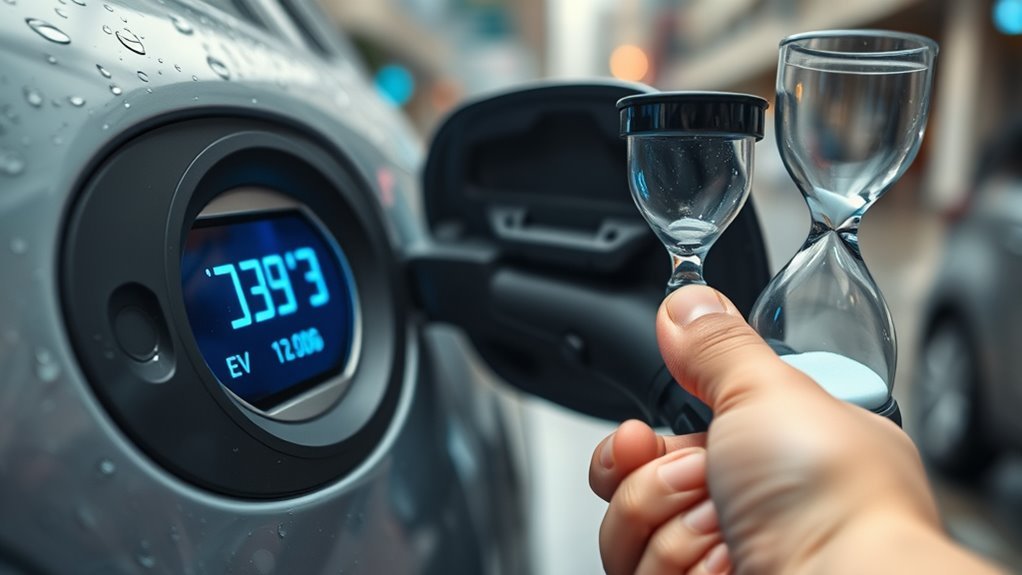
Understanding how the battery’s State of Charge (SoC) affects your EV’s charging duration is crucial for maximizing your experience.
Charging is fastest when your battery’s SoC is low, typically from 0% to 80%. Beyond 80%, charging efficiency declines considerably due to the battery chemistry limits designed to prevent overheating. Most manufacturers recommend capping your charge at 80% to improve battery health, as the last 20% can take as long as the first 80%.
Lithium-ion batteries thrive in mid-range SoC levels, so it’s wise to avoid deep discharges and frequent full charges.
Regularly monitoring your battery’s state and charging patterns will help maintain ideal charging speeds and prolong battery lifespan.
How to Charge Your EV Faster: Tips and Tricks
To charge your EV faster, you’ll want to implement a few key strategies that make a noticeable difference. Start by utilizing Level 2 chargers at home, which can provide 10 to 60 miles of range per hour, compared to the meager 2 to 5 miles from Level 1 chargers. On the road, seek out DC fast chargers, adding up to 100 miles of range in just 20 minutes.
| Strategy | Benefit |
|---|---|
| Use Level 2 Chargers | 10-60 miles of range per hour |
| Opt for DC Fast Chargers | 100 miles in about 20 minutes |
| Manage Energy Usage | Turn off A/C and lights to boost speed |
Maintaining your EV battery around 20°C enhances efficiency, while good charging habits—like checking software settings—can optimize energy management. Implement these tips to liberate your EV charging experience!
Frequently Asked Questions
Why Is My EV Taking so Long to Charge?
Your EV’s charging speed might slow due to battery health, temperature extremes, or using a less efficient charger. Check your equipment and location, as busy stations can also affect how quickly your vehicle charges.
Why Does the Last 20% of EV Charge Take so Long?
The last 20% of your EV charge takes longer due to battery chemistry. As charging speed slows, it prevents overheating and guarantees safety, making that final stretch more time-consuming than the initial 80% you experienced.
Does Driving a Car Charge the Battery Faster Than Idling?
Absolutely, driving your EV charges the battery faster than idling. Regenerative braking harnesses energy during motion, while battery management systems optimize recovery. So, accelerate wisely, and feel the liberation in your ride!
Why Does Charging From 80 to 100 Take Longer?
Charging from 80 to 100% takes longer because the battery management system slows the charging speed to protect battery health. This guarantees safety while maximizing performance, making that final stretch less efficient for quick top-ups.
Conclusion
In conclusion, understanding EV charging can clear confusion and combat common misconceptions. By recognizing the factors that slow down your charging experience, you can make smarter choices. With the right infrastructure and awareness of your battery’s state, you can maximize your charging speed. So, whether you’re at home or on the go, employing effective strategies can transform your time at the charging station from a frustrating wait into a fast, efficient experience.






Leave a Reply