Yes, Elon Musk owns about 12% of Tesla, making him the largest individual shareholder. His considerable stake allows him to greatly influence the company’s direction and strategic decisions. Other key shareholders include Kimbal Musk and institutional investors like Vanguard and BlackRock, who collectively hold substantial portions of Tesla’s stock. Understanding the ownership dynamics is vital for investors. To grasp how these elements affect Tesla’s future and your investment strategy, you’ll want to explore further.
Key Takeaways
- Elon Musk is the largest individual shareholder of Tesla, owning approximately 519.7 million shares, which represents 12% of the company.
- Kimbal Musk, Elon’s brother, holds about 1.4 million shares, while CFO Vaibhav Taneja has 133,317 shares.
- Major institutional investors include Vanguard Group with 252.39 million shares and BlackRock with 206.74 million shares, highlighting significant institutional backing.
- Tesla’s concentrated ownership structure, primarily by Musk and institutional investors, influences strategic decisions and governance.
- As of 2026, Musk’s ownership likely remains pivotal in shaping Tesla’s direction towards innovation and market growth.
Breakdown of Tesla Ownership in 2026
As we look ahead to 2026, you’ll notice a notable consolidation of Tesla’s ownership, primarily dominated by Elon Musk, who remains the largest individual shareholder with approximately 519.7 million shares. This substantial stake underscores Musk’s profound influence over Tesla’s strategic direction and innovations.
Other shareholders like Kimbal Musk and CFO Vaibhav Taneja hold minimal shares compared to Musk’s dominance, with Kimbal owning about 1.4 million and Taneja holding 133,317 shares.
Major institutional investors, including Vanguard Group, BlackRock, and State Street, collectively possess hundreds of millions of shares, reflecting strong confidence in Tesla’s future.
The company’s market capitalization of $1.5 trillion emphasizes its growth potential in the electric vehicle market. As Tesla pursues groundbreaking innovations, shareholder influence, particularly from Musk, plays a vital role in shaping the company’s trajectory.
This concentrated ownership structure could markedly impact Tesla’s future developments and strategic decisions.
Key Individual Shareholders of Tesla
Key individual shareholders play a crucial role in Tesla’s ownership landscape, with Elon Musk leading the pack as the largest shareholder. Holding approximately 12% of the company, Musk’s influence is paramount in shaping Tesla’s direction. The Musk family maintains a notable presence, with Kimbal Musk owning 1,448,435 shares, reflecting a concentrated ownership model.
Here’s a breakdown of key individual shareholders:
| Shareholder | Shares Held | Percentage Ownership |
|---|---|---|
| Elon Musk | 519,743,904 | 12% |
| Kimbal Musk | 1,448,435 | 0.05% |
| Vaibhav Taneja | 133,317 | 0.003% |
| Tom Zhu | 47,599 | 0.002% |
This distribution highlights the significant shareholder influence of the Musk family, underscoring their essential role in Tesla’s ongoing evolution.
Major Institutional Investors in Tesla
Major institutional investors considerably impact Tesla’s ownership structure, with Vanguard Group leading the way. As of November 2025, Vanguard holds approximately 252.39 million shares, accounting for over 7.59% of Tesla’s outstanding shares, showcasing significant institutional influence.
BlackRock follows closely, owning around 206.74 million shares, or about 6.22%. State Street also plays an essential role, with 113.76 million shares, representing over 3.5% of the total stock. Other players like Geode Capital and Capital World Investors add to this dynamic, holding 65.33 million and 44.04 million shares, respectively.
These figures reflect broader shareholder trends that highlight the growing power of institutional investors in shaping corporate governance and strategic direction at Tesla.
The increasing influence of institutional investors is pivotal in guiding Tesla’s corporate governance and strategic initiatives.
With inclusion in multiple ETFs, such as Vanguard’s Total Stock Market Index Fund and BlackRock‘s iShares Self-Driving EV and Tech ETF, these institutions not only hold substantial stakes but also influence market perception and investment strategies related to Tesla.
Who Is Elon Musk and What Is His Role at Tesla?
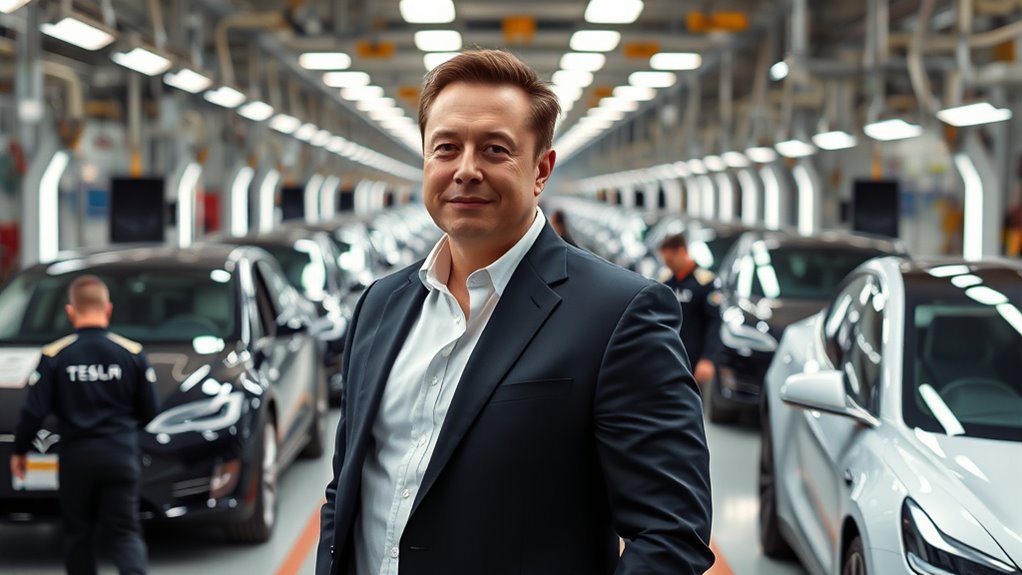
Elon Musk, a key figure in Tesla’s success, has a background that blends early entrepreneurial ventures with a rigorous education in physics and economics.
His career trajectory includes pivotal roles in companies like Zip2, PayPal, and SpaceX, which laid the foundation for his leadership at Tesla since 2008.
Understanding Musk’s early life and major ventures provides insight into how his vision shaped Tesla into a leader in the electric vehicle market.
Early Life And Education
Born on June 28, 1971, in Pretoria, South Africa, Musk’s journey to becoming a tech titan began with a strong educational foundation.
Childhood influences, including his early interest in technology and entrepreneurship, shaped his ambitions. He moved to the U.S. to pursue his educational journey, attending the University of Pennsylvania, where he earned a B.A. in physics and a B.S. in economics by 1997.
This rigorous academic background equipped him with critical thinking skills and a deep understanding of the technological landscape. These formative experiences laid the groundwork for his future ventures, driving him to co-found Zip2 and later X.com, which evolved into PayPal.
Ultimately, these early steps positioned him as a key player in the tech world.
Career And Major Ventures
As Tesla’s CEO and Technoking since 2008, Musk has transformed the company from a niche player in the automotive industry into a global leader in electric vehicles. His influence has been profound, shaping Tesla’s innovations and strategic direction.
Here are key aspects of Musk’s career and ventures at Tesla:
- Early Investor: Joined Tesla in 2004, becoming CEO in 2008.
- Major Models: Led the development of the Model S, Model 3, and Cybertruck.
- Market Leader: Under his leadership, Tesla became the world’s most valuable automaker in July 2020.
- Shareholder: As of November 2025, he owns about 12% of Tesla’s shares, reinforcing his pivotal role in the company’s success.
The Strategic Role of Tesla’s Board of Directors
Tesla’s Board of Directors plays an essential role in shaping the company’s governance and strategic decisions.
With members who bring extensive technology and business expertise, the board influences Tesla’s direction and maintains investor confidence.
Their decisions not only affect operational outcomes but also reflect their expectations for the company’s future performance.
Board Composition Impacts Governance
While steering through the complexities of the electric vehicle market, a well-structured board of directors is vital for effective governance at Tesla.
The board’s composition directly influences how the company navigates governance challenges and enhances shareholder confidence. Here are four key factors to take into account:
- Board Diversity: A mix of backgrounds fosters innovative solutions and perspectives.
- Experience: Members with tech and business expertise guarantee strategic alignment with market demands.
- Transparency: Board members’ stock transactions can reflect company health, guiding investor sentiment.
- Alignment with Shareholders: With Elon Musk as the largest shareholder, decisions are closely tied to shareholder interests.
This diverse and experienced board is essential for Tesla’s ongoing success and adaptability in a fast-evolving landscape.
Strategic Decision-Making Process
Effective governance at Tesla hinges not just on board composition but also on the strategic decision-making process employed by its directors. The board’s strategy is crucial in steering the company through challenges and aligning with shareholder interests. Utilizing a robust decision framework, directors leverage their extensive experience to influence company performance and risk management.
| Strategic Focus | Decisions Impacted | Outcomes |
|---|---|---|
| Technology Innovation | Product Development | Enhanced market position |
| Governance Practices | Transparency Initiatives | Increased investor trust |
| Risk Management | Crisis Response | Resilience in operations |
| Financial Oversight | Investment Strategies | Sustainable growth potential |
This structured approach fosters accountability and builds investor confidence in Tesla’s trajectory.
Analyzing Tesla’s Stock Performance in Context of Ownership Dynamics
As investors evaluate Tesla’s stock performance, understanding the dynamics of ownership becomes essential. The interplay between major stakeholders influences stock volatility and investor confidence in significant ways.
Here’s a snapshot of Tesla’s current ownership landscape:
- Elon Musk: Holds approximately 519.7 million shares, making him the largest individual shareholder.
- Vanguard Group: Owns 252.39 million shares, representing over 7.59% of outstanding shares.
- BlackRock: Holds 206.74 million shares, accounting for about 6.22% of ownership.
- Current Stock Price: At $449.18, the stock shows a slight decline of -0.04%, with a 52-week range of $214.25 to $498.83.
This ownership structure not only shapes investor sentiment but also reflects broader market dynamics, reinforcing the complexity of Tesla’s financial landscape.
Understanding these factors can empower you as an investor seeking liberation through informed decisions.
How Tesla’s Ownership Structure Impacts You as an Investor
Understanding Tesla’s ownership structure is essential for you as an investor, especially since it particularly shapes the company’s strategic direction and market perception.
Elon Musk, owning about 12% of Tesla, wields significant ownership influence, impacting key decisions that may affect your investments. Additionally, institutional investors like Vanguard and BlackRock, with over 13% combined, reflect strong confidence in Tesla’s growth potential, which can bolster stock performance.
Elon Musk’s 12% stake and institutional backing signal confidence in Tesla’s growth, influencing investment performance.
The diverse ownership structure means varying priorities in corporate governance, potentially creating conflicts that could affect your interests. This dynamic can influence investment strategies, as large asset management firms back Tesla’s innovative capacity, signaling market trends that may sway your investment decisions.
A market capitalization of $1.5 trillion further underscores its value, enhancing investor sentiment. By understanding these factors, you can better navigate Tesla’s ownership landscape and align your investment strategies accordingly.
The Future of Tesla Under Elon Musk’s Vision
With a strong ownership structure in place, Tesla’s future is increasingly shaped by Elon Musk’s ambitious vision. As the largest individual shareholder, Musk’s influence drives the company’s trajectory towards groundbreaking advancements.
Here’s what you can expect:
- Autonomous Driving Expansion: Expect a robust shift towards AI-driven solutions, including the rollout of robotaxis.
- Electric Innovation: Tesla’s commitment to pioneering electric vehicle technology continues with models like the Cybertruck.
- Enhanced Supercharger Network: Musk aims to expand charging infrastructure, ensuring accessibility for all Tesla owners.
- AI Integration: The introduction of features like the Grok AI chatbot will create a seamless user experience, revolutionizing how you interact with your vehicle.
In this transformative era, Tesla isn’t just about electric cars; it’s about redefining mobility and energy, paving the way for a liberated, sustainable future.
Frequently Asked Questions
Who Actually Owns Tesla?
Tesla’s ownership is divided among various shareholders. You’ll find Elon Musk as the largest individual shareholder, while institutional investors like Vanguard and BlackRock hold significant Tesla investments, shaping the company’s financial landscape.
What Companies Does Elon Musk Own?
You’ll find Elon Musk owns several companies, including SpaceX Innovations, which revolutionizes space travel, Neuralink Developments, focused on brain-machine interfaces, and The Boring Company, enhancing urban infrastructure with innovative tunneling solutions.
What if I Invested $1000 in Tesla 5 Years Ago?
If you’d invested $1,000 in Tesla five years ago, your investment growth would’ve skyrocketed. With impressive stock performance, your initial amount could be worth nearly $19,739 today, reflecting phenomenal returns on your investment.
Is Tesla Made by Elon Musk?
Tesla isn’t made by Elon Musk alone; it’s a product of collaboration. While Musk’s role is pivotal, the visionary founders, Martin Eberhard and Marc Tarpenning, laid the groundwork that propelled Tesla into the spotlight.
Conclusion
To summarize, Tesla’s ownership landscape in 2026 reveals a complex interplay of individual and institutional investors. Significantly, Elon Musk retains a substantial stake, holding approximately 14% of the company. This ownership not only solidifies his influence but also aligns his vision with shareholder interests. As Tesla continues to innovate, understanding this dynamic can help you gauge potential market movements. With institutional investors owning nearly 60% of shares, their decisions will also greatly impact Tesla’s future trajectory.






Leave a Reply