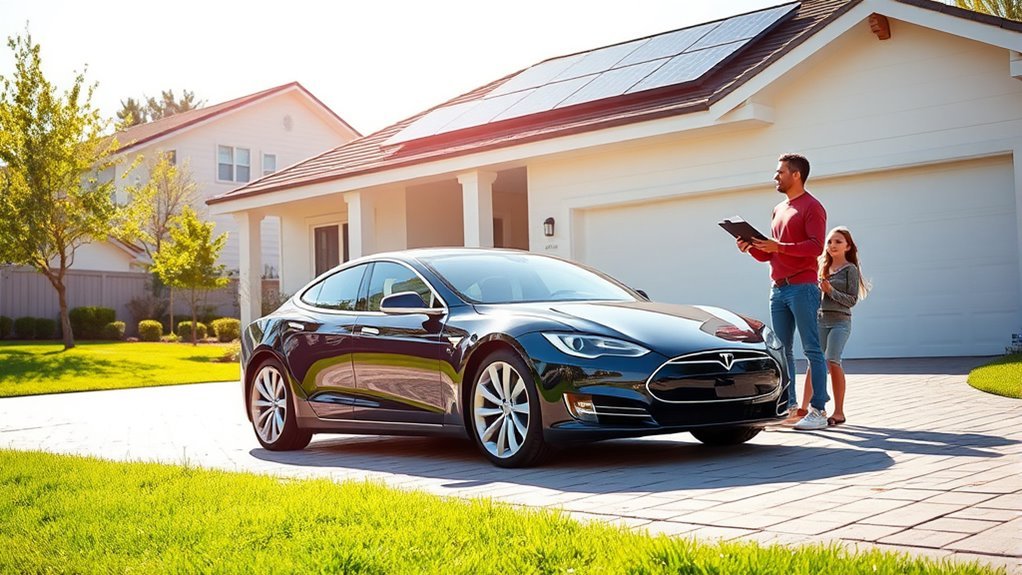
To qualify for the Tesla Tax Credit in 2026, you must meet income limits: $150,000 for single filers, $225,000 for heads of households, and $300,000 for married couples. Your new electric vehicle must comply with specific manufacturing requirements, including final assembly in North America and a minimum battery capacity of 7 kWh. Additionally, the vehicle’s price must not exceed set caps based on its category. Understanding these criteria will help guarantee you qualify for the credit.
Key Takeaways
- To qualify for the Tesla Tax Credit in 2026, your Modified Adjusted Gross Income must be below $150,000 for single filers, $225,000 for heads of household, or $300,000 for married couples.
- The vehicle must have a minimum battery capacity of 7 kilowatt hours and meet sourcing requirements for battery components from North America or free-trade countries.
- Ensure the vehicle’s final assembly occurs in North America and that its gross weight rating is under 14,000 pounds for full credit eligibility.
- The MSRP must be within the limits: $80,000 for larger vehicles and $55,000 for sedans or passenger cars.
- Stay informed about potential changes to eligibility criteria or state-specific incentives that could affect your qualification for the tax credit.
Essential Insights on Tesla Tax Credit for 2026
As you consider purchasing a Tesla in 2026, it’s crucial to understand the nuances of the Clean Vehicle Tax Credit, which can significantly impact your financial decision.
This credit allows you to claim up to $7,500 for new electric vehicles, providing substantial tax credit benefits. However, eligibility hinges on specific income limits: $300,000 for married couples, $225,000 for heads of households, and $150,000 for other filers.
To maximize your electric vehicle incentives, verify your Tesla meets sourcing requirements, with key battery components derived from North America or free-trade countries. Additionally, keep in mind that final assembly must occur in North America, and vehicle prices must stay below caps of $80,000 for larger vehicles and $55,000 for others.
Importantly, the tax credit can even be transferred to dealerships, simplifying your purchase process and enhancing your overall experience.
What Are the Income Limits for the Tesla Tax Credit?
Understanding the income limits for the Tesla tax credit is vital to determining your eligibility for significant savings when purchasing an electric vehicle.
Knowing the Tesla tax credit income limits is crucial for maximizing your savings on an electric vehicle purchase.
For new EV purchases, the limits are set at $150,000 for single filers, $225,000 for heads of household, and $300,000 for married couples filing jointly.
When it comes to used EVs, these caps are lower—$75,000 for single filers, $112,500 for heads of household, and $150,000 for married couples.
To qualify, your Modified Adjusted Gross Income (MAGI) from the year of vehicle delivery or the previous year is important for tax credit calculations.
Accurate income verification is necessary, as exceeding these limits disqualifies you from the tax credit.
Always consult IRS guidelines or a tax professional to guarantee compliance with these requirements, empowering you to make informed purchasing decisions.
Tesla Tax Credit: Key Vehicle Requirements
To secure the Tesla tax credit, your vehicle must meet specific eligibility criteria designed to promote compliance with government regulations.
First, the vehicle should have a minimum battery capacity of 7 kilowatt hours and must be produced by a qualified manufacturer. It’s essential that the vehicle is new, meaning it hasn’t been previously purchased or registered by anyone else.
Additionally, to qualify for tax credit benefits, the final assembly must occur in North America.
Your vehicle’s gross weight rating also plays a role; it must be under 14,000 pounds to access the full tax credit amount.
Price constraints are another factor; the maximum MSRP is set at $80,000 for vans, SUVs, and pickups, while other vehicle types are capped at $55,000.
Steps to Successfully Claim Your Tesla Tax Credit
To successfully claim your Tesla tax credit, start by verifying your vehicle’s eligibility based on its assembly location and battery capacity.
Next, gather all necessary documentation, including the time-of-sale report from your dealer.
Finally, complete the required IRS forms, ensuring you’re prepared for any compliance checks.
Verify Vehicle Eligibility
Before you can successfully claim your Tesla tax credit, it’s crucial to verify your vehicle’s eligibility by following specific guidelines.
Start your verification process by consulting the eligibility checklist: verify your vehicle is a new electric or plug-in hybrid, with a minimum battery capacity of 7 kilowatt hours and a gross vehicle weight rating under 14,000 pounds.
Check that the vehicle’s final assembly occurred in North America, and confirm the manufacturer’s suggested retail price (MSRP) doesn’t exceed $80,000 for larger vehicles or $55,000 for sedans.
Additionally, validate that a required percentage of the battery components and critical minerals are sourced from North America or free-trade countries.
Finally, obtain necessary documentation from the seller to support your claim.
Gather Required Documentation
Gathering the right documentation is essential for successfully claiming your Tesla tax credit. You’ll need various documentation types to prove eligibility and streamline the process.
| Documentation Type | Description | Importance |
|---|---|---|
| Binding Written Contract | Proof of vehicle acquisition before 9/30/2025 | Confirms purchase timeline |
| Seller Documentation | Details on assembly location and battery capacity | Confirms vehicle eligibility |
| MAGI Records | Records from the delivery year or prior year | Verifies income limits |
Ensure your vehicle meets Clean Vehicle Credit criteria, like being new and having a minimum 7 kWh battery. By collecting these documents, you enhance your chances of successfully claiming your Tesla tax credit.
Complete IRS Forms
Completing the necessary IRS forms is essential for successfully claiming your Tesla tax credit. Start by filling out IRS Form 8834, which confirms your eligibility for the Qualified Electric Vehicle Credit.
Verify your Tesla meets IRS guidelines, including final assembly in North America and MSRP limits based on the vehicle type. Check that your modified adjusted gross income (MAGI) is within the required limits—$300,000 for married couples filing jointly and $150,000 for other filers.
If eligible, decide whether to claim the credit on your tax return or transfer it to the dealer for an immediate discount. Keep all relevant documentation, such as the vehicle purchase agreement, to substantiate your claim when needed.
The Impact of MSRP Caps on Tesla Tax Credit Qualification
As the federal tax credit for electric vehicles becomes increasingly significant for consumers, understanding the impact of MSRP caps on Tesla’s eligibility is essential. Here’s what you need to know:
- MSRP Limits: Vans, SUVs, and trucks mustn’t exceed $80,000; sedans and passenger cars, $55,000.
- Inclusion of Accessories: The MSRP calculation includes base price and accessories but excludes taxes and dealer fees.
- Used Vehicle Cap: Used Teslas must have an MSRP of $25,000 or less for the used EV tax credit, which offers up to $4,000.
- Importance of Compliance: Adhering to these MSRP caps is vital; exceeding them could disqualify you from the tax credit.
Understanding these MSRP implications helps you craft a successful tax credit strategy, ensuring you benefit from available incentives while making informed purchasing decisions.
Final Assembly Criteria for Tesla Vehicles
To qualify for the Tesla tax credit, you need to guarantee your vehicle’s final assembly is completed in North America, as this is a key requirement.
Additionally, vehicle weight regulations can affect eligibility, so it’s essential to verify that your Tesla meets these criteria.
North American Assembly Requirement
While the North American assembly requirement is a crucial factor in determining Tesla vehicles’ eligibility for the federal EV tax credit, it underscores the importance of local manufacturing.
To guarantee compliance verification, keep the following in mind:
- Final assembly must occur in North America.
- The assembly location is listed on the vehicle’s window sticker.
- The National Highway Traffic Safety Administration’s VIN database can verify compliance.
- Vehicles not meeting this requirement are ineligible for the tax credit, regardless of other factors.
Understanding these assembly locations helps you navigate the eligibility criteria.
By supporting local manufacturing, you contribute to job creation and sustainable practices.
Confirming your Tesla qualifies for the EV tax credit starts with meeting these essential assembly guidelines.
Vehicle Weight Regulations
Understanding vehicle weight regulations is essential for determining Tesla’s eligibility for the federal EV tax credit. To qualify, your Tesla must have a gross vehicle weight rating (GVWR) of less than 14,000 pounds, adhering to vehicle classification standards.
This restriction guarantees that only lighter electric vehicles benefit from the credit, promoting more sustainable choices. Additionally, you should consider weight distribution factors, as they can influence vehicle performance and efficiency.
Remember, the final assembly of your Tesla must occur in North America, and it must meet minimum battery capacity requirements of at least 7 kilowatt hours.
Always consult the latest IRS guidelines, as eligibility criteria can change and impact your qualification for the tax credit.
Exploring Additional Benefits for Electric Vehicle Buyers
As you consider purchasing an electric vehicle (EV), it’s essential to recognize the various benefits that extend beyond the federal tax credits.
These additional incentives can greatly enhance your investment in an EV.
Here are some remarkable benefits:
- State Incentives: Many states offer rebates or tax credits that can further reduce your costs.
- Immediate Tax Credit Transfer: You can transfer your federal tax credit to a dealership for an instant discount, streamlining your purchase.
- Business Use Deductions: If you use your EV for business, you may qualify for deductions under Section 179, potentially up to $31,300.
- Home Charging Station Credit: Installing a home charging station can earn you a tax credit of 30% of installation costs, up to $1,000.
These benefits not only lower your expenses but also promote a sustainable lifestyle, empowering you to embrace the electric revolution.
Frequently Asked Questions
Am I Qualified for a Tesla Tax Credit?
You’ll qualify for the Tesla tax credit if your income aligns with tax credit eligibility criteria, and your vehicle pricing meets assembly and battery requirements. Confirm your purchase is for personal use, not resale.
Who Qualifies for the $7500 EV Tax Credit?
You qualify for the $7,500 EV tax credit if your income’s under specific limits and you meet the eligibility requirements. Immerse yourself in the world of EV tax incentives and embrace your eco-friendly liberation!
Do Teslas Qualify for Tax Credits in 2025?
Yes, Teslas may qualify for 2025 tax credits, depending on factors like battery sourcing and price limits. Confirm your vehicle meets the eligibility criteria for maximum benefits when considering your purchase.
Do All Used Teslas Get the $4,000 Federal Tax Credit?
Not all used Teslas qualify for the $4,000 tax credit. For eligibility, your vehicle must be at least two years old, meet specific battery requirements, and stay under the $25,000 price cap.
Conclusion
As you navigate the landscape of Tesla tax credits in 2026, think of it as a winding road—each curve representing income limits, vehicle specifications, and assembly criteria. By understanding these elements and following the steps to claim your credit, you can steer your way toward potential savings. Just like a well-tuned electric vehicle, your preparation can lead to a smooth ride. Embrace the journey, and make informed choices to maximize your benefits as an electric vehicle buyer.






Leave a Reply