
The Toyota Blind Spot Monitor (BSM) enhances your driving safety by using radar sensors to detect vehicles in your blind spots. When a vehicle is detected, indicator lights blink on your side mirrors, alerting you during lane changes, helping to reduce lane-change accidents by 14%. While BSM boosts awareness, it isn’t a total replacement for visual checks. For further details on features and models equipped with BSM, you’ll find valuable insights ahead.
What Is the Toyota Blind Spot Monitor (BSM)?
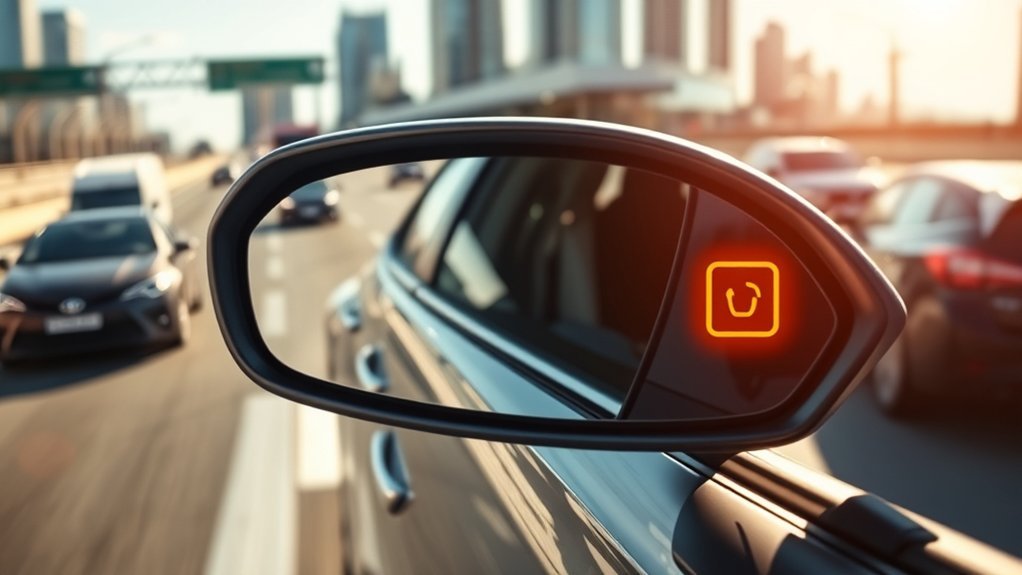
The Toyota Blind Spot Monitor (BSM) is a cutting-edge safety feature designed to enhance your driving experience by keeping you aware of vehicles lurking in your blind spots.
The Toyota Blind Spot Monitor enhances your driving experience by keeping you aware of hidden vehicles in your blind spots.
Utilizing advanced radar sensors, this driver assistance system detects vehicles that you mightn’t see when changing lanes. When a vehicle is identified in your blind spot, BSM activates indicator lights on the side-view mirrors to alert you, ensuring you’re informed before making any lane changes.
This added layer of awareness is particularly valuable when merging onto highways, greatly reducing the risk of accidents. In fact, BSM has been shown to reduce lane-change crashes by 14% and injury-related incidents by 23%.
Most Toyota models either come equipped with this vital safety feature or offer it as an option, underscoring Toyota’s commitment to enhancing your safety on the road.
Embrace this innovation for a more liberated driving experience.
Essential Features of Toyota’s Blind Spot Monitor
Toyota’s Blind Spot Monitor (BSM) comes packed with features that markedly enhance your driving safety and awareness. Utilizing advanced radar sensors, the BSM detects vehicles in adjacent lanes, providing you with vital driver awareness.
When a vehicle occupies your blind spot, you’ll receive a visual warning through blinking lights on the side mirror—an immediate cue to stay alert. This system activates when you signal a lane change toward a detected vehicle, emphasizing potential hazards.
Operating effectively at speeds exceeding 10 mph, BSM is disabled when reversing or manually turned off, ensuring it’s only active when you need it most. The effectiveness of BSM is evident; it reduces lane-change crashes by 14% and injury-related incidents by 23%, greatly enhancing overall safety.
Standard in many Toyota vehicles, like the 2025 Camry, it’s also available on lower trims, making this innovative technology accessible for all drivers.
Benefits of Using BSM When Changing Lanes
When you’re maneuvering through busy traffic, using the Blind Spot Monitor (BSM) can greatly enhance your safety during lane changes. This technology actively reduces the risk of lane-change crashes by 14% when used effectively.
BSM provides visual alerts through indicator lights on your side-view mirrors, making you immediately aware of vehicles in your blind spots. As you signal a lane change, the BSM system blinks the indicator light if a vehicle is detected, further boosting your safety.
In hectic driving situations, BSM helps you identify safe gaps for lane changes, allowing you to drive with more confidence. When combined with traditional mirror checks, it creates a thorough approach to lane-change safety, considerably reducing driving stress.
How BSM Keeps You Safe When Merging?
When merging onto busy highways, your awareness of surroundings is essential, and that’s where the Blind Spot Monitor (BSM) steps in.
It provides real-time alerts about vehicles in your blind spot, enhancing your safety during high-speed merges.
With BSM technology, you can confidently change lanes, knowing you have an extra layer of protection against potential collisions.
Enhanced Awareness of Surroundings
Merging onto busy highways can be a challenging task, but the Blind Spot Monitor (BSM) greatly enhances your awareness of surroundings.
Utilizing advanced radar sensors, BSM detects vehicles in adjacent lanes, providing essential information as you prepare to merge. This system considerably reduces the risk of lane-change crashes, boasting a 14% decrease in accident rates during merges.
When a vehicle enters your blind spot, BSM activates visual alerts on your side-view mirrors, making it easy to stay informed. Operating effectively at speeds above 10 mph, BSM supports your confidence in high-traffic situations.
With this enhanced awareness, you can navigate merging more safely, empowering you to make informed decisions and enjoy a smoother driving experience.
Safety During High-Speed Merging
High-speed merging can be intimidating, especially in heavy traffic, but Toyota’s Blind Spot Monitor (BSM) is designed to keep you safe during these critical moments.
This innovative technology detects vehicles in adjacent lanes, reducing the risk of accidents. When another vehicle enters your blind spot, BSM provides visual alerts through indicator lights on your side-view mirrors, enhancing your awareness.
Research indicates that BSM can lead to a 14% reduction in lane-change crashes, making it invaluable for drivers maneuvering busy highways. By keeping you informed about rapidly approaching vehicles, BSM boosts your confidence, allowing for safer merging decisions.
With BSM, you can enjoy the freedom of the road, knowing your safety is prioritized during high-speed merges.
Critical Limitations of Blind Spot Monitoring Systems
Although Blind Spot Monitoring (BSM) systems enhance driving safety, they come with critical limitations that every driver should be aware of.
One major concern is detection limitations; BSM may miss small motorcycles, bicycles, pedestrians, or stationary objects like guardrails. The detection range, typically between 1.6 ft. and 11.5 ft. from the sides, mightn’t cover all blind spot areas, leaving gaps in safety.
BSM systems may overlook small vehicles and stationary objects, creating potential blind spot gaps that compromise safety.
Adverse weather conditions, such as rain or snow, can further compromise BSM functionality by obstructing sensors. Additionally, sensor misalignment due to impacts or blockages from dirt can hinder operations, necessitating regular maintenance.
Most importantly, you shouldn’t rely solely on BSM; it’s essential to use visual confirmation and check mirrors before changing lanes.
Understanding these limitations helps you stay aware and proactive, ensuring your safety while driving.
Which Toyota Models Come Equipped With BSM?
If you’re curious about which Toyota models come with Blind Spot Monitoring (BSM), you’ll find a mix of standard and optional features across the lineup.
The 2025 Camry, for example, includes BSM as a standard feature in all trims, while the Corolla offers it on the XSE trim and as an option elsewhere.
Additionally, the RAV4 integrates BSM within its standard Safety Sense suite, showcasing Toyota’s commitment to enhancing driver safety.
Standard Features Across Models
As you explore the range of Toyota vehicles, you’ll find that Blind Spot Monitoring (BSM) is becoming increasingly standard across many models, enhancing your driving experience with added safety features.
The 2025 Toyota Camry includes BSM as a standard feature across all trims, ensuring you stay aware of your surroundings.
In the Toyota Corolla, BSM appears on the XSE trim and as optional equipment on lower trims, giving you flexibility.
The standard Toyota Safety Sense suite in the RAV4 incorporates BSM technology, enhancing driving safety.
Additionally, the Toyota Highlander and 4Runner feature BSM as a standard option on higher trims, showcasing Toyota’s commitment to integrating advanced safety features across its lineup.
Optional Availability On Trims
When it comes to selecting a Toyota model with Blind Spot Monitoring (BSM), you’ll find a variety of options tailored to different preferences and budgets.
The 2025 Toyota Camry includes BSM as a standard feature across all trims, ensuring safety is a top priority.
If you’re considering a Toyota Corolla, BSM is available on the XSE trim and as an optional feature on lower trims, enhancing your safety options.
For those eyeing the RAV4, BSM is part of the standard Toyota Safety Sense suite, making it a fantastic choice.
Additionally, higher trims of the Toyota Highlander and 4Runner also offer BSM as a standard feature, providing even more choices for safety-conscious drivers.
How to Easily Turn the BSM System On and Off?
You can easily turn the Blind Spot Monitoring (BSM) system on and off in your Toyota, making it convenient to customize your driving experience.
If you prefer a quick adjustment, look for the physical button located on the center console in some models. Simply press it to turn the BSM system on or off.
Alternatively, you can navigate through your infotainment system. Access the safety settings or driver assistance options, and confirm your choice to toggle the BSM status.
This flexibility allows you to adapt the system based on your driving preferences. Remember, activating the BSM system is essential for enjoying its benefits during lane changes and merges.
If you’re unsure about managing these settings, don’t hesitate to seek dealership assistance, like at Longo Toyota of Prosper, for expert guidance.
Empower yourself with the knowledge to enhance your safety on the road!
Debunking Myths About Blind Spot Monitoring
While many drivers appreciate the added safety that Blind Spot Monitoring (BSM) systems provide, misconceptions about their capabilities can lead to dangerous driving habits. It’s vital to understand that BSM isn’t a replacement for visual checks; it’s a supplementary system that enhances your awareness.
| Myth | Reality | Impact on Safety |
|---|---|---|
| BSM replaces visual checks | Requires confirmation through visual checks | Increased risk of lane-change crashes |
| BSM is infallible | Can’t detect small vehicles or pedestrians | False sense of security |
| BSM is always active | Must be enabled and can be turned off | Potential for missed alerts |
| Weather affects BSM performance | Adverse conditions and sensor obstructions hinder function | Increased accident risk |
| BSM performance is flawless | Can produce false positives, requiring driver vigilance | Essential for safe lane changes |
Stay vigilant, keep your sensors clean, and always double-check your blind spots.
Why Is BSM an Essential Safety Feature for Modern Drivers?
As traffic conditions grow increasingly complex, the importance of Blind Spot Monitoring (BSM) becomes evident for modern drivers. This advanced safety feature considerably reduces lane-change crash rates by 14% and injury-related incidents by 23%.
With real-time alerts through visual indicators on your side mirrors, BSM enhances your awareness of vehicles in your blind spots, making it easier to navigate busy urban environments and high-speed highways.
When you’re changing lanes and merging, BSM employs radar sensors to detect nearby vehicles, providing timely warnings when they’re as close as 1.6 feet away. This additional layer of protection encourages safer driving practices, allowing you to maneuver with confidence.
Frequently Asked Questions
How Does Toyota Blind Spot Monitoring Work?
Toyota’s Blind Spot Monitoring uses sensor technology and a radar system to enhance driver awareness. It detects vehicles in your blind spot, providing alerts for collision prevention, ensuring safer lane changes and improved rearview monitoring.
What Are the Benefits of BSM on a Toyota?
BSM enhances your safety features, boosting driving confidence during lane changes. It improves vehicle awareness with tech integration, offering enhanced visibility and accident prevention, ultimately enriching your user experience and making every drive safer and more enjoyable.
Will BSM Still Work if It’s Raining?
Yes, BSM can still function in light rain, but visibility challenges may affect sensor reliability. To guarantee system accuracy, maintain your vehicle’s sensors and adapt your driving habits to changing weather conditions for ideal safety.
What Is the BSM Indicator on the Blind Spot Monitor?
The BSM indicator functions by illuminating in your mirrors to signal nearby vehicles. It integrates visual alerts and warning signals from sensors, ensuring you’re aware of blind spots, enhancing your driving safety and confidence.
Conclusion
In today’s fast-paced world, having a reliable Blind Spot Monitor (BSM) is as essential as having a trusty co-pilot by your side. This innovative technology not only enhances your safety while changing lanes and merging but also boosts your confidence on the road. So, whether you’re cruising down the highway or steering through city streets, remember that BSM is like having a modern-day guardian angel, keeping watch so you can focus on the journey ahead. Drive smart!







Leave a Reply