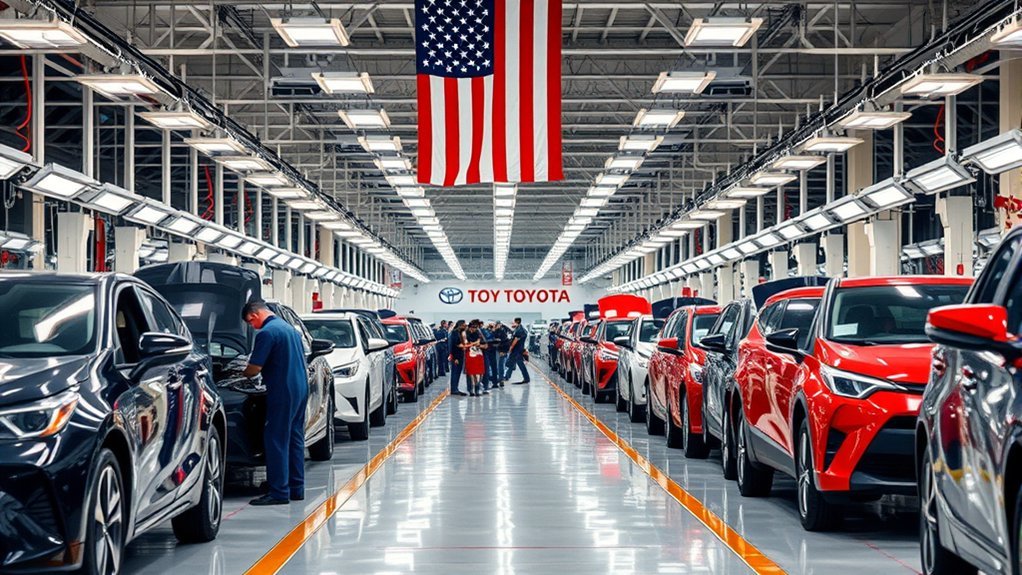
Over 40% of Toyotas sold in the U.S. are made domestically, reflecting the brand’s strong commitment to local manufacturing. Significantly, the Toyota Camry, produced at the Georgetown, KY plant, leads the way with 75% of its parts sourced from within the country. This domestic production not only creates jobs but also positively impacts local economies. If you’re curious about how this affects your purchasing decision, you might want to explore further insights.
What Percentage of Toyotas Sold in the U.S. Are Built Domestically?
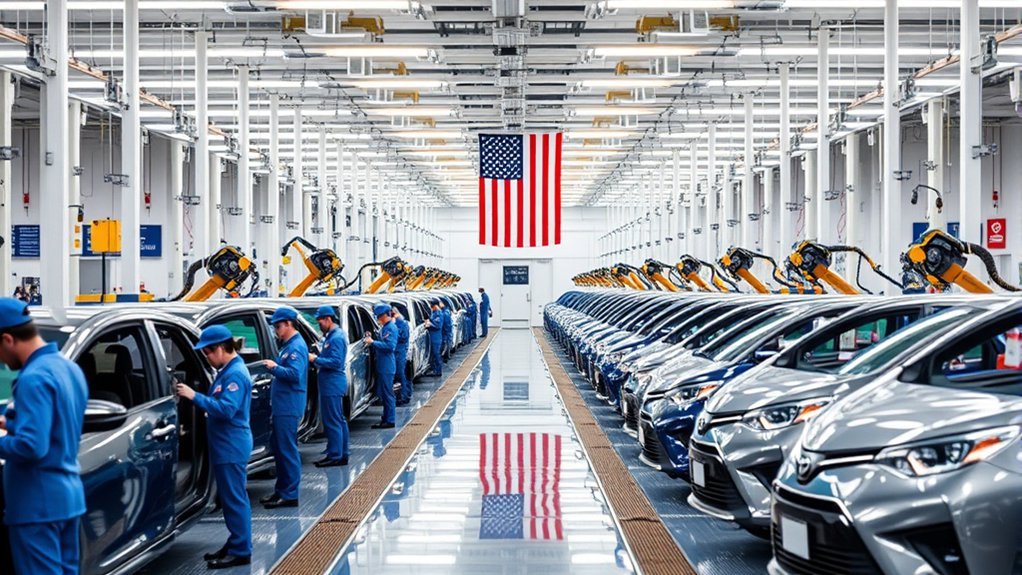
When considering the origins of Toyotas sold in the United States, you’ll find that over 40% are built domestically. This significant figure underscores Toyota’s commitment to local manufacturing and reflects a broader trend in the auto industry.
The Toyota Camry, produced at the Georgetown, KY plant, stands out as America’s best-selling car, emphasizing the importance of vehicles made in America.
With multiple plants across Kentucky, Texas, and Indiana, Toyota has strategically positioned itself to enhance domestic production. In fact, the 2016 Cars.com American-Made Index ranked the Camry highest, showcasing its substantial domestic parts content and assembly location.
Toyota’s strategic plants in Kentucky, Texas, and Indiana highlight its dedication to domestic production and quality.
Furthermore, Toyota’s U.S. manufacturing facilities source parts from around 270 supplier locations, further bolstering the percentage of Toyotas that are genuinely made in America.
This data-driven approach reflects a commitment to both quality and local economic engagement, empowering consumers who value domestically produced vehicles.
The Impact of Toyota Manufacturing on the American Economy
Toyota’s manufacturing presence in the U.S. has a profound impact on job creation, directly employing thousands and supporting countless local suppliers.
With over 32 million vehicles produced since 1986, this commitment not only fuels economic growth but also stabilizes communities by fostering local investment.
As you consider purchasing a Toyota built in America, you’re actively contributing to a robust domestic economy.
Job Creation Impact
While many companies have contributed to job creation in the U.S., Toyota stands out with over 470,000 jobs generated since it began manufacturing stateside. This job creation impact is substantial, as Toyota has produced 32 million vehicles in North America since 1986, reinforcing its commitment to local manufacturing.
With over 70% of the 13 models produced here supporting U.S. sales, the significance of domestic production becomes clear. Additionally, Toyota’s operations generate billions in economic activity, bolstering local economies through direct employment.
Local Supplier Support
The impact of Toyota’s manufacturing presence in the U.S. extends beyond job creation, considerably influencing local supplier networks and the broader American economy.
By operating several plants primarily in Kentucky, Texas, and Indiana, Toyota produces over 40% of the vehicles sold in America domestically. This commitment to local supplier support is evident through partnerships with around 270 U.S. suppliers, fostering strong relationships that enhance regional businesses.
These connections not only drive direct employment at Toyota facilities but also stimulate economic activity in surrounding communities. Such interdependence promotes sustainability and reduces reliance on imports, ultimately contributing to local economic stability.
Toyota’s efforts exemplify how a global corporation can positively impact local economies through robust supplier networks.
Economic Growth Contribution
As Toyota continues to expand its manufacturing footprint in the U.S., its contributions to economic growth become increasingly evident. The company’s facilities generate billions annually through direct employment and local supplier support, enhancing economic stability in communities across Kentucky, Texas, and Indiana.
With over 32 million vehicles produced in North America since 1986, and 13 models manufactured domestically, Toyota supports over 70% of its sales through domestic content. This commitment not only creates thousands of jobs but also aligns with consumer demand for eco-friendly practices, reducing waste and promoting sustainability.
Advantages of Local Manufacturing
When you consider the advantages of local manufacturing, it’s clear that reduced shipping costs and quicker market response are significant benefits.
By producing vehicles domestically, Toyota can adjust to consumer preferences faster and cut down on transportation expenses.
Additionally, their commitment to environmental sustainability practices not only minimizes waste but also aligns with broader corporate responsibility goals.
Reduced Shipping Costs
Local manufacturing offers Toyota significant advantages in reducing shipping costs, particularly by producing over 40% of the vehicles sold in the U.S. domestically. By assembling vehicles in the U.S., Toyota minimizes the expenses tied to shipping cars from Japan, effectively lowering overall costs.
The strategic placement of Toyota plants near key U.S. markets also enhances logistics efficiency, allowing quicker access to suppliers and reducing turnaround times for parts delivery. This proximity not only cuts transportation costs but also aligns with environmental practices that promote sustainability.
Quick Market Response
In a rapidly changing automotive landscape, Toyota’s ability to manufacture over 40% of its vehicles in the U.S. at plants in Kentucky, Texas, and Indiana allows for a remarkable quick market response.
This local production enables you to swiftly adapt to consumer preferences and market demands, cutting down on shipping costs and delays. The proximity of manufacturing facilities to major markets enhances efficiency, allowing Toyota to track trends in real-time.
By relying less on imports, you’re supporting economic stability and job creation within the U.S. workforce. Integrating local practices into the Toyota Production System (TPS) not only boosts product quality but also cultivates a culture of continuous improvement among employees.
For more insights, feel free to reach out at our email address.
Environmental Sustainability Practices
While many companies grapple with the environmental impact of manufacturing, Toyota has embraced local production in the U.S. as a strategic advantage in sustainability. By assembling vehicles domestically, Toyota noticeably reduces its carbon footprint and aligns with eco-conscious consumer demands.
Key practices include:
- Implementing energy-efficient technologies in U.S. manufacturing facilities.
- Sourcing parts from over 270 local suppliers, minimizing transportation-related emissions.
- Reducing waste through innovative recycling and waste management strategies.
These efforts not only support local economies but also contribute to Toyota’s overarching sustainability goals.
As you consider your choices, remember that opting for a Toyota means supporting environmentally responsible practices that work towards a healthier planet.
The Toyota Production System: Efficiency and Local Adaptation
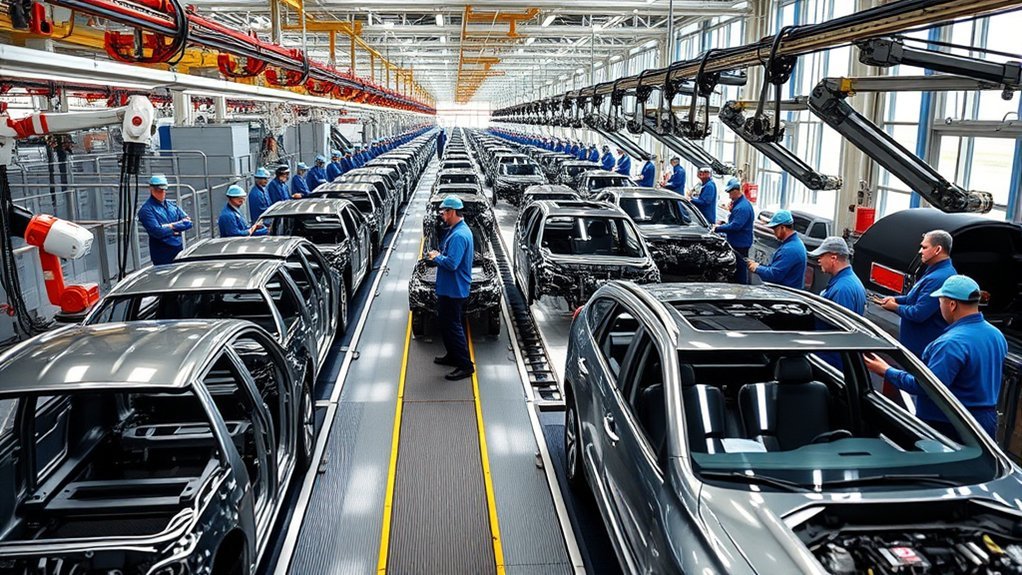
As Toyota adapts its renowned Production System (TPS) to the American manufacturing landscape, it blends efficiency with local expertise to enhance overall productivity.
By emphasizing continuous improvement, or Kaizen, TPS encourages employee contributions, ensuring that quality control remains paramount. Toyota Motor has tailored its system to fit U.S. industry standards while preserving foundational principles, resulting in significant process enhancements and superior product quality.
Integrating local practices into TPS has enabled Toyota to effectively address the unique needs of American manufacturing, fostering a responsive approach. This adaptation has played a critical role in minimizing waste and implementing environmentally sustainable practices.
Remarkably, over 40% of Toyotas sold in America are built domestically, reflecting the effectiveness of TPS in bolstering local manufacturing capabilities. By harmonizing efficiency with local adaptation, Toyota not only drives productivity but also champions sustainability in its American operations.
Top Toyota Models: Domestic Content Rankings
Toyota’s dedication to domestic manufacturing is evident in its top models, which consistently rank highly regarding American content. The Camry holds the top spot on Cars.com’s American-Made Index, with an impressive 75% of its parts sourced domestically and assembled at the Georgetown, Kentucky plant. This facility is the largest vehicle manufacturing site globally, adding to the appeal of its domestic content.
Other notable models include:
- Toyota Sienna: Also boasts at least 75% domestic parts, showcasing strong American ties.
- Avalon Hybrids: Produced in the same Georgetown facility, reinforcing Toyota’s commitment to local manufacturing.
Additionally, over 40% of Toyotas sold in America are built right here in the U.S., making the Camry not just America’s best-selling car but also a symbol of domestic production.
This focus on American content guarantees that you’re supporting local economies when you choose Toyota.
How Toyota’s Commitment to Sustainability Shapes Manufacturing
In an era where sustainability is paramount, the practices adopted by Toyota in its U.S. manufacturing plants illustrate a proactive approach to environmental responsibility. By implementing robust environmental practices, Toyota minimizes waste while enhancing operational efficiency. This commitment not only decreases reliance on imports, as over 40% of Toyotas sold in America are built domestically, but also fosters local job creation.
Toyota’s Kaizen philosophy encourages continuous improvement, where every employee contributes ideas to boost sustainability. The company is also investing in electric vehicle infrastructure, planning to establish battery manufacturing sites across various states. This reflects a long-term vision of sustainability in American manufacturing.
| Sustainability Initiative | Impact |
|---|---|
| Waste Reduction Practices | Minimizes environmental impact |
| Domestic Production | Supports local economies |
| Employee Engagement (Kaizen) | Enhances efficiency and innovation |
| EV Infrastructure Investment | Prepares for future market needs |
| Local Practices Integration | Aligns global strategies effectively |
30th Anniversary of TMMK: A Milestone Celebration
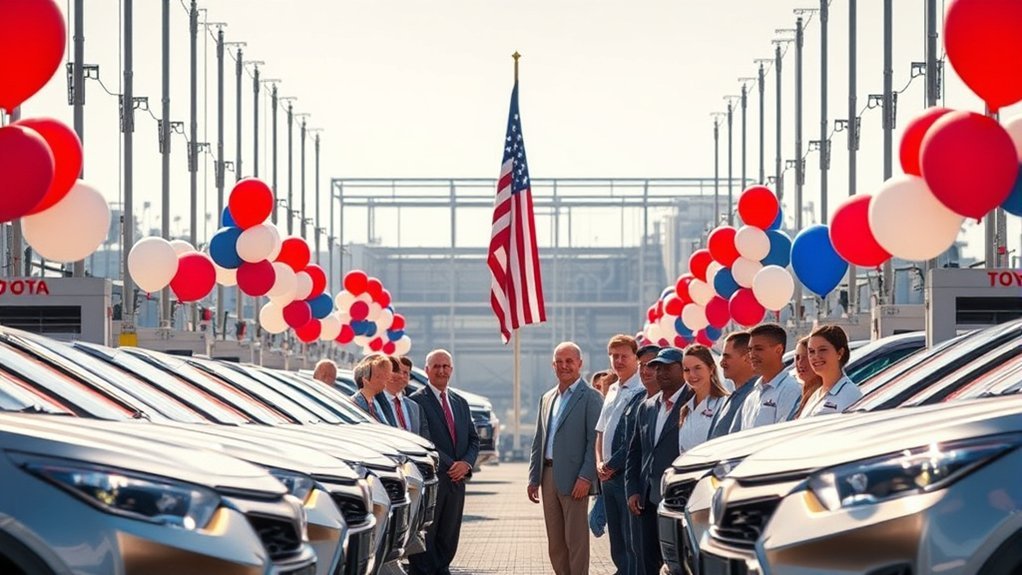
Celebrating 30 years of operation, Toyota Motor Manufacturing Kentucky (TMMK) stands as a demonstration of the company’s impact on U.S. manufacturing and local economies.
Celebrating three decades, TMMK exemplifies Toyota’s influence on U.S. manufacturing and community development.
This milestone reflects not just a celebration of vehicles but also of community and quality. As the plant produces the popular Toyota Camry, recognized as America’s best-selling car, you can appreciate the scale of TMMK’s influence.
- Over 10 million vehicles rolled off the line, showcasing excellence in production.
- Local economies have thrived, thanks to job creation and community engagement.
- Employee contributions were acknowledged, highlighting the human element behind the manufacturing process.
This anniversary symbolizes TMMK’s commitment to quality and its crucial role in Toyota’s North American operations.
Future Innovations in Toyota’s Manufacturing Strategy
As TMMK commemorates three decades of excellence, the focus now shifts toward the future, where innovation reshapes the landscape of manufacturing. Toyota’s commitment to electric vehicles (EVs) is evident through investments in battery manufacturing across North America. This strategy not only supports sustainability but also enhances American manufacturing capabilities.
By integrating continuous improvement practices like Kaizen into their operations, you can expect higher product quality and employee engagement. Toyota’s adaptation of the Toyota Production System (TPS) to align with U.S. industry standards guarantees efficiency and quality control.
Here’s a snapshot of Toyota’s future innovations:
| Focus Area | Current Initiatives | Goals |
|---|---|---|
| Battery Manufacturing | New plants across various states | Support EV production and infrastructure |
| Sustainability | Eco-friendly manufacturing processes | Reduce carbon footprint |
| Innovation | Adapting TPS principles | Enhance efficiency and quality |
| EV Infrastructure | Collaborations for charging networks | Meet consumer demand |
How Domestic Content Affects Your Toyota Purchase Decision?
When considering your next vehicle purchase, the domestic content of a Toyota can greatly influence your decision. Over 40% of Toyotas sold in America are built domestically, which appeals to many consumers.
Here are a few key factors to think about:
- The Toyota Camry, with 75% of its parts sourced from U.S. suppliers, stands out on the American-Made Index.
- Supporting local manufacturing means contributing to billions in economic impact and job creation.
- Cars with higher domestic content resonate with those concerned about sustainability and corporate responsibility.
When you know your car is assembled using local practices, it aligns with American consumer preferences and standards.
This connection can enhance your sense of liberation, knowing your purchase supports the economy and promotes responsible manufacturing.
Ultimately, the domestic content of your Toyota could be a deciding factor in your choice.
Frequently Asked Questions
What Percent of Toyota Is Made in America?
About 40% of Toyotas sold in America are made domestically, reflecting a strong commitment to American manufacturing. This investment not only supports local economies but also guarantees a significant portion of parts and assembly occurs in the U.S.
Which Toyotas Are Made in America?
Toyota models like the Camry, Corolla, Tacoma, Tundra, Sequoia, Sienna, and Highlander are crafted in American factories. Each vehicle reflects a commitment to local manufacturing, supporting jobs and economic growth in the U.S. automotive industry.
What Car Is 100% Made in the USA?
The Ford Mustang 5.0L GT stands as a car 100% made in the USA, showcasing American manufacturing excellence. With 88.5% of parts sourced domestically, it exemplifies the commitment to local production and quality craftsmanship.
Where Are Most Toyota Cars Manufactured?
Most Toyota cars are manufactured in multiple locations, particularly Kentucky, Texas, and Indiana. These manufacturing locations substantially contribute to Toyota’s commitment to local production, reflecting a dedication to quality and regional economic support.
Conclusion
To sum up, understanding that over 70% of Toyotas sold in the U.S. are built domestically can reshape how you view your purchase. This statistic highlights Toyota’s significant investment in American manufacturing, creating jobs and boosting local economies. With each Toyota you buy, you’re not just choosing a reliable vehicle; you’re supporting thousands of American workers. As you make your next decision, consider the broader impact of your choice—it’s more than just a car; it’s a commitment to community.







Leave a Reply